
Content marketing
Social
Content

Contents:
- The global political and ecommerce picture
- AI and ecommerce latest
- Social commerce
- Ecommerce market share
Listen to the highlights from author Rose Keen and Econsultancy Senior Analyst Lynette Saunders.
1. The global political and ecommerce picture

Uncertainty abounds
The top story for ecommerce, and business more broadly, this quarter is uncertainty. The heady combination of tit-for-tat tariffs, an unpredictable US administration, the shifting state of security in Europe and multi-region economic slowdowns is enough to keep even the most stalwart business leader up at night.
Though uncertainty is generally not good for business, the good news is that for many brands, and the people behind them, this is not their first rodeo when it comes to global disruption. Since 2020, agility in the face of a stormy business environment has become the norm. Also, as evidenced by our fourth story – the main beneficiary of wobbly consumer confidence – at least in the US – has been ecommerce.
Tariffs bite for both businesses and consumers
The tariffs-retaliation cycle we have seen between the US’s key trading partners since February is creating significant costs for US-based businesses as brands and retailers alike scrabble to both keep track of and respond to a rapidly shifting situation.
For ecommerce players this creates both inbound and outbound challenges. Inbound challenges may take the form of increased costs in terms of materials, manufacturing, or purchasing of wholesale goods from suppliers over the border. Subsequently, there is the question of whether to absorb those costs or risk their competitiveness by passing it along to the consumer. Lessons from tariffs past suggest that it is usually the consumer that ends up picking up the bill.[1]
Outbound challenges concern how – or whether – businesses will serve their international customers. One company grappling with these questions is the New York-based beauty brand Borghese, who made the decision to stop international DTC shipping, cutting off around a third (30%) of their direct customer base.
Speaking to Modern Retail, Borghese COO Dawn Hilarczyk shared that this was a customer experience and brand reputation decision. In her words: “We didn’t want someone to buy a $53 moisturizer and then get slapped with a $200 bill from DHL.”[2]
For US brands and retailers considering how to reduce the risk of surprise costs or delays for their international shoppers there are few potential responses – international warehousing, partnerships with local retailers and, probably the most vital and quickest to implement: clear communication with the customer leading up to the point of purchase.
Import regulation shifts create rough weather for Temu and Shein
The US’s tariffs on imported Chinese goods have reportedly provoked the likes of Temu and Shein to both reduce their product catalogue and raise prices for US consumers.[3]
Another headwind facing these platforms is the proposed end to the ‘de minimis’ tax exemption on packages valued under $800. This loophole was temporarily closed by the White House in February, leading USPS to cease delivery of parcels from China as it scrambled to work out how to collect the newly-imposed charges.[4] Following significant chaos, the de minimis exemption was reinstated for the time being, but it is expected to be phased out in the near future.
De minimis has been an integral part of the business model for platforms like Shein and Temu. Knowing that it is to close, these businesses will need to significantly rethink their operations.
As reported in Bloomberg,[5] this and the introduction of tariffs is resulting in a supply chain management and business model overhaul at Temu as the company transitions to something it calls a ‘half-custody’ framework, where Temu would control price setting and shipping, to one where that would sit with sellers. In addition to this, Temu has reportedly asked merchants to ship their own goods in bulk to US-based warehouses, thus reducing Temu’s control, and responsibility, to just the digital marketplace itself.
For Shein, the likely closure of the de minimis exemption has led the company to further delay its London IPO to the second half of 2025. Amid these challenges, Shein is reportedly set to radically cut its potential listing valuation to around $50 billion, significantly below its 2023 fundraising value of $66 billion.[6]
The rise of these ultra-low-cost China-based ecommerce platforms has been one of the key stories in ecommerce for the couple of years. Retailers in the US, and the other nations exploring bans or limitations on the likes of Temu, may welcome the removal of these new, deep pocketed competitors.
A further consequence of importing from China becoming more expensive is that it will make the business model for many third-party Amazon resellers less appealing. For larger brands, this will likely mean a shift in their competitor set on these platforms and potential opportunities, offering a small silver lining to what is a rather large economic storm cloud hovering over the US.
Retailers respond to tariffs by encouraging consumer boycotts
Europe has delayed the introduction of retaliatory tariffs until mid-April. The tariff disputes between the US and Europe have been focused on the content of consumers’ glasses with the EU’s threat of a 50% levy on American whiskey met with the US threat of a 200% alcohol tariff. This is a move that could significantly impact Europe’s wine producers.
Alongside formal, governmental threats, consumers and retailers in the affected nations are taking matters into their own hands via boycotts on US goods.[7]
In response both to tariffs and the expansionist rhetoric of its southern neighbour, Canada has been experiencing a patriotic retail wave. Retailers have taken up the call with a broad campaign urging shoppers to ‘Buy Canadian Instead’.[8]
It is unlikely that grassroots boycotts will do much to shift attitudes in the White House. However, the less brands and retailers outside of the US need to rely on custom or products from the United States, the less exposure they will have to US tariffs. For Canadian, European and other non-US brands, these boycotts may have the effect of softening that economic blow.
Brands and retailers in the affected regions should track consumer sentiment carefully. Should this movement gain both scale and momentum, they may want to consider what product mix and messaging as part of their digital experience would allow them to capture customers looking for a non-US alternative.
Ecommerce benefits from US consumer uncertainty
The latest data from the US Census Bureau showed that online spending was the big winner in February, as non-store retailers (the category that ecommerce activity sits within) reported that sales were up 6.5% YOY. This figure is far ahead of the 3.4% increase seen across total retail sales.[9]
The main beneficiaries of this shift in spending online have been Amazon and Walmart, which together accounted for 40% of all US online retail transactions in 2024.[10] In its latest earnings call, Amazon reported a global sales increase of 10% YOY, reaching a total of $187.8 bn of which $115.6bn came from North America. Meanwhile, Walmart reported a 20% increase in US ecommerce sales ahead of the 4.6% growth rate in total US sales.[11]
2. AI Latest

GenAI retail traffic – where is the opportunity?
According to Adobe data, US traffic from GenAI channels to retail sites has been doubling every two months since the end of Q3 last year. Though these gains are impressive, it is worth remembering that remarkably high growth figures are usually only possible if you are starting from a low base.
Commenting on the results, Vivek Pandya, manager of Adobe Digital Insights, acknowledged that generative AI traffic “remains modest compared to other channels, such as paid search or email”, but nevertheless called the rate of growth “notable”.
However, at present, that same Adobe data suggests users coming from GenAI sources are less likely to convert. Though that gap has narrowed in recent months, it still seems that for the minority of consumers who use GenAI tools for ecommerce, these tools are primarily used for product research.[12]
The growth in GenAI search and chatbots as a driver of traffic aligns with data from Adobe’s Digital Trends research, in partnership with Econsultancy, which found that consumers were increasingly comfortable with GenAI as part of the broader customer experience.[13] Among those customers using AI for shopping, Adobe reports that satisfaction levels are high with 92% saying the use of AI enhanced their experience.[14]
The extent to which these technologies shift customer journeys will very much depend on the scale of adoption and will vary a lot by category. For the moment, brands and retailers should pay careful attention to their traffic and engagement data to understand how customer journeys may be changing.
Walmart introduce GenAI bot for merchants
Though the majority of coverage of GenAI in retail has focused on the customer experience, there are opportunities behind the scenes as well. Earlier in March, Walmart introduced its new GenAI chatbot designed to support the retailer’s merchants. Named ‘Wally’, the bot is designed to help buyers understand complex stock and sales data, for instance to identify the factors behind why a particular product may be under- or over-performing. It is also designed to support tasks like forecasting.
Built on Walmart’s own data, Wally includes a semantic layer allowing it to navigate the intricacies of product and buying trends data to meet specific merchandising business needs.
The efficiency benefits of moving this kind of reporting from a manual process to an automated one are clear. Data capabilities have also been among the most persistent, and difficult to bridge, skills gaps.[15] The idea of being able to outsource those processes to a tool that merchants can then interrogate via natural language is understandably appealing.
There are watch outs, though, when it comes to outsourcing processes to AI. A study from researchers at Microsoft and Carnegie Mellon University has shown that the more people use GenAI as part of their job, the less critical thinking they tend to apply. With the nature of that critical thinking shifting to ‘information verification, response integration, and task stewardship’, rather than things like problem solving.[16]
However, that same study found that the higher the confidence the individual has in their own ability to do the task, the more likely they were to think critically – particularly when evaluating and applying AI responses.
For retailers looking to integrate and benefit from GenAI tools in front of or behind the scenes, this means that the need for skills in areas like data and analysis has not been eliminated, but rather heightened.
Amazon eyes the full customer journey with new AI service
Amazon wants to help businesses overcome the challenge of having a ‘disconnected patchwork of [AI] tools that don’t effectively communicate with each other’ by getting them to integrate their AI service, Amazon Connect, across all touchpoints.
Launched in March, the new version of Amazon Connect offers an ‘all-you-can-eat AI pricing that remains tied only to your underlying channel usage rather than AI consumption’ and is designed to simplify the admittedly confusing task of choosing and integrating GenAI suppliers.[17]
Amazon is known for its monopolistic tendencies – which is reflective in this bid to capture the entirety of a brand’s GenAI CX support pie. Monopolies, as we know, are rarely for the customer in the long run, even if they solve a real problem in the short term.
The timing of this launch also suggests this may be a bid from Amazon to defend ground against its rival Alibaba, who has been ramping up the development of digital infrastructure in major overseas markets – most recently in Mexico.[18] This expansion is only set to be accelerated by Alibaba’s planned $53bn investment in cloud computing and AI infrastructure over the next three years.[19]
Related content:
3. Social Commerce

Social commerce the fastest-growing UK retail channel
Eight out of ten UK retailers report that social is the fastest-growing commerce channel. The research, published by delivery company Scurri, revealed some interesting differences in approach and activity across different-sized brands.
In particular, midsize brands are more active in shopper engagement on social commerce than their larger enterprise rivals. Key areas in which they pull ahead include brand customer content (48% vs 39%), live shopping events (46% vs 24%) and the area with the largest gap: activation of paid partnerships (42% vs 29%). With larger brands more likely to emphasise creator and influencer partnerships as part of their social commerce strategy. [20]
Influencers can be a powerful tool in supporting social commerce, allowing brands an easier route into a new, perhaps alien-feeling, channel. However, working with influencers should not be where social commerce strategies begin and end. Brands active in this space should consider how content from other sources, like their own employees or customers, can also play a role in driving social commerce sales.
TikTok Shop’s European expansion
As reported in Econsultancy’s Social Trends Quarterly, the past quarter has been a torrid time for TikTok, with the threat, introduction and then temporary reversal of a ban in the US.
With the app’s future in the US still uncertain, TikTok is turning its attention to other parts of the world map. – most notably Europe. Since December 2024, TikTok Shop has launched in Spain, Ireland, Germany, France, and Italy.[21]
These rollouts represent a reversal of TikTok’s decision to pause its European expansion of Shop, likely due to concerns about the regulation burden inherent in doing business in the EU.[22] With a US ban still on the cards, it seems those challenges are not seen as the hurdles they once were.
With ecommerce penetration lower in these regions, TikTok Shop may have to wait some time before it enjoys the level of uptake currently seen in the US. However, as evidenced by the growth in live shopping in the UK and the omnipresence of short form video more broadly, TikTok has repeatedly proven its ability to shift consumer behaviour. This will make it a competitor to watch for local businesses as Shop establishes itself in additional regions.
TikTok Shop’s sector experimentation
TikTok’s ambitions are not limited to geographic expansion – it has its eyes on other sectors as well. Most recently, and a little surprisingly, this has led to the introduction of an automotive ad offering. Alongside a new specialised ad programme for car brands, TikTok has introduced inventory ads for dealers looking to drive direct sales.[23]
Though product catalogue ads are not quite the same thing as being able to buy our next minivan from the app directly, it does integrate social content further into and further along the automotive customer journey.
This quarter also saw the first supermarket join TikTok shop in the UK, albeit for a very limited run. Lidl’s social ‘pop up’ offered shoppers the chance to buy 3,000 ‘high protein’ bundles, all of which sold out in under 20 minutes.[24]This launch was more of a PR move than the full introduction of a new channel for the grocer. However, its success may well open the door to further experimentation.
This is all the more likely given that in China, the region which acts as the model for social commerce ambitions, social has become an established channel for grocery sales.
Etsy looks to replicate TikTok and Pinterest experience
After a disappointing fourth quarter, Etsy CEO Josh Silverman has cited personalisation, and a more social-platform-like experience in general, as a way for the marketplace to turn its fortunes around. On their earnings call in February, Silverman shared that “We have a lot to learn from folks like TikTok and Instagram and Pinterest and others on this, but there’s been a lot published on how to do this well that we think we can learn from and really accelerate our growth.”[25]
While social platforms have indeed proven adept at capturing and keeping our attention, that magic does not always translate to the ecommerce experience. Nowhere is this more evident than in the news this quarter that Amazon has shuttered ‘Inspire’, its own bid to create a TikTok like feed.[26]
The lessons here both from the failure of Amazon’s ‘Inspire’ and the eventual success of TikTok Shop is that social commerce only works when there is true integration between content and commerce. Entertainment should be treated as equal in importance to any commercial aspirations. It is the creator and user content that gains social platforms their audiences – something that can be hard for an ecommerce marketplace to replicate.
Related content:
4. Ecommerce Market Share
Latest US data has ecommerce responsible for 16.4% of total retail sales
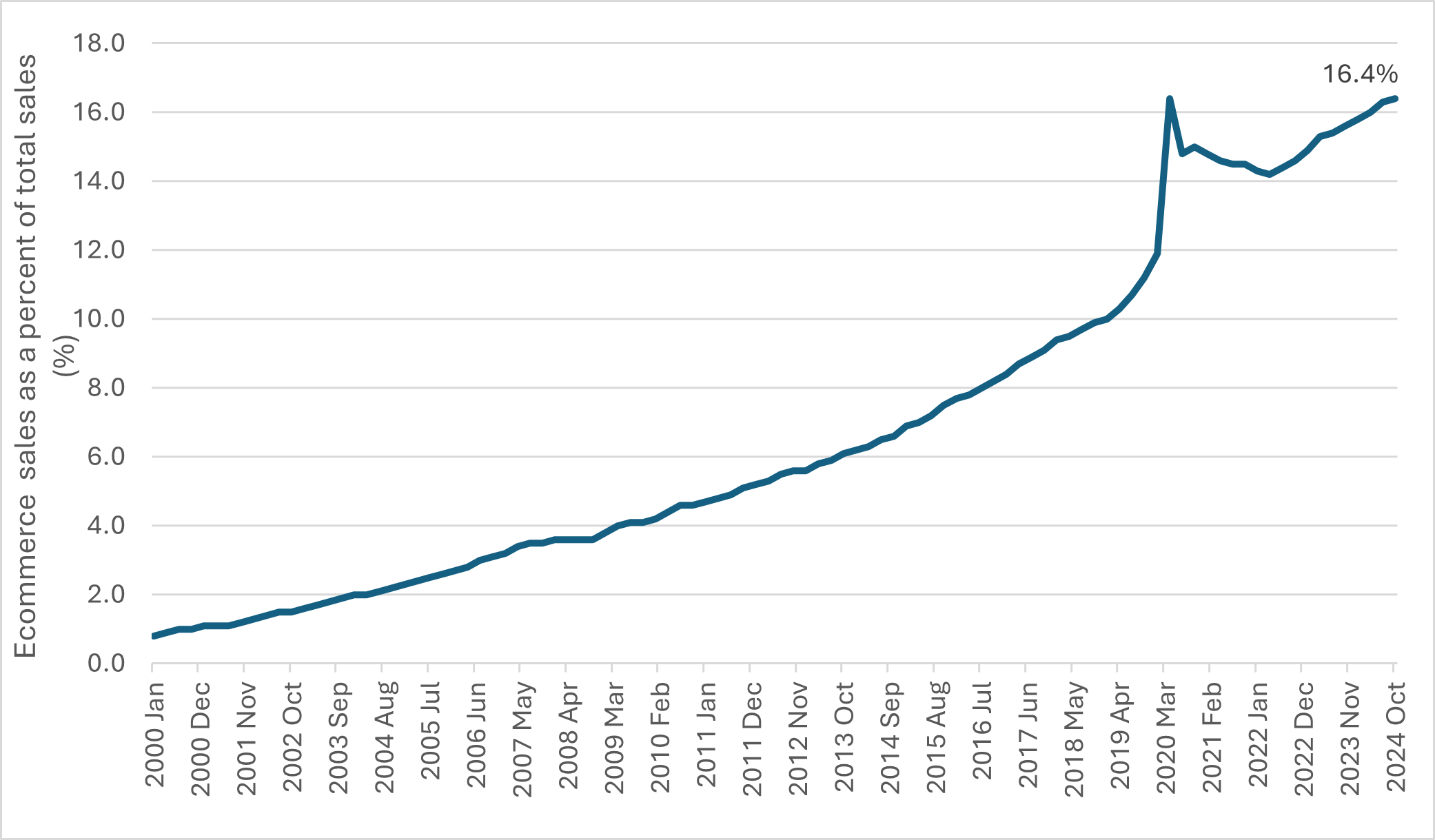
Note: US Census Bureau, Ecommerce Retail Sales as a Percent of Total Sales [ECOMPCTSA], retrieved from FRED, Federal Reserve Bank of St. Louis. Retrieved: 24th March 2025. Source: https://fred.stlouisfed.org/series/ECOMPCTSA
In the UK, ecommerce accounted for 25.7% of total retail sales in January
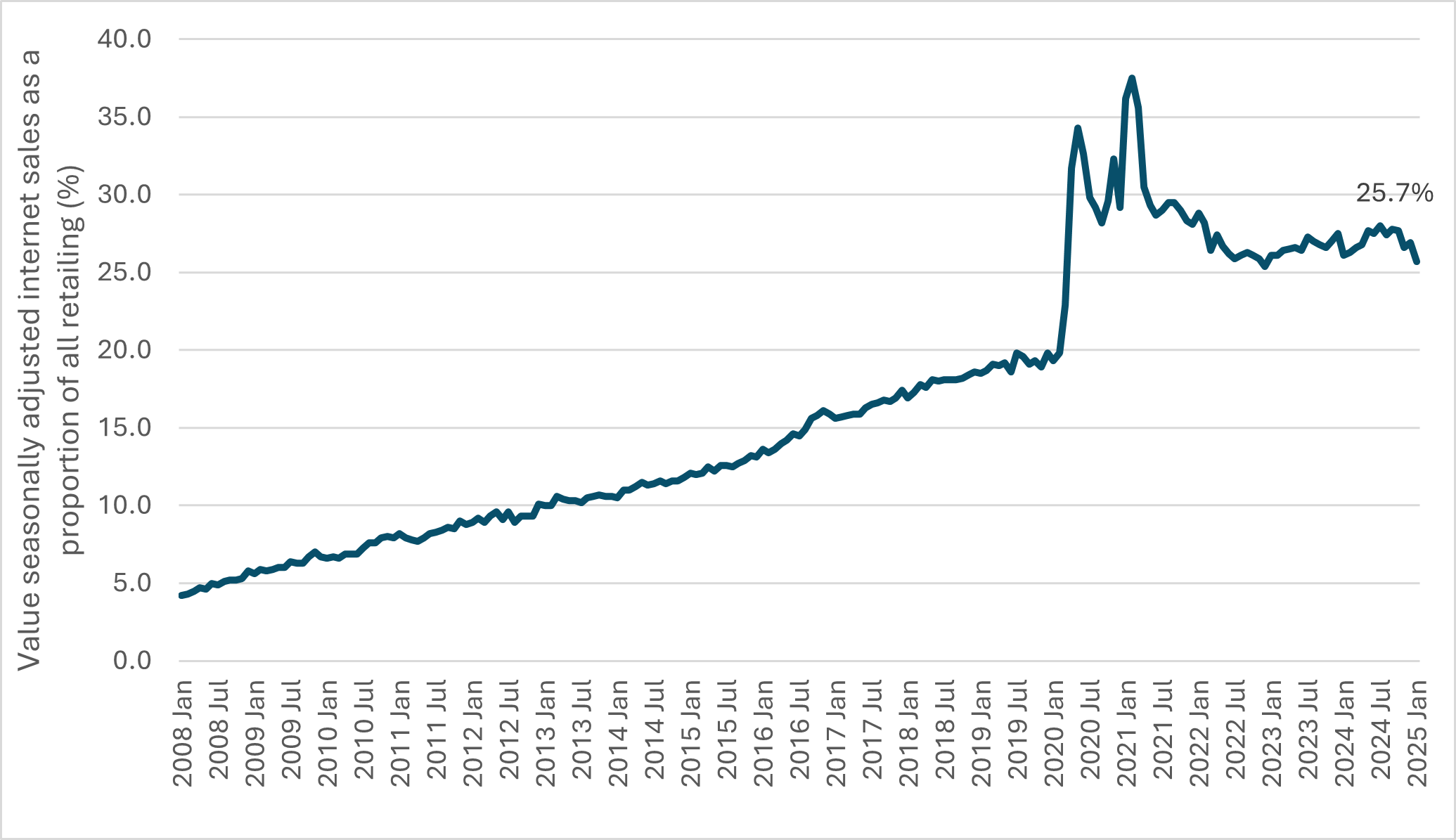
Note: All UK retail excluding automotive and fuel, seasonally adjusted, January 2008–January 2025. Source: https://www.ons.gov.uk
Ecommerce share of total UK retail across grocery, fashion and household goods
| Sector | January 2025 |
| Predominantly food | 8.9% |
| Textile, clothing and footwear | 26.7% |
| Household goods | 23.3% |
Enhance your ecommerce skills with Econsultancy’s on-demand learning
-
From optimising your retailer partnerships to winning the digital shelf, Econsultancy’s portfolio of learning covers the skills you need for ecommerce success.