
Content marketing
Social
Content

1. Introduction
The effectiveness of digital marketing is determined by how successful a company’s promotion of its products and services through digital media has been towards meeting its business goals. However, in recent years, there have been changes in two major areas – technical and regulatory – which have had an impact on the way marketers measure digital marketing effectiveness.
The digital ecosystem is undergoing a major transformation with the end of third-party cookies and increasing regulation around what customer data can be used. One of the challenges that some marketers face is the need to rethink the way they measure the impact of their campaigns across different channels. While many data and analytic platforms and solutions are providing help to marketers in this area, it has never been more critical for marketers to ensure that they have the most appropriate approach in place for their business.
It is clear that marketers are recognising the need to focus on measurement, with a survey by Kantar showing that ‘improving marketing effectiveness’ is the top priority for marketers.[1] With the continued pressure on budgets, many companies are also redirecting spend towards digital touchpoints, which traditionally have been easier to measure.
However, the removal of third-party cookies, currently anticipated to be at the end of 2024, will have a significant impact on marketing measurement, as well as a company’s ability to target their digital advertising. A key concern for marketers as these changes have been underway is being left with a limited view of how each channel or campaign has performed. In particular, with the ongoing challenge of looking at multiple ad platforms and sources, how they can understand the effectiveness of integrated communications across digital channels and the role that each channel is playing in their campaigns.
This report will explore the latest developments which are impacting how marketers are measuring their campaigns and targeting their advertising. In particular, to set out the options available for marketers to consider in order to successfully measure their digital marketing without third-party cookies.
1.1 Executive summary
- One of digital marketing’s greatest assets has been its perceived measurability. However, regulatory requirements such as GDPR and CCPA, along with technical changes such as the deprecation of third-party cookies, are impacting the ability of marketers to collect customer data and use this for tracking and targeting consumers.
- Technical changes to the industry are being made by some of the largest technology platforms at a browser level, as Google, Apple and Mozilla continue phasing out third-party cookies as a data collection method. The final stage being Google’s planned phaseout of third-party cookies in Chrome, expected by the end of 2024. Further privacy features are also in place preventing the use of device IDs on mobile devices.
- The move away from third-party cookies has a direct impact on the way digital marketing is measured, creating challenges in the following areas:
- Multi-touch attribution modelling, making it difficult to understand what a customer has seen or interacted with in the run up to a conversion.
- Brand studies and controlled experiments, which depend on third-party cookies to create and compare distinct groups that have and have not seen the marketing.
- Targeting consumers and measuring reach and frequency, as third-party cookies allow marketers to ensure a consumer does not see an ad multiple times.
- There is now an imminent need for marketers to have an alternative solution in place, yet only 30% consider their organisation fully or mostly prepared, with only 8% saying they are fully prepared.
- There are still options for measurement that do not rely on third-party cookies and are compliant with regulations and technical changes. Each of these will have a unique set of benefits and challenges, which marketers should evaluate against their objectives.
- The changes taking place are driving an even greater need for marketers to focus on collecting their own data sources, to support both understanding how their campaigns are performing, and to help reach audiences.
- Econometrics/market mix modelling is again growing in popularity, as one method that depends the least on data collected by third-party cookies. A number of interviewees also discussed adopting a blend of techniques in order to provide a holistic view of how a campaign has performed and what is driving incremental sales. This focuses on the concept of measurement triangulation by combining econometrics, digital attribution and experimentation.
- There is not one measurement approach that will work for everyone. Marketers should choose the best approach for their needs and objectives. It is important for companies to evaluate the success of any new measurement approach they adopt.
- To support a measurement approach requires having the right foundations in place. This requires senior level support around building an effectiveness culture, with clear measures of success which are supported with adequate budget. Building a solid data foundation is required to ensure the quality of data used for analysis and building models, which is supported with the right technology infrastructure and skills.
- It is recognised that creativity plays a key role in driving the effectiveness of a campaign, enhancing conversion rates by up to 50% and profitability by as much as four times. Having a focus on this at the outset can help companies drive more effective campaigns. AI and GenAI can help companies test and optimise their campaigns.
- Targeting and retargeting customers without third-party cookies means companies need to explore alternative ways to reach their audiences. This is placing even more emphasis on marketers to focus on the value of collecting their own first-and zero-party data, as well as exploring ways to work with secondary partners. Contextual and interest-based targeting, along with lookalike audiences are all being explored by companies as alternative ways to reach audiences.
- To support measuring and driving digital marketing effectiveness companies should continue to keep up to date on changes taking place and to evaluate the impact of these.
1.2 Methodology
This report is based on primary research which involved exploring findings from two reports:
Econsultancy’s 2023 Future of Marketing report, which was based on a survey of 835 client, vendor and agency-side marketers. The survey was fielded to Econsultancy and Marketing Week’s audiences between 9 June and 3 July 2023.
The ‘Language of Effectiveness 2023’ report[2] has been produced using responses to an online survey of 1,369 qualifying marketers conducted by Econsultancy’s sister brand Marketing Week between 27 March and 28 April 2023.
In-depth interviews were carried out with industry experts. Econsultancy would like to thank the following interviewees for their invaluable contribution of time and expertise to this report:
- Kumar Amrendra, Head of Digital Marketing, Sky UK Ltd
- Amy Blasco, Partner, Enterprise Data, Experience and Marketing Lead, IBM
- Laura Chaibi, Director, International Ad Marketing and Insights, Roku Inc
- Sebastian Cruz, Regional Digital Marketing and Media Director, Shiseido, Asia Pacific
- Gary Danks, General Manager, AIM, Kochava
- Mauricio Ferreira, Marketing Effectiveness Lead, Confused.com
- James Hurman, Founding Partner, Previously Unavailable
- Gabriel Hughes, CEO and Founder, Metageni
- Dr Grace Kite, Economist and Founder, Magic Numbers
- Chloe Nicholls, Head of Ad Tech, IAB UK
- Roxane Panopoulos, Group Manager, Regional Measurement & Insights – Netherlands and Nordics, Snap Inc
- Marina Peluffo, Head of Business Intelligence, Prima (speaking as industry expert)
- James Sharman, Northern Europe Digital Acceleration Lead, Haleon
- Steven Silvers, EVP, Global Creative and Media Solutions, Kantar
1.3 About the author
 Lynette Saunders is a Senior Analyst at Econsultancy, where she works on delivering industry-leading research, briefings and reports for the digital marketing industry and speaks at a number of external conferences.
Lynette’s previous experience includes delivering web analytics, measurements and insights, as well as leading usability and customer experience programmes focusing on improving the overall online customer experience for Cancer Research UK and the Royal Mail Group.
Contributors
This report has updated and expanded on guidance originally published in Econsultancy’s 2020 Measuring Digital Marketing Effectiveness Best Practice Guide, authored by digital marketing consultant Alexandra Kozloff and Laurence Bird, Econsultancy’s Director of Research, who has overseen the new edition of the guide.
2. The Importance of Measuring Marketing Effectiveness
Being able to measure how well a company’s marketing is performing is essential in order to understand the impact campaigns are having towards meeting the goals of the business and in driving growth and profitability. It also enables an organisation to identify where opportunities exist to make changes and optimise budgets.
For the purposes of this report, the focus will be on understanding the effectiveness of digital marketing. However, for the majority of companies, this may be only one element of their overall marketing activities if they are using offline as well as online media. In such cases, the effectiveness of a company’s digital marketing should not be looked at in isolation, since its effectiveness will be part of a bigger picture.
2.1 Defining digital marketing effectiveness
Digital marketing can be defined as the messages put out to audiences through channels such as search, online display advertising, digital out of home (DOOH), connected TV, social media, email and affiliate marketing, across all digital devices, including desktop or laptop computers, tablets and mobile phones.
One of the many advantages of digital marketing has always been the ability to measure its impact, often in real time. As digital media has evolved, it has become clear to marketers how critical digital channels are in achieving the reach and frequency they need to build their brand. In response to this and the impact of the economic climate, there has been a shift towards higher digital budgets, with over half (58.3%) of marketers saying they have increased their spend on digital, according to Marketing Week and Kantar’s Language of Effectiveness study.[3]
Marketers recognise how crucial measurement is in digital marketing and continue to prioritise it. In Econsultancy’s 2023 Future of Marketing survey, there was an almost unanimous response in support of its importance, with 99% of those surveyed responding that data, analytics and measurement is going to become more important, or stay as important, in the next two years.
2.2 Understanding campaign effectiveness
A company should be looking to determine how its marketing spend has helped to achieve its goals. This means understanding which channels have worked more effectively in driving a particular outcome and delivering incremental sales.
A key part of any campaign brief is to identify the objectives of each marketing activity and to set clear KPIs and metrics at the outset in order to determine the measures of success. The measures of success should also take into consideration the type of activity being undertaken, in terms of whether this is focused on performance or brand marketing, which will impact the time period over which measurement takes place.
2.2.1 Defining KPIs and objectives
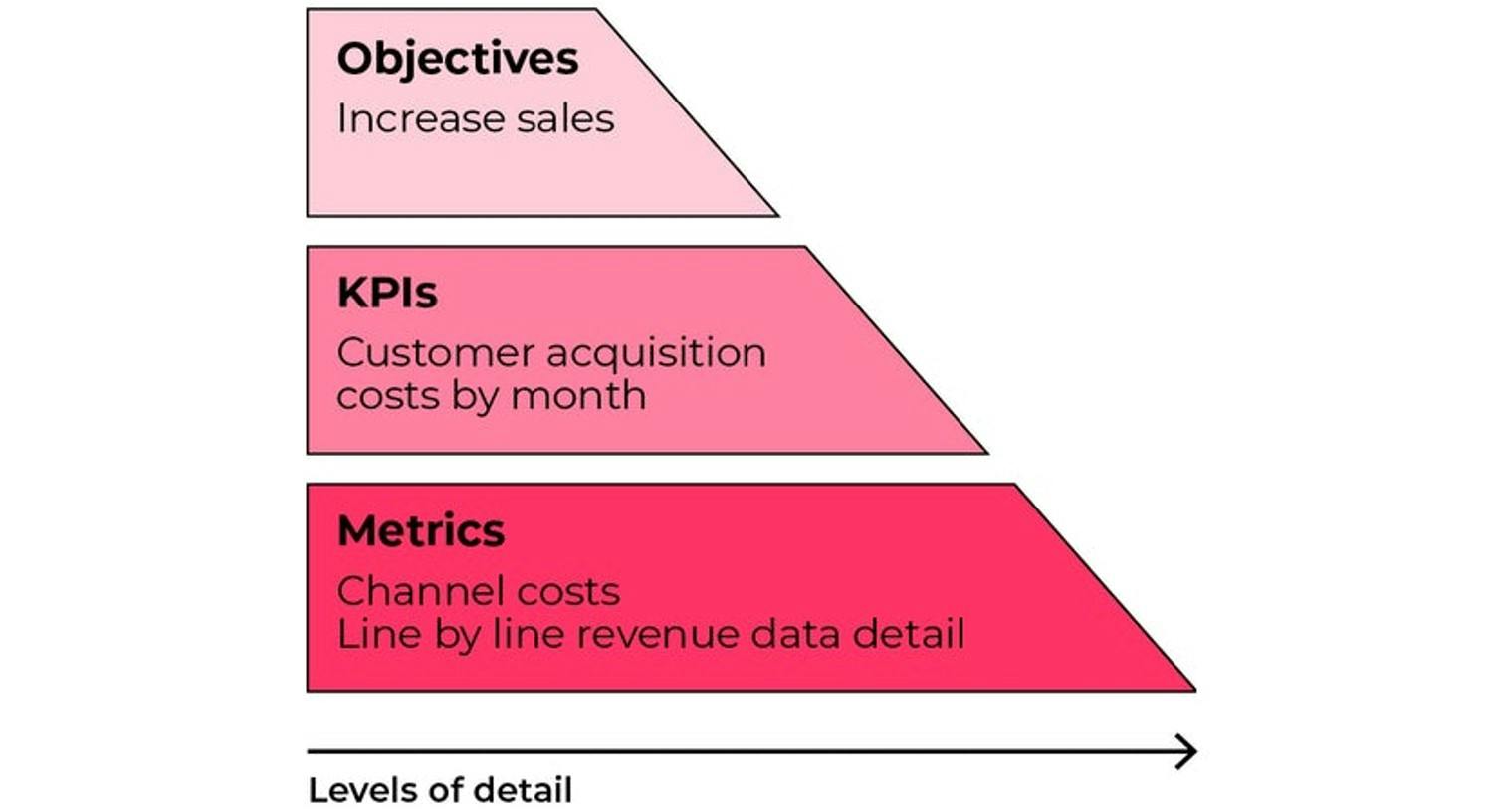
When exploring alternative approaches to using third-party cookies, it is important for companies to be led by their specific campaign objectives and KPIs. Econsultancy’s guide on the Fundamentals of Marketing Measurement and Analytics features a simple model (Figure 1), which shows how business or brand objectives should sit at the top of the measurement pyramid, with a small basket of KPIs under this which ladders up to those objectives. These KPIs can in turn be tracked using a larger set of metrics that also ladder up to specific KPIs.
Figure 1: Aligning objectives, KPIs and metrics
Source: Econsultancy
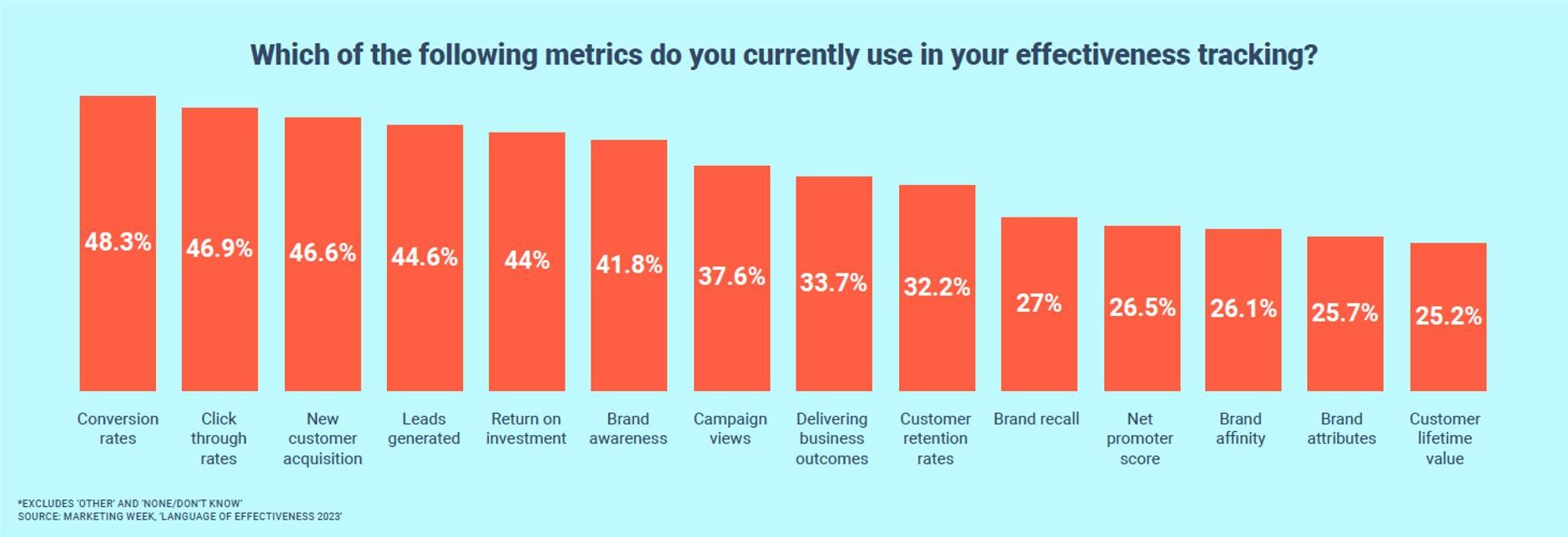
Marketing Week’s 2023 Language of Effectiveness survey, supported by Kantar, revealed there is a tendency for companies to focus on short-term metrics for their effectiveness tracking. As illustrated in Figure 2, the top five metrics were conversion rates, clickthrough rates, new customer acquisition, leads generated and return on investment (ROI), where each was cited by between 44% and 49% of marketers.[4]
Figure 2: Metrics used by companies in their effectiveness tracking
Source: Marketing Week’s 2023 Language of Effectiveness Survey
In terms of long-term metrics, the only one cited by more than 40% of respondents is brand awareness, with other metrics seeing around 32% or less response, including customer retention rate, brand attributes, customer lifetime value and net promoter score.
It is important for companies to consider the balance between short-term and long-term measures. While there is recognition of the importance of brand building, it is clear that with the challenges around the economy and pressures on budgets, marketers are still being driven by the need to generate sales and deliver on short-term measures. As highlighted in Figure 2, this will generally lead to more of a focus on short-term metrics, as opposed to taking a longer-term view based around business outcomes.
Findings from Marketing Week and Kantar’s Language of Effectiveness survey point to marketing effectiveness needing to be better aligned to business priorities and senior leadership.[5] The report argues this should be achieved by embedding an understanding of the full commercial return of all short- and long-term marketing activity throughout organisations, as well as building the culture and capability to measure it credibly.
To respond to taking a more long-term view there is a need to focus on outcomes. While the metrics shown in Figure 3 can provide some insight into how audiences have responded to a campaign, companies should have a set of clearly defined objectives, which then link directly to business outcomes such as customer satisfaction, retention and lifetime value.
Figure 3: Metrics vs outcomes

Source: Econsultancy
Understanding what success looks like will help a company determine the outcomes and goals they are looking for and what needs to be measured.
Defining what success looks like
“Understanding if a particular measurement approach is successful will depend on the success metrics defined upfront. For example, for most of the investment, is it profitable or helping to grow share? For some part of the investment, is this helping to grow brand health metrics, such as spontaneous brand awareness or top of mind?
“Defining what success looks like upfront has helped us to make sure we are on the right track and keep the confidence of senior stakeholders regarding how we are managing marketing investments.”
Mauricio Ferreira, Marketing Effectiveness Lead, Confused.com
This was a key point highlighted in discussions with the IAB in terms of having established objectives at the outset and being clear on what success looks like.
Set clear objectives and KPIs to determine the most appropriate measurement strategy
“Setting clear objectives and key performance indicators (KPIs) before launching a campaign is vital in allowing for targeted tracking and measurement. This is even more important given the industry’s shift away from third-party identifiers. The right approach hinges on defining what success looks like for that particular campaign from the outset and the metrics that will most clearly indicate whether those objectives are being met.
“Secondly, the use of various measurement and tracking solutions aids in assessing campaign effectiveness. These include brand studies and attribution modelling, which allows for the tracking of customer interactions and conversions.
“Thirdly, the ability to track the customer journey across different touchpoints provides valuable insights into what led to a sale and where improvements can be made. This is facilitated by industry-wide insights from UKOM on how audiences behave online, as well as ad tech that provides accurate data on customer interactions.
“And finally, the use of attention metrics allows for a deeper understanding of what content or creatives are having an impact, enabling more precise media planning and campaign optimisation.”
The IAB’s Measurement Toolkit breaks down the key steps involved in creating a measurement plan and outlines methodology options.[6]
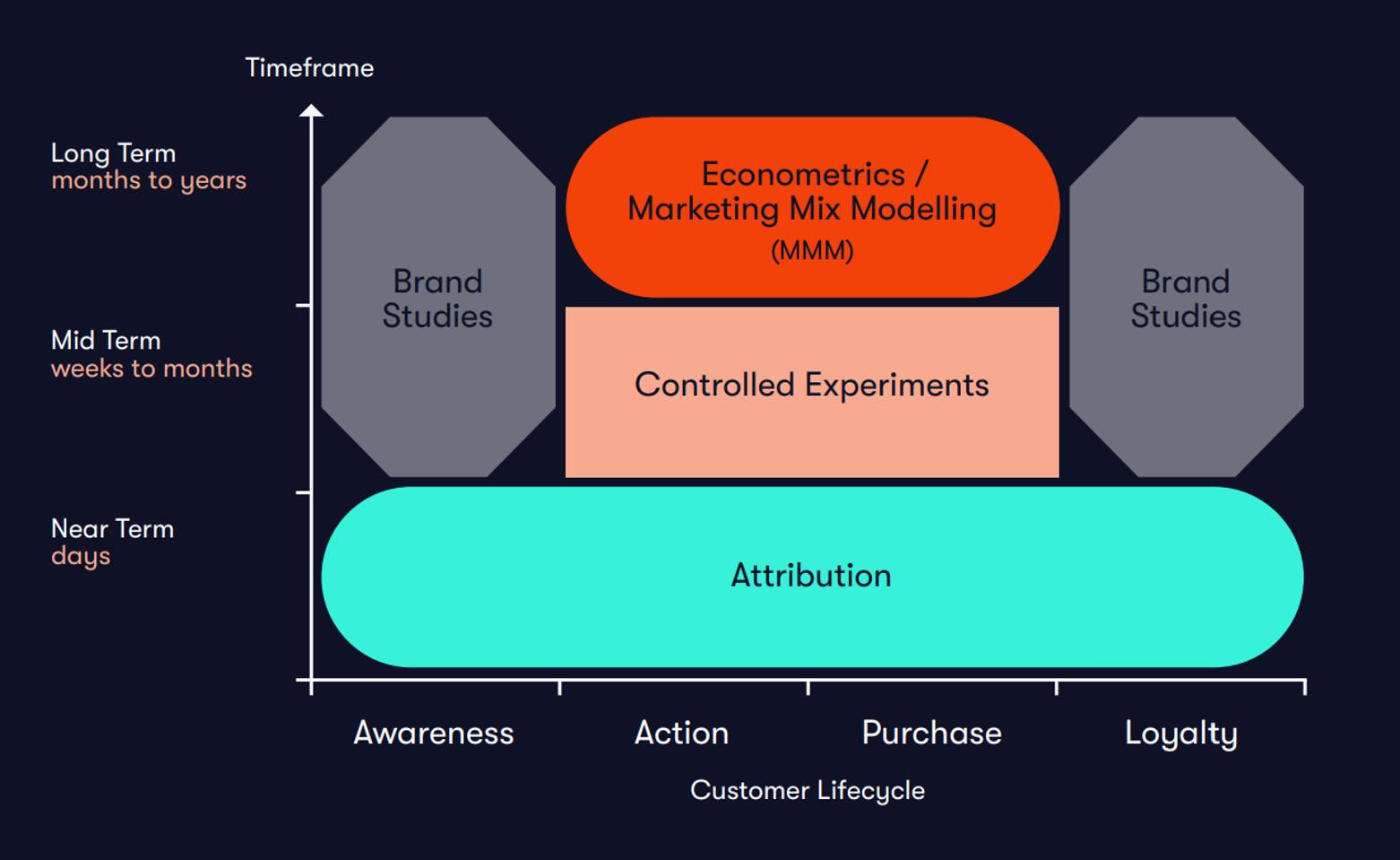
Figure 4: A blended approach to the use of measurement methodologies
Source: IAB UK
Chloe Nicholls, Head of Ad Tech, IAB UK
As illustrated above, different measurement approaches can help determine how a campaign has performed at different points in the customer journey, but there is a need for companies to have a holistic view of how their campaign has performed. In order to achieve this, a common suggestion among the interviewees for this report was that companies can consider using a combination of methods. The idea being that adopting a blend of approaches can provide companies with better insight into how their marketing activities are performing, and what is driving incremental sales, as well as counteract the challenges around the loss of third-party cookies and having to rely on last-touch attribution.
Understanding effectiveness needs to provide a view of all marketing activities
“Understanding effectiveness needs to provide a holistic view of all our activities. From a sales perspective, we’re offline and online. We do a lot of PR, events and influencer marketing as well as traditional print and out of home.”
Sebastian Cruz, Regional Digital Marketing and Media Director, Shiseido, Asia Pacific
Understand how channels compare with one another
“You can’t just measure digital activities on their own. Companies need to know how they compare to other channels so they can have a holistic view. The benefits of using an approach such as marketing mix modelling to measure effectiveness is it puts all the different media channels into one comparable framework.”
Dr Grace Kite, Economist and Founder, Magic Numbers
Section 5 looks at the different marketing measurement approaches which can used by marketers and some of the key benefits and challenges to be considered when determining which approach or blend of approaches would work best.
Applying the learning: Success metrics should adapt with the business growth strategy
Laura Chaibi, Director of International Ad Marketing and Insights at Roku Inc, describes that when focused on performance metrics tied to digital outcomes, the volume of performance data can feel like instant gratification due to the speed of outcomes. Whether it be an increase in search, website visits or even direct conversions to immediate sales, an overdependence on these metrics to grow indefinitely can happen. At some point, a ceiling is reached and marketers need to anticipate this.
“When a brand or category maximises or exhausts all their digital channels (search, social, video, mobile, display) and needs to seek growth elsewhere, they also need to prepare to reorient around what success looks like and the associated metrics. This might be brand health metrics, share of category volume or value and seeking white space opportunities for the brand to be associated with i.e. brand attributes that are not a natural fit. Mental shortcuts then need to be made through advertising, such as a toiletry brand moving into beauty, or a snack brand into a main meal association.
“CTV advertising is a great bridge from digital into TV, as a direct leap would open up huge absolute reach and demand, and the brand (if a scale-up brand, for example) may not be equipped to manage the distribution and demand. As cited from Dr Grace Kite, the absolute volumes of conversion she has seen typically stay the same, so if a brand converts 3% sales in digital and moved to TV, for example, they need to be prepared to manage the sales volume at mass reach and the distribution needs to be in place.”
3. The Changing Digital Marketing Measurement Landscape
How digital marketing is measured is currently in a state of great flux. This is due to widespread regulatory and technical changes that have restricted the data that is available to the digital advertising industry, leading to the decline of third-party data from browsers and device manufacturers. This data has been important for both measuring digital marketing activity and targeting advertising.
Consumers’ expectations around privacy also continue to rise, and they are increasingly limiting the amount of data they are willing to share and blocking cookies. This chapter will explore the changes in more detail and the impact they are having on measurement techniques.
3.1 Regulatory changes
Around the world there has been an increase in privacy-focused regulation, with companies needing to be conscious of what data is collected, where it is stored and how it is used.
Regulations in Europe
On 25 May 2018, the EU General Data Protection Regulation (GDPR) came into force across Europe. This regulation imposed much tighter controls on how companies can collect and handle information about individuals on the internet.
In the UK, the GDPR is retained in domestic law as the UK GDPR and any companies processing domestic data must continue to comply with the UK GDPR and the DPA (Data Protection Act) 2018.[7] The UK GDPR also applies to processor and controllers based outside of the UK if offering goods or services to individuals in the UK or monitoring the behaviour of individuals in the UK.
UK organisations will need to comply with the EU GDPR if they operate in the EEA, offer goods and services to, or monitor the behaviour of, individuals in the EEA.
Further guidance on data protection in the UK is provided by the Information Commissioner’s Office.[8]
In addition to GDPR is the ePrivacy Regulation, which when brought into force will set out specific rules governing electronic communications and will take precedence over GDPR in situations where both laws apply.[9]
The ePrivacy Regulation aims to strengthen and update the online privacy rights of users.[10] It will replace the current 2002 ePrivacy Directive and does not just apply to personal data, but also affects B2B marketing. While this was expected to take effect on 25 May 2018, alongside the EU GDPR, this did not happen. The agreed text of the ePrivacy Regulation has yet to be finalised,[11] which will then be followed with an expected 24-month transition period.
A further regulation companies need to be aware of regarding user consent is the Digital Markets Act (DMA). The DMA requires that ‘gatekeepers’, identified as large digital platforms providing core services, such as search engines, messenger services and app stores are required to comply with the DMA by 6 March 2024. In particular, they will be responsible for collecting user consent.[12] The six ‘gatekeepers’ identified are Alphabet (parent company of Google and Android), Amazon, Apple, ByteDance (parent company of TikTok), Meta (parent company of Facebook, Instagram, and WhatsApp, along with others) and Microsoft (parent company of LinkedIn).[13]
Despite the ending of third-party cookies, advertisers and publishers will still need to obtain user consent to process user data. Google, in particular, has stated it is strengthening the enforcement of its EU user consent policy.[14] For any company that wants to continue using Google services such as Google Ads and Google Analytics, it will be mandatory to implement Google Consent Mode v2 by March 2024 to ensure Google complies with the DMA.[15] This is an enhancement of the original Google Consent mode which has been designed to better align with user preferences and data privacy regulations. Those who are not using Google Consent Mode v2 by the deadline will not be able to capture any data about any new users in the EEA or personalise ad experiences for them. The impact of this being that it will be impossible for a company to then do remarketing in Google Ads, Floodlight, and Display.
In January 2024, Apple announced planned changes to iOS, Safari and the App Store, which impact developers’ apps in the EU as part of compliance with the DMA.[16] New capabilities will become available to users in the 27 EU countries in March 2024. Further resources are available to developers explaining the changes.[17]
Regulations in the US
In the US, regulations are determined at a local state level with a key piece of legislation being the California Consumer Privacy Act (CCPA) of 2018,[18] which was enacted on 1 January 2020. This gave consumers more control over the personal information that businesses can collect about them. As detailed on the State of California Department of Justice website,[19] the law secured new privacy rights for California consumers. These included the right to know about the personal information a business collects, how it is used and shared and the right to opt out of this, along with the right for a consumer to have their personal information deleted (with some exceptions).
On 1 January 2023, the California Privacy Rights Act (CPRA) took effect as an add-on to the CCPA. It gives consumers new rights in addition to those in the original regulation, such as the right to correct inaccurate personal information that a business has about them and the right to limit the use and disclosure of sensitive personal information collected about them.
This is the same date the Consumer Data Protection Act (CDPA) took effect in Virginia, which gives consumers the rights to view, obtain, delete and correct their data, and requires companies that conduct business in the state to get permission from users to process their data.
In addition to California and Virginia, further states across the US have comprehensive privacy laws in place or are proposing bills.[20]
Regulations around the world
Many countries outside the EU have similar data protection regulation to GDPR. Some notable examples include:
- Australia: The Privacy Legislation Amendment Bill 2022, passed by the Australian Parliament in 2022, increased fines for data breaches and brought the country’s privacy laws further into alignment with competition and consumer remedies within the EU’s GDPR laws.
- China: China’s Personal Information Protection Law (PIPL) came into force on 1 November 2021, where previously data privacy had been governed by different laws. PIPL is designed to protect users’ privacy rights when they use the internet or buy their goods and services online. While much of the PIPL has been based on the EU GDPR, it comprises stricter standards and penalties, which therefore has far-reaching implications for companies that do business in China and handle cross-border data.[21]
- Japan: Any business that holds personal data in Japan is required to abide by the APPI Amendment. It includes provisions around third-party transfers and protects the rights of individuals in regard to their personal data. The law (which replaced the former Act on Protection of Personal Information in 2017) has helped Japan to get on the EU’s ‘white list’ of countries with adequate data protection legislation.
The above highlights some key pieces of data regulation which have come into force, but there are many others in place. Depending on where companies are based, how customer data is being used, and across which territories and countries, they will need to comply with the appropriate regulations. Information by country is provided in a practical guide to data privacy laws by Case IQ.[22]
AI and data protection regulations
Another factor for marketers to bear in mind is that the EU’s GDPR and the UK’s GDPR apply to the use of generative AI where this includes the processing of personal data. In order to regulate the use of AI, the European Commission has proposed the first regulatory framework for the use of artificial intelligence. The AI Act received provisional agreement at the end of 2023 by the European Parliament but has yet to come into force.[23]
Marketers should continue to stay abreast of the various laws and regulatory-led initiatives and around the use of AI across all jurisdictions.
3.2 Technical changes
In addition to the regulatory changes that have restricted what information a company can collect, a number of technical changes have impacted how companies can use third-party cookies and device IDs to both target consumers and measure their activities.
3.2.1 Deprecation of third-party cookies
The ability to target users with digital marketing and understand how well it is performing often relies on third-party cookies for cross-site tracking. Third-party cookies are small pieces of code that are created by a ‘third party’ such as a website or technology platform. They are then stored on a user’s browser to track their activity once they leave the website that installed it. This provides a view of the user’s online activity to be captured and used for tracking and targeting.
However, technical changes to the industry are being made by some of the largest technology platforms to protect user privacy. Since 2019, Apple, Mozilla and Google have all made, or are in the process of making, major changes to the availability of third-party cookies on their browsers. This has led to much industry talk of the overall decline of the third-party cookie as a means for measuring the effectiveness of digital marketing.
Apple and Mozilla’s browsers have already phased out third-party cookies. Mozilla Firefox has since further strengthened user privacy by implementing Total Cookie Protection, which includes protection against fingerprinting and ‘supercookies’. Mozilla describes supercookies as being similar to tracking cookies, which enable a tracker to stitch together visits to different websites, but notes how the key difference is that a user’s browser was not designed to store supercookies.[24] Tracking companies have found ways to secretly place these in other browser features, such as hiding them in the cache, thereby making it harder for them to be blocked or cleared compared to normal cookies.
Google plans to phase out support for third-party cookies in Chrome by the second half of 2024.[25],[26] The start of the deprecation of third-party cookies began when ‘Tracking Protection’ was switched on for 1% of Chrome users (30 million) in January 2024, with the remaining to be phased out in the second half of 2024, according to the latest timeline, updated in December 2023.[27] However, a report from the UK Competition and Markets Authority in January 2024 has ordered Google to pause eliminating third-party cookies until their multiple competition-related concerns around their Privacy Sandbox proposals are addressed.[28]
Chrome is the world’s leading internet browser with a global market share of 65% as of January 2024,[29] making its final removal of third-party cookies, when marketers will no longer be able to rely on these as a form of measurement, set to have significant implications. The impact has been described as ‘the death of the cookie’ by one interviewee for Econsultancy’s Fundamentals of Digital Advertising Best Practice Guide.
The death of the cookie
“We are experiencing the slow death of the cookie. From a measurement perspective, we need to be more confident with modelling to fill in some of these gaps. However, we shouldn’t look at the cookieless future as just a targeting or measurement challenge, it is really an indication of the growing priority of privacy across all of marketing, which will impact everything from app development to CRM programmes.”
Liam Pook, Head of Digital, PHD Melbourne[30]
However, despite this impending decline, according to Econsultancy’s Future of Marketing report, less than a third of marketers (30%) consider their organisation either fully, or mostly prepared, for the loss of third-party cookies.
3.2.2 Google’s Privacy Sandbox
Following Google’s announcement that it was not looking to implement user-level identifiers to replace third-party cookies, in August 2019 Google announced the soft launch of the Privacy Sandbox initiative for Chrome, software which it described as “a secure environment for personalisation that also protects user privacy”.[31]
Google is seeking industry feedback on the Privacy Sandbox, which is an industry-wide effort to develop new technology that will improve people’s privacy across the web and apps on Android. The changes aim to reduce the sharing of personal data. The proposed solutions will limit tracking of individuals and provide safer alternatives to existing technology on these platforms, while keeping them open and accessible to everyone.
Google’s Privacy Sandbox will form a set of initiatives to create a viable framework for advertising and measurement without third-party cookies.[32] This will include a number of APIs to support cross-site use cases without third-party cookies or other tracking mechanisms. Advertisers will be able to use solutions such as Google Topics, the Protected Audience API and its new Attribution Reporting and Private Aggregation APIs. These will all have implications for marketers who are trying to understand the future of ad targeting and measurement post third-party cookies. A further feature being tested from Google’s Privacy Sandbox is IP Protection, which prevents IP addresses being used as ad targeting identifiers, as discussed in an Econsultancy article.[33]
Alongside the various changes underway, there are side rulings which point to the illegality of Google Analytics in an EU context. As described in one article, this is the view from the Austrian, French, Italian, Danish, Finnish, Norwegian, Swedish and other European Data Protection Authorities.[34] The key reason being cited is that Google Analytics violates GDPR, as it is “subject to surveillance” by US intelligence services and providers can be ordered to disclose the data of European citizens. Under the Cloud Act, US authorities can demand personal data from Google, Facebook, Amazon and other providers, even when they are operating or hosting that data in another jurisdiction.[35]
3.2.3 Apple’s Private Click Measurement (PCM)
Apple’s Private Click Measurement (PCM) is a proposed web standard for measuring the effectiveness of click-through advertising in a privacy-preserving way. It allows external websites to measure where external links, such as ads, result in a conversion.[36] The external website decides what constitutes a conversion, such as a purchase or sign-up. With PCM, no user-identifiable information is sent to the external website, so it protects user privacy, while giving advertisers the ability to measure the effectiveness of their ad campaigns. For those apps running in iOS 14.5 or later, they are able to take advantage of PCM.
3.2.4 The decline of device IDs
Since the inception of the smartphone, third-party cookies have not worked on mobile apps. Instead in their place, manufacturers offered a device ID, which provided an anonymised ID that could be used to track user behaviour on these devices and allow marketers to see any actions related to marketing activity.
However, Apple kickstarted the demise of the device ID, called the IDFA (Identifier For Advertisers), in 2021 with the launch of its new privacy feature called App Tracking Transparency. This required consumers to actively opt in to allow the use of IDFA for each app they accessed, effectively giving them the ability to opt out of sharing their personal data with third parties.[37]
While this meant the use of fingerprinting was prohibited, there were no additional measures in place to fully police it. Apple is now looking to change this through its new app developer requirement that obliges companies wanting to access certain APIs to provide a reason. Developers will then need to select from one or more of the ‘approved reasons’, detailing how their app will use the API to allow it to do so for those stated purposes. The requirement will mean that by spring 2024, any apps and app updates that do not include a reason will be rejected.[38]
In early 2022, Google followed suit by announcing that the Privacy Sandbox initiative would extend to mobile and eventually replace Google’s GAID (Google Advertising ID) by 2024.
The decline of the device ID will have a very similar impact on marketers’ ability to measure digital advertising across mobile as the demise of third-party cookies on desktop, making it more challenging to understand the behaviour of people online and attribute any marketing to that behaviour.
However, how third-party cookies were being used in order to recognise a user was not perfect before. Cookie match rates could range from anywhere between 40% and 60% in Europe,[39] which does not take into account the challenge of those tracking cookies already being rejected by some browsers or deleted and blocked by users. From a consumer perspective, this meant they could often be shown irrelevant ads. From a business perspective, budgets were often being wasted on not reaching potential customers.
The technical and regulatory changes are taking place at the same time consumers are becoming more aware of their data rights. Companies need to ensure that upholding consumers’ privacy is a priority and that they are adapting their measurement approaches and the ways in which they collect and use data around this. Marketers must continue to monitor the impact the various changes are having on the way they measure their digital marketing activity and collect data.
4. Responding to the Changing Digital Marketing Measurement Landscape
Marketers relying on third-party cookies to measure the effectiveness of their campaigns now face an imminent need to put alternative solutions in place.
Act now, or be left out in the cold
“We’re resetting our measurement foundations and getting the frameworks in place. So, when the third-party cookieless world does arrive, we’re not left short.”
Alex Dousie, Senior Vice President Brand Marketing, Dow Jones[40]
Many developments around privacy and tracking have already impacted the way that marketers can measure. The blocking of third-party cookies across Firefox, Safari and Internet Explorer, as well as Apple’s App Tracking Transparency (ATT), are already making it a challenge for companies to tie together a user’s activities across the internet. In addition to this, customers have also been taking action to prevent being tracked by deleting or blocking cookies.
Marketers are having to rely on less accurate data
“Every day it’s becoming more difficult to track a user’s entire purchase journey, meaning marketers are having to rely on less accurate measurement and more assumptions.
“We are already seeing this in Google Ads … In the Search Terms report, I’ve seen accounts where 40% of the search term data is missing, even if it’s resulted in conversions.”
Brooke Osmundson, Director of Growth Marketing, Smith Micro Software[41]
While many publishers and tech platforms such as Google, Facebook, Amazon, and TikTok offer their own reporting tools, they can only measure how a campaign is performing across their own channels and do not take into account the impact of other channels. While a company may get some insight into the short-term impact of their campaign, it will not enable them to understand the medium and long-term impact of their marketing. This point was evidenced in an article by Meta, Nielsen and GFK showing 60% of all the effects of advertising were long-term, meaning driving consideration among future buyers as well as immediate ones.[42],[43]
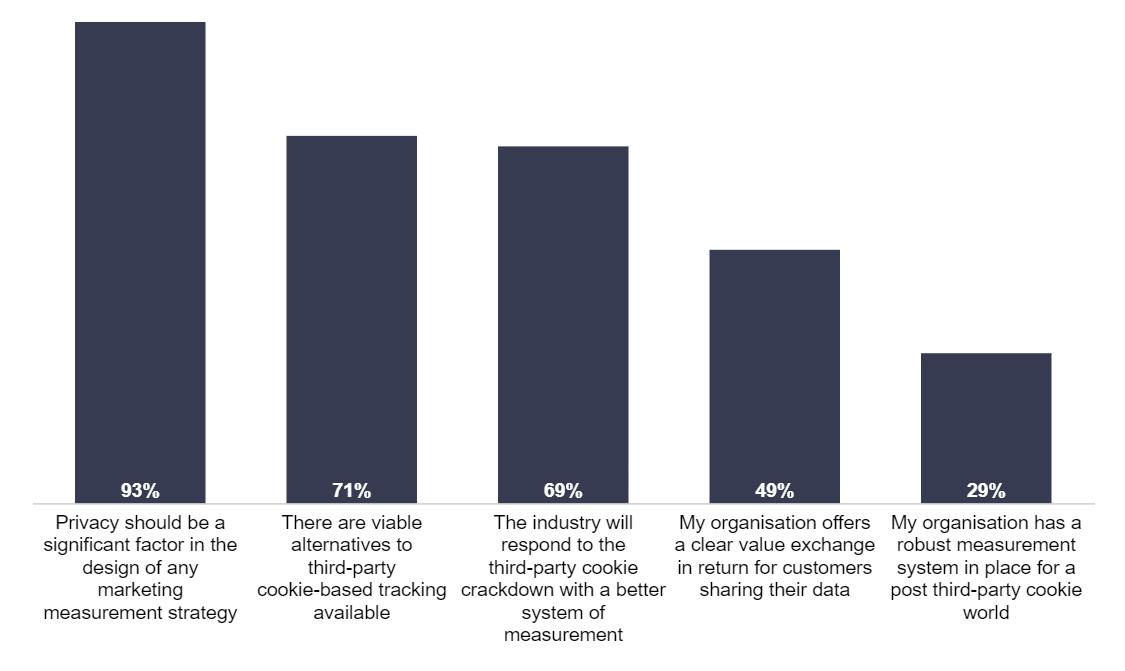
Despite the challenges, marketers remain mostly optimistic about the third-party cookieless future. Econsultancy’s Future of Marketing report revealed that 71% of marketers feel that there are already viable alternatives available, with 69% believing that the industry will respond with a better system of measurement (Figure 5).
Figure 5: Do you agree or disagree with the following statements? (agree only)
Source: Econsultancy’s Future of Marketing survey | Sample: 383
The report suggests that part of the reason for this optimism is that many believe the changes will lead to companies adopting more positive, customer-centric data strategies that have a clear stance on privacy, with 93% of marketers recognising that privacy needs to be integral to any measurement strategy (Figure 5).
However, while it would seem that over 70% of marketers believe that there are viable alternatives, less than a third (29%) say they have a robust measurement system in place (Figure 5), and only 8% of marketers say they are ‘fully prepared’ for the demise of third-party cookies, with a further 22% declaring that they are ‘mostly prepared’.
Among the marketers whose organisations are putting alternative measurement arrangements in place, the most popular method is to focus on collecting first-party data (65%), according to Econsultancy’s Future of Marketing report (Figure 6). This is followed by brand studies (49%), zero-party data (40%) and market research (40%).
Figure 6: What alternative forms of measuring digital marketing campaign effectiveness is your organisation already using, or considering adopting? Select all that apply
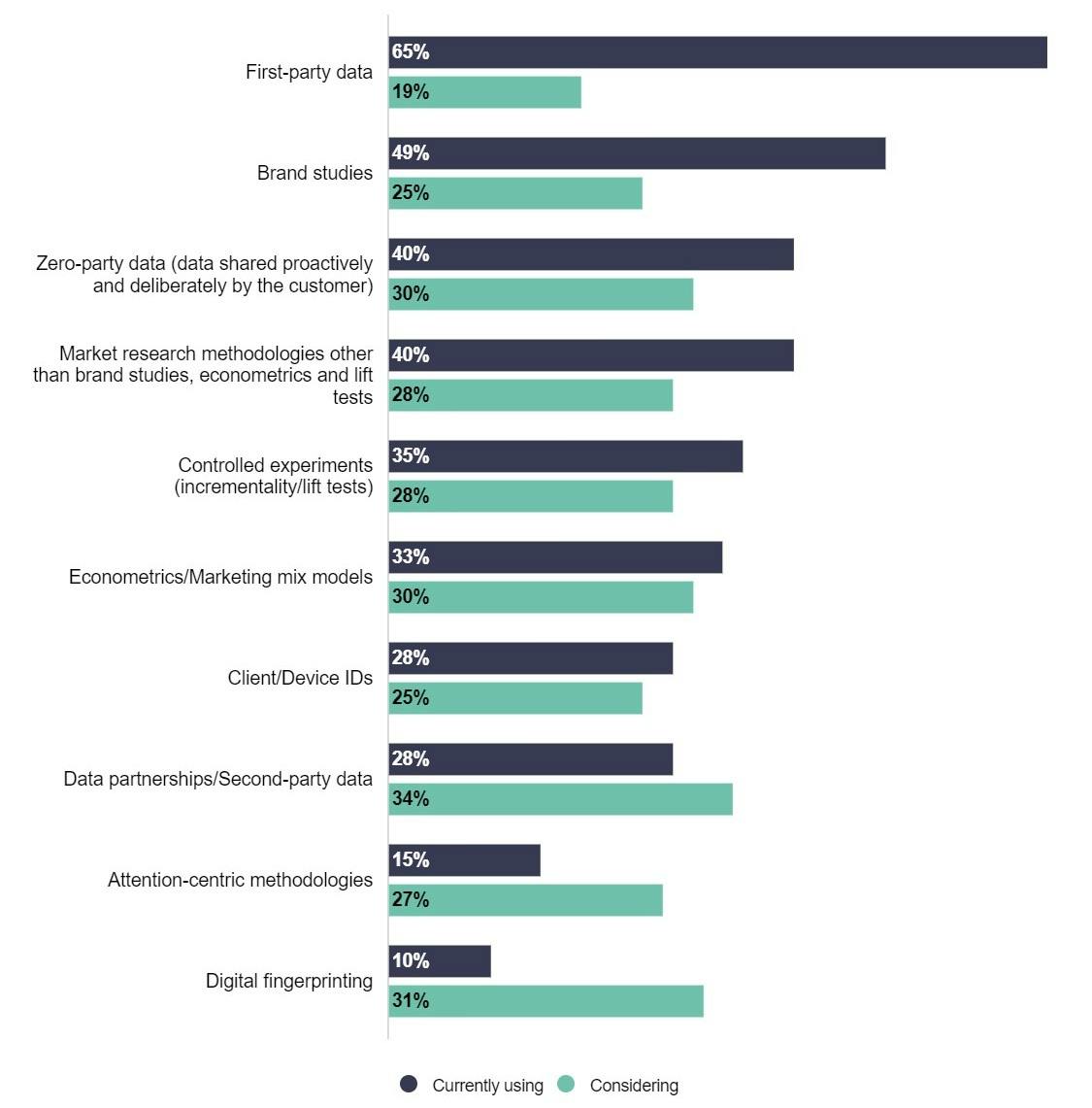
Source: Econsultancy’s Future of Marketing survey | Sample: 362
Section 5 explores in more detail the alternative measurement options available to marketers.
4.1 Focusing on first-party data
With the demise of third-party cookies already underway, more emphasis has been placed on the need for marketers to focus on collecting their own data in order to understand how their campaigns are performing and to reach audiences. This section discusses the importance of building up a company’s own data sources, along with the key considerations for laying the foundations of an effective approach to measurement.
4.1.1 Introduction to data and types
It is clear from Econsultancy’s Future of Marketing report that companies are recognising the importance of gathering their own data. The survey revealed that first-party data is in use or being considered as an alternative to third party cookies for measurement by 84% of respondents. This is being further supported by a focus on zero-party data, which is in use or being considered by 70% of respondents. Table 1 outlines the differences between the different data and cookie types, and how these relate to measurement approaches.
Table 1: Different data and cookie types, and how they can be used
| Data type | Definition and collection methods | Use in measurement |
| Zero-party data |
|
|
| First-party data |
|
|
| Second-party data |
|
|
| Third-party data |
|
|
When it comes to the use of cookies, a key distinction is that first-party cookies are created by the website that a user is browsing, and the user is able provide their consent to their data being collected. This means that first-party data is gathered directly from customers in a privacy-compliant way and is owned by the company that owns the website and sets the first-party cookie.
4.1.2 Benefits and uses of first-party data
A key benefit of a company using its own data sources is that it can provide a better understanding of customers’ behaviour. First-party data is considered to be more accurate than third-party data from external sources, since it has come directly from the user with their consent.
First-party data can be used as the foundation for customer profiles and enhanced with other forms of data to enrich and validate them.
First-party data may include the data that is housed within a company’s CRM system, i.e. customer account data, or data from owned media assets (such as a website or app) that reveals preferences, interests or behaviours. These rich customer profiles can then be used to create a single customer view, which then means individuals’ behaviour can be monitored across channels, and used to measure how campaigns have performed. This data can then also be used for modelling and to target lookalike audiences in order to reach unknown audiences and prospects.
First-party is key
“Our advice is to lean strongly into first-party data for day-to-day measurement and use secondary sources where necessary to add more detail, draw customer insights and develop testable hypothesis about marketing strategies.”
Gabriel Hughes, CEO and Founder, Metageni
Benefits
- Reduces reliance on third-party data, which will not be as readily available with the imminent removal of third-party cookies.
- First-party data can be more reliable, as companies know how it has been collected and it comes directly from the customer, making it very valuable and considered higher quality.
- Privacy compliant with consent obtained directly from the consumer.
- Enables a company to track the results of their campaigns against individuals, not just at a campaign level, and assess which are the most effective.
- Information which is based on a company’s own customers provides the potential for personalisation and relationship building.
- Supports segmentation modelling of cohorts and lookalike audiences for future targeting.
- Having access to a company’s own first-party data enables them to then use this to feed into their measurement and targeting approaches.
Using CRM first-party data to understand effectiveness
Having access to first-party data from a CRM system with which to both target customers, but also use for measurement purposes, was highlighted as a key benefit by Sebastian Cruz, Regional Digital Marketing and Media Director at Shiseido Asia Pacific.
“As a luxury skincare company we benefit from having robust CRM data coming in from our in-store points of sale, which customers are happy to consent to providing, along with data from our website. There is definitely a strong push across the company towards a first-party data mindset. Our CRM first-party data gives us a lot of insights already and is helping us to also understand longer-term metrics like lifetime value. If we want to understand retention and what’s driving it in terms of the source of recruitment from an attribution perspective, our CRM can help here.
“The power of our CRM data really comes about because of the complexity of our portfolio in terms of our brands and SKUs. We are able to mine data and insights by channel, product line, skew and see which tactic has worked. We can even tie a result back to the creative and product to see from an uplift perspective which specific parts of our portfolio are actually driving business.
“CRM data, though, is not the full picture, and it is limited from a brand perspective, so that is where some of our other methodologies like using our analytics, campaign and sales data along with statistical regression analysis and marketing mix modelling help in combination with this.”
Sebastian Cruz, Regional Digital Marketing and Media Director, Shiseido, Asia Pacific
Companies can also work with secondary partners to further optimise their first-party data sources. Integrating a company’s first-party data where consent has been given with an ad platform’s API enables marketers to understand how customers convert to a sale, without compromising their privacy. Platform data such as Meta’s Conversions API (CAPI) can then be matched to actual sales data. Kasper Moll, Global Paid Social Manager at Pandora, shared the benefit they are seeing when speaking on a Meta panel.[44]
“Pandora sells around 280,000 items of jewellery per day, so it uses CAPI to ‘triangulate’ insights from multiple data points, as well as to optimise advertising campaigns. I want to have a good connection between real-life [sales] numbers and in-platform [conversion data]. If they are in sync, then I can trust [the performance of the ads] we buy on the platform. We can then use two approaches to personalisation.”
4.1.3 Challenges of first-party data
As companies work to build up their own sources of data, there are some challenges to be mindful of.
- It takes time, resources and effort to generate and maintain first-party data. Users need to be encouraged to share their data.
- It requires scale. There needs to be enough data held on a large enough portion of customers to effectively target and measure campaigns.
- To optimise the data requires a single view of the customer, but siloed teams and a lack of the right technology to support this can be a roadblock.
Scaling up first-party data
“The challenge is both how we collect more first-party data, but then how we can use it to replace some of the third-party cookie data we would have had previously and get some scale to achieve the large reach we need to drive awareness. We are currently still identifying audiences that are similar cohorts and segments for targeting when using Google.
“It is also about trying to understand the value exchange to give consumers in order to get that first-party data to then be in a position to use it elsewhere and drive that effectiveness. When we’ve used a mixture of personalisation and first-party data, we see a 20% improvement in marketing effectiveness.”
James Sharman, Northern Europe Digital Acceleration Lead, Haleon
4.1.4 Enhancing data sources with zero-party data
Zero-party data is generated when people actively choose to share data with an organisation and directly provide the company with information, such as their customer preferences. This can be collected via customer profiles, preference centres, surveys, quizzes, competitions, polls or through loyalty programmes.
Businesses can then enhance their customer profiles with this data, which enables a company to learn more about the likes, dislikes, opinions and interests of their audiences. The customer motivation to share zero-party data is often a desire for greater personalisation or customisation, where the end user is able to explicitly state their own preferences and needs. This, in turn, gives companies more direct information about customer preferences.
Insights provided directly by a consumer can also be fed into measurement analysis tools. Steven Silvers, EVP of Global Creative and Media Solutions at Kantar, describes how the vast majority of the data that the company has is zero-party data: “At Kantar, we can use a variety of zero- and first-party data to run our media effectiveness analysis. It also means that the machine learning and AI products that we release are trained off very good clean data. It’s data that we know we have the rights to since the consumers have given it to us explicitly, and it’s data that other companies don’t have.”
As described in Table 1, a business can also enter into a partnership with another company to use its first-party data. This becomes second-party data for the business, but as it is the partner’s first-party data, it has been consented to by the customer.
4.2 Preparing for the demise of third-party cookies
For those companies currently still relying on third-party cookies, now is the time to audit their own practices to understand how data is being used and what data is available so that they can explore what alternative options would work best.
To help prepare for the demise of third-party cookies, there are a number of key strategies that marketers can adopt, which are covered in Econsultancy’s Data-Driven Marketing Best Practice Guide. A summary of these is provided below.
Applying the learning: Strategies to prepare for the demise of third-party cookies
- Audit processes: Conduct an audit of exactly how customer data is collected and utilised across the marketing team and wider organisation. It is also important to understand how privacy awareness can be incorporated into data systems, processes and technologies, and to conduct training on privacy-related policies and tactics.
- Focus on first-party data acquisition and enrichment: Steps can now be taken to mitigate the loss of data from third-party cookies by proactively developing strategies to acquire more zero- and first-party data. This means identifying the best opportunities to collect data throughout the course of the customer journey and across channels, understanding the required value exchange needed and being creative in how this is presented to users.
- Invest in CRM: The changing dynamics around cookies and first-party data will make it more imperative for businesses to utilise existing data assets as much as possible and focus their CRM strategies on driving loyalty and building relationships with their customers.
- Improve technologies: There is a greater need for businesses to have their data and technology infrastructure such as customer data platforms set up well to derive true value from first-party data and for any tech stack to be flexible enough to work with multiple compliant IDs.
- Adapt targeting: Certain forms of targeting (such as retargeting) will be affected more by the cookie changes, which potentially places greater emphasis on other forms of targeting such as contextual, geographic and those aimed at broader audience groups.
Econsultancy | Data-driven Marketing Best Practice Guide
5. Digital Marketing Measurement Approaches
There is not one measurement method that will suit everyone, and a company should explore what approach, or combination of techniques will best meet their needs. The approach a company selects will be influenced by a number of factors including their objectives, the marketing mix of channels they are using and the budget available.
This section will explore the key measurement methods which are available to today’s marketers, or that are being explored, and will highlight some of the benefits and challenges of each.
5.1 Attribution modelling
One of the most popular approaches used by marketers to understand the impact of different elements of a campaign on driving a customer action has been attribution modelling.
Attribution models assign credit to marketing channels to help marketers understand which touchpoints along the customer journey have contributed to a customer action – for example, a purchase, download or website visit, depending on the objective of the campaign. It is about understanding the value of each type of marketing and the role it has played towards driving a sale or action.
Some of these approaches work by allocating credit to just one touchpoint, otherwise known as single-touch attribution models. These include:
- First touch: all credit is given to the first interaction (e.g. ad view or website click).
- Last touch: all credit is given to the last interaction (e.g. ad view or website click).
- Last ad interaction: all credit is given to the last ad that was displayed or interacted with, i.e. it does not include website clicks or other non-advertising related interactions.
Until the technical changes to third-party cookies made this approach more difficult to implement, it had generally been regarded as better practice to use multi-touch attribution models, which instead gives credit to more than one touchpoint along the customer journey. These options include:
- Time decay: credit is distributed across the interactions, assigning the least to the first touch, building to the most for the last touch.
- Linear: credit is distributed evenly across every interaction.
- Position based: credit is divided in a U-shaped model, where 40% is given to the first and last touch, and 20% is spread across other interactions in between.
- Custom: credit is divided up between the interactions exactly as the marketer wishes.
5.1.1 Benefits of attribution modelling
Multi-touch attribution modelling enables marketers to take into account all the touchpoints a customer has engaged with and allocates a certain amount of importance to each. Using this information, marketers are then able to see the value that each type of marketing activity and touchpoint has had on driving a conversion or action. This also enables marketers to understand where the opportunities exist to increase marketing efficiency and drive sales.
5.1.2 Challenges of attribution modelling
Many advertisers employ multi-touch attribution modelling to better understand which parts of their digital marketing are contributing to the final conversion, relying on third-party cookies to bring in data about the user’s journey to feed into the model, such as which websites they visited or searches they made.
However, multi-touch attribution models that rely on third-party cookies will no longer be viable, as without these cookies there is no information being passed across different websites. If there is no visibility of where a customer has been, and which websites they have visited in the run up to a conversion, it is impossible to credit any of those interactions in a multi-touch attribution model.
For those companies who continue to rely on last-touch, a key challenge is that it does not take into consideration how other elements of digital advertising have contributed to a conversion. Allocating budget based on this information means guessing the role of each channel and is likely to lead to wasting budget on some channels.
Last-touch does not take into consideration the contribution of other digital activity
“If companies rely on last-touch they are undervaluing digital ‘upper funnel’ marketing activity such as generic search, social, video and email, and instead overvaluing lower funnel channels like brand search, voucher code websites and retargeting. In particular, the influence of brand marketing is not being factored in, and it doesn’t account for companies running a range of marketing activities at the same time.”
Gabriel Hughes, CEO and Founder, Metageni
Last-touch under values display and social
“One of the biggest challenges we see with attribution within Sky is that last-touch always under indexes display and social advertising because people invariably don’t click on a display ad they see. Instead, at some point they will do a search and click through or come to your website directly. It will therefore under index display over search ads.”
Kumar Amrendra, Head of Digital Marketing, Sky UK Ltd
5.1.3 Alternative options around attribution modelling
With multi-touch models that relied on third-party cookies no longer an option when the full deprecation of third-party cookies takes place, there are alternatives companies can consider when seeking to understand the value different elements of their campaign are having on driving a conversion. They can create their own custom attribution models using machine learning and predictive modelling techniques, or work with an agency on this.
Google’s data-driven attribution reporting
Many marketers using Google Analytics had relied on multi-touch attribution reporting in the tool to help determine the impact and value of different touchpoints in driving conversions. On 1 July 2023 Google Analytics 4 (GA4) replaced Universal Analytics, with the move seeing significant changes to the data, metrics and reporting available to users of the tool, in addition to some added and expanded features. One notable update was the switch to ‘data-driven attribution’ as the default attribution model.[45]
Google’s data-driven attribution uses the historical data from a company’s account to determine how people interact with their ads and decide to convert. Machine learning algorithms assign fractional credit to customer touchpoints which may have previously been undervalued. Google’s Smart Bidding can then react to these opportunities, resulting in performance gains, according to Google.[46]
Google describes its data-driven attribution reporting as different from other attribution models since it uses a company’s conversion data to calculate the actual attribution of each ad interaction across the conversion path. Data-driven attribution looks at data from a company’s website, shop and Google Analytics conversions from Search (including Shopping), YouTube, Display and Discovery/Demand Gen ads. By comparing the paths of customers who convert to the paths of those who do not, the model is able to identify patterns and determine which steps have a higher probability of leading a customer to a conversion. The model then allocates more credit to those valuable ad interactions on the customer’s path.
With Google Analytics 4, Consent Mode generates anonymous data which is used to power Google’s behavioural modelling and conversion modelling. By using machine learning, the tool can use the data generated by users who consented to cookies and fill in the blanks to provide a fuller picture of all users. For those users who do not provide consent, Google records pings, which are events that are not associated with the user. The tool can then compare those pings to the actual behaviour of similar consenting users to ‘fill the gap’ of missing user data and provide marketers with a more accurate look at website metrics, while adhering to users’ privacy preferences. The Cookie Information blog article provides some questions and answers for companies wanting to further understand Google’s Consent Mode v2.[47]
Google’s Privacy Sandbox attribution solutions
The proposals for Google’s Privacy Sandbox will enable users to measure the performance of digital ads using the Attribution Reporting API[48] and the Private Aggregation API.[49] These solutions operate as follows:
- Attribution Reporting API: Measures when an ad click or view leads to a conversion by matching data which is then aggregated and encrypted. The API allows advertisers to gain insights into conversions without tracking an individual’s activity across websites.
- Private Aggregation API: Allows developers to generate aggregate data reports using data from the Protected Audience API and cross-site data from Shared Storage. It allows a histogram to be constructed from the aggregation of data across users in defined buckets. It differs from the Attribution Reporting API, which is designed to measure conversions, instead having been built for cross-site measurements.
However, a key challenge for marketers is having confidence in the numbers, as often how the attribution has been calculated is regarded as a ‘black box’. In addition to this, each platform’s reporting tools attribute sales in different ways, making it hard to draw direct comparisons if a company is using multiple tools. This is further complicated by the fact that sales can be potentially claimed by different parties as their own. For example, the default attribution setting for a campaign with Meta Ads will be different to Google Ads, and Google Analytics does not include view-through conversions by default.
Custom attribution modelling
By nature, attribution modelling provides a short-term view of results, which makes measuring the effect of a company’s branding a challenge and prevents them from having a full view of how they are performing in the long term. In response to this, some agencies have been developing customised approaches to attribution modelling in order to be better aligned around the entire customer journey.
Adopt a customer-centric approach and understand the entire customer journey
“We strongly encourage our clients to shift their focus from marketing-centric to customer-centric approaches. The challenge in a marketing measurement context is that the way in which each marketing channel tends to influence the customer journey is very different, so you have to think about both the marketing channel and the customer at the same time. The concept that links the two things together is the customer journey itself. This is why attribution is so important, as it resolves the question of what exactly your marketing contributes to the customer journey and therefore contributes to customer engagement and conversion.
“With this in mind, a central requirement of our custom attribution approach is to apply a different attribution model for different categories of customers. This means that our machine learning predictive attribution models are given information about the customer in order to predict the contribution of marketing to conversion likelihood. The most basic customer segment that must be applied is the distinction between a new and repeat customer.
“It is astonishing to consider that most attribution models attribute new and existing customers in exactly the same way, when we know their purchase behaviour is very different. Machine learning is able to spot patterns in the data which are not obvious to the human analyst, and also incorporate these into a predictive attribution model that blends marketing signals with analytics and human behaviour. In our approach we incorporate available customer data signals into the first-party attribution models we train for clients, thereby leveraging their customer-centric data to help evaluate the ROI from marketing.”
Gabriel Hughes, CEO and Founder, Metageni
5.2 ID-based solutions
To help marketers understand what an individual has done across the web, identity-based (ID) methods of measurement are being explored as an alternative to third-party cookies. Over a quarter of marketers (28%) in Econsultancy’s Future of Marketing report indicate they are already using this form of measurement, with a quarter considering it as a possible option.
ID solutions create a consumer identifier that advertisers can then use to serve targeted advertising to users and measure online behaviour. ID solutions use personal data such as an email address, phone number or login ID to track users. When a user visits a website, their personal data is collected and sent to an ID provider. The user is then matched to an existing ID, or a new ID is created, and the user’s personal information is encrypted or hashed to protect their privacy.
5.2.1 Benefits and challenges of ID solutions
A key advantage ID solutions have over third-party and first-party cookies is that by using an identifier such as an email address or phone number, the ID can become a universal identifier since it can be used not just across websites, but other platforms and channels, such as a retailer’s store. These IDs can then be used to understand the behaviour of individuals throughout the customer journey, making it possible to measure the effectiveness of any marketing activity they have been exposed to on that journey.
However, the main limitation of ID solutions is related to scale. They require thousands of publishers and advertisers to systematically collect and share user data, and, at present, multiple ID solutions are needed to give publishers and advertisers enough data to effectively identify users. This creates an additional challenge for companies trying to build a holistic picture of what a user has interacted with, as it requires companies being able to work together and use the same IDs.
5.2.2 Types of ID solutions
With the recognition that any ID solution requires scale and adoption from a number of parties across supply-side partners and platforms, there continues to be a number of ID solutions being considered.
In 2020, IAB Tech Lab launched Project Rearc to address the challenge posed by the deprecation of third-party cookies and other identifiers. Bringing together stakeholders from across the digital supply chain, it aims to ‘re-architect’ digital advertising by building systems and standards that preserve addressability with consumer privacy and security at its heart.[50] Project Rearc has developed three broad categories for different types of addressability solutions. These are outlined below. “I would recommend making sure any company is well acquainted with these as it’s a really useful way to start defining what could work for your business,” suggests Chloe Nicholls, Head of Ad Tech at IAB UK. IAB UK’s website has further information about the different categories.[51]
Understanding the different addressable solutions
Linked audiences: Publisher and advertiser audiences can be directly linked using an identifier at a 1:1 level. This is achieved through identity resolution mechanisms where a specific tokenised identifier – such as an email or device ID – is used to match and track individual users across different sites and platforms.
Browser or operating system linked audiences: Audiences are delivered via solutions that allow advertisers to target and measure audiences on a one to many level within the confines of a contained environment. Rather than identifying users 1:1, they provide access to a group of people who have been grouped and anonymised via privacy-enhancing technologies (PETs). Key examples include the Privacy Sandbox Topics API and Apple’s iOS SKAdNetwork for mobile apps.
Unlinked first-party audiences: When there is no ability to link the advertiser’s audience to the publisher’s audience, seller-defined audiences (SDAs) are being used. These enable publishers, DMPs and data providers to scale their first-party data responsibility.
IAB UK[52]
The IAB’s Project Rearc is ongoing, and companies are encouraged to participate. Nicholls highlights how the IAB has created a checklist of questions advertisers and agencies should be putting to prospective vendors,[53] as well as a directory of solutions in the market to help businesses get acquainted with their options.[54]
A key consideration on the checklist is whether any technology a company is exploring is truly ‘cookieless’. Any solution a company chooses needs to be compliant with all necessary regulatory and commercial rules and able to operate within the revised commercial environment of Apple’s ATT and Google’s Privacy Sandbox.
5.2.3 User identity graphs
An identity graph is a database that stores all the identifiers which correlate with individual customers across every touchpoint. It enables a company to have a view of how users interact with their website, ads, different platforms, channels and so on. The database combines personally identifiable information (PII), such as an email address or phone number, with non-PII data, such as publisher IDs or data from first-party cookies. A company could have the same customer in their CRM, email marketing tool and ad platform. An identity graph can process the data from all the tools and the customer’s devices and stitch this together into one profile.
An identity graph can help marketers and publishers find similar customers based on their interests, intent or behaviour and group them into audiences. These audiences can then be used for targeting, upselling, remarketing and personalisation. Two methods which can be used to group data and help build cross-device customer identities are deterministic matching and probabilistic matching.
Deterministic matching finds an exact match between records, where users are identified across different screens using login details. However, while providing accurate authenticated users, the number of those which can be matched are likely to be low, amounting to only 20% of internet users as suggested in one article.[55]
Probabilistic matching looks for a degree of similarity between two or more datasets and is based on the probability that the records are the same person. This can be done by using algorithms to score and weight the variables and inconsistencies present in the profiles.
Greater scalability can be achieved with machine learning algorithms that match datasets and identify users across different devices using data such as location, device type, IP address, operating system and browser type.
The profiles can also then be tied to universal IDs provided by solution providers. The solution provider’s technology will then search, match and refresh the profile to make sure that data is up to date and profiles are complete.[56]
A key benefit of user identity graphs is that they enable cross-channel and cross-platform tracking and targeting, as well as the ability to deliver personalised advertising. Marketers can therefore create their own identity graphs or work with a user ID graph provider company such as LiveRamp, The Trade Desk and other DSPs who are providing access to their large datasets. Companies like Amazon and Netflix are good examples of how they are able to use their ID graphs to track user behaviour across different devices and serve them relevant product recommendations.
5.2.4 Digital fingerprinting
Digital fingerprinting is used to create a user fingerprint based on data snippets (such as attributes of a device IP address, OS version, language settings, browser extensions, etc.), which then enable a user to be identified across the web. Econsultancy’s Future of Marketing report revealed that 10% of marketers are using digital fingerprinting, while 31% are considering it as an alternative to third-party cookies.
However, what companies should bear in mind if they are using or considering this as an option, is how it complies with regulations. GDPR requires data that has been collected through browser fingerprinting to be necessary for the specific purpose it has been acquired for, and that companies ask users for consent, similar to the current cookies consent.
A further challenge is that this approach is also on the decline as Apple has already publicly prohibited fingerprinting. Other major browsers like Chrome and Firefox have also made changes that make the process difficult and limit the ability of companies to fingerprint users. There is also industry concern that this type of practice is just a privacy workaround that will not last for long before catching the attention of regulators.
5.3 Data clean rooms
Data clean rooms (DCRs) have been suggested as the go-to alternative to cookie-based targeting that allow companies to gain greater audience insight without compromising on privacy.[57] A data clean room acts as a repository, storing large amounts of user data. It enables different sources of data to be aggregated and matched, such as first-party data uploaded by a marketer, sales activity data uploaded by an advertiser, or campaign exposure data uploaded by a publisher.
For example, a company such as an FMCG brand could share its insights with a company such as Walmart, Disney, Target etc. Each party places its user level data into a data clean room so they are able to see what the other already knows about audiences they have in common. This can include audience overlap, reach and frequency, purchasing behaviour, and demographics.
When matched, the uploaded information is anonymised and kept within the confines of the clean room. Personal data from each companies’ customers are therefore not revealed or shared with the other company. The outputs from the data clean room can then be used to provide aggregate level insights, e.g. the users who have performed a certain action should then be offered this. This data can then provide insights into the effectiveness of a particular marketing activity and, where data has been combined from different sources, is able to provide cross-channel insights (Figure 7).
Figure 7: Using data clean rooms for measuring digital marketing

Source: Econsultancy
Many publishers use data clean rooms, so if a brand wants to know if they can find a particular customer on a major publisher website, they can check with whichever data clean room that a publisher has shared its data with. Here datasets can be compared to identify the percentage overlap. If there is a match of, say, 95% between both datasets, the chances of reaching that particular user are high.
An example of this in practice is The Trade Desk’s clean room data integration with Disney.[58] Disney has a clean room product which is backed by Snowflake, Habu and InfoSum. Advertisers that buy ad space through The Trade Desk can target audiences in connected TV (CTV) households by matching to Disney’s identity graph. Advertisers can then use Unified ID 2.0 (UID2) to target those audiences across Disney’s properties.[59]
5.3.1 Benefits and challenges of data clean rooms
The anonymised data held within a data clean room can be used for measurement and attribution to understand the impact of a campaign on sales. It can also be used to drive marketing activities: for example, by determining reach and frequency, it can help marketers channel efforts in the right direction. It can also support audience building, provide customer insights and enable journey analysis.
The use of data clean rooms is an option that is being considered by both advertisers and publishers, often in partnership. Amazon Web Services (AWS) has launched a service to help companies and their partners customers create their own data clean rooms.[60]
Roxane Panopoulos, Group Manager of Regional Measurement & Insights – Netherlands and Nordics at Snap, described how the company is exploring DCRs as a way of being able to share data in a privacy-safe manner and measure incrementality. “If we want to look at incrementality as a metric, often you need to have an exposed group and you need to be able to identify who’s been exposed and who hasn’t. This has been one of the bigger challenges with the privacy changes. The data clean rooms present a new kind of solution that we’re investing in with advertisers to actually build that collaborative privacy-safe dataset where we can both query.”
There is a key challenge around the scalability of data clean rooms, which need to have a significant amount of entries in order to have a good chance of matching a specific user. This requires many publishers and advertisers coordinating to share user data. However, match rates are still considered to be low, with reports of publishers only having data on 3–10% of their visitors.[61]
A further challenge for companies exploring this option is that all data clean rooms differ, which is something the IAB Tech Lab is trying to change.[62] Another concern is that while on the surface data clean rooms might sound an effective way for advertisers to reach audiences and track performance of their campaigns, there are still questions around the compliance of them all with privacy regulations.[63]
A company considering using DCRs as an option should ensure they have clarity on how a data clean room is complying with privacy regulations.
5.4 Data partnerships/second-party data
Consumer-facing platforms which include the likes of Google, Facebook, Amazon and Apple, along with other social media platforms, have increased their dominance with the collection of vast amounts of first-party data and have in effect formed walled gardens, which restrict access to their data. They offer the largest pool of second-party data available to advertisers and provide a number of different tools to marketers to help measure digital campaigns. According to Econsultancy’s Future of Marketing report, close to two-thirds (62%) of respondents indicate they are using or considering this approach as an alternative means of measurement.
5.4.1 Benefits and challenges of data partnerships/second-party data
Working with a second party enables a company to have access to that partner’s trusted first-party data, however, due to the closed nature of walled gardens, advertisers are dependent on the tools offered by the publishers and content platforms to measure activity within them. This also creates challenges around transparency in understanding the performance of their campaigns.
Meta offers clients a range of different options including conversion and brand lift tools, commerce insights and MMM.[64] Apple offers reporting on search ads,[65] and through the SKAdNetwork, a way to measure the impact of marketing campaigns on app installs.[66] Google provides reporting via Google Analytics with GA4 now offering data-driven attribution, but it is placing more focus on its Privacy Sandbox for the future of measurement.[67]
A key challenge for companies is trying to get a cross-channel view. While they can get a view of how their marketing activity has performed across channels within their ecosystem, they are unable to attribute performance across walled gardens and other channels.
5.4.2 How server-side tracking can support measurement and targeting
One of the ways ad platforms are adapting to a future without third-party cookies is by using server-side tracking. With client-side tracking, the user’s browser sends data directly to the tracking platform’s server. With server-side tracking, a tracking pixel or tag is used instead, and when an action is completed, the data is sent first to a company’s website server (or a server operated by a third-party on the company’s behalf) before being transferred to the advertising platform or destination system.
A key advantage of adopting this approach is that most ad blockers do not block requests sent in this way, and the process operates on a first-party data basis. From a platform’s perspective, this therefore allows them to get around cookie or tracking restrictions and is something Meta has been pushing with its cloud-based Conversion API (CAPI). Using server-side tracking such as Facebook’s CAPI also means companies have complete control over the data they send because it sits on their servers. Data can then be enriched further with a brand’s own CRM data or lower-funnel events before it is forwarded to Facebook or other platforms, resulting in more reliable data and better optimisation.
A further advantage of using server-side measurement is that it uses first-party cookies and provides businesses with the flexibility to set their own cookie expiration dates.
Other social platforms have also followed suit such as Pinterest and TikTok, allowing brands to send website or app events from their servers directly to the platforms’ servers. Snap also offers companies its Conversions API (CAPI),[68] which allows the advertiser to directly pass web, app and offline events to Snap via a server-to-server (S2S) integration. This helps Snap’s system to optimise a company’s ad campaigns, improve their targeting and measure the conversions that resulted from their Snapchat campaigns. Roxane Panopoulos, Group Manager of Regional Measurement & Insights – Netherlands and Nordics at Snap, describes how the platform asks companies for as many data feeds as possible so that it is easier for Snap to deduce signals of who has converted on the advertiser platform.
A key note of caution for any brand utilising server-side tracking is to use this in a transparent manner. It is important for brands to ensure that they are explicit in telling users that their data is being shared with social networks.
5.4.3 Retail media and its ecosystem for measurement
Retail media networks (RMNs) are the advertising platforms created by retailers that give brands access to promotional inventory across owned retailer channels. Networks typically provide a range of formats, tools and methods to enable the placement of ads and campaign reporting.
The opportunity that retail media affords brands is the ability to use a retailer’s first-party data to effectively target in-market shoppers when they are close to the point of sale, and to be able to report on the performance of their marketing activity.
Econsultancy’s Retail Media Best Practice Guide highlights how one of the key benefits of retail media is the ‘closed-loop’ measurement and attribution it provides. Having access to actual sales data means that advertisers can tie campaign activity back to direct sales impact and return on investment. This can also help advertisers understand which shoppers are driving the incremental results, and this applies to advertising on retail owned media as well as campaigns that make use of off-site data.
The ISBA (Incorporated Society of British Advertisers) is working with retailers and brands such as Unilever to create a common set of measurement standards which can work towards bringing more granularity to campaign reporting on retail media networks.
Cross-media measurement: New measurement tool pilot
As brands look for new ways to measure across different media, five advertisers – L’Oréal, EE, PepsiCo, P&G and Unilever – are set to take part in the first live trial of ISBA’s cross-media measurement tool Origin, with L’Oréal’s media director suggesting the platform could be “revolutionary” for the advertising community.
ISBA,[69] which brings together a powerful network of marketers with common interests, is focused on championing an advertising environment that is transparent, responsible and accountable. The body’s aim is to create a common measurement tool across media to help advertisers improve efficiency by reducing waste from duplicated reach and unwanted frequency. It does this by feeding in multiple different measurement tools into one dataset to help advertisers plan, track and evaluate campaigns across digital and broadcast platforms.
ISBA has announced the official launch of phase four of Origin.[70] Phase two of the Origin project delivered the proof of concept in 2021, while phase three’s focus was on the build of a single-source panel via Kantar and of the platform’s technical infrastructure via Accenture. In phase four, the venture moves from theory into practice, with real campaign data from linear TV, digital video and digital display being used for the first time. The second wave of trials will accommodate up to 30 advertisers before moving into the pilot launch phase in 2024.
Marketing Week[71]
5.5 Brand studies
After first-party data, according to Econsultancy’s Future of Marketing report, brand studies are the second most popular option being used and considered as an alternative form of measurement by close to three-quarters (74%) of marketers.
Brand studies focus on understanding the impact of marketing on the long-term goals of a marketer, such as brand awareness, recall or affinity. They often work by creating two groups of people and measuring the difference in their responses, then attributing any shifts to the campaign. There are two main ways a brand study can be undertaken:
- Test and control. A test group sees the marketing while a control group does not, and both groups are surveyed to understand the impact of the campaign on levels of brand recall, awareness, likeability, etc. Figure 8 illustrates this.
- Pre and post. Before a campaign runs, respondents are surveyed about their attitudes to a brand. The survey is repeated after the campaign runs to measure any uplifts that may be attributed to the campaign.
Many publishers offer brand lift studies to help companies understand the value of their marketing activity with the publisher. For example, Meta offers its Brand Lift test,[72] where brand polling and other brand awareness measurements are used to assess the value of running Meta ads and how well they perform independent of other marketing efforts. The approach works by selecting a representative sample of people eligible to a company’s advertising. The sample group is then randomly divided into test and holdout groups. Causal inference techniques are used to measure the impact of a company’s advertising within the sample group. Meta also has the capability of working with other partners to look at the impact of ads on offline sales.
Using brand and sales lift studies
“Most of the effectiveness measures we are using at the moment are drawn from brand and sales lift studies. In particular, Meta has the ability to work with Dunnhumby on a sales lift study, where you can get a direct correlation of the sales uplift in Tesco when you’ve run a Meta campaign. You do need a certain level of penetration of your brand, so it’s not applicable to all brands, but it’s a great measure because it’s more than just your normal brand lift measures.”
James Sharman, Northern Europe Digital Acceleration Lead, Haleon
5.5.1 Benefits and challenges of brand studies
Brand studies compare two distinct groups to each other – one that has seen the marketing message, and one that has not – and then credits any uplifts to the marketing. Third-party cookies are frequently used to create the groups. When a consumer sees the marketing on a website, a third-party cookie is dropped onto their browser, allowing marketers to create one group of people that have the cookie, and therefore saw the ad, and another group of those that do not, and therefore did not see the ad. Following this, the two groups can either be surveyed to measure differences in attitudes, or their behaviour could be tracked using cookies to measure if they went on to, for example, purchase or visit a website.
This has been a very useful and commonly used method of measurement, as brand studies can also be conducted as marketing campaigns are running to test the effectiveness of, for example, different creative or media placements. However, without third-party cookies, creating two groups of people based on what they have seen and done on the internet will be far more challenging. However, it is still possible to create groups that are not based on third-party cookies by using other dividing variables, such as geography. Brand lift studies can also still be carried out with platform providers such as Google[73] and Facebook.[74]
5.6 Panel-based methodologies
A panel-based approach is one of the most traditional forms of measurement. Both brand studies and panels are enjoying a resurgence due to the technical and regulatory changes that are limiting other methods. Panels are created by research companies who recruit people to knowingly take part in their research. They are then rewarded for their time and data with money, vouchers or charitable donations.
Steven Silvers, EVP of Global Creative and Media Solutions at Kantar, explains: “The gradual removal of third-party cookies from the digital landscape means that methods of online ad effectiveness tracking need to evolve in a privacy-compliant way. Kantar’s panel-based approach uses cookieless and privacy-compliant methodologies, which give advertisers consistent and transparent measurement of advertising effectiveness across all platforms. Kantar’s panels leverage its consent-based and privacy-compliant Profiles Network of 100 million consumers globally.”
Having a panel of people who can be questioned or observed allows brands to measure their marketing in several different ways, which are outlined below.
Brand studies via panel
Panels offer a way for brand studies to be conducted without the use of third-party cookies using a test and control methodology, for example by:
- Isolating test and control cells based on claimed media consumption. For instance, if a campaign was run on a select number of websites, the marketer could ask respondents whether or not they visited those websites during the campaign period.
- Purposefully exposing a test cell to a campaign in the survey itself, to then be compared to a control cell that was shown a dummy campaign during the research.
Pre- and post-approaches can also still be conducted through panels, where respondents can be recruited via a panel before and after a campaign is run to assess its effectiveness.
Tracking via opted-in panels
Some research companies, publishers and retailers have built their capabilities from insights derived from panels for many years and argue this approach positions them very well to offer advertisers a way to measure in the long term.
By creating a panel of opted-in respondents who consent to their online activity being measured by downloading software to their devices in return for incentives, there is a way to measure effectiveness that complies with regulation and does not depend on third-party cookies. Kantar, as an example, has direct data integrations with a wide range of media companies and publishers which enables it to provide independent and privacy-compliant ad effectiveness measurement.
5.6.1 Benefits and challenges of panel-based methodologies
Privacy-compliant. Panels rely on groups of opted-in people that provide data through responses to surveys, rather than via their online behaviour being collected by third-party cookies, which means this remains a viable measurement method.
Consumer consent and incentive. Panels offer a clear way for consumers to opt in while offering them a good level of control over how their data is used. Panels are also one of the only approaches that offers some payback to the consumer for the use of their data.
Robust, ‘person-centric’ data. Panels offer a robust approach, which unlike cookies and IDs, look at people, not devices. Reputable panel owners go to great lengths to ensure quality respondents and legitimate data. Having representative data enables more accurate insights to be delivered.
Detailed insights and longitudinal data. Panels involve collecting data from the same group of panellists over an extended period of time. This enables researchers to track changes in consumption patterns, attitudes and behaviours.
Comparatively expensive. Recruiting respondents and maintaining good quality panels can be a very time- and resource-intensive.
Maintaining panel engagement. It can be challenging to retain panellists over time. To help overcome this, market research suppliers use incentives, survey design and panel engagement programmes to retain panellists.
5.7 Controlled experiments and incrementality tests
Controlled experiments measure the impact of marketing by creating test and control groups, and then exposing them to different marketing messages, channels, formats or creative, as illustrated in Figure 8, and then subsequently tracking their behaviour.
Figure 8: Test and control groups
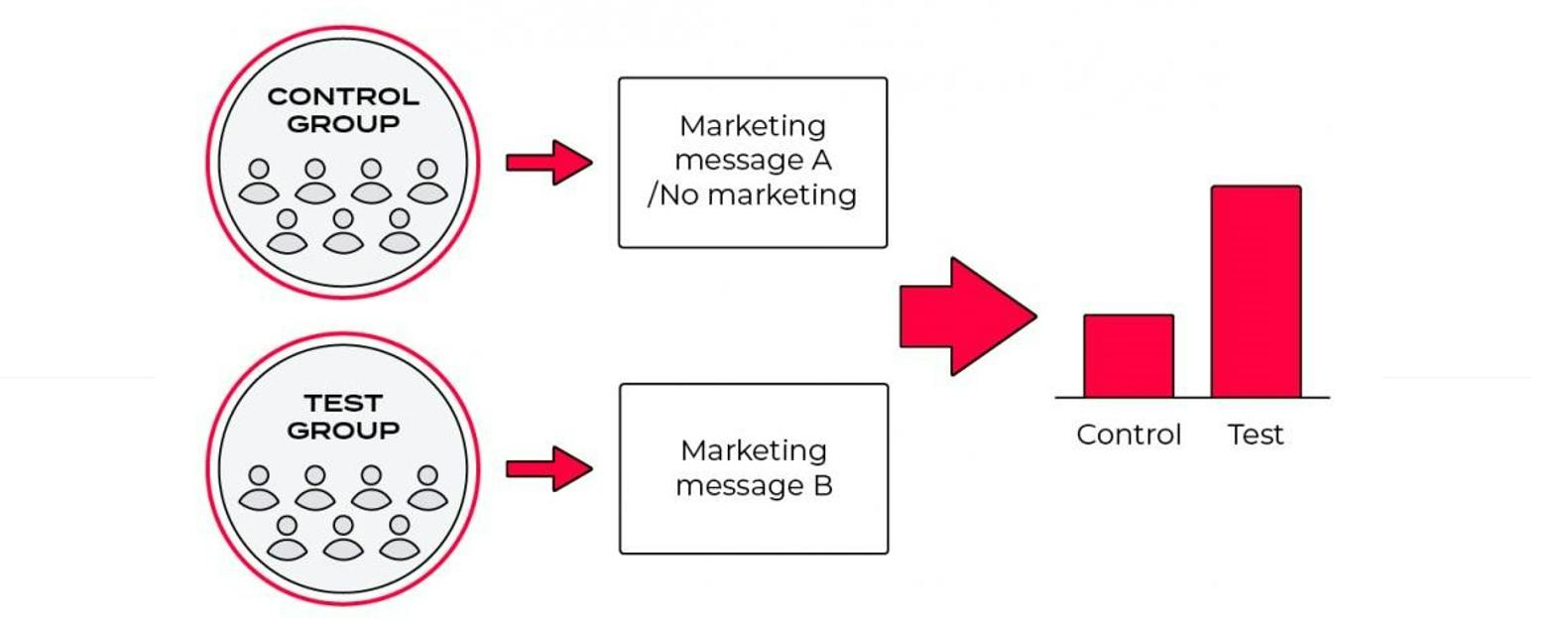
Source: Econsultancy
Incrementality tests in marketing enable the isolation of a variable that is being tested using a control and experiment methodology. Controlled experiments can be conducted while a campaign is running to track how a particular variable, such as website visits or ad views, affects conversions. They have often been used alongside econometrics and attribution modelling to isolate the impact of a marketing campaign and drill down into areas of detail that the models cannot, otherwise known as measuring the true impact or ‘incrementality’ of a particular marketing activity.
A number of interviewees highlighted the value of adding experiments and incrementality tests to the blend of approaches used to understand how a company’s marketing is performing, and then being able to adjust budgets accordingly.
Using incrementality testing to better understand where additional value is being generated
Go-MMT is one of India’s largest online travel providers and is the parent company of multiple hotel and travel brands. Due to its reliance on last-click attribution, the company was struggling to measure the true impact of its advertising and determine its highest-performing advertising platforms. In order to make data-led budget decisions, the company specifically wanted to compare the performance of its mobile-centric app install campaigns on Meta with the performance of campaigns on another publisher.
Go-MMT adopted the incremental measurement approach outlined in Measure to Grow, a report from Meta and the Boston Consulting Group.[75] The report revealed that companies in India who were adopting measurement based on incrementality were unlocking additional business growth.
Working with a marketing analytics company and Meta, Go-MMT set up an incrementality-based geo-lift experiment to measure their app downloads. The study involved twenty-three cities: the control group was made up of twelve, leaving the remaining eleven in the test group. The test group was further divided into three groups, Meta ads were shown to the first group, ads from another digital channel were shown to the second, with the third group being shown ads from both Meta and the other channel. The cities in the control group were not shown any ads.
As a result of the geo-lift experiment Go-MMT were able to see the true incremental impact of its app install campaigns and compare performance across platforms. A key finding revealed that Meta outperformed the other channels, delivering an 8% higher incremental lift for app install campaigns on Meta technologies.
The analysis has allowed Go-MMT to introduce geo-lift as a common method of measurement across platforms, and to continue to measure the incremental performance of its campaigns.
Go-MMT / Facebook[76]
5.7.1 Using controlled experiments and incrementality tests
Consideration needs to be given as to how to create a robust test and control group, particularly in an environment where third-party cookies and device IDs cannot be depended upon to create these discrete groups. In order to create valid test and control cells there must be enough people in a given group to account for any anomalies in the data, so that it is more likely any uplifts were not due to chance but instead a direct result of the marketing message the test group has been exposed to. Statistical significance can easily be checked through online calculators,[77] which offer an easy method of ensuring that any one isolated group is of a large enough sample size to be representative of the wider population.
Types of experiments a company can use include brand lift studies, conversion lift studies, A/B tests and geographical experiments. A/B testing could involve groups of existing customers where first-party data is available to target ads or emails to different groups to assess the impact. A geographical experiment takes two regions with similar makeups and conducts a test where marketing is switched on in one and off in the other.
There are also opportunities to do controlled experiments in partnership with publishers and platforms that have access to first-party data, such as Facebook and Google. Roxane Panopoulos, Group Manager of Regional Measurement & Insights – Netherlands and Nordics at Snap, talks about the platform’s focus on geographical lift measurement as an option that works well for them. “One of the challenges for a platform like Snapchat, where typically share of voice is low – i.e. our share of spend as part of total digital is relatively low – is that smaller platforms like ourselves are harder to measure using traditional approaches like MMM when looking at overall impact. This means that, in some reporting tools, the amount attributed to our platform is often underrepresented in driving a conversion. Conducting a geographical lift study can help a company to determine incremental sales of using Snapchat.”
5.7.2 Benefits and challenges of controlled experiments and incrementality tests
Experiments are a very valuable tool as they allow businesses to determine the incremental impact of specific marketing activities.
Delivers robust tactical insight. Controlled experiments can deliver robust, yet tactical insights that can help a marketer as they run a campaign. Overall, controlled experiments are considered one of the best-in-class options to those seeking to measure.
Incrementality tests can highlight where additional business value can be gained
Jewellery company Pandora wanted to conduct a series of tests focused on incrementality to determine the additional business value generated as a direct result of a marketing campaign or media exposure. A key priority was to assess the effectiveness of a full-funnel strategy and identify best practices.
The results revealed that after three weeks a full-funnel approach surpassed a performance-only approach. Based on this, a cross-regional strategy was identified for Facebook’s platforms where they ran awareness campaigns targeted to broad audiences and optimised for either reach or brand awareness.
The work highlighted the benefits of incrementality-based studies and showed what was highly effective for the brand was adding awareness to performance activities. As a result, Pandora made lasting changes to its budgeting, testing, campaign targeting and media mix strategies to help to drive reach and efficiency.
Results revealed that executing a full-funnel strategy achieved a 73% lower cost per incremental conversion and a 148% increase in reach. When bidding for broad audiences compared with interest-based audiences this led to a four-times increase in the size of the retargeting audience with a 60% lower cost per incremental conversion. As part of Pandora’s paid social mix Facebook’s efficiency increased by three times.
Pandora / Facebook[78]
Requires resource and time. The need to have valid test and control groups can be challenging both from a practical and resource viewpoint, as it can be either costly or time-consuming, or both, to get robust test and control groups where companies do not have easy access to data sources. For example, an online retailer will have access to first-party data as a result of purchases made by customers. An FMCG or pharma company that is selling through a third-party will not have access to first-party data sources, except where they have started to build these up through their own marketing initiatives or by expanding into direct channels.
Lacks the long-term picture. Controlled experiments give a great snapshot in time as to the effectiveness of the campaign in question but do not address some of the longer-term brand impacts.
Requires a valid test and control cells. To truly understand the impact of the marketing that is being undertaken, each iteration of the marketing message needs to be tested independently. It is possible to create a few different test cells to understand more than one of these iterations at a time, but only within the limitations of keeping a good enough sample size to ensure the test is statistically significant.
Does not scale easily and quickly, especially if using multiple channels. However, it can be good when being combined with other solutions such as marketing mix modelling.
5.8 Attention-based measurement
Attention-based measurement is seeing renewed interest in recognition of the fact that treating all impressions as equal is not really reflective of the truth of customer behaviour. This is supported by a study from Teads, which found that attention is three times better at predicting outcomes than simple viewability.[79] Over a third of marketers (37%) in Econsultancy’s Future of Marketing report indicate they are either using or considering this an alternative form of measurement to using third-party cookies.
Attention has always been at the heart of advertising, but technology means brands can now look beyond traditional metrics around reach and viewability to understand their audiences in new ways. In 2022, a number of big ad agencies developed and scaled their own attention models, as brands around the world turned to this as a measurement option.
Heineken was one brand who developed its first globally tested attention measurement campaign in 2022.[80] According to the brand’s director of consumer connections in Brazil, Fernanda Saboya, attention metrics offered a more “qualified vision of impact” compared to previous measurements.
5.8.1 Using attention-based measurement
There are two main approaches to attention-based measurement:
- Attention metrics: Measured by JavaScript tags on live campaigns, such as scroll rate and interactivity (including volume up/down, clicks or length of time the ad is in view, to name a few).
- Attention data: Gathered from panels of opted-in consumers where eye-tracking software is deployed to gather data on what people are looking at, and therefore paying attention to, when consuming media. This data is then used (in combination with other datasets such as survey data and data from tags, as above) to create models to give attention norms to different advertising channels and formats.
The first approach allows marketers to go beyond the usual basics of measuring a campaign, such as if the campaign is merely ‘viewable’ (in other words, if the activity has the opportunity to be seen by a consumer). Instead, it uses more data points to understand if the campaign caught the attention of the target audience.
The second approach allows marketers to get some cross-channel insights about the marketing that is capturing the most attention, and to weight their campaigns accordingly. The suppliers of this data offer planning and measurement tools with which to better understand the impact of marketing activity across digital. This approach offers the further benefit of allowing some cross-media measurement, for example measuring the number of seconds an eyeball on average looks at a digital marketing message versus a TV ad.
Chloe Nicholls, Head of Ad Tech at IAB UK, describes how IAB UK’s members have helped to shape a guide for advertisers on attention as a way of understanding consumer engagement.[81] The resources include the IAB’s Attention Definition Matrix, which covers the four main methods used to measure attention (Figure 9).
Figure 9: IAB UK’s Attention Matrix
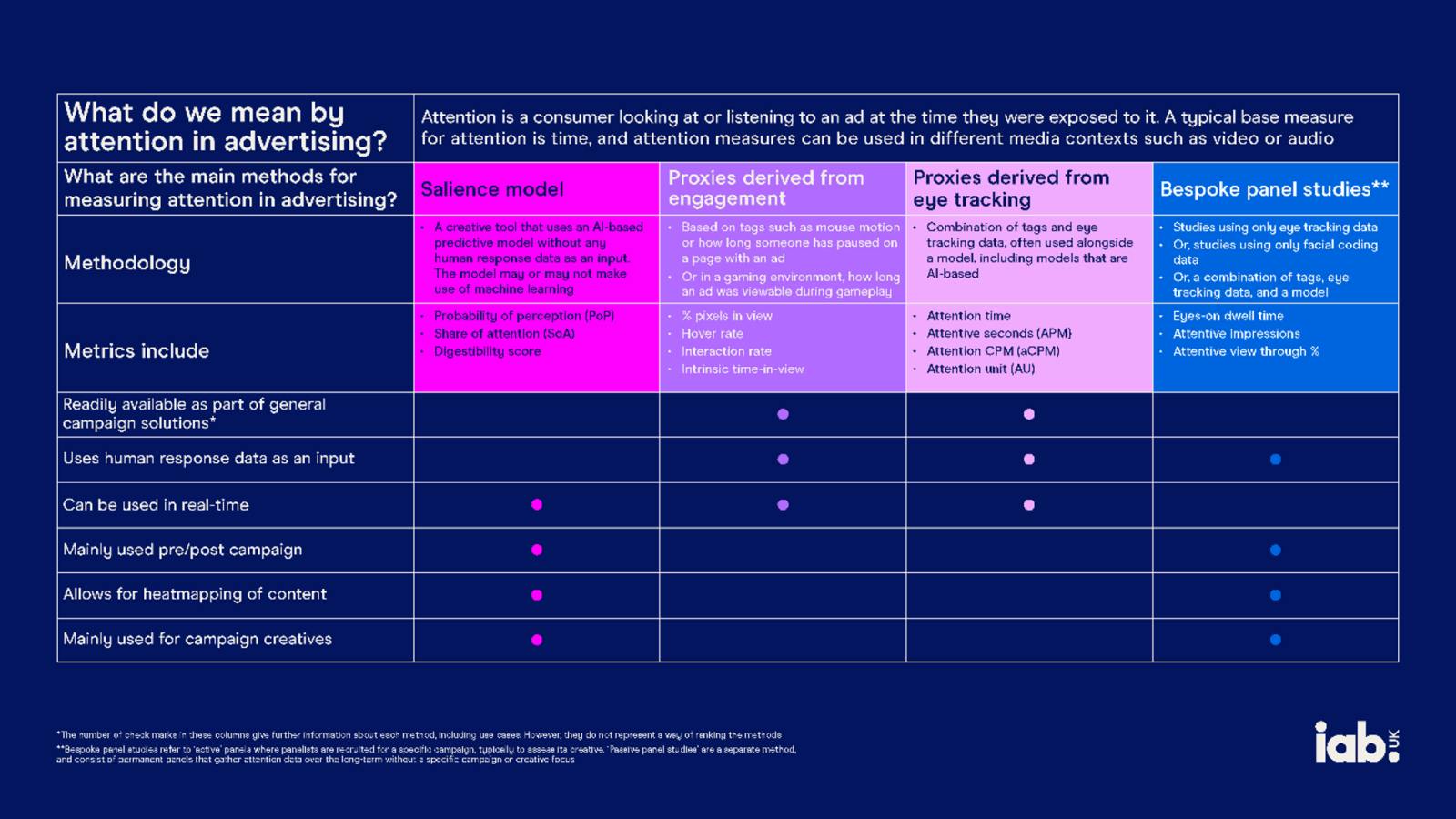
Source: IAB UK
The value in using attention as a metric is one which James Sharman, Northern Europe Digital Acceleration Lead at Haleon, describes they are heavily focused on to measure effectiveness throughout the funnel. Citing a study from Teads that revealed that the further down the funnel a customer goes, the more attention is required,[82] Sharman said: “This is the opposite of what we thought before, because normally we would spend longer on the big brand campaigns as we assumed that once people had heard of us, the purchase would be a relatively easy click. Their report changed the way we looked at campaigns with attention becoming much more of an important KPI for us.”
5.9 Econometrics/marketing mix modelling (MMM)
Econometrics, or marketing mix modelling (MMM), is an approach that brings together data from a variety of sources such as on and offline media, sales and promotions, as illustrated in Figure 10. It can also factor in external influences such as seasonality and the economy.[83] It then applies statistical models to help marketers better understand the impacts of each of these variables on marketing KPIs such as sales or awareness.
Figure 10: Econometrics/marketing mix modelling
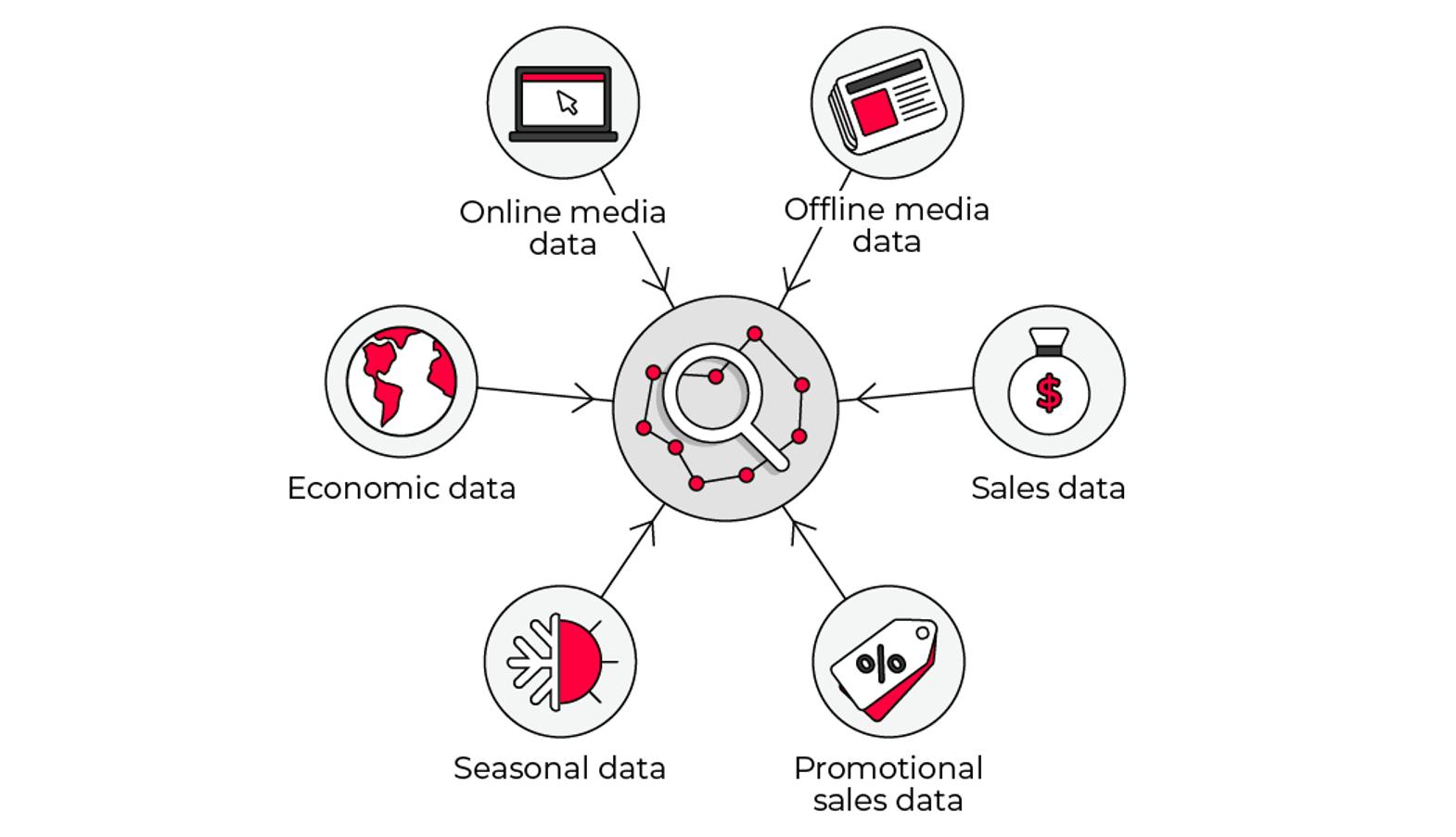 Source: Econsultancy
This measurement approach is growing in popularity, as it one of the methods that depends the least on data collected by third-party cookies, instead pulling in a wide range of data sources. It remains a viable way for marketers to measure the effectiveness of digital marketing, as well as gaining insight into marketing incrementality. The support for this approach is evident from responses to Econsultancy’s Future of Marketing report, where close to two-thirds of respondents (63%) indicate they are using or considering econometrics as an alternative form of measurement.
By bringing together a companies’ offline and online channels in a comparable way to provide an overall view of what is affecting sales, MMM enables companies to make those bigger strategic decisions and provides good media planning input. The importance of this was highlighted by Dr Grace Kite, Economist and Founder of Magic Numbers: “Everything that you get from all the advertising platforms is not comparable because of the different methodologies.” Marketing mix modelling is also an approach that respects privacy regulations.
5.9.1 Benefits and challenges of econometrics/marketing mix modelling
When evaluating econometrics/MMM, key benefits include:
High-level strategic insights. Econometrics by definition includes a broad range of data sources, giving marketers an overview of all the elements of a marketing campaign and providing some top-level indications of what is working most effectively.
Improved trust from a more comprehensive view. A layer of mistrust can often exist around attribution models and how the algorithm has been calculated by a particular platform or publisher. MMM can provide a full view of a company’s budget and the impact, as long as all stakeholders are engaged and provide all the data that could impact the model.
Consider the value MMM can deliver
“MMM is not an if but when you do it, since it has so many benefits. MMM is one of those tools that gives you a read on incremental benefits you get from the market, seasonality, weather, and the impact of these on your sales. It is about using signals to inform the model and about making small correctional changes to your strategy rather than pulling a handbrake on ad spend.”
Gary Danks, General Manager, AIM, Kochava
Improved efficiency from marketing spend. A core output of MMM is a cost-benefit/ROI analysis providing insight into which media channels are the most cost-effective and which should be used more in the future.
Estimate marketing incrementality. MMM can help estimate incrementality, the additional value that marketing brings, since it includes non-marketing business drivers in the models in order to best estimate and forecast total sales.
Marketing mix modelling enables marketers to strategically adjust their investment
“Marketing mix modelling shows the marketer where the influence actually came from, providing a different perspective on the market, rather than relying on last-touch attribution, for example, which doesn’t take account of all the touchpoints a consumer may have interacted with. Touch attribution will also treat a sale the same whether it happened on a Monday or a Saturday, and it will not take account of seasonality, which marketing mix modelling can do.
“Marketing mix modelling gives a marketer that top-down view. It will attribute activity across all of their different online and offline media and take account of external factors that affect sales, whether they’re positive or negative. Marketers can then strategically adjust their marketing investment to allocate it where there’s more influence than maybe they thought they were getting, as well as put the brake on networks where there’s less influence.
“Marketing mix modelling delivers efficiency from a company’s marketing spend, where clients see an improvement in sales of around 17% for the same amount of budget. It’s giving them the insights to make better investment strategies and increase their return on investment.”
Gary Danks, General Manager, AIM, Kochava
However, some of the challenges often raised around traditional econometrics include:
Limited granularity. While econometrics modelling provides high-level strategic insights, it can create more challenges for marketers who are seeking to understand the specific detail of what did or did not contribute to the success of a campaign, by channel, media placement or creative, for example.
Not available to everyone. To implement econometrics effectively, much data, both historic and current, is needed to input into the statistical models. Not every marketer has this data, and even if they do, they may lack the budget to invest in the approach.
Lack of wider understanding. Econometrics models are complex tools that depend on high-level statistical analysis. There may not be the internal skills available to carry out the analysis, which then requires external agency resources.
5.9.2 Using econometrics/marketing mix modelling
It is important at the outset for companies considering this approach to have clarity on the scope of what they want to explore and the key questions to be answered. MMM requires historical data for the analysis and there will be resources required in the data collection stage and for the hypothesis development. In terms of carrying out the modelling, companies will need to determine whether they have skilled data analysts in-house who have experience of MMM, or whether they need to engage the services of an external agency.
Taking a people-first approach to understanding what drives sales
“We promote a people-first approach to measurement. We bring everybody from across the business together to understand what drives sales, what their hunches are, what their knowledge is, and what research have they got already. Then we build that into our models along with marketing and everything else to help explain what is happening.
“We can look at our data and even with a holistic picture get quite granular, which enables a company to get an understanding of performance across their digital channels. For example, this could be around keywords and different bidding strategies for PPC. For social media channels we can provide feedback on the objectives people chose, whether impressions, views or reach.
“We are able to connect the data and look at a time series of data to build a model of sales over time. This enables us to map the trends and variables to understand what’s driving sales at any different point in time and what is working. I see the best value from this type of modelling is for making those bigger picture decisions.”
Dr Grace Kite, Economist and Founder, Magic Numbers
In terms of the frequency of reporting that a company may want, this will again depend on their marketing activity, business priorities, product portfolio, budget and ability to respond to the outputs from the analysis. Interviewees for this report that were using MMM were likely to carry out a minimum of two pieces of analysis a year, with others conducting analysis more frequently.
As a result of technological advances, solutions have emerged for marketing mix modelling which can also provide results on a more regular basis, whether that be daily, weekly or monthly.
Increasing the frequency of marketing mix modelling
“Marketing mix modelling is built on historical data so will need at least a year’s worth of data, but it’s a data science methodology so the more data, the better. This includes whatever a company’s KPIs are that they are measuring and optimising against at that moment, as well as sales, cost and ad spend data.
“We then have access to econometrics such as seasonal data, elections, sporting events which can all have an impact on a brand’s sales activity. The data is then injected into the model. Sometimes our clients also have market intelligence data as well as competitive data that they’ve got access to, which can be used in their model as well.
“With our product, we pull in the data every day via APIs, and then we refresh the model and publish the results every 24 hours, so our clients always get the most up-to-date data and insights. Whilst we pull data from a company’s attribution platform, we only work at country level. We look at their total sales for the UK – for example, their sales funnel could be something like installs, first-time purchase, total revenue, second purchase etc. – and we model all of the sales funnel.
“If the data is good, we can get our model to an average of 95% accuracy over a two-week forecast. In comparison, when we modelled last-touch attribution, the same system could only get to a 30% accuracy over a two-week forecast, meaning for a company using last-touch attribution data for measurement, their model had a 70% error rate over a two-week forecast.”
Gary Danks, General Manager, AIM, Kochava
A key reason many companies are choosing to use marketing mix modelling is its ability to provide context and help answer the ‘why’ behind changes in sales, particularly if campaigns run across a number of channels. Dr Grace Kite, Economist and Founder of Magic Numbers, provided some example case studies across different sectors where MMM had helped answer some key questions.
Table 2: Use cases for marketing mix modelling
| Sector and challenge | Analysis and solutions |
| Online retailer wanted to understand how to combat slowing growth and falling margins. |
|
| Financial services client with a multiple product portfolio wanted to understand how to balance their budget across the portfolio to drive overall profitability. They wanted to test whether there was an opportunity to test stronger weights on above-the-line activity. |
|
| Subscription services company recognised their category was changing and their traditional tactics needed to evolve. |
|
Source: Magic Numbers
It is important for companies considering this approach to be clear on the questions to be answered by the analysis. Working with agencies can help to formulate these. As well as deciding whether this measurement approach is the right one, companies should carefully select the agency/consultancy they work with if they choose to collaborate with an external partner. In a letter published by 17 senior and well-respected specialists with deep expertise in marketing mix modelling, including Les Binet and Dr Grace Kite, the authors provided advice for companies when evaluating suppliers to ensure the solutions being considered are not too simplistic and are properly adapted to the specific business being analysed. They outlined a series of questions to ask, and recommended seeking three quotes.[84]
Applying the learning: Key questions to ask when evaluating a marketing mix modelling approach
- Does the model include factors like price, economy, seasonality, covid? Will the supplier report on how these things affect the business?
- Does the model cover at least two years of data, preferably three?
- Does the supplier measure how upper-funnel ads like TV and YouTube affect outcomes in lower-funnel ads like PPC?
- Will the supplier share advertising response curves with the company’s media planners?
- What happens if the results come back and the company doesn’t believe them, say, because they don’t line up with something else they know?
- Will the supplier be able to explain the model to a company’s finance people? Will their numbers line up with those from finance?
- Could analysts who understand regression look under the bonnet at the model and all the tests and carry out statistical due diligence?
- Can the supplier demonstrate to the company that the models are good at forecasting?
Magic Numbers | Beware Misleading MMM[85]
6. Choosing a Digital Marketing Measurement Approach
There are many approaches available to marketers to consider when choosing a methodology for marketing measurement, from those that rely on econometrics modelling to brand studies, controlled experiments, and partnerships where brands work with other parties to understand the performance of campaigns. The impact of the decline of third-party cookies and device IDs has had a direct impact on many of the measurement approaches which have been covered in Section 5. Table 3 provides an overview of these.
Table 3: Overview of how the decline of the third-party cookie and device ID impacts digital marketing measurement approaches
| Measurement approach | Impact of the decline of third-party cookies and device IDs | How challenges can be countered |
| First-party and zero-party data | Not impacted. | |
| Attribution modelling | Multi-touch attribution models which rely on third-party cookies/device IDs to bring in data about the user’s customer journey will no longer be possible. . |
Last-touch attribution is still possible but this will not take account of other channels a user has engaged in. Google offers data-driven attribution modelling and its Privacy Sandbox will offer an Attribution Reporting API. Custom attribution can be developed based on machine learning predictive attribution modelling. |
| ID-based solutions | IDs need to be created either with the consent of the user or at an anonymous group level based on interests. A key challenge is scale with multiple parties required to share user data. | Only use IDs that are based on first-party or second-party data sources. The IAB UK has details on different types of addressable solutions which include linked audiences, browser or operating system linked audiences and unlinked first-party audiences. |
| Data clean rooms | Clean rooms become more useful as they offer a way to match and anonymise first-party data with second-party data and to measure cross-channel. | |
| Data partnerships | Not impacted since it uses first-party data given with consent. | |
| Brand studies | There will be challenges with creating exposed/control groups that rely on third-party cookies/device IDs to define who has or has not been delivered the ad. | Create control/exposed groups out of tests, or by using zero-, first- or second-party data. |
| Panel-based methodologies | Not impacted. | |
| Controlled experiments and incrementality tests | There will be challenges with creating exposed/control groups that rely on third-party cookies/device IDs to define who has or has not been delivered the ad | Create control/exposed groups out of other data sources e.g. geographic tests or by using zero-, first- or second-party data. |
| Attention-based measurement | Not impacted. | |
| Econometrics/marketing mix modelling (MMM) | Mostly unimpacted unless the model depends on appended digital data from third-party cookies/device IDs (usually via a multi-touch attribution model). . |
Check with the econometrics provider that they do not append third-party-dependent multi-touch attribution models into their product, and where possible incorporate zero- or first-party data for granular insights. |
6.1 Aligning the measurement approach with the business and objectives
There is not one approach that will suit everyone. Companies should look to determine what approach is most suitable for their business and objectives. There are a number of questions companies can ask to help identify which might be the most appropriate measurement approach to suit their needs and whether they should consider a blend of approaches. Consideration will also need to be given to the budget required, particularly if a number of different techniques are used.
Apply the learning: Questions to ask to determine which measurement approach is most suitable
- What are the campaign objectives and KPIs?
- How much money is being invested in marketing activities, and how does this compare to how much money is available for measurement and testing? Does this reflect sufficient budget in terms of the proportion of investment in marketing activities?
- What data sources are required for the approach and how can the data be further enhanced from other sources e.g. data partnerships?
- Does the approach require historical data for analysis and how much data does the company have? (MMM requires a certain amount of data to work with, typically a minimum of two years.)
- How many media channels is a company using? (If only using one channel, then MMM might not be suitable, but if considering using TV, that can be a key driver towards using MMM.)
- How many campaigns are being run a year? (If only one campaign, MMM might not be suitable.)
- Can the chosen measurement method scale in proportion to spend?
- Can the model be validated through robust testing?
6.2 Adopting a hybrid and blended approach
It is clear from talking to brands and agencies that many companies are adopting a blended approach to get a better understanding of what is working.
A blend of techniques can provide us with deeper insight
“We use MMM to provide us with good media planning input, but we then use brand lift studies for our more tactical digital campaigns to make sure that we’re effective with our claims and creative. If we’ve got a hypothesis which is fairly small, we will usually do some kind of control experiment and shut off a geography, for example, so we can test different claims.”
James Sharman, Northern Europe Digital Acceleration Lead, Haleon
The challenges around attribution have led companies to adopt what Google refers to as the ‘trifecta’ approach, with this being hailed the ‘golden trinity’ framework. As described in an article by Marketing Week,[86] the ‘trifecta’ is where organisations combine experimentation, econometrics and short-term digital attribution to assess marketing effectiveness.
This blended approach is backed by Les Binet, Group Head of Effectiveness at adam&eveDDB,[87] among others, who describes it as the optimal blend of marketing effectiveness evaluation approaches. Google, in its 2019 report on measuring effectiveness,[88] highlighted that one of the ‘Three Grand Challenges’ was to successfully combine these complementary methods.
“As companies move away from third-party cookies in general, looking at marketing attribution on its own is taking a back seat,” observes Marina Peluffo, Head of Business Intelligence at Prima. “Instead, companies are shifting to a more holistic view that MMM can bring, and then they are validating what they see from the MMM studies through A/B testing and adopting a triad of techniques around measuring marketing effectiveness.” An illustration of this is shown in Figure 11.
Figure 11: Integrated triad approach to measuring effectiveness
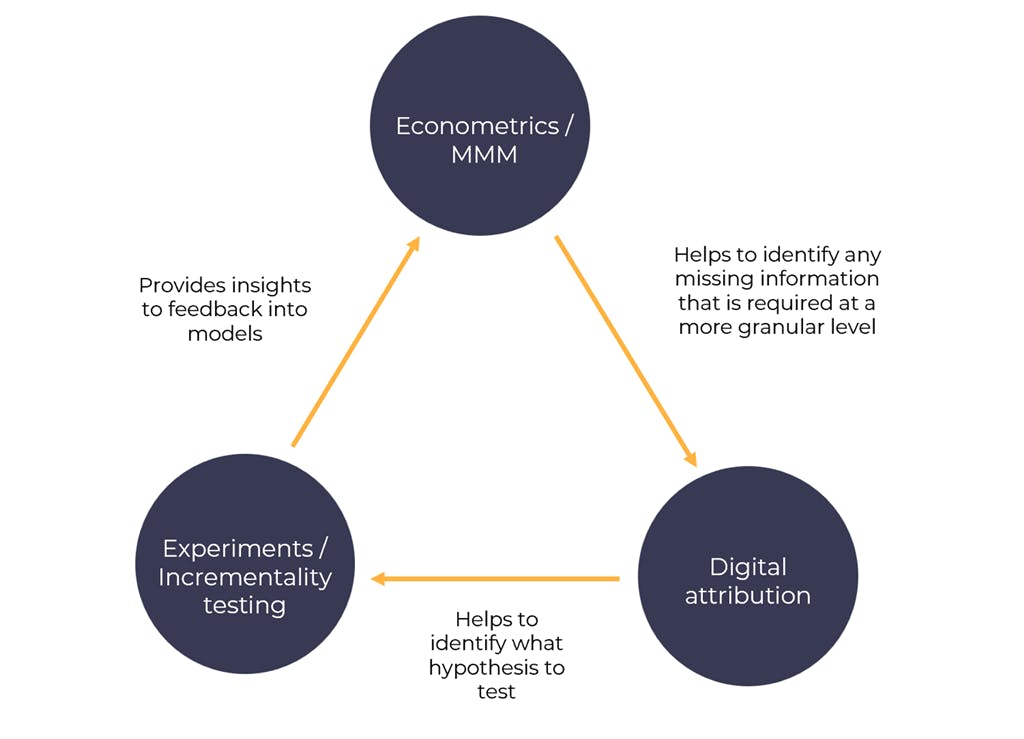
Source: Econsultancy
Adopting the concept of an integrated and blended approach to marketing measurement enables companies to work towards gathering a complete understanding of the landscape and how they are performing.
Adopting the measurement trifecta
“The first pillar of the trifecta is the marketing mix econometrics model. At Sky, we use the econometric models as our baseline view for all our media investments across all products and marketing channels. These studies are look back impact analysis, and it takes at least a quarter to present the recommendations as it needs input from offline media and other external sources which is not available in near real time.
“Digital marketing performance reporting is near real time as opposed to other media, which means measuring the effectiveness of investment in digital marketing requires investment curves which are near real time. So, we build additional digital investment curves in parallel with the econometric investment curves to allow for in-quarter optimisations and scenario planning.
“Econometrics can’t deal with the incrementality of granular activity like individual partners within a plan, or campaigns within a media channel. To solve such challenges, we employ the second pillar of measurement – media testing. The golden standard in media experimentation is geo-lift studies which remain our primary tool for all strategic questions, but we also use other forms of media testing, like at customer level, cookie level, or session level, depending on the hypothesis we are trying to prove. Typical questions include whether a technology, partner, activity or tactical change has been incremental in opening new headroom, driving media effectiveness, or delivering incremental sales.
“Finally, the third and last pillar is platform attribution. Unlike the first two pillars it can’t measure incrementality of media but analysed over time, this is a good measure of shift in effectiveness of digital media, though the loss of cookies poses a challenge to its accuracy, and newer techniques/technology will soon replace the traditional attribution measurement.
“Measuring incrementality is the only way one would know what the return on media investment is; the first two pillars of the trifecta are great at it, but they take time while platform attribution is near real time but is only directionally correct. This challenge is overcome by using the relationship between incrementality measurement and platform attribution thus helping us measure the incrementality of digital media in near real time.
Previously, we used to say that incrementality testing feeds into econometrics to improve their accuracy. However, in the current day and age when everyone in the industry is experimenting, it is a two-way dialogue between media testing and econometrics. Econometrics learns from media testing results, and media testing needs to apply econometric principles when isolating impacts. The trifecta of measurement has helped Sky ‘right size’ its digital media investment and isolate what is driving effectiveness.”
Kumar Amrendra, Head of Digital Marketing, Sky UK Ltd
The benefits of adopting a blend of techniques are being seen by a number of companies. This was a point made by Sage in Marketing Week and Kantar’s Language of Effectiveness report in terms of gaining insights into short- and long-term effectiveness. “It’s pretty complex – you’ve got a lot of data points and it takes time to build them. But if you can get that right, blending those three approaches allows us to improve what we do over the long- term and allows us to yield the most insight to inform our marketing decisions going forward.”
Mauricio Ferreira, Marketing Effectiveness Lead, at Confused.com, further supports using a combination of techniques to get a better picture of effectiveness. “We use three main sources of truth for marketing measurement and triangulate as many sources as available for each channel, from econometrics/MMM (via agencies); geo-tests (both agencies and in-house) and digital attribution/MTA”. This approach provides clearer results for Confused.com.
Combination of channels provides clear results and greater confidence
“We have explored multiple approaches, such as launching new channels using geo-tests and combining the results with econometrics. With clear results from two different methodologies, we managed to get buy-in from the senior leadership and invest further in those new channels. Also by re-evaluating current channels using a similar combined approach (econometrics plus geo-test), we were able to demonstrate to senior stakeholders that we are also assessing the effectiveness of the current channels on an ongoing basis.”
Mauricio Ferreira, Marketing Effectiveness Lead, Confused.com
Research carried out by Google and Kantar looked at developing a marketing effectiveness framework and reinforced the view that there is no single silver-bullet solution for measuring marketing effectiveness.[89] The research identified three stages of marketing effectiveness maturity: ‘establishing’, ‘developing’ and ‘advanced’.
Three stages of marketing effectiveness maturity: ‘Establishing’, ‘developing’ and ‘advanced’
Advanced organisations were found to embrace a blended approach in order to achieve a holistic view, and on average they used twice as many effectiveness evaluation methods as establishing organisations. The research also confirmed that marketing effectiveness maturity is driven by the golden trinity, with controlled experiments being the last method typically to be adopted by advanced organisations, alongside digital attribution and econometrics.
Advanced organisations are also integrating brand measurement to evaluate lasting effectiveness in order to plug a perceived gap in the trinity. This is a reflection of the importance of long-term marketing impact which advanced organisations are five times more likely to believe in, when compared with establishing organisations, and they are two times more likely to integrate brand measurement into their effectiveness ecosystem.
The research demonstrates that ROI has a constructive role to play, but this relies on being used in combination with other meaningful metrics. For establishing marketers ROI is the primary metric used, but as organisations mature, they become less reliant on ROI, instead using it alongside KPIs such as media-driven commercial metrics (revenue, profit), delivery metrics (reach, frequency), performance metrics (CPA, CTR) and brand metrics (awareness, consideration).
Marketing Week | Three Steps to a Marketing Effectiveness Framework[90]
Gabriel Hughes, CEO and Founder of Metageni, describes how the agency’s clients are increasingly having to rely on a fragmented picture supplied by ad platforms and are struggling to reconcile numbers. This has led to an increased demand for custom measurement solutions and services. In response, Metageni uses “hybrid approaches combining elements of predictive multi-touch attribution and market mix modelling, based on a brand’s first-party data, in a custom approach.” This approach is described in detail in an article written by Hughes, which discusses how together these techniques are complementary, providing both a strategic and tactical view of a company’s marketing.[91]
Adopting hybrid attribution
“Our approach is to only work with a client’s first-party data for our custom attribution solutions, combining raw click-level site traffic analytics with transaction data and marketing platform data. This is used to train machine learning-based attribution models. Each one is entirely unique to each brand, and leverages customer signals, with different attribution for different customer types.
“We then bake in models of impression effects which are estimated using econometric techniques and reconciled with the attribution data on a daily basis. Again, these models are unique to each client, allowing the upper funnel impacts of social, display and video to drive low-funnel navigational sales via channels like brand search, organic brand, affiliates and of course direct. This way, the analysis is as robust as we can get, and the numbers add up.
“The model’s predictive accuracy is transparent and tracked daily, so we will retrain models when accuracy falls below an agreed threshold.
“With digital data granularity, it is possible to do all this with historical data of just a few months if the sales volume is there, making this a viable option for most major consumer brands online.
“Brands with significant marketing are well advised to run both expert-led MMM and custom attribution in combination, as well as consider an experimental framework to validate new marketing tactics for both strategic and tactical decision-making.
“An example of a customer adopting a hybrid custom approach was Toolstation, one of the UK’s fastest growing providers of tools and building materials. They identified online revenue opportunities of 7.5% of total revenue from paid digital channels, across the trade and DIY business. Analysis revealed that an additional 29% of conventional branch sales occur following online research, supporting the optimisation of the online marketing activity as being crucial for Toolstation. Deploying marketing mix modelling unveiled +18% ROI opportunities which were used to optimise their 2022 budget ahead of the ecommerce downturn that year.”
Gabriel Hughes, CEO and Founder, Metageni
6.3 Evaluating the success of a measurement approach
Having chosen a measurement approach, it is then important for a company to have confidence in their decision and identify ways in which to improve its effectiveness.
“Determining the effectiveness of new measurement approaches, especially in the context of integrated channel performance and attribution, is crucial,” says Amy Blasco, Partner of Enterprise Data, Experience and Marketing Lead at IBM. She has set out some key signals companies can look for when evaluating new approaches.
Evaluating the success of new measurement approaches: Key signals
- Consistent and predictable ROI measurement: There should be a clear connection between marketing spend and the resulting return on investment (ROI). A successful approach will help marketers make decisions that consistently yield a positive and predictable ROI.
- Granular channel insights: A successful methodology will provide granular insights into how each channel is performing.
- Decreased cost per acquisition (CPA): Over time, as the accuracy of the measurement method improves, marketers should observe a decrease in CPA, as they can now allocate budget more efficiently based on precise channel performance.
- Improved customer lifetime value (CLTV): An effective approach not only focuses on immediate conversions but also on long-term engagement. A rise in CLTV would indicate that the approach helps in retaining and nurturing customers, thanks to a better understanding of the integrated channels.
- Feedback loop and continuous learning: As campaigns are adjusted based on insights, the subsequent performance should inform the next set of decisions. Continuous learning and iterative improvement are signs of a successful approach.
- Integrated view across channels: A successful approach will reveal how channels influence one another. For instance, did a user see a YouTube ad before clicking on a Google Search ad? Understanding this cross-channel interplay is crucial for integrated marketing.
- User engagement and retention metrics: Beyond just acquisition, understanding how engaged and loyal customers are is crucial. An effective measurement tool should provide insights into metrics like churn rate, session length, and repeat interactions.
- Positive market comparisons and benchmarks: Compare the performance metrics with industry standards or competitors using similar approaches. If your metrics are favourable in comparison, it is an indicator of an effective measurement and strategy.
- Positive stakeholder feedback: While data is crucial, feedback from stakeholders, like sales teams or customer service, can provide qualitative insights. If they report better lead quality or improved customer interactions, it corroborates the data-driven insights.
While adopting newer methodologies for measuring digital marketing effectiveness, it is crucial to maintain a balance between quantitative metrics and qualitative insights. Over time, the consistent achievement of key performance indicators, combined with positive stakeholder feedback, will validate the success of these.
Amy Blasco, Partner, Enterprise Data, Experience and Marketing Lead, IBM
6.4 Using AI and machine learning to support measurement approaches
As technology continues to advance and data capabilities develop at pace, there are even more opportunities for how artificial intelligence (AI), machine learning (ML) and predictive analytics can support measurement analysis and empower data-driven decision-making and marketing activity.
Providing a multidimensional understanding of audiences
“We’ve recently witnessed the ability of machine learning to analyse online consumption patterns across billions of data touchpoints, providing a multidimensional understanding of audiences. This allows marketers to anticipate shifts in behaviour, interest and intent, rather than reacting to stale data.
“Attention is a great example of a metric that is gaining momentum thanks to advances in ML, combining real human data points with modelled data to provide us with a better understanding of user engagement.
“Moreover, AI and ML can be used to uncover which elements of a campaign are driving success or holding it back through advanced measurement capabilities. This provides marketers with a deeper understanding of their audiences and campaigns, enabling them to optimise their decision-making and implement strategies that deliver against key metrics.”
Chloe Nicholls, Head of Ad Tech, IAB UK
One of the biggest pain points with marketing mix modelling historically has been around data collection, but this has been improved through big data capabilities, better tracking and the ability of AI and ML to support the analysis of big datasets. “I see this as creating an environment that is more conducive to performing marketing mix modelling and companies are also developing their own teams and talent in this area,” says Marina Peluffo, Head of Business Intelligence at Prima.
There is also a need to ensure that calculations are not too simplistic and that they take account of the business and the context in which it operates, along with any factors influencing this. This was a point made by Gabriel Hughes, CEO and Founder of Metageni, who highlighted it was key to ensure models using AI and machine learning be tested for their accuracy.
Using AI and machine learning for modelling and predictions
“The ability to quickly deploy these models, and get high accuracy, has increased massively in recent years. We employ our own optimisation using a genetic (evolutionary) algorithm to help discover the best model. We also test new models of ‘holdout’ data, which is data the model is not exposed to in advance, to ensure high standards of data science best practice. Model accuracy is tracked for each client so we can retrain models as and when model accuracy changes.
“Recently we have also been exploring the use of the new generative AI capabilities to support our live Report and Insight platform, which we call ‘Creating Data Stories’. The main blocker is that brands do not want to share their first-party data with the big AI platforms, so any generative language models need to be hosted and sandboxed independently, for each client. But this work is progressing well and the potential is huge.
“Finally, we see huge potential in predicting how customers will behave to target potential buyers. We ran a successful project with AO doing this in 2020, which won us the ‘Best Use of AI’ award in the Ecommerce Awards that year. We are taking similar approaches with our other clients as the predictive capability continues to improve.”
Gabriel Hughes, CEO and Founder, Metageni
7. Developing an Effectiveness Framework
Selecting the right measurement approach will come down to a company’s strategy being aligned with its measurement approach. Regardless of the approach selected, there are some key drivers that will support its success. This includes senior level support and sufficient resources, with teams working together across the business towards clear KPIs and goals. Companies should develop an effectiveness framework to support their measurement approach, one that is grounded on solid data foundations and a culture of test and learn.
7.1 Secure senior level support and nurture a culture of effectiveness
To move beyond a tactical view of performance, it is important for companies to have senior level support in order to build an effectiveness culture that combines techniques for short-term tactical optimisation with longer-term strategic goals.
Building an effectiveness culture requires silos to be broken down and for there to be alignment between marketing and other parts of the business on how marketing effectiveness is assessed. In particular, trust needs to be built with finance teams through accurate forecasting of longer-term outcomes, supported with more frequent reporting of short-term metrics that align with these.
Direct Line Group has won two IPA Effectiveness Gold Awards. Describing the key drivers to the company’s success, Ann Constantine, former Head of Insight, Marketing Effectiveness and Customer Experience at Direct Line Group, highlights how this has required long-term commitment across the organisation, a focus on finding the right talent, working with agency partners and getting the wider business on board. “The idea at Direct Line is for these effectiveness conversations to be shared with peers across the organisation, who can then feed back.”[92]
Diageo is another organisation that has made its commitment to marketing effectiveness clear, driving a full culture shift within the business. One article describes how the company has created a marketing effectiveness ‘muscle’ and driven through culture change.[93] The business aims to ensure every single one of its marketers understands and uses the tools they have in place. “It’s not a marketing efficiency programme,” says their Vice President of customer value creation and end-to-end commercial planning. “We are not optimising for ROI, we are investing to deliver against our growth opportunity.”
Effectively communicating the success of marketing also plays an important role in gathering support across an organisation, to demonstrate the value of marketing and the role it plays in driving a business forward. However, a concerning finding from Marketing Week and Kantar’s Language of Effectiveness survey showed that 15% of brands say the results of their marketing campaigns are not communicated to the wider company.[94] Yet, in not doing so, over half of respondents (50%) said they feel demotivated when the success of campaigns is not actively communicated with the wider business. There is a clear improvement opportunity to be gained by responding to this. This is particularly the case in the charity sector where it is important to show how marketing is contributing to increased fundraising.
Demonstrate the impact of the numbers with storytelling to gather support across teams
Warren Fiveash, Head of Marketing at the Teenage Cancer Trust, describes how they work hard on the storytelling behind the numbers to demonstrate the impact that campaigns have had both in the short- and long-term.
“There’s a joined-up process in terms of how we plan and then how we make sure we’re communicating our insights across teams, so not just from a marketing point of view, but across all the other teams. We understand what the need is across the organisation, from the frontline and fundraising point of view, and what we need to do to improve our services. Then, how can we help from a marketing point of view to achieve those things?”
Fiveash highlights how it works both ways, as other departments must be clear ahead of time about their needs to ensure they receive the metrics which matter most. Another key point raised by Fiveash is the importance of being open when work has not necessarily gone to plan, in the spirit of learning and creating a culture of transparency. “It’s not about failure, it’s about learning,” he said.
Marketing Week | Why Sharing Marketing Effectiveness is Key[95]
Overall, internal messaging can be crucial in getting the wider business engaged with the effectiveness agenda and approach. Teams should all be working together to understand the impact that marketing has and the role that they play in supporting this, including what they need to do.
7.2 Make the case for measurement resources
Often when companies are looking to make efficiencies in challenging times there is a danger of making cuts or changes to what marketing activities should take place, without the right analysis to guide their decisions. Inadequate funding can mean there is not enough resource to support the effective measurement of performance.
Measurement requires adequate funding
“Under spending on measurement is a false economy, as more money will be wasted through incorrect revenue, margin and ROI attribution than it costs to measure and correct the marketing mix.
“We find brands that spend around 3–5% of their marketing budget on measurement generally achieve savings and ROI gains far in excess of that in return. Companies should take into consideration that it takes time to get a measurement capability set up and develop a proper test and learn process which leverages that capability. But it has to be set up ahead of major risky marketing investments, and not as an afterthought.”
Gabriel Hughes, CEO and Founder, Metageni
To support the case for tools such as incrementality measurement platforms (as opposed to attribution) or cookieless solutions, Kumar Amrendra, Head of Digital Marketing at Sky UK Ltd, suggests companies can assume an incremental efficiency of at least 10%. “If a company puts that back into the context of the bottom-line impact and investment that they have made in marketing, the tools pay for themselves within the year or multiple times within the year, and the benefit outweighs the cost.”
While some solutions such as econometric modelling are more expensive than other techniques, it also comes down to a company assessing the balance between the budget being allocated to marketing activities and what proportion of this is being spent on measuring success.
7.3 Invest in data skills and internal teams
As the technical and regulatory environment in which digital marketing exists continues to change, it is important for marketers to be in a position to respond to these by investing in the right skillsets internally and to be equipped for changes moving forward.
Marketing Week’s 2023 Career and Salary Survey revealed that data and analytics is the most significant skills gap in marketing departments (Figure 12).[96] Bridging this skills gap should be a priority for both individuals and teams.
Figure 12: Has the business identified any skills gaps in the marketing department?
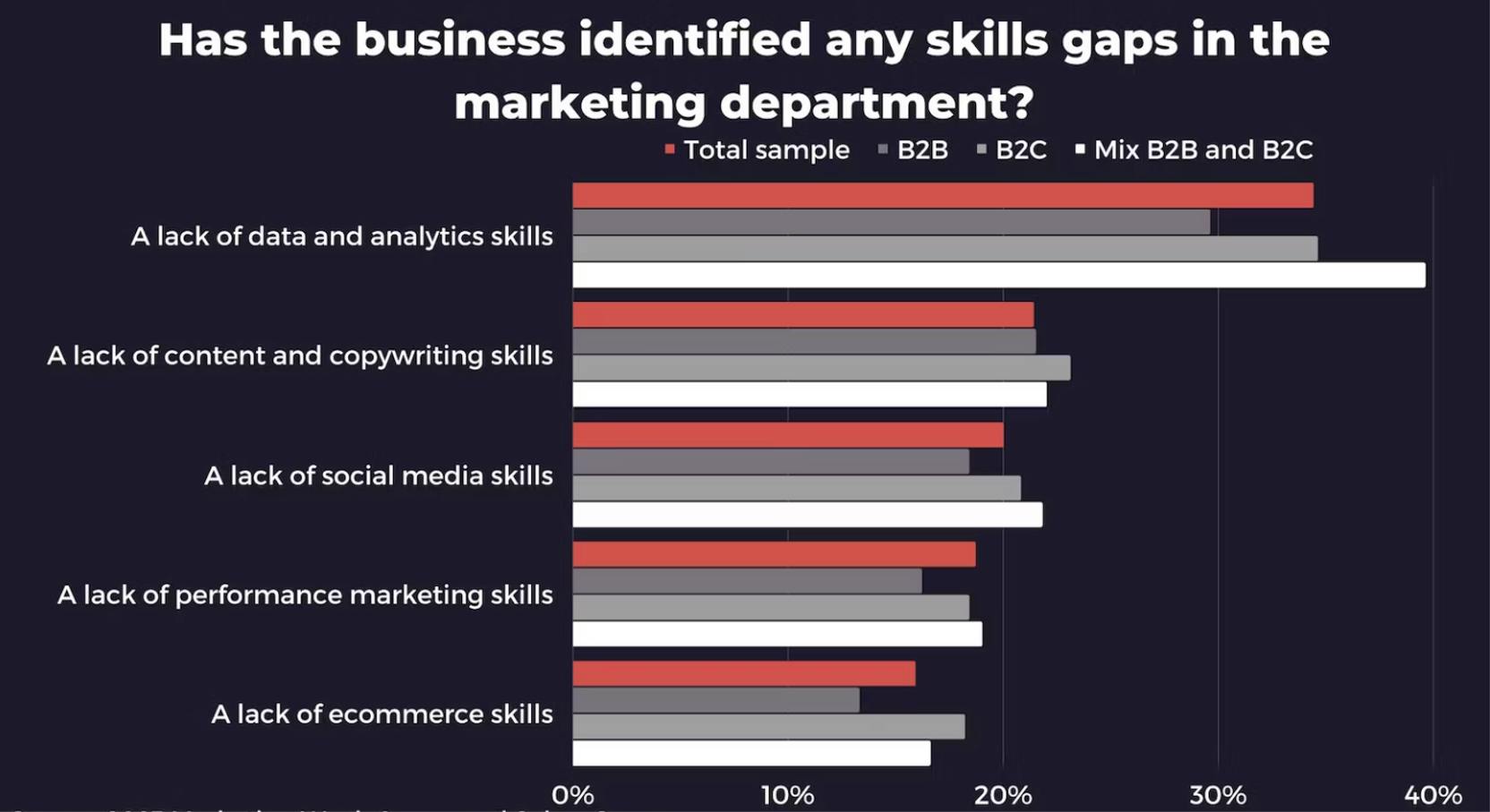
Source: Marketing Week 2023 Career and Salary Survey[97]
Data skills can no longer sit in isolation in research or insight teams. Marketers must train and recruit to ensure that both specialist and generalist data capabilities are represented throughout the marketing function. See Econsultancy’s analytics and data training hub for relevant courses, and the report on Winning the Race for Digital Skills for further guidance.
7.4 Adopt a test and learn approach
It is important for marketing teams to be testing frequently to optimise outcomes. This requires marketers to define what success looks like for the campaign and set clear objectives and KPIs. The importance of doing this was reinforced by the interviewees for this report.
Identify the North Star objective
“Find the North Star objective which focuses everyone around what you’re trying to achieve within that campaign. Secondly, determine what is your hypothesis for a campaign and how can you really learn from it. Even if a company doesn’t have the campaign spend for a brand lift study, you can run A/B tests to understand if people are achieving those high-value actions or not based on your landing pages, or based on the content that you have. Finally, being able to build your first-party data stores is key to understanding effectiveness in the long term.”
James Sharman, Northern Europe Digital Acceleration Lead, Haleon
Be clear on objectives and how they will be measured
“Set specific objectives. Build an understanding of what types of marketing impact on specific types of objectives. Act on that understanding, then measure the specific objectives you set. You want to have a view of whether a campaign cut through and was engaged with or remembered, whether it drove a shift in brand health, and whether that laddered up to an increase in sales. Econometric or marketing mix modelling studies can then help attribute incremental sales to specific activities.”
James Hurman, Founding Partner, Previously Unavailable
Teams should adopt a test and learn mindset and develop habits that help them quickly turn assumptions into validated learning. Beginning with a hypothesis supports this approach. A hypothesis is a statement that aims to explain an occurrence or observation of some kind, but it should be one that is both informed and testable. Having a clear process for testing a hypothesis can help a company deliver a more effective campaign at the outset.
Decide on the hypothesis and experiment
“We have a framework which involves setting out a clear objective and hypothesis, selecting KPIs, optimising creative, and then a test and learn phase to identify what is the experience when a consumer lands on our website and select the measurement factor. This is to determine what are we trying to learn and measure, rather than just looking at the data. One thing we try not to do is change the measurement factor once we’re live with the experiment. We almost lock the campaign charter away and then run the experiment and refer back to our original KPIs to measure whether it has been successful.”
James Sharman, Northern Europe Digital Acceleration Lead, Haleon
Apply the learning: Develop a clear hypothesis to test
Barry O’Reilly’s model for the structure of a hypothesis encompasses three key elements that every hypothesis should have: the idea or theory, the outcome, and the measure by which a team will identify success or failure. For example:
- We believe <this capability>
- Will result in <this outcome>
- We will have confidence to proceed when <we see a measurable signal>
While this hypothesis structure is commonly used in product strategy and development, it is a useful way of framing marketing-related hypotheses. A simple example of a marketing hypothesis set out in this way is:
- We believe that changing the image on the landing page
- Will result in a higher number of onwards customer journeys
- We will have confidence to proceed when we see a measurable uplift in clickthrough rate
Econsultancy | Product Strategy and Marketing Best Practice Guide
Adopting an always-on approach to testing
ASOS is a brand that has adopted an always-on testing programme, and they triangulate a number of measurement techniques to support this. They have a programme using a variety of attribution models to measure attributed revenue and they use an always-on incrementality testing approach. This is based on either a geographic basis, where they’re holding out parts of their programme in certain areas, or where they are using Google’s full-funnel lift measurement.
One example is the ASOS video action campaign in Canada. On the back of this the brand saw a 45% increase in incremental conversion, however as ASOS was measuring the full-funnel impact using search and brand lift, it saw that it had a 200% brand lift in Canada, and a 300% incremental search lift.
Overall, while ASOS ran a performance campaign, because of the thoroughness of their measurement approach, it was able to measure the upper-funnel and mid-funnel impact of that programme. This provided the brand with an integrated marketing perspective where brand and performance merge.
Google | How ASOS is Driving Growth[98]
7.5 Build a solid data foundation supported with the right technology
With any measurement approach, the quality of the data that is used for the analysis, or to train a model, will impact the outputs and the clarity of the picture on what is driving effectiveness. Steven Silvers, EVP of Global Creative and Media Solutions at Kantar, worries marketers do not think enough about the difference the data makes. Silvers notes the importance of data quality as well as data governance: “The ethical collection of data and how it is used needs to be a consideration. That also relates to how vendors have collected the data.”
A solid data foundation enables companies to have confidence in the data that is used for measurement and analysis, and for true value to be realised.
Econsultancy’s Data-Driven Marketing Best Practice Guide describes how a solid data foundation can be built up around three critical elements: collection and storage, governance and cleansing.
The guide further outlines the stages of maturity involved in adopting a data-driven approach across an organisation. A summary is provided below of what is needed in terms of the people and expertise required, the processes that need to put in place, how technology supports this and how it is driven by the right strategy.
Table 4: A maturity model in data-driven marketing
| Basic | Enabled | Advanced | |
| People |
|
|
|
| Process |
|
|
|
| Technology |
|
|
|
| Strategy |
|
|
|
A key attribute of an advanced organisation, in terms of technology, is the ability to integrate data across the organisation. When it comes to collecting and bringing together data, customer data platforms (CDPs) are becoming increasingly popular tools.
A CDP can help organisations bring different data sources across the organisation together in one place, as illustrated in Figure 13. This enables companies to combine their first-party data, behavioural data, along with data from other partners, where consent has been given, in order to build customer profiles with a single unified view across the organisation. The data can then be shared for a number of different business objectives from measurement through to targeting and delivering personalised marketing.
Figure 13: Role of a CDP
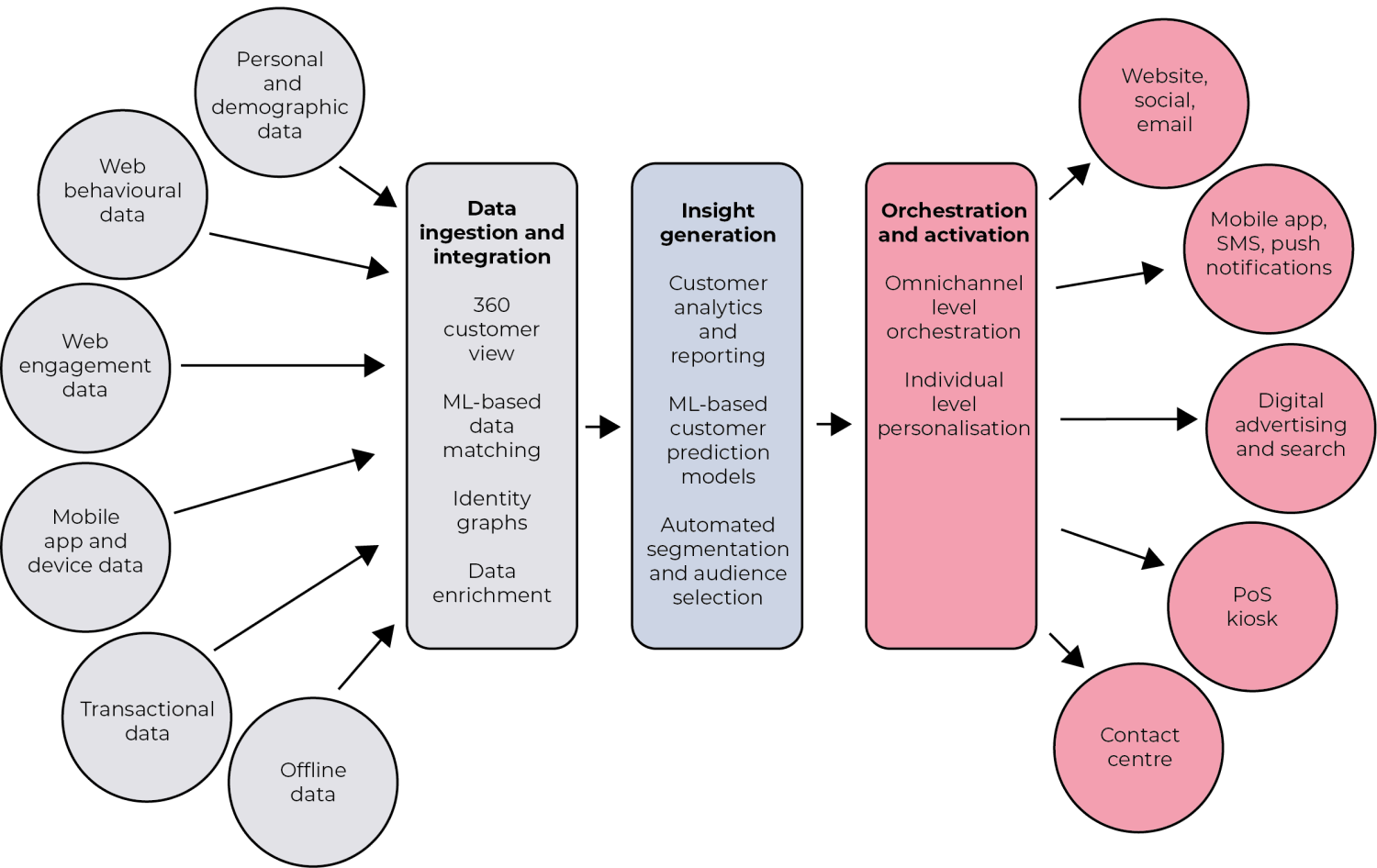
Source: Econsultancy
CDPs also keep a ‘trail’ of where data has come from, providing a record of data sources and a record of where data is passed to. Data known about an individual can also be continually updated. This can help a company ensure compliance against various regulations. CDPs support:
- Data governance: The ability to set rules and policies around data collection, storage and processing, ensuring that data is collected and used in compliance with privacy regulations.
- Data management: Data collected can be managed and controlled, including the ability to comply with any request to delete or anonymise data.
- Consent management: Customer consent for data collection and processing can be managed and tracked, ensuring compliance with privacy regulations.
Companies should focus on building up their own CRM data and bringing all data sources together to create a single view of the customer. To learn more about how a CDP can help support this, see Econsultancy’s Customer Data Platforms Best Practice Guide.
7.6 Invest in first-party data and providing a value exchange
As discussed in Section 4, the technical and regulatory changes in the industry have driven a renewed focus on first-party data and the need for companies to build up their own data sources where customers have proactively shared information. Having access to their own data sources will help a company to establish a solid data foundation, as discussed above. First-party data can then be used to help measure the effectiveness of a company’s digital marketing and drive more effective campaigns through better targeting, personalisation and more relevant experiences.
The value that first-party data provides to companies is evident in the findings from a study conducted by Google and the Boston Consulting Group.[99] The study was designed to look at how companies achieve success using first-party data strategies. It found that companies using first-party data for key marketing initiatives saw an uplift in revenue of up to 2.9 times, compared to those that did not, and saved up to 1.5 times in costs.
To build up sources of customer data, companies should focus on encouraging customers to share their data by providing a strong value exchange. Econsultancy’s Future of Marketing report shows that marketers are still struggling to demonstrate clear value to the customer, with just under half (49%) of marketers agreeing with the statement, ‘My organisation offers a clear value exchange in return for customers sharing their data’. Customers are often willing to share their data if they are provided with something in return for this.
Some brands will have access to more first-party data than others, in particular those in financial services or travel, where data is collected as part of the purchase process or account set up. However, there are still ways for businesses in other sectors, where they may not have a direct relationship with a customer, to collect first-party data through competitions, polls, quizzes, product selectors, etc., and demonstrate a value exchange.
For James Sharman, Northern Europe Digital Acceleration Lead at the consumer health company Haleon, it is about trying to understand the value exchange to give consumers in order to get that first-party data so as then to be in a position to use it elsewhere and drive effectiveness.
Encouraging customers to share their data
“Being a healthcare business, most of what we what we do is around product recommendations, or providing help with different health conditions. A good example of a value exchange to the consumer for their data is our Voltarol Movement Coach, which launched this year. It helps people in pain recover from injuries, offering 70 pieces of content including videos and exercise plans.[100]
Figure 14: Voltarol’s Movement Coach offers a clear value exchange to consumers

Source: Haleon
“People can complete a quiz and input details about their pain in order to receive a personalised movement plan. It’s a great piece of content, which is totally free for the consumer, but we get to understand demographic data as well as behavioural and lifestyle data in terms of severity and where someone has got that pain. Before we would have had to make inferences based on clickthrough rates, but now we can start to see in our first-party data those different touchpoints and understand there are over 40% of our consumers suffering with back pain and only 2% with wrist pain. We can then start to adjust our campaign activity based on these insights and our communications with our customers.
“We saw a 99% completion of the experience and at an overall level, the campaign cut through and drove unaided and aided brand awareness of Voltarol. We very successfully landed the message association, strengthened all brand attributes and significantly strengthened lower-funnel metrics of brand consideration and purchase intent.”
James Sharman, Northern Europe Digital Acceleration Lead, Haleon
The growing importance of first-party data has created a need for marketers to consider the different ways in which they can proactively acquire it in a privacy-compliant manner. This requires a good knowledge of privacy requirements, but also good judgement and creative thinking around understanding the value exchange that will encourage more customers to submit first-party data. Some useful best practice techniques are highlighted in Econsultancy’s Data-Driven Marketing Best Practice Guide, as outlined below.
Applying the learning: Enhancing sources of first-party data
- Ensure clarity of ownership and responsibility for privacy and regulatory compliance in the collection and use of first-party data to avoid confusion.
- Integrate privacy awareness into everything that the team is doing around customer data, including technology and processes.
- Utilise a broad range of activity and touchpoints to drive collection of first-party data. For example, paid-for activity and campaigns are good opportunities for data collection if the value exchange is right and it is made simple for users.
- Recognise that the objective is not always to collect as much first-party data as possible. Although quantity is important, so is quality, which means that the team should be focused on collecting the first-party data that is most useful for the business and enhancing customer experience.
- Understand that value exchange is a nuanced concept – the more engaged users are, and the more benefits that users see, the more likely they are to submit data. Data can also be collected and enhanced over time. For example, a retail or subscription service may only require basic user data at sign-up stage but can collect much deeper behavioural and interaction data over time as the customer uses the service.
Econsultancy | Data-Driven Marketing Best Practice Guide
Speaking to a panel hosted by Meta, Nic Travis, Head of Digital Marketing at Lloyds Banking Group, highlighted the importance of understanding when it is the right time to ask a consumer for their data, as well as explaining why it is necessary and the value exchange behind it.[101] The bank changed its approach recently, he said, because it wanted to avoid the appearance that it was a ‘box-ticking’ exercise for the brand.
Understanding the right time to ask for data
“When a customer is out of the product application journey and downloading our app, we deemed that’s the right context for permission. It’s then a relationship journey rather than a purchase journey. It becomes: ‘How can I get the most out of this product that I bought? How can I get the most out of this service?’ And therefore, asking for consent to deliver personalised advertising in that context is the appropriate place. We’ve seen very high opt-in rates from that approach.”
Nic Travis, Head of Digital Marketing, Lloyds Banking Group | Marketing Week[102]
Marketers can use a range of different techniques to collect first-party data and it is important to continually refine approaches. As well as providing a clear value exchange to customers, using progressive profiling strategies and asking for just the minimum information at the outset can also help to improve the chances customers will be willing to share their data. Marketers can then use additional campaigns to collect additional data from users.
7.7 Deliver a strong digital experience
The effectiveness of a company’s marketing campaign is influenced by the experience a user receives when they reach a company’s website, and their level of engagement with a product or service. A company may run an effective advertisement or campaign which drives a user to visit their website, but this then needs to deliver on the expectations of the user.
According to Econsultancy’s Digital Trends research, conducted in partnership with Adobe, close to half (42%) of practitioners believe their customer experience sometimes falls short of customer needs, with only 7% of practitioners considering their organisation’s digital CX to be exceptional and able to surprise and delight customers.
Greater focus on content and user experience
“Companies need to focus on the experience and delivering on the basics. With reduced capacity for granular targeting, brands can refocus on creating quality content and superior user experiences to organically attract and retain audiences. Brands are putting more emphasis on channels they can control, like email marketing and mobile app analytics. By enhancing the user experience on owned channels and incentivising actions (e.g. newsletter sign-ups), companies can gather more data directly.
“The evolving landscape necessitates innovation, a deeper connection with audiences and a renewed emphasis on privacy, content quality and user experience.”
Amy Blasco, Partner, Enterprise Data, Experience and Marketing Lead, IBM
Focusing on the experience the customer receives when they arrive at a brand’s website can help to drive more effective campaigns, which is a point made by James Sharman, Northern Europe Digital Acceleration Lead at Haleon. “An example is our Corsodyl product for gum disease, where rather than taking people direct to a product information page, we take them to a gum health tool. The consumer can look at pictures and indicate their symptoms and it will tell them about the health of their gums, whether to speak to a health professional, or to try a mouthwash if it is not too severe. Having those high-value actions and those experiences on our website is really helping our brand managers look at the website differently, which in turn will help build out our first-party data strategies.”
Apply the learning: Develop an effectiveness framework
- Build an effectiveness culture: Secure senior-level support for both short-term tactical optimisation and longer-term strategic goals. Ensure alignment across marketing and other parts of the business on how to assess marketing effectiveness.
- Communicate the success of marketing effectiveness: Demonstrate the value that marketing plays in driving the business forward and share insights across teams.
- Allocate adequate funding to measurement: Underspending on measurement is a false economy as more money will be wasted in incorrect attribution. Assess the balance between budget being allocated to marketing activities and the proportion of spend on measurement. Brands that spend 3–5% of marketing budget on measurement have been shown to achieve savings and ROI gains in excess of that in return.
- Define key metrics which balance a short- and long-term view and support business outcomes: Have clearly defined campaign objectives and KPIs to determine the most appropriate measurement strategy. Understand what success looks like and identify the North Star objective to focus everyone on what the campaign is trying to achieve.
- Adopt a test and learn approach: Decide on the hypothesis and have a clear process for testing it that is part of a broader ongoing approach to identifying improvement opportunities.
- Build a solid data foundation: The quality of the data used for analysis and modelling will impact the outputs. To have confidence in the data, robust processes around data collection and storage, data governance and data cleansing need to be in place.
- Focus on building up own data sources: Using first-party data for key marketing initiatives has been shown to deliver revenue uplifts for companies. Investing in the collection of first- and zero-party data can help companies enhance their customer profiles to understand how campaigns are performing and for targeting and retargeting customers.
- Deliver a strong digital experience: The experience a user receives when they reach a company’s website can influence the effectiveness of a campaign. Companies should focus on creating quality content and delivering superior user experiences.
8. Driving Digital Marketing Effectiveness
As part of developing a successful campaign, there some key drivers at the outset which can help to influence effectiveness, from the quality of the creative and understanding what works to targeting the right audience in the right channel. This section will explore the importance of creative effectiveness and the role that it plays in the success of a campaign as well as targeting approaches.
8.1 Using creativity to drive effectiveness
It is widely recognised that creativity places a key role in driving the effectiveness of a campaign, with claims that good creative content can enhance conversion rates by up to 50% and profitability by as much as four times.[103]
The power of creativity was supported in the findings from Marketing Week’s Language of Effectiveness survey with Kantar.[104] The research highlighted how marketers are putting more focus on the quality of their creative in a tough economic environment, where standing out has never been more important. According to the survey, 80% of brand-side marketers believe that creative effectiveness is one of the most influential factors in the overall success of a campaign. The importance marketers put on the quality of creative is also rising. Nearly two-thirds (61%) of respondents claim they have increased their focus on creative in the past year, with close to a quarter saying it has increased substantially.
Advances in technology are opening up a number of opportunities and enabling brands to ensure at the outset that they are optimising their creative to deliver more effective campaigns. As Marina Peluffo, Head of Business Intelligence at Prima, observes: “I see a rising trend which is around creatives and advancing the idea of creative data. Brands are well-familiarised in how data can help to better target their audiences at the placement level, but that same practice is coming to the creative process in terms of striking the right balance between the level of personalisation, performance optimisation and maximising ROI.”
Used effectively, good creative can also help shorten the customer journey towards driving conversions. A good example of this is from Hyundai Motor UK.
Using digital advert creative to enable customers to book a test drive without being redirected elsewhere
Hyundai Motor UK wanted to increase test drive bookings in order to meet the growing consumer demand for electric vehicles. Their strategy was to drive conversions at the moment of consumer awareness and intent, in a contextually relevant environment. The aim was to make the user journey more seamless to encourage test drive bookings while users were at the top of the funnel.
Hyundai Motor UK worked with an operating system that enabled in-advert transactions with no redirects. Lead validation software was integrated, to capture first-party data in real-time, which enabled Hyundai to carry out live customer, performance and behavioural data analysis and campaign optimisation.
Data was then used for follow-up confirmation emails and retargeting. Consumers were targeted with ads placed in relevant news, lifestyle and automotive content in national media channels. Each ad took the reader through five booking steps. Tracking was added to each stage, to monitor awareness and engagement at each stage.
The impact of the approach was an 18% increase in conversion rate, which was nine times higher than that achieved via their website.
Econsultancy | Case Study Library
Creativity plays a powerful role in driving effectiveness and it is important for marketers to understand how it can be incorporated into their strategy and the way they work to deliver campaigns.
8.1.1 The creative effectiveness ladder
The importance of creative effectiveness has been studied by James Hurman, Founder of Previously Unavailable, and fellow effectiveness expert Peter Field. Together they developed ‘The Effectiveness Code’ by analysing 4,863 effectiveness award entrants and winners submitted between 2011 and 2019 (from the IPA Databank, the Cannes Creative Effectiveness Lions database and WARC) to try and understand the underlying markers of effectiveness. A key output from this analysis was ‘the creative effectiveness ladder’.
The creative effectiveness ladder
The ladder identifies the six main types of effects that creative marketing produces, from least to most commercially impactful. The ladder begins with the ‘influential idea’, which leads to ‘behaviour breakthrough’, ‘sales spike’, ‘brand builder’, ‘commercial triumph’ and finally the ‘enduring icon’.
Figure 15: The creative effectiveness ladder lays out six stages of brand impact
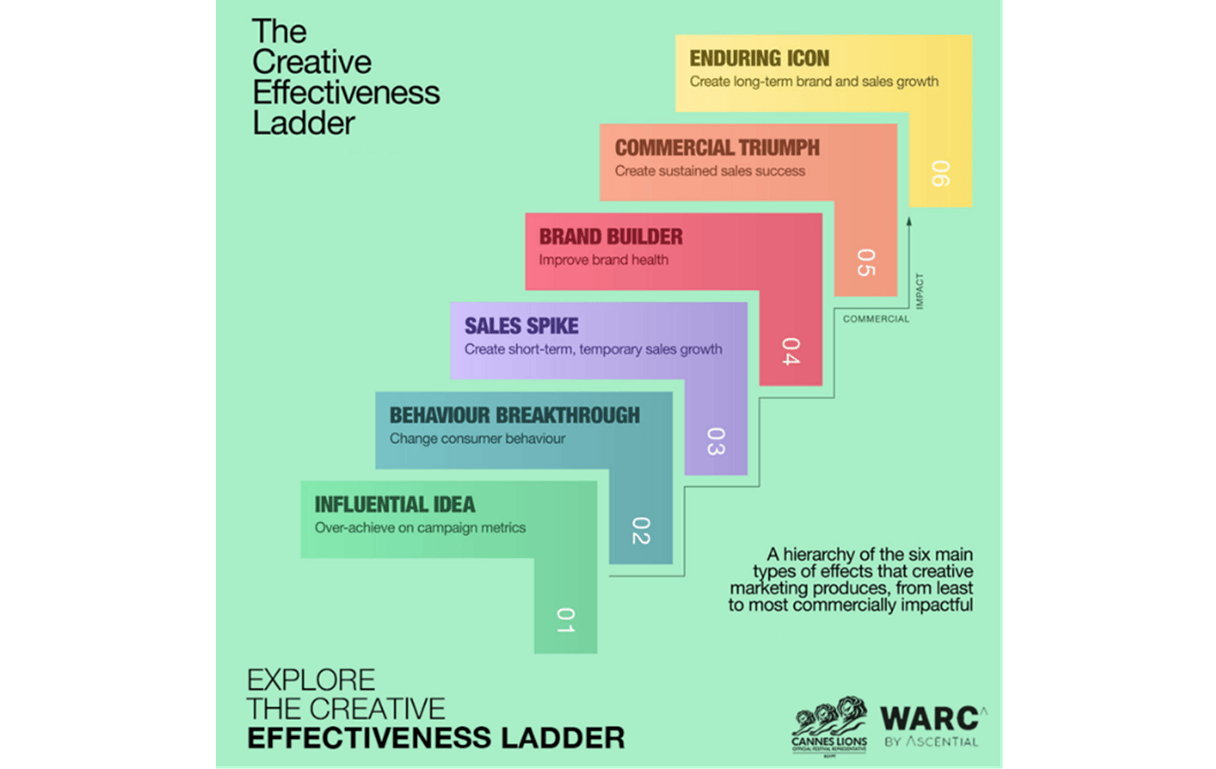
Source: WARC
While analysing the case studies, the authors found the campaigns that were the most effective had some common features. Field and Hurman called these features ‘Creative Commitment’.
Creative Commitment is a composite measure of three specific campaign elements: media spend, campaign duration and breadth of channels used. The analysis revealed that high Creative Commitment scores correlated very tightly with effectiveness – i.e. as Creative Commitment increases, so does effectiveness.
The analysis of the effectiveness case studies strongly indicated that campaigns which were most effective shared these characteristics: high levels of spend; a long period of campaign duration and a wider breadth of media channels utilised within the campaign.
WARC[105]
Discussing the research, Hurman said: “The message here is not that creative-award-worthy work is automatically effective. Rather that, if we have a well-planned and insightful strategy, we can magnify and supercharge the effectiveness of that strategic thinking with work that has creative-award-winning qualities.”[106]
By assessing which level of the creative effectiveness ladder a company’s work has reached, marketers can then see which further rungs on the ladder need be achieved in order to eventually reach the goal of ‘enduring icon’. This approach creates a useful framework to help agencies and advertisers improve creative effectiveness and optimise campaign levers around media spend, duration and breadth of channels used.
8.1.2 Testing and optimising creative
The importance of adopting a test and learn approach was explored in Section 7.4. The value of testing is also key to optimising a brand’s creative and a number of options exist to support companies with this.
Test and optimise creative
“We can run a preflight brand study with the likes of Meta, where you run about a million impressions in a week and the ad is served to real consumers. This enables you to test your ads, creatives and get a quick turnaround. Results can be seen in three to seven days, enabling us to make some changes to creative or claims ahead of our actual campaign.”
James Sharman, Northern Europe Digital Acceleration Lead, Haleon
The importance of understanding the value that creative plays in driving effectiveness and incorporating this into measurement and testing solutions was raised by Steven Silvers, EVP of Global Creative and Media Solutions at Kantar. He described how he sees a lot of opportunities around creative testing and that this is an underdeveloped portion of media effectiveness.
Creative testing can help predict the effectiveness of a campaign
“If you look at studies that have been done, anywhere between 40 and 60% of the effectiveness of a campaign is dictated by the creative, but most measurement solutions don’t consider it. What we’re starting to do is think of the quality of the creative as not just a measure of how good your creative is, but as a prediction of how the media will perform. If we’re doing a test of your ad and how it looks on, say, TikTok, and we’re getting consumers to tell you whether or not it worked, that’s a good prediction of how that ad will work when it runs on TikTok.
“We have built predictive machine learning models to help brands make decisions, such as our creative testing product called Link AI, which can in 15 minutes take a video and predict what a panel of people would say about it. It is built on the Link database, from over 250,000 tests, more than 10 years of data, and over 35 million human interactions. Scores in Link AI predictions include Short Term Sales Likelihood and Power (long-term equity), as well as diagnostic metrics such as Impact, Branding and Enjoyment, as shown below. For digital ads, we can also predict brand lift on awareness, consideration and purchase intent.
Major global advertisers, agencies and publishers such as Unilever, Coca-Cola, Whirlpool and Google use Link AI in a variety of ways to dramatically extend their creative effectiveness testing beyond survey research. For instance, they use it to extend their testing programmes to cover multiple digital ads and smaller campaigns, to unearth and validate creative best practice, to test competitor ads, and to iteratively test and optimise ads throughout the creative development process.”
Figure 15: Link AI’s behavioural KPI scores for a video ad
Source: Kantar[107]
Steven Silvers, EVP, Global Creative and Media Solutions, Kantar
With developments in technology, and particularly AI tools, brands can now get a better understanding of what has worked well in previous campaigns and apply a creative quality metric to future campaigns to ensure they are optimising as best they can. Tools such as Kantar’s Link AI product, as well as other solutions such as CreativeX, are helping companies to do this.
Defining rules for effective creative assets through a creative quality score
Nestlé used CreativeX, a company that builds data platforms for brands, to analyse thousands of historic campaigns using AI to define the ‘rules’ for effective creative assets. The analysis identified nine ‘creative hygiene’ best practices based on commonalities among the top performing ads. A new metric called a ‘creative quality score’ was assigned to each ad based on how well it complied with the hygiene factors. Nestlé ads with a higher creative quality score achieved 66% higher return on ad spend.[108]
In a video interview for CreativeX, a spokesperson for pharmaceuticals company Bayer, talked about how the multinational focuses on communicating what its brands can do to improve people’s lives.[109] However, they highlighted what the company missed in the past is how it should measure creative excellence, not just optimisation or ROI alone.
Bayer, working with CreativeX, developed a creative quality score, which provides one consistent conversation and better use of their investments. For Bayer, having a creative quality score gives the company speed and scale, and they have it implemented across 40 countries and 50 brands.
At a result of using the score, with Google they saw an uplift of triple digital +107% improvement in brand lift in YouTube ad recall and awareness, as well as better usage of media funds.
CreativeX | Case Studies[110]
Testing can be carried out at scale using AI tools, and Generative AI is opening up even more possibilities for marketers.
Using generative AI to optimise creative
“A company might be trying to make a prediction of what the attention is going to be for an ad, or the memorability, and understand how the different elements are being weighted from a viewer’s point of view. This is a very interesting trend, because then a company can tie it in with the generative AI solutions that are out there, and they can start to test how creative links to different emotions and a brand’s identity.
“Rather than having a focus on the best placement of the creative, a company could explore what would they change in an ad if they want to improve a brand metric such as awareness. The tool can them provide options which can be A/B tested based on that.
“Right now there are all these generic algorithms that will predict memorability or attention, but I am seeing a layer of customisation by the brands, where you can say, ‘If I’m going to target this type of audience, what kind of branding should I consider and what kind of creative elements should be present?’”
Marina Peluffo, Head of Business Intelligence, Prima
Amazon has already seen the potential in offering GenAI capability to support marketers in this area. Through Amazon Ads, it is offering marketers a first look at its new GenAI capability, designed to help spruce up dull ads. Amazon’s survey results found that nearly 75% of advertisers who were unable to build successful campaigns cited choosing a creative format and building ad creatives as their biggest challenges.[111]
8.2 Targeting and retargeting without third-party cookies
The deprecation of third-party cookies will have a significant impact on the ability of companies to understand the intent of customers and use this information to target and retarget users. However, there are alternatives approaches brands can use to reach audiences effectively without having to rely on third-party cookies.
For years consumers have been tracked across different websites and this data has been used and shared between different parties. This has enabled various parties to understand consumers who may be interested in a company’s products and services and serve them with advertising and retargeting communications.
One option that companies can adopt as an alternative to using third-party data to support targeting is to use their own first-party data, enabling them to reach specific audiences and track their activity. The insights they gather about customer segments can then be used to help predict future customer behaviour and as the basis for targeting, as well as supporting identifying similar customers.
Understanding whether people are in the market for your product
“A key challenge as third-party cookies go away is that companies won’t know if people (intent-based audiences) are in the market to buy something. Cookieless solutions like usage of first-party data, server-side tracking, privacy-enabled IDs and contextual targeting can help mitigate the challenge. Sky is currently trying to ascertain through test and learn how we channel the same volume of spend within a cookieless environment to deliver the same volume of sales and effectiveness, or better, and whether contextual audiences in a contextual environment deliver the same outcome or not.”
“With first-party data, the most important thing for a business like Sky is finding more people who look like our customers. If I am trying to acquire new customers, I should be certain that I am not mistargeting to existing customers. That is when first-party data becomes important for suppression of existing customers from marketing, thus delivering cost-saving efficiencies.
“Using a CDP, Sky’s capability of identification of our existing customers has doubled, who we can prevent from seeing a prospect advert. At the same time, for our existing customers’ marketing, we can be more targeted and personalised – managing what they see, and at what point in their lifecycle, thus enabling us to surface the right content to them.”
Kumar Amrendra, Head of Digital Marketing, Sky UK Ltd
An interesting point made by the experts interviewed for this research was around the importance of companies going back to the segmentation of their customers. Deepening a company’s understanding of their existing customer base can help them to identify where and how best to find similar audiences. Once a company knows the type of audience they want to reach, they can then explore options, such as whether to target similar audiences through Google and Meta, use YouTube audiences, or retarget customers through matching audiences.
8.2.1 Working with secondary partners
Working with a second party gives a company access to the partner’s trusted first-party data, as discussed in Section 5.4. A key advantage of working with secondary partners such as publishers, platforms and retail media providers is how their data can support a company in its targeting and retargeting.
Retargeting with secondary partners
“In this part of the globe, the challenge around the effectiveness of retargeting without third-party cookies has advanced faster versus in the west, because of our mobile-first environment in Asia. Social is driving a large degree of traffic to our websites, and a lot of it is mobile-heavy. Therefore, reliance on just purely cookie-based data has gone down quite significantly over the last couple of years.
“Instead, we are adopting a privacy-compliant way of doing typical retargeting with secondary partners.”
Sebastian Cruz, Regional Digital Marketing and Media Director, Shiseido, Asia Pacific
Data partnerships are enabling marketers to enrich audience segments within the partner’s first-party data. The data opportunity in retail media is explained by Dunnhumby in Econsultancy’s Retail Media Best Practice Guide.
The data opportunity: Dunnhumby
Dunnhumby’s Global Head of Product, Strategy and Partnerships, Retail Media and Personalisation, Julie Jeancolas, described four main benefits and opportunities for marketers in retail media:
- Access to unique shopper insights: This can help brands better understand their customers and their (often rapidly changing) shopping behaviours, whether that comes from the shift to online or evolving choices due to the rising cost of living.
.
Using Dunnhumby as an example, a brand can log into the Dunnhumby dashboard to understand brand performance at an SKU level (such as sales, brand share, number of shoppers, average spend per shopper) against a category level and make period on period comparisons. Brands can also see their shopper profile including level of affluence, lifestyle, what other categories brand shoppers buy, and where they shop (e.g. online and/or offline, locations of stores). This can help brands not only plan retail media campaigns but also other brand activity. - Shopper targeting: Access to a retailer’s first-party and loyalty programme data can enable more precise consumer targeting based on actual purchase behaviours (as opposed to interest, intent or panel data). This can eliminate wastage and deliver better conversion rates. For example, Unilever can target people on Facebook that have shown an interest in baby products, but on Tesco.com they can target customers that have actually bought baby products in the past three months.
- A brand safe environment: Many retail media networks have high levels of transparency around ad viewability rates and offer environments which are inherently brand safe, alleviating the concerns that marketers may have with use of programmatic advertising.
- Closed-loop measurement: Access to transaction data means that marketers can track the direct impact of their advertising in retail media on sales. This ‘closed loop’ measurement opportunity ensures that retail media is highly accountable.
Econsultancy | Retail Media Best Practice Guide
An example of the potential for a data partnership could be where a company has a particular segment of customers with certain behaviours, but they want to understand the customer behaviour of those buying a different product or brand. By developing a data collaboration, which might be with a supermarket through a retail media solution, they can gain insights about customers that buy a competitor product or other related products. This might also include whether those customers are receptive to discounts or pricing sensitivity. The data gathered can then help with lookalike modelling to reach and target prospects.
Technology providers and platforms are playing an important part in the retail media ecosystem. Examples of these include The Trade Desk, LiveRamp, Dunnhumby, Teads, Criteo and CitrusAd. These platforms have developed sophisticated capabilities, facilitating the improved use of retailer data and easier retail media targeting and trading.
Several platforms have also partnered with retailers to power their retail media offerings, while others act as aggregators of retail media inventory enabling ease of access to multiple retailers via a self-serve platform. To understand more about the retail media landscape and how companies can work with different partners to reach and target new audiences, see Econsultancy’s Retail Media Best Practice Guide.
An increasing number of retail media networks are also developing partnerships with connected TV companies. Laura Chaibi, Director of International Ad Marketing and Insights at Roku Inc, describes how the company is working with other parties to support brands in understanding how their advertising is working across different channels. “We’ve developed partnerships with the likes of Walmart and DoorDash, where these companies already have a very mature data infrastructure. Brands are using clean room technology for privacy-compliant data sharing, and with cookie (tracking) deprecation in digital, media mix modelling and econometric studies are seeing a resurgence to understand where advertising is working.
“In a connected TV environment, there are emerging capabilities being pioneered that allow viewers to engage with ‘shoppable’ action ads using the remote across the TV streamer’s journey. We see quick service retail (QSR) delivery apps and wellness apps being downloaded, or financial brands offering credit card applications or new banking applications. Automotive brands are also finding it a successful way of encouraging potential customers to sign up for more information about car models or to ‘press OK’ to locate a dealer. We’re helping companies to use different techniques to help people get to the next step. But more specifically, it’s about trying to shorten the distance from the communication to sale and remove friction along the way.”
Opportunities therefore exist for companies to form data partnerships and work with secondary partners to not only understand how a campaign has performed within a particular partner’s platform but to reach and target their customer base.
8.2.2 Contextual and interest-based targeting
Contextual targeting is playing a prominent role in the online ad market and the global investment in contextual targeting is set to reach $376.2bn by 2027.[112] This form of targeting is having a resurgence as it offers companies an alternative means of reaching audiences in the absence of third-party cookies.
Contextual ad targeting is a method of delivering relevant ads based on the content of the page a user is viewing, where advertising is aimed at matching a user’s interests, rather than who the user is (or is thought to be). Marketers are then able to put the most appropriate ad in the right context for the customer using contextual signals. It therefore benefits from not requiring large amounts of first-party data or needing consent to work. It can also be served within media like videos, audio and images, drawing on data such as sound, speech, image analysis and metadata for context.
Using contextual targeting to effectively reach audiences
LeasePlan, an online savings platform, wanted to grow its customer base and reach German consumers that were actively researching their financial options. It chose to deploy a contextual targeting strategy, rather than use demographic variables such as age, to reach people interested in topics such as investing, saving, stocks and property.
The company tested the effectiveness of contextual targeting on pages with content related to savings and investment against the use of interest-based audiences across a broader range of websites. The results showed contextual targeting to be especially effective.
LeasePlan combined various data points and analysed website behaviour, conversion rate, customer experience and drop-off rates. It then used AI to detect factors influencing customer behaviour that could not be observed by human analysis, and used the findings to map the typical customer journey from the first brand interaction to opening an account.
Using this approach, LeasePlan was able to optimise its campaign to achieve a lower cost per account opened and increase its account openings in Q1 2023 to more than three times the previous quarter’s figure.
Econsultancy | Case Study Library
From a user perspective, contextual targeting has the potential to offer an improved user experience, where ads served should be more relevant to them. It can also prove beneficial to publishers, with one article highlighting research showing a potential for companies of 2.5x incremental revenue by serving more appropriate, rather than intrusive ads.[113]
Econsultancy has discussed the boom in contextual advertising and how brands can take advantage of it and the developments which are happening in this area, highlighting how Reddit’s acquisition of Spiketrap, an audience contextualisation company, provided the platform with more than 100,000 active interest-based communities.[114]
Further discussed is TikTok’s introduction of a new contextual advertising tool, TikTok Pulse,[115] which is said to enable brands to advertise alongside top-performing content in the For You feed. The emergence of a non-tracking-based and privacy-conscious approach on one of the biggest social media platforms is symbolic of the future of the digital advertising industry.
Connected TV (CTV) and contextual targeting
CTV is a rapidly growing channel for contextual targeting which is providing another means for marketers to reach audiences they are interested in, without having to rely on cookies. Laura Chaibi, Director of International Ad Marketing and Insights at Roku Inc, describes how they are seeing three different marketer types who are maximising CTV to target customers (Figure 17).
Figure 17: How marketers can use CTV to reach audiences
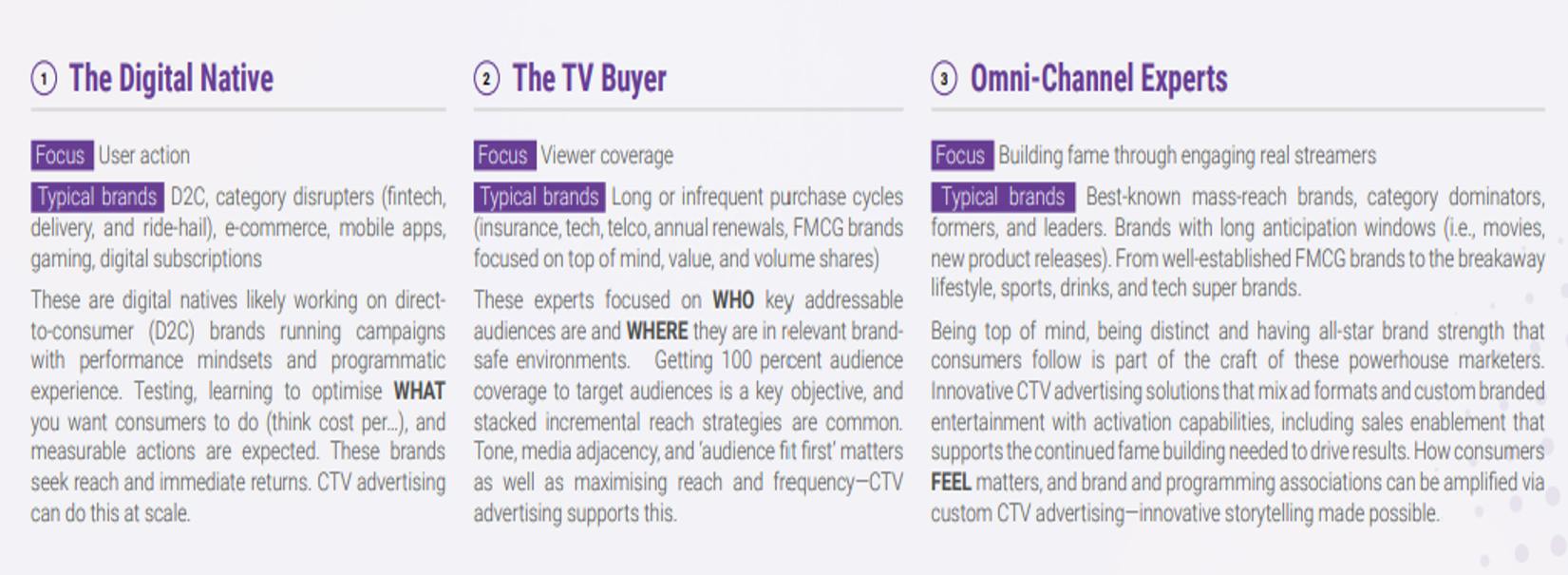
Source: Roku Inc
Viewers can also be targeted in real time based on what they are about to watch as a result of new AI-based targeting tools. Chaibi describes how targeting audiences via CTV is enabling this to drive real-time responses. “In Canada and the US, automatic content recognition (ACR) technology is being used as a form of fingerprinting the programming of live or on demand TV, or even gaming, on the screen. We can then understand whether an ad has been shown to a viewer, so that we can then help the advertiser find what audiences have not yet been shown a particular ad.
“We can then help brands find incremental reach. For example, with an automotive brand, they may have a linear TV campaign and want to find additional nonlinear TV viewers in our ecosystem, such as those that have accessed a free TV streaming app with ad-supported programming. As the TV streamer’s journey goes on, advertisers have increasingly more creative options to be part of the journey, such as being part of Roku City, or featured on the home screen to reach all TV streamers.”
CTV presents an exciting opportunity for marketers to explore to reach potential audiences and according to Econsultancy’s 2023 Future of Marketing report, almost half of marketers (43%) see this channel as playing an important role in the future.
8.2.3 Behavioural targeting and lookalike audiences
The demise of third-party cookies places even more importance on the need for companies to gather and utilise their own CRM data. Even without third-party cookies, CRM data provides quality information about target groups and enables companies to create lookalike audiences of prospective customers.
Segmentation enables an existing set of customers to be categorised or grouped based on four key types of data: behavioural, geographic, demographic and psychographic data. Econsultancy’s Segmentations and Personas Best Practice Guide looks at how companies can use these data types to understand and segment their audiences.
Segmentation provides marketers with clearly defined groups against which hypotheses can be mapped. Without having access to third-party cookies, companies can look at the characteristics of their target audiences at a high level and determine, based on their analysis, which are more likely to use certain channels and devices. Then across the chosen platform, companies can target similar characteristics and find similar audiences using their own first-party data.
Using segmentation to understand potential audiences
“A key starting point for companies is their segmentation. They can explore the data to create microsegments to understand the different types of audiences and their behaviours. Once you know how to provoke that behaviour it can be tied back to the forensics to see what was the last action someone took and what group they belong to. Then based on someone exhibiting similar behaviour to that group, give that person another set of actions.”
Amy Blasco, Partner, Enterprise Data, Experience and Marketing Lead, IBM
A company can use first-party data for the segmentation and modelling of cohorts and lookalike audiences for future targeting. Google and the social platforms now offer some form of this lookalike targeting. In the past, lookalike models were often based on demographic factors such as age, location, B2B role, etc. Increasingly, these models are also incorporating behavioural data to identify and target new potential customers who behave similarly to existing customers – or even just to target people who behave like a company’s most valuable customers.
Using lookalike audiences to target high value customers
Ritual is a premium vitamin subscription brand. It was looking to acquire higher value customers and lower its customer acquisition costs. To do this, the brand partnered with the agency Retina.AI to run a campaign that leveraged the lifetime value data of existing customers to target similar, potentially high-value customers, while also excluding low-value ones.
As a result of building a lookalike model based on lifetime value, the campaign saw a 29.5% reduction in cost per acquisition (CPC), with customers targeted in this way also delivering higher lifetime value versus those acquired through the usual method of audience targeting.
Retina.AI[116]
Kumar Amrendra, Head of Digital Marketing at Sky UK Ltd, describes the broadcaster’s approach: “For lookalike models, we are exploring cookieless technologies for the future including clean rooms, federated learning, server-side tracking, etc. – all of which is enabled through our CDP. We are sharing our first-party data and onsite behaviour like page views, product added to basket, sales, etc. with platforms like Google and Meta to optimise campaigns in a better way through targeting lookalike audiences.”
Google is also helping companies to target users based on their behaviour via the Privacy Sandbox tools Topics API[117] and Protected Audience APIs,[118] as summarised:
- Topics API: Enables interest-based advertising without the use of third-party cookies or tracking user behaviour across websites. The user’s device would infer topics for a user based on device usage during a period of time. A topic would then be randomly selected for targeting from the user’s top five topics for the time period.
- Protected Audience API: An in-browser API that enables advertisers and ad tech companies to show interest-group targeted ads without relying on third-party cookies. It is also designed so that it cannot be used by third parties to track user browsing behaviour across websites.
An interesting point raised by Roxane Panopoulos, Group Manager of Regional Measurement & Insights – Netherlands and Nordics at Snap, is that companies should also consider the wider customer funnel to reach a broader audience and to drive incremental sales.
Consider the wider customer funnel to reach a broader audience
“If a company does a broad targeting impression-driven campaign, which is going to reach as many people as possible and get clicks, we will be able to identify who clicked on an ad and then retarget these users.
“We are trying to serve this new narrative of not targeting people who are likely to do what you want them to do, because it’s very likely you’re actually paying for dollars you would get anyway. Instead it is about thinking incrementally and using a platform like Snapchat, or another platform, to drive reach and awareness, and then driving people down the funnel using first-party data because we know what people did on the platform.
“Getting the right purchase that drives your brand is important, and we are seeing that the more advanced companies are thinking about this the more they focus on incrementality.”
Roxane Panopoulos, Group Manager, Regional Measurement & Insights – Netherlands and Nordics, Snap
This very much fits with a point made by Byron Sharp about how sales growth will not come from relentlessly targeting a particular segment of a brand’s buyers, which he believes harms marketing effectiveness.[119] This was the case for P&G who some years ago found that sales of Febreze air freshener stalled when it targeted Facebook ads exclusively to people with families and pets, but improved after the campaign was opened up to anyone over the age of 18.[120]
9. Conclusion
The industry continues to be in a state of flux, and it is clear that the future of measurement and targeting will be one without third-party cookies. Technical and regulatory changes will continue to evolve to ensure the continued privacy of consumers is protected. What this means for marketers is an ongoing need to keep abreast of the changes taking place and the impact of these on their own practices.
The magnitude of the technical and regulatory changes does depend on the exact objectives and category of each brand. Marketers who are less focused on third-party cookies and performance marketing, and more interested in the long-term brand impact of marketing activity, may find their measurement approaches are less directly affected.
While there is no silver bullet to solve how to measure digital marketing effectively, and there are pros and cons to each approach, it would seem that many companies are looking to combine a blend of techniques to provide a more holistic view of how their marketing has performed. The experts all advise that key to the success of a blended approach is the ability to determine how digital metrics can become more closely aligned with business performance over superficial KPIs. “Marketers need to be willing to take a multifaceted approach to measurement by combining different strategies and thoroughly testing to ensure the approach is delivering against well-defined KPIs,” says Chloe Nicholls, Head of Ad Tech at IAB UK.
To help overcome many of the challenges highlighted and determine which measurement approach a company should choose, marketers require clear business objectives and a solid data foundation to underpin their marketing activity. In order to build a solid data foundation, companies must invest in first- and zero-party data and the supporting infrastructure and processes to manage this data.
Now is the time for companies to take this opportunity to assess their current approach to digital marketing measurement, to ensure that their internal teams and data are fit for purpose. It is important to be clear on what they are measuring and why, and to test and optimise. Companies need to get started now so as to have a good baseline on what to base their measurement on.
The importance of creativity is likely to be a key focus in the future for marketers wanting to improve the effectiveness of their campaigns. This is an observation underscored by Steven Silvers, EVP of Global Creative and Media Solutions at Kantar: “We’re definitely moving into a world where looking at the creative, as well as the media plan, is going to be really critical. Using AI and machine learning to predict what is going on because you can’t measure everywhere is going to be essential, as is having that baseline data to train the models.”
There is also a recognition that the consumer will continue to enjoy greater control and transparency over their data. With the changes that are taking place, marketers should focus more on business outcomes, as opposed to short-term metrics. These forces will ideally combine to create a better, more mature, environment for digital advertising and its measurement in coming years.
9.1 Checklist
The following checklist acts as a helpful guide for marketers exploring alternative measurement and targeting approaches.
- Audit current measurement and targeting approach. Identify where and how any third-party cookies and device IDs are being used for measurement and targeting, and assess how the technical changes will impact this. Involve partners and vendors to fully understand the impact of the changes and the alternative options available.
- Clarify business outcomes and questions to be answered. Set clear campaign objectives and KPIs to allow for targeted tracking and measurement. Think beyond short-term tactical metrics to provide a more holistic view of how effective marketing is in driving both performance and brand marketing in the long-term.
- Recognise that business culture supports the strategic role that media plays. Senior-level support and a mindset that acknowledges the importance of having a measurement approach that meets the needs of the business is key. There should be recognition that the chosen measurement approach may take time to set up and provide answers, such as with marketing mix modelling. The CMO and CFO need to work together to understand the impact of sales and marketing together, and how budget is driving long-term performance and not just supporting short-term KPIs.
- Allocate adequate budget for measurement and optimisation. This means setting a budget which is proportionate to marketing spend, where brand and performance teams are working together to optimise, drive customers down the funnel and measure success.
- Provide a holistic view of all activity. Select a measurement approach that can provide insights into all channel activity and what is driving incremental sales.
- Ensure the relevant skills are in place or find the right supplier. Identify whether the necessary skills exist or can be developed in-house by investing in internal teams. Involve partners and vendors in conversations and identify ways they can support any initiatives. Use the checklist provided by the IAB that lists key questions to ask vendors when looking at ID solutions, as well as the questions provided by Magic Numbers for evaluating a marketing mix model.
- Adopt a test and learn approach. By testing hypotheses through experimentation and A/B testing, teams can turn assumptions into validated learning which can be used for optimisation.
- Focus on first-party data and enrichment. Invest in the collection and enhancement of first-party and zero-party data sources. Identify ways to improve this and demonstrate a clear value exchange to customers for their data. Ensure first-party tracking capabilities are in place.
- Build a strong data foundation that is supported with the right technology. This requires robust processes for data collection and storage, data governance and data cleansing. This should be supported with the right technology infrastructure so that data sources can be integrated across the organisation to support the measurement of campaigns and derive true value from first-party data.
- Understand the possibilities of current and alternative measurement approaches as they adapt to the changes. Keep up to date with the regulatory and technical changes as they occur and determine how they will impact the business. Identify any steps the business needs to take to respond to these.
- Communicate the effectiveness of marketing campaigns and results to the wider business. Internal messaging can be crucial in getting the wider business engaged with the effectiveness agenda. Create a culture of transparency where the focus is on sharing both the highs and lows and learning.
The digital ecosystem will continue to evolve with further enhancements around privacy and as technology continues to evolve. Marketers need to stay up to date with the latest changes and understand how these impact their business.
10. Further Reading
10.1 Econsultancy Best Practice Guides
Econsultancy | Achieving Omnichannel Best Practice Guide
https://econsultancy.com/reports/achieving-omnichannel-excellence/
Econsultancy | Brand Purpose Best Practice Guide
https://econsultancy.com/reports/brand-purpose/
Econsultancy | Content Marketing Best Practice Guide
https://econsultancy.com/reports/content-marketing-best-practice-guide/
Econsultancy | Customer Data Platforms Best Practice Guide
https://econsultancy.com/reports/customer-data-platforms-best-practice-guide/
Econsultancy | Customer Journey Mapping Best Practice Guide
https://econsultancy.com/reports/customer-journey-mapping-best-practice-guide/
Econsultancy | Customer Retention Best Practice Guide
https://econsultancy.com/reports/customer-retention-best-practice-guide/
Econsultancy | Customer Lifetime Value Best Practice Guide
https://econsultancy.com/reports/customer-lifetime-value-best-practice-guide/
Econsultancy | Data-driven Marketing Best Practice Guide
https://econsultancy.com/reports/data-driven-marketing-best-practice-guide/
Econsultancy | Digital Transformation: Agility and Innovation Best Practice Guide
https://econsultancy.com/reports/digital-transformation-agility-and-innovation-best-practice-guide/
Econsultancy | Digital Transformation and the Role of Data https://econsultancy.com/reports/digital-transformation-and-the-role-of-data/
Econsultancy | Direct-to-Consumer Best Practice Guide
https://econsultancy.com/reports/direct-to-consumer-best-practice-guide/
Econsultancy | Ecommerce Best Practice Guide
https://econsultancy.com/reports/ecommerce-best-practice-guide/
Econsultancy | Fundamentals of Digital Advertising
https://econsultancy.com/reports/fundamentals-digital-advertising/
Econsultancy | Fundamentals of Marketing Measurement and Analytics
https://econsultancy.com/reports/the-fundamentals-of-marketing-measurement-and-analytics/
Econsultancy | Implementing a Customer Experience (CX) Strategy Best Practice Guide
https://econsultancy.com/reports/implementing-a-customer-experience-cx-strategy-best-practice-guide/
Econsultancy | Influencer Marketing Best Practice Guide
https://econsultancy.com/reports/influencer-marketing-best-practice/
Econsultancy | Marketing Automation Best Practice Guide
https://econsultancy.com/reports/marketing-automation-best-practice-guide/
Econsultancy | Optimising Marketing Spend Best Practice Guide
https://econsultancy.com/reports/optimising-marketing-spend-best-practice-guide/
Econsultancy | Personalisation Best Practice Guide
https://econsultancy.com/reports/personalisation-best-practice-guide/
Econsultancy | Product Strategy and Marketing Best Practice Guide
https://econsultancy.com/reports/product-strategy-and-marketing-best-practice-guide/
Econsultancy | Ratings and Reviews Best Practice Guide
https://econsultancy.com/reports/ratings-and-reviews-best-practice-guide/
Econsultancy | Retail Media Best Practice Guide
https://econsultancy.com/reports/retail-media-best-practice-guide/
Econsultancy | Segmentations and Personas Best Practice Guide
https://econsultancy.com/reports/segmentations-and-personas-best-practice-guide/
Econsultancy | Social CX and Customer Service Best Practice Guide
https://econsultancy.com/reports/social-cx-and-customer-service-best-practice-guide/
Econsultancy | Social Media Platforms Overview
https://econsultancy.com/reports/social-media-platforms-overview/
Econsultancy | User Experience and Interaction Design
https://econsultancy.com/reports/user-experience-and-interaction-design/
10.2 Econsultancy Trends Reports
Econsultancy | Future of Marketing
https://econsultancy.com/reports/the-future-of-marketing/
Econsultancy | 2023 Digital Trends
https://business.adobe.com/uk/resources/digital-trends-report.html
Econsultancy | 2022 Digital Trends – B2B Journey Management in Focus
https://business.adobe.com/mena_en/resources/digital-trends-journey-management-report.html
Econsultancy | 2023 Digital Trends – Retail in Focus
https://business.adobe.com/uk/resources/reports/retail-digital-trends.html
Econsultancy | Ecommerce Trends Report
https://econsultancy.com/reports/ecommerce-trends/
Econsultancy | Case Study Library
Econsultancy’s database of case studies showcases best practice and innovation from companies around the globe.

Browse the Case Study Library: https://econsultancy.com/case-studies/
Submit a success story: https://econsultancy.com/case-studies/submit/