
Content marketing
Social
Content

1. Introduction
This is the sixth edition of Econsultancy’s Future of Marketing report. It examines the trends affecting the industry and marketers’ priorities over the next two years.
1.1 Executive summary
- Marketers see the future as bright: Over three quarters of marketers (76%) have a rosy view of the future of the industry, with over a third (34%) describing themselves as ‘very optimistic’. Marketers’ sense of optimism extends to their budget sheets, with 61% of marketers expecting budgets to increase over the next two years. Key spending priorities include strategic initiatives, data and insight capabilities and technology and infrastructure.
- GenAI dominates thoughts about the future: The positive outlook is driven in part by the excitement around GenAI. Over half of marketers (57%) say that their organisations either have GenAI solutions already in place or are in the process of running pilots. Holding marketers back from the safe and effective use of GenAI is a lack of skills and training, with this among the top challenges to their organisations’ use of generative AI. Though AI is seen as a key opportunity, it is also raising concerns about how it might impact cut through and brand trust.
- Investment in skills is a defining feature of current and future success: The greatest difference between market leading organisations versus their competitors is the importance they place on talent and skills. Despite this, a significant proportion of organisations lack an effective skills development programme. As new capabilities emerge, investment in skills will be increasingly critical for competitive fitness.
- Short-termism is a hurdle to marketing effectiveness: Maximising marketing effectiveness tops the list of marketers’ priorities, however a focus on short-term responsiveness is a barrier to this. Almost two thirds of marketers (64%) report that their organisation over-prioritises customer acquisition above retention and lifetime value. This prioritisation of the short over long-term value can also be seen in the anticipated split between brand and performance marketing efforts, which will challenge marketers’ ability to maximise the value of their marketing spend.
- Personalised experiences at scale may soon be the expectation: The vast majority of marketers (89%) see CX as important for their organisation’s success and survival. The competitive advantage in investing in CX is clear, with market leaders reporting higher levels of maturity across core CX areas like customer journey orchestration, the ability to measure the ROI on CX investment and omnichannel personalisation. Hyper-personalisation has long been a goal for marketers, and new technologies and data capabilities may hold the key to finally realising that ambition.
- Marketers believe they have a role to play in sustainability efforts, but lack strategy: Though the majority of marketers (86%) believe marketing is important to an organisation’s environmental efforts, they lack clarity over what that role should be. Clarity is also lacking at the organisational level, with only a third (33%) of marketers’ organisations having a clear sustainability strategy in place.
1.1 About this research
The Future of Marketing survey was fielded to marketing professionals between 6 September and 17 October 2024. Detailed breakdowns of the respondent profiles are included in the Appendix. The values in the charts are rounded to the nearest whole decimal, and as a result, some graphs may not total 100%.
Methodology
- Phase 1: Analysis of the findings from Econsultancy’s Future of Marketing survey of 1,096 brand, vendor and agency marketers.
- Phase 2: A series of in-depth interviews with a range of digital and marketing experts representing different sectors and global markets.
Econsultancy would like to thank the following interviewees who contributed to this report:
- Richard Agnew, Director of Brand Communications & Insights, Jaguar, Range Rover,
Defender & Discovery (JLR) - Sara Ali, Director of Brand, Social & Content, TUI
- Björn Barnard, Digital Marketing Director EMEA, ACCO Brands
- Pierre Charchaflian, Senior Partner, Global Leader Marketing Transformation Consulting Practice – IBM IX
- Paul Davies, Managing Partner, Econsultancy
- Chris Hintermeister, Brand & Business Leader, Tropicana Brands Group
- Haley Eiser, Senior Marketing Director, Reckitt
- Shonodeep Modak, Chief Marketing Officer for Energy Management, Schneider Electric
- Bea Montoya, Chief Operating Officer, Simply Business
1.2 About the author

Rose Keen is a Senior Analyst at Econsultancy, where she helps deliver industry leading research on ecommerce and marketing. With over 10 years of media and business strategy experience, she has worked across a wide range of industries, from automotive and technology to food and fashion. Her particular interest is in behavioural science and the intersection between consumer behaviour, cultural shifts and technology. Find her on LinkedIn here.
2. Key Findings
Each year that Econsultancy has undertaken this research clear themes have emerged from both the global survey results and the in-depth expert interviews. This year, the results tell two tales. One front of mind, the other an undercurrent flowing throughout the survey results.
The first, unsurprisingly, is generative AI and the transformation that many marketers predict those new technologies may unlock.
The second, is the increasing clarity on what defines market leading organisations versus those who are merely keeping pace or underperforming – namely, a focus on customer experience, data maturity and an investment in skills.
You will find both these threads running throughout marketers’ priorities, fears and predictions for the next two years.
2.1 2025 outlook
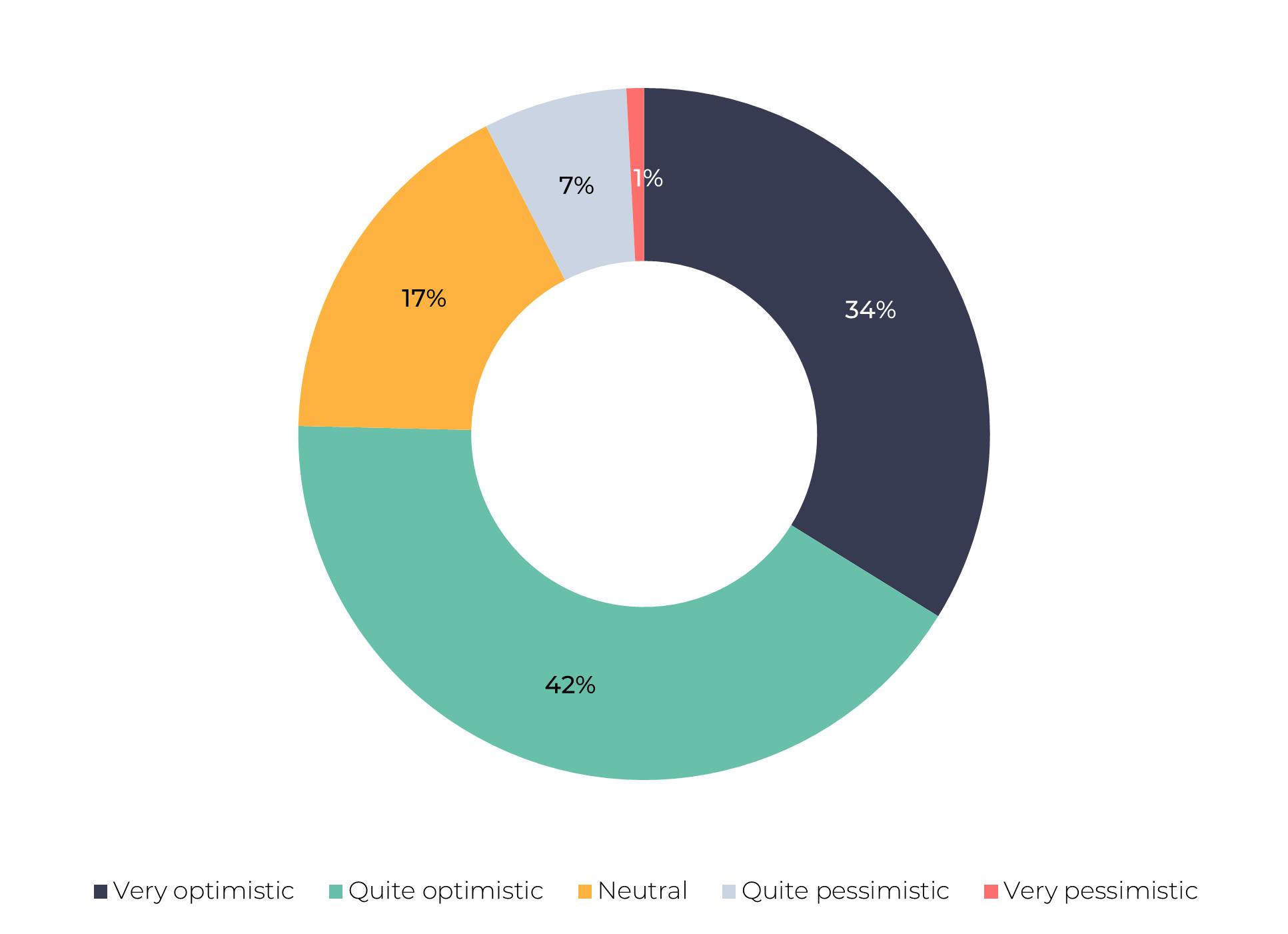
Marketers’ glasses are more than half full, with 76% saying that they feel positive about the future of the industry and over third (34%) describing themselves as very optimistic – this is up from just over a quarter (26%) last year.
Figure 1: How optimistic do you feel about the future of marketing?
Source: Econsultancy’s Future of Marketing survey | Sample: 609
A consistent theme across the years Econsultancy has been doing this research is the optimism of marketers. Foundational to that confidence is the understanding that marketing is and has always been a vital part of any business. During tough times in particular, marketing becomes increasingly important as an engine of growth.[1]
The reason for this current uptick in optimism, however, is likely more contemporary – the transformative potential of generative AI. This is a view that is held by Shonodeep Modak, Chief Marketing Officer for Energy Management at Schneider Electric: “Generative AI is set to be the next transformation of marketing. It is going to fundamentally change the way we work and what we deliver, which is very exciting.”
2.2 Priorities (and fears)
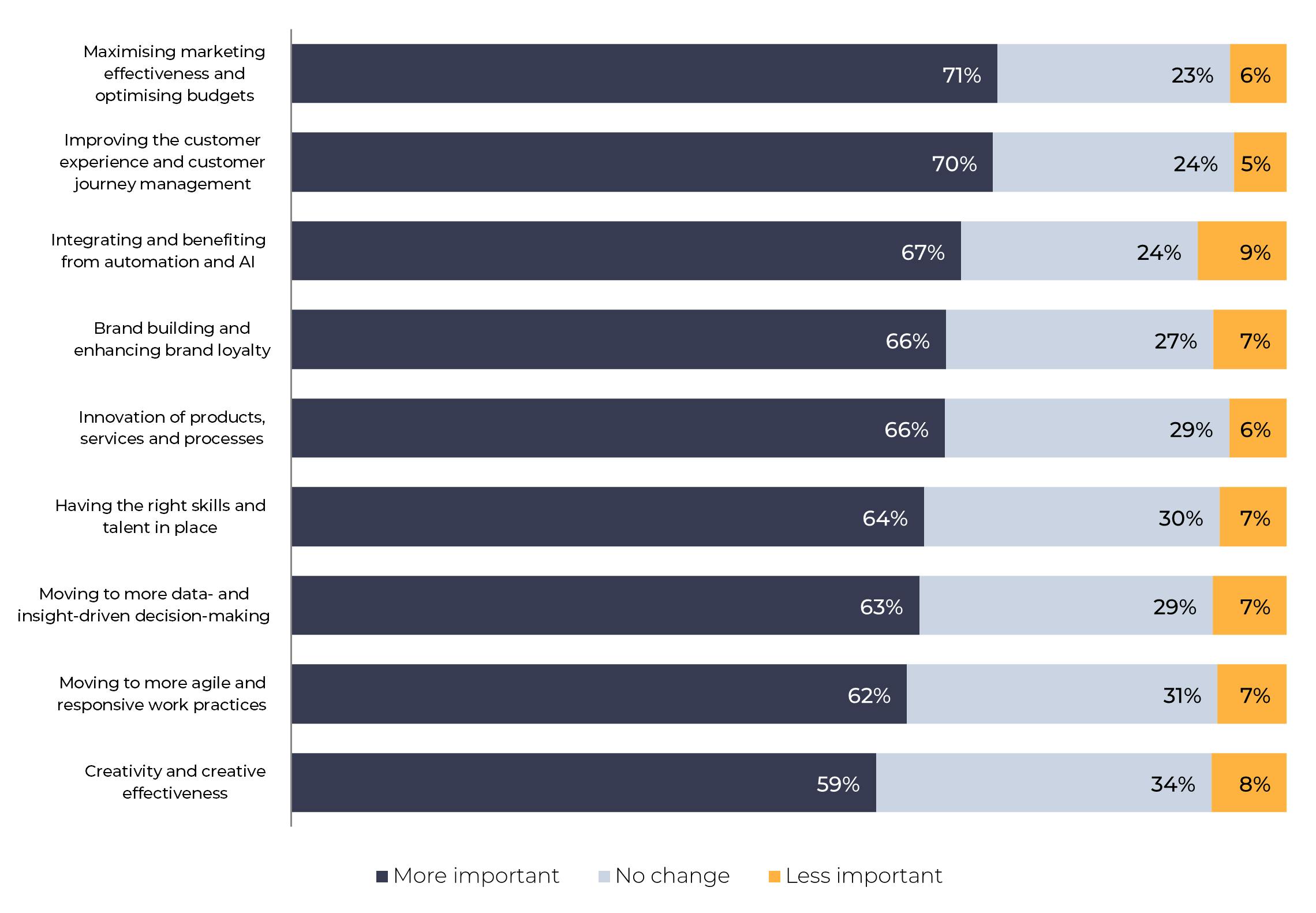
Over the next two years, marketers’ top three priorities are a mix of the evergreen – with ‘maximising marketing effectiveness’ topping the ranking (71% more important), followed closely by ‘improving the customer experience and customer journey management’ (70%) – and the responsive, with ‘integrating and benefiting from automation and AI’ (67%) placing third.
Figure 2: How do you expect the importance of the following to change over the next two years for your organisation?
Source: Econsultancy’s Future of Marketing survey | Sample: 813
Though ranking third, AI is a key driver of marketer’s concerns and fears. Almost nine out of ten (88%) marketers say that with the rise of AI-generated content and misinformation, building and maintaining brand trust is increasingly important. These concerns extend to the ways AI-generated content will impact marketing effectiveness itself, with 82% of marketers reporting that achieving cut through with marketing is increasingly a challenge. This issue may predate the emergence of generative AI, but it is being accelerated by the proliferation of AI-generated, often junk content.
2.3 Marketing budgets
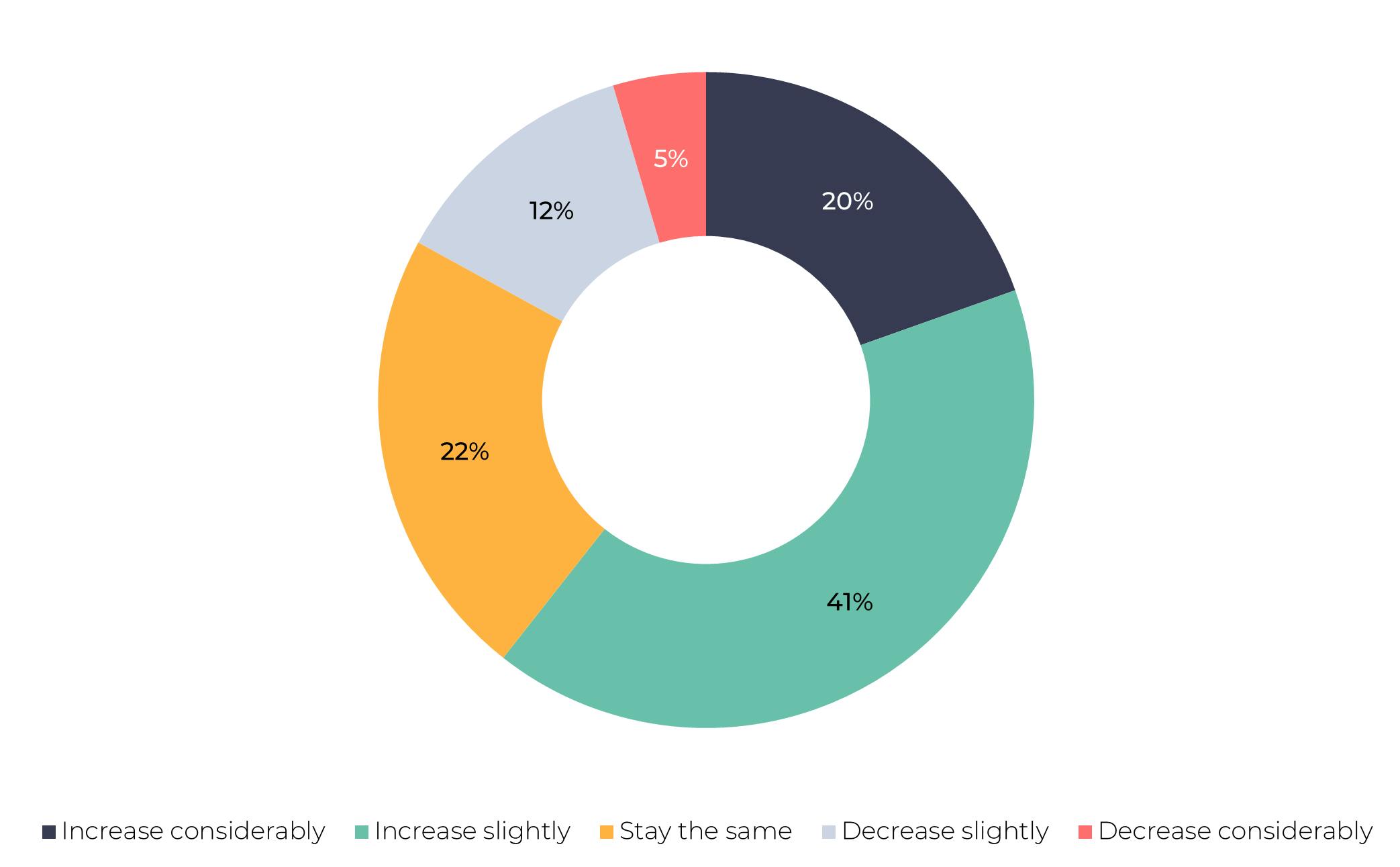
Marketers’ sense of optimism extends to budgets, with 61% of respondents expecting budgets to increase. Further adding to that rosy view on marketing spending, one in five marketers (20%) expect their budgets to increase significantly. This is a considerably more positive outlook than was seen last year, where in the midst of the inflationary crisis, only 11% of marketers predicted a sizeable increase in their budgets.
Figure 3: How do you expect marketing budgets to change over the next two years?
Source: Econsultancy’s Future of Marketing survey | Sample: 787
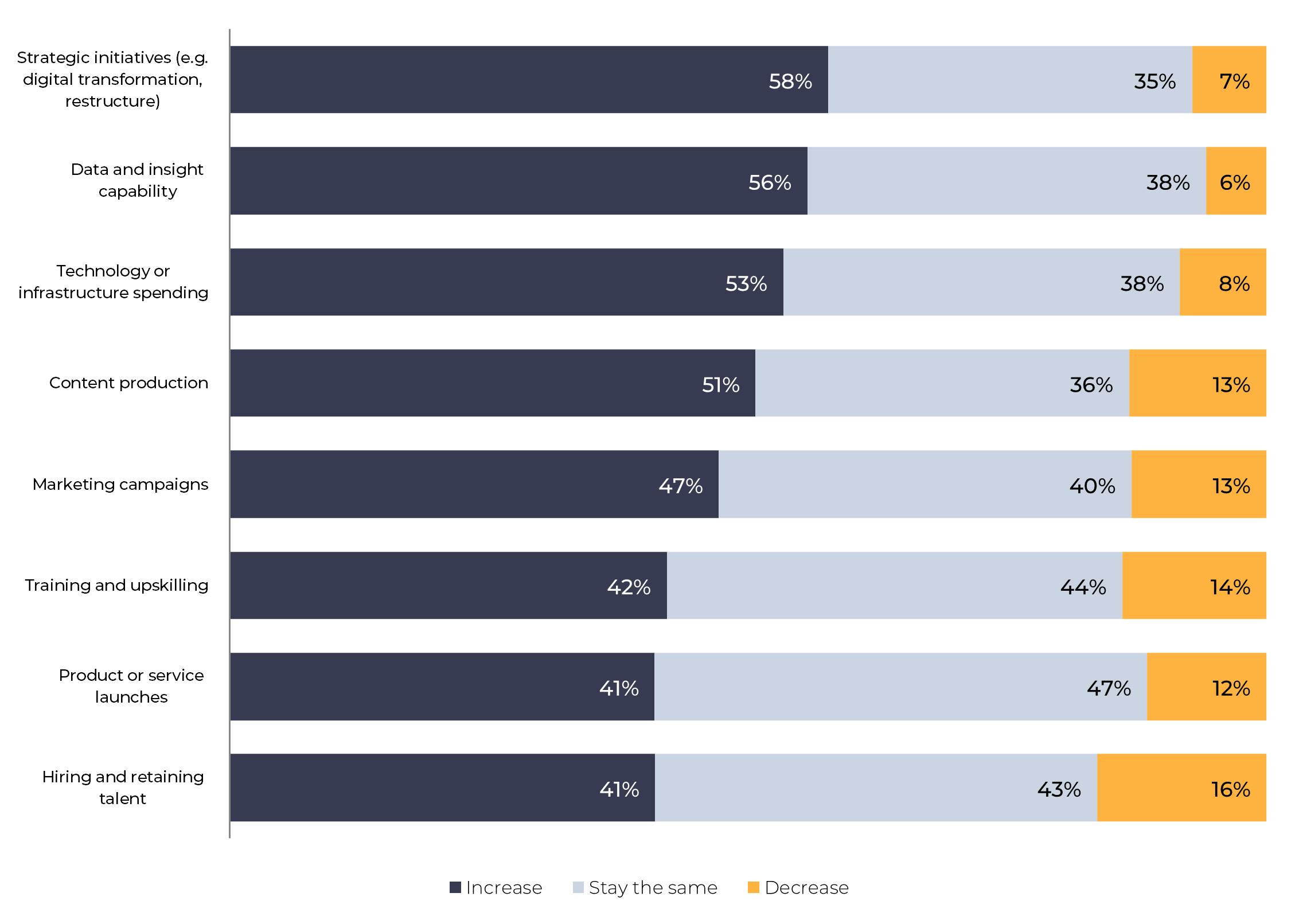
How that money is set to be spent also reflects the focus on the opportunities presented by GenAI. The top three spending areas – strategic initiatives, data and insight capabilities and technology and infrastructure – are all foundational to success with AI.
Figure 4: How do you expect marketing spend on the following to change over the next two years?
Source: Econsultancy’s Future of Marketing survey | Sample: 746
What is missing from this list of planned investments, however, is the fourth pillar for success with AI, or any technology – people. In fact, the training and hiring of talent ranks among the bottom of the anticipated spending priorities.
2.4 Skills and future fitness
The greatest difference in terms of priorities between market leading organisations and those who underperformed or kept pace with their sector was how likely they were to emphasise the importance of having the right talent and skills in place, with 69% of market leaders believing that this was only going to become more important to their organisation’s success over the next two years.
Despite the importance of skills for remaining competitive, only 26% of marketers report that their organisation’s digital skills development and training offer is fully fit for purpose.
Those organisations not investing in upskilling their teams risk a widening competitive gap – particularly as new capabilities arise. Market leading organisations are almost twice as likely to report that their training offer meets current needs and is responsive when new skills emerge versus market followers or trailers.
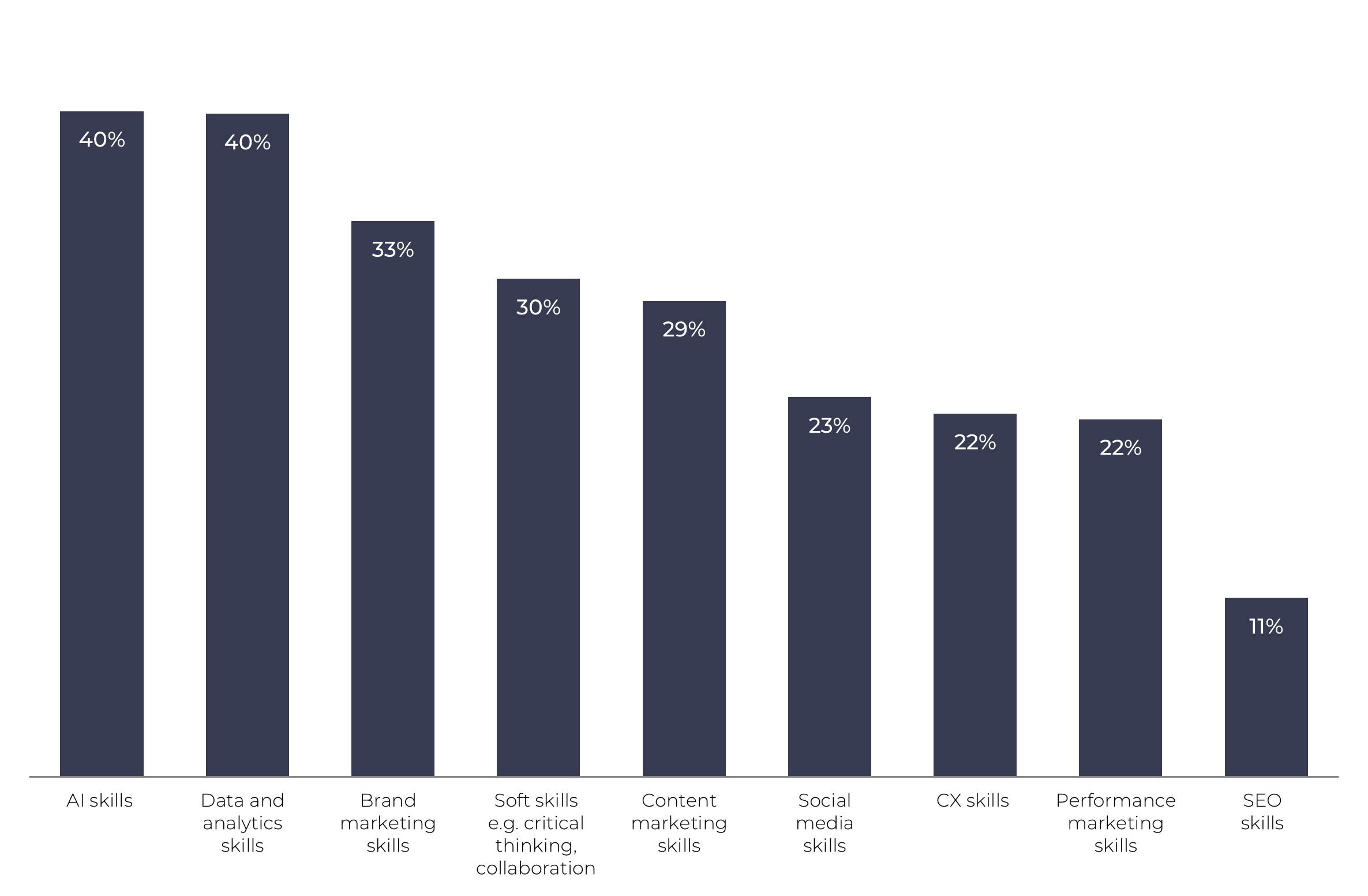
New skills were among the top asks for marketers, with 40% of respondents predicting that AI skills will be the most important capabilities to develop over the next two years.
Figure 5: To be fit for purpose for the next two years, which skills areas do you think it is most important for marketers and marketing teams to develop? Select up to three
Source: Econsultancy’s Future of Marketing survey | Sample: 618
Despite the importance of skills in supporting the successful and safe rollout of these technologies, provision of AI training is lacking, or entirely absent, in many organisations. This exposes organisations to risks both in terms of the misuse of these tools and in terms of competition. A lack of skills is seen as one of the top three challenges facing marketers in making use of these tools, ahead of budgets or security concerns. (See Section 3 for more on this.)
Equally important was data and analytics capabilities, something that has become foundational to modern marketing but remains a persistent skills gap.
“Data fluency is rightly one of the most in-demand capabilities for our clients,” explains Paul Davies, Managing Partner at Econsultancy. “The difference is that now data is less of a silo and more of a transversal skill, one that runs the entire breadth of the customer journey from awareness through to advocacy.”
Though specific skills may be front of mind for marketers and those looking at training provision, for the experts interviewed for this report, those specific capabilities have to be balanced with the holistic development of talent. This includes proficiency in areas like brand skills (ranked third in importance), which have been overlooked due to the increased focus on channel expertise, at least in the early stages of career development.
“At ACCO Brands we take training seriously,” explains Björn Barnard, Digital Marketing Director EMEA. “But when it comes to junior or new members of the team, it can be difficult to develop the right mix of broad experience and specific expertise, which presents a challenge when it comes to succession planning as well as retention. After all, there is only so long most people are happy to be limited to one channel for.”
This is a view shared by capabilities expert Davies: “Building these kind of capabilities needs a broader approach.” He explains: “Our most effective programmes ‘raise-the-floor’ with evergreen skills like customer insight and briefing alongside ‘raise-the-ceiling’ interventions for marketing specialists in fields such as CX and data.”
This holistic approach should also encompass ‘soft skills’ like critical thinking – capabilities that will only become more important as AI becomes more integrated into daily workflows.
3. AI and Technology
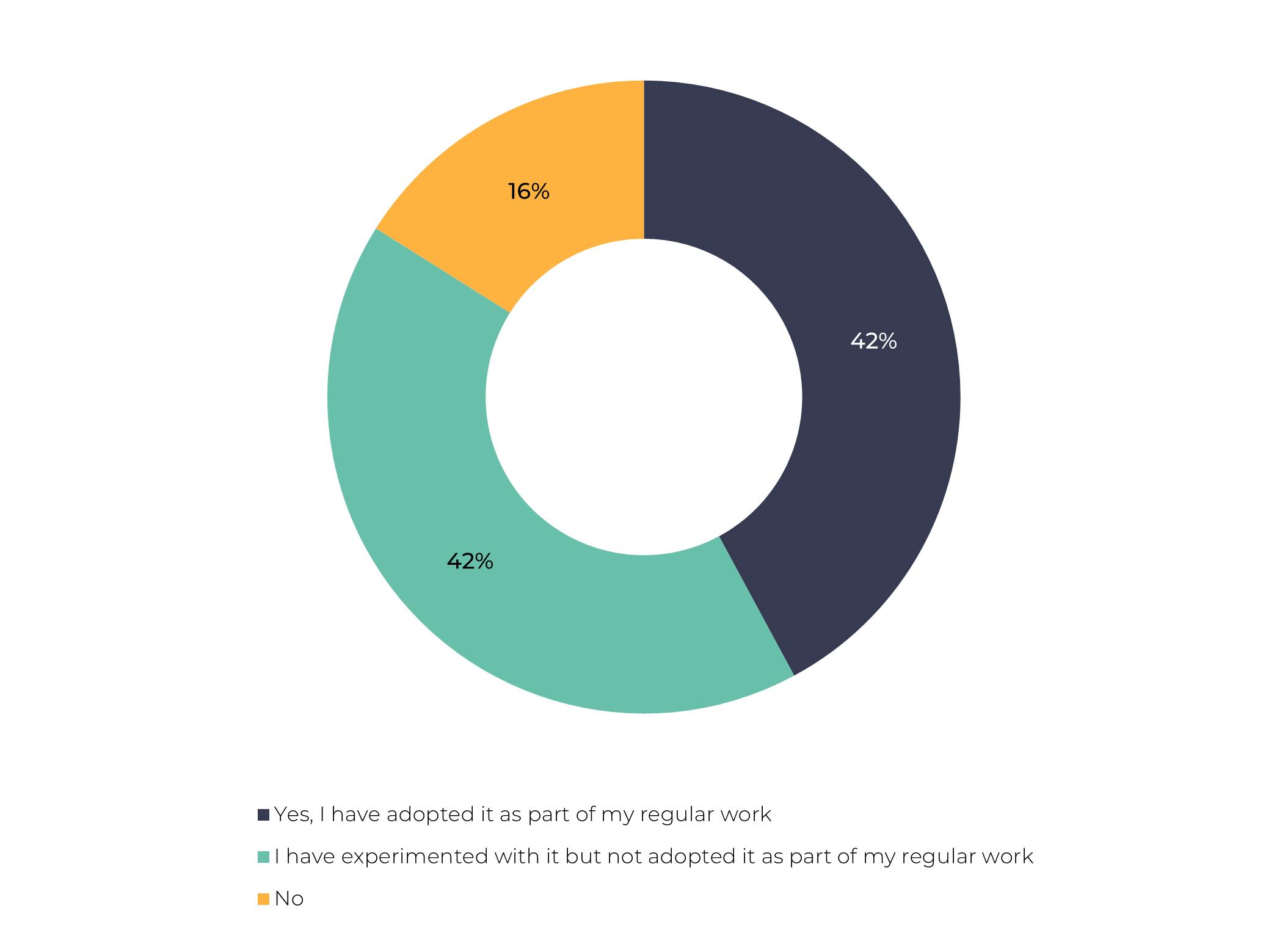
The emergence of GenAI has been the biggest story within marketing in last few years. One of the remarkable things about these technologies is how quickly they have been adopted. Less than four years after the release of DALL-E (the launch that kicked off the GenAI boom), 42% of marketers report that they have integrated these technologies into their regular work.
Figure 6: Do you currently use generative AI for work?
Source: Econsultancy’s Future of Marketing survey | Sample: 629
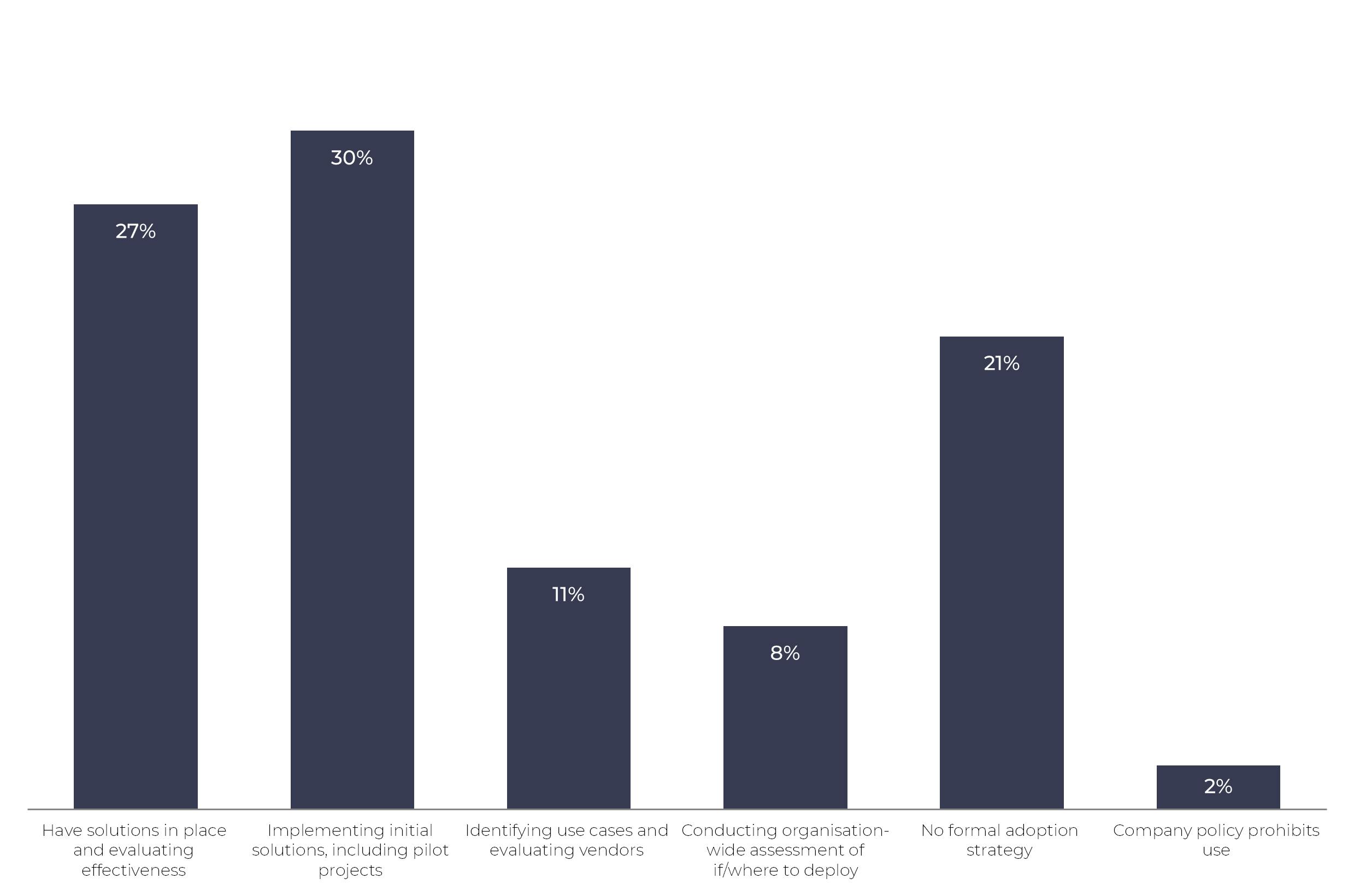
That speed of adoption extends beyond the individual level, with over half of marketers reporting that their organisations either have solutions in place and are evaluating their effectiveness (27%) or are in the process of running pilots (30%).
Figure 7: Which of the following statements best describes your organisation’s current status regarding the adoption of generative AI?
Source: Econsultancy’s Future of Marketing survey | Sample: 626
3.1 Top GenAI use cases
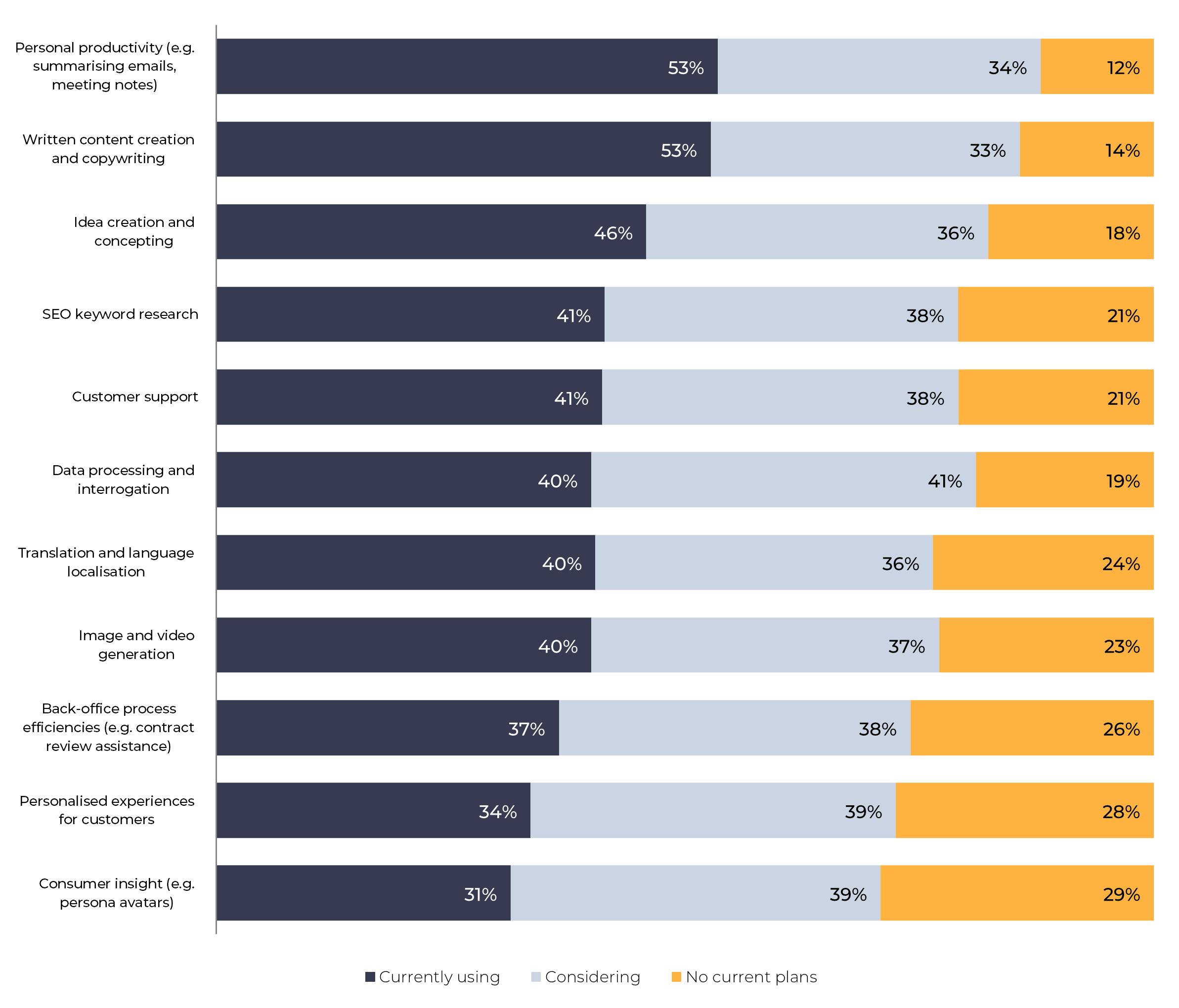
Among those with solutions or pilots in place, the most popular use cases are personal productivity (53%), the generation of written content (53%), and then ideation and concepting (46%).
What these three uses have in common is that they represent some of the core competencies of the LLMs available at present. This should be a key consideration for organisations when considering where to integrate these tools, as a large-scale study by Boston Consulting Group found that the ability for GenAI to improve the performance of workers was highly dependent on them being applied to a task within a technology’s main capabilities.[2] They are also some of the most brand safe uses available for marketers.
Bea Montoya, COO at Simply Business, shares her organisation’s experience of applying one of those top use cases: “Our digital communications team has been using GenAI to create leaner processes. They’ve seen increases of 50% in productivity. The result is a win-win – mundane but essential tasks can be semi-automated with AI, whereas the work that requires a creative and specifically human touch can go straight to our brilliant people. As a result, our people feel more satisfied at work, and our customers receive even more of the expert services they usually expect from us.”
Figure 8: What use cases for generative AI is your organisation already either pursuing or considering?
Source: Econsultancy’s Future of Marketing survey | Sample: 587
GenAI: Risk vs Reward
For a lot of marketers, I think AI sits firmly at the intersection of risk and reward. A primary binary lens is internal or external, that is, is AI being deployed at the operational (internal) level or is AI being used to engage consumers (external). The rewards seem to outweigh the risks for firms using AI to drive operational efficiency, whereas the risk seems higher for marketers using AI for external consumer-facing initiatives.
Chris Hintermeister, Brand & Business Leader, Tropicana Brands Group
3.2 GenAI performance
For the marketers using them, the majority report that the experience and performance of these tools have either lived up to or exceeded expectations. The best performing use was data processing and interrogation, with 46% of marketers whose organisations had these solutions in place saying they exceeded expectations. This was followed by personal productivity (42% exceeded expectations), and consumer insight (41% exceeded expectations).
Image generation saw the greatest expectation gap, with 14% saying that applying GenAI tools for this purpose did not meet expectations. Idea creation had the second largest gap, with 13% of marketers reporting it did not match up to what they had expected.
LLMs can be useful for expanding creative thinking. However, they are only ever as good as the prompts and approaches used. Improve your ability to use GenAI with Econsultancy’s Applied AI in Marketing and Ecommerce: Ideation and Decision-Making course.
3.3 GenAI concerns and challenges
One of the most worrying findings to emerge from this year’s survey is that 21% of marketers report that their organisation has no formal GenAI adoption strategy (Figure 7). Given the high rates of experimentation and adoption, this suggests a significant proportion of marketers are using these tools without any formal guidance or guardrails.
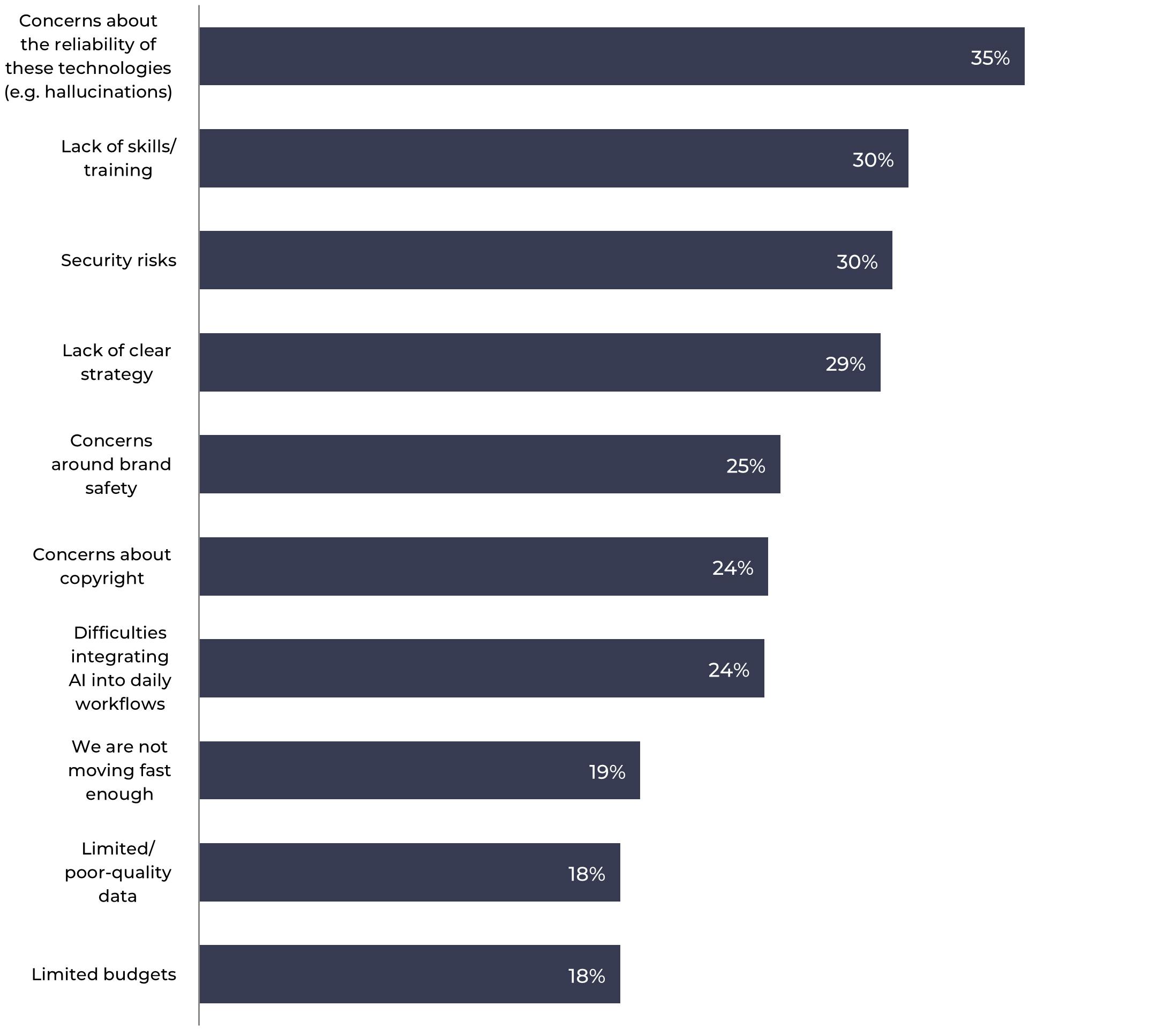
This opens brands up to significant potential risks – around things like misuse, copyright infringement and incorrect or misleading content being published thanks to a hallucination or miscomprehension by the model. Aligning with that latter risk, the reliability of the outputs of these tools was the top concern raised by marketers when it comes to the use of GenAI.
Equally concerning regarding the safe and effective use of GenAI is a lack of skills and training, with this placing second in the list of challenges facing marketers in the use of the tools. That this finding is partnered with AI skills being seen as the most important skillset for marketers to develop over the next two years (Figure 5) suggests the shortcoming here is in the provision of training from organisations – not the appetite.
“Training is critical for building marketers’ understanding of how to apply GenAI safely and effectively in their business,” explains Paul Davies, Managing Partner at Econsultancy, adding that organisations not partnering technical investment with skills investment risk the success of the rollout. For those looking to offer training, he shares that “at Econsultancy we recommend a two-pronged approach. First is general training in how to understand and use GenAI in your day to day. Second is more specialised training for specific use cases like image generation, data manipulation, etc.”
Figure 9: What are the biggest challenges to your organisation’s use of generative AI in marketing over the next two years? Select up to three
Source: Econsultancy’s Future of Marketing survey | Sample: 586
Alongside technical skills, the emergence of GenAI will enhance the need for so-called ‘soft skills’: core human capabilities like critical thinking, creativity and curiosity.
Emphasising the importance of critical thinking, marketers should beware of allowing themselves to get swept up in hype. Instead, adoption of any new technology should be informed by a real problem to be solved or where it can create real value.
Econsultancy’s quarterly webinar series Digital Shift tracks the latest applications of GenAI, with guidance on successful deployment.
4. Marketing Effectiveness
Faced with a more complex media and business landscape, that achieving the most bang for your marketing buck has topped the list of priorities for marketers this year is not surprising (Figure 2). The ability to measure whether a strategy or campaign is meeting an organisation’s goals is not only key to both making the right decisions in marketing, but also marketing’s position within the broader business.
Vital to both being able to reach the right people and connect the dots to understand effectiveness is of course data. However, a full third (33%) of marketers fall short here, describing their organisation’s data maturity as either low or poor with limited visibility of customers and their behaviours. This is despite the fact that having a unified source of data is increasingly essential to remaining competitive (explored further in Section 6).
While brands’ growing focus on marketing effectiveness – and the business performance it can drive – is clear, establishing a culture of effectiveness has proved difficult for many. For Andrew Geoghegan, former Chief Marketing Transformation Officer at PZ Cussons, this may be driven in part by marketers’ own worries about being held accountable.
Speaking to Econsultancy sister brand Marketing Week, Geoghegan describes how he hears “lots of excuses” for not measuring effectiveness. “There’s not enough data, there’s not enough investment of time,’ he expands, “But I do think it comes down to fear and some capability gaps. And I think the biggest way to address that is to create that no fault culture,” – one that balances results from the present, alongside rewarding improvements in the future.[3]
Establishing a culture of marketing effectiveness at Reckitt
We have invested a lot in understanding what drives creative effectiveness for our business and understanding how that works from a global, regional and local perspective. We’ve also invested in finding the right partners and nurturing those relationships.
We spent a lot of time identifying what our challenges are and what we need to do, considering how we can structure our organisation, operations and systems for success and what capabilities are needed both within, and beyond, marketing. All of that understanding is a key input to consider in the new structure we are putting in place.
Haley Eiser, Senior Marketing Director, Reckitt
For more on ensuring every pound spent on marketing makes a difference, and how to develop an effectiveness framework, see Econsultancy’s guide to Measuring and Driving Digital Marketing Effectiveness.
4.1 Balancing the short and the long term
One of the other factors holding marketers back from maximising their return on investment is an undue focus on the short term, with 64% of marketers saying their organisation over-prioritises customer acquisition above retention and lifetime value.
This short-termism can also be seen in the anticipated split of marketing activity between performance and brand (58% to be dedicated to performance versus 42% to brand).
These findings come over a decade on from Binet and Field’s seminal work ‘The Long and the Short of It’, which demonstrated the danger of overinvesting in short-term tactical activation over brand building marketing. Binet is a firm believer in the need for organisations to invest in both, however he recommends the ‘60:40’ approach, with 60% of spend going on brand.[4]
Further making the case for the benefits of greater investment in brand marketing is research published last year by System1, which shows that for many brands, and in most contexts, the optimal split of marketing budgets would see more spend on brand building versus short-term activation. The research also suggests that brand-building ads may have a significant short-term impact too.[5]
Blurring boundaries
The increasing inflation and convergence of media requires us to adapt the way in which we plan and activate. We cannot clearly separate ‘performance’ or ‘sales driving’ media planning from ‘brand’ or ‘emotive’ advertising so easily, which will challenge some marketers who have specialised, and is challenging agencies to work more holistically. This then raises questions on measurement and tracking where common methodologies are lacking. All of this at a time when the rate of change has never been faster – we’re facing signal loss, managing non-linear customer journeys, adopting new technology, managing more data than ever, and launching new platforms. This means we must collaborate more than ever across the customer ecosystems.
Sara Ali, Director of Brand, Social & Content, TUI
4.2 Navigating the media environment
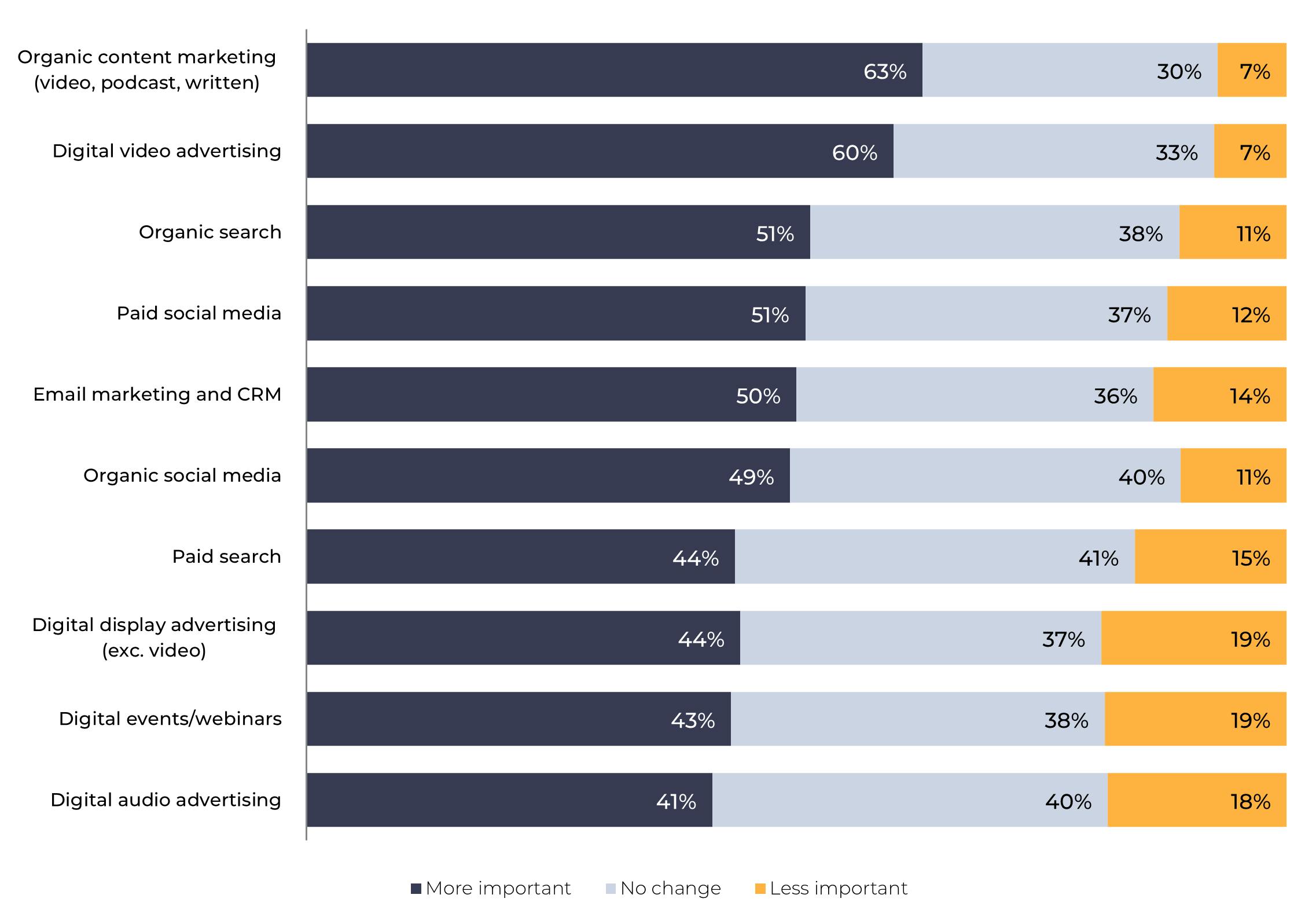
The increasing complexity and fragmentation of the media environment has been a key theme of this research over the last few years. That pattern continues, with all the channels asked about in this year’s survey set to either stay as or increase in importance.
Deciding where to focus energies and budgets is a key challenge facing marketers, as Chris Hintermeister, Brand & Business Leader at Tropicana Brands Group, explains: “Given the multitude of options marketers have to reach consumers it can be challenging to optimise advertising spend.”
Solving this problem comes down to prioritisation and clarity on the organisation’s goals – a task made harder by the fact that “media channels are at varying degrees of maturity, and as a result, the metrics and associated returns will look different.”
Hintermeister warns: “Organisations that prioritise the wrong metrics are likely to mismanage their advertising spend… marketers should be reminded that not all ROIs are created equal, so it’s critical to know what you are optimising for.”
Though the media environment may be increasingly complex, for Reckitt’s Senior Marketing Director Haley Eiser, the principle behind making those decisions is deceptively simple. “Long story short, you need to follow the consumer,” explains Eiser, “you need to follow their journey.”
Figure 10: How do you expect the importance of the following to change over the next two years in terms of marketing effectiveness?
Source: Econsultancy’s Future of Marketing survey | Sample: 670
For many marketers this complexity is leading them focus in on the spaces they own, with organic content topping the ranking in terms of increasing in importance. This aligns with last year’s results, which also placed organic content as the part of the marketing mix set to increase most in importance.
Alongside opportunities in the organic space, there are also threats. Specifically, what impact GenAI search will have on search and the content ecosystem.
“We are concerned about what impact AI and zero-click searches are set to have on our organic visibility,” shares Björn Barnard, Digital Marketing Director EMEA at ACCO Brands. To explore this, ACCO are planning some test projects “to better understand within our space what content or which external publishers are actually influencing the AI results”.
With it still being such early days, the full scale or nature of the impact GenAI search will have on the customer journey and content marketing is not yet clear. However, early signals suggest that investing in brand visibility and in content that meets the needs of and answers the questions of customers may provide some insurance.[6]
Video, both organic and paid, is seen as being particularly important for marketing effectiveness over the next two years. This follows the broader trend seen across digital that as connection speeds have increased, so has the visual nature of content.
Video’s impact on the nature of creative
Marketing is going to change from a creative perspective, in part because of the importance of video. You can’t just be obvious, instead your brand content is going to need to become entertainment.
Haley Eiser, Senior Marketing Director, Reckitt
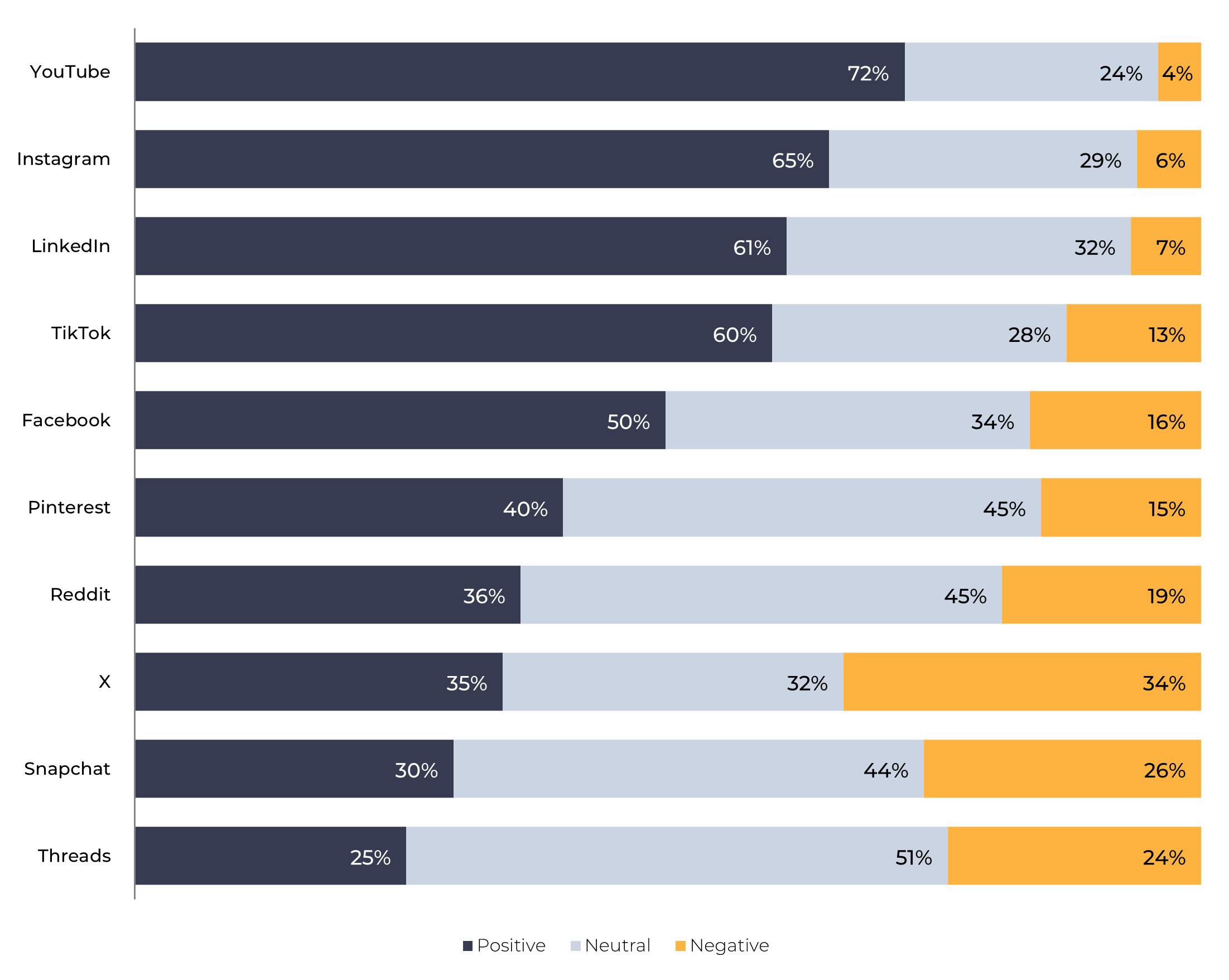
Video’s increased importance can also be seen in marketers’ attitudes towards different social platforms. YouTube scored the highest among its peers in terms of effectiveness, while X had the least favourable score, with 34% of marketers having a negative opinion of its effectiveness, reflecting the controversy and brand safety concerns that have afflicted the site since its 2022 takeover.
This aligns with research from Kantar, as reported by Econsultancy, that a net 26% of marketers are planning to reduce their ad spend on X in 2025 in what would be “the biggest recorded pullback from any major global ad platform”.[7]
Figure 11: What is your view on the marketing effectiveness of the different social media platforms?
Source: Econsultancy’s Future of Marketing survey | Sample: 647
4.3 Achieving creative excellence
In a media environment where achieving cut through is increasingly a challenge, what makes for effective creative is a preoccupation of the industry, particularly as over half of the media impact of a campaign can be attributed to the quality of its creative.[8]
Speaking at Econsultancy’s sister event Festival of Marketing, Ritson shared his playbook of 10 steps for marketing effectiveness and emphasised the importance of big ideas, distinctive assets and the quality of briefs. He also highlighted the essential role that emotion plays in marketing effectiveness: “The phrase ‘emotion is powerful’ is a cliché, but also a truism.”[9]
For Sara Ali, Director of Brand, Social & Content at TUI, that final point is reflective of what she is seeing in the market: “We are so overloaded as consumers, you can already see the return to more emotive, humorous and evocative marketing.
Given the challenge of cut through and the fragmented media landscape, creating compelling narratives – that tap into consumers emotions – has never been more important to marketers. A focus on storytelling also allows brands to make the most of the new range of formats and tools available to them. For more on telling really great brand stories, see Econsultancy’s Storytelling for Marketers Best Practice Guide.
AI-driven creative quality score
As much as AI may be driving concerns around future marketing effectiveness, it is also underpinning an increased understanding of what creative has – and increasingly will – work.
By analysing thousands of past campaigns these tools are capable of surfacing the ‘rules’ for successful creative. They can also be used for pre-campaign testing, allowing a brand to understand how well a campaign is likely to perform before launching it.
Brands who adopt these tools are reporting improved marketing performance. Drinks company Diageo, for instance, uses AI-powered technology CreativeX to pre-test its digital content. This pre-testing allows the organisation to understand what creative is likely to cut through, helping to reduce the company’s cost per 1,000 views by 50%. Elsewhere, consumer health company Haleon has attributed increased purchase intent and ad recall to the organisation’s creative effectiveness tools.[10]
The idea behind deploying these tools is not to curtail creativity. Instead, they should enable marketers to better understand what assets are likely to be most successful based on a wealth of past experimentation.
5. Customer Experience
The increasing importance of customer experience has been one of the most consistent throughlines across all of Econsultancy’s trends research for the last decade. The ability to deliver a joined-up experience has moved progressively from being a competitive advantage to a hygiene factor. This remains the case this year, with 89% of marketers seeing CX as significant or very significant to their organisation’s performance over the next two years.
Given its competitive importance, it is unsurprising that those organisations who outperformed the market are more likely to see CX as vital, with these market leaders reporting much higher levels of maturity across core CX areas like customer journey orchestration, the ability to measure the ROI on CX investment and omnichannel personalisation.
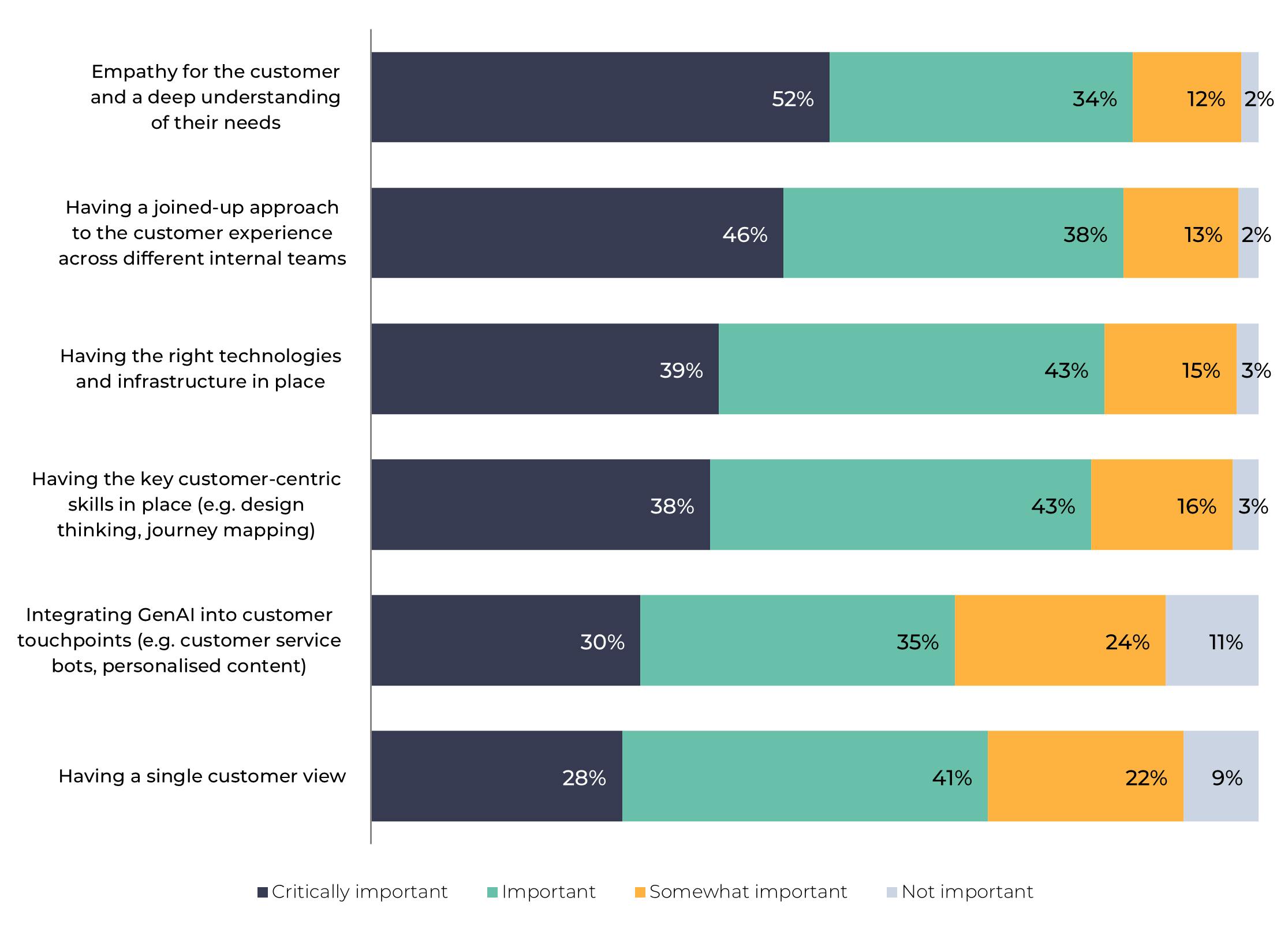
Key to creating a great customer experience is empathy for the customer and a deep understanding of their needs, having a shared CX approach across different areas of the business and the adept use of technology to facilitate and connect different touchpoints.
Figure 12: How important will the following be in meeting customer experience (CX) expectations over the next two years?
Source: Econsultancy’s Future of Marketing survey | Sample: 717
5.1 Are we there yet?
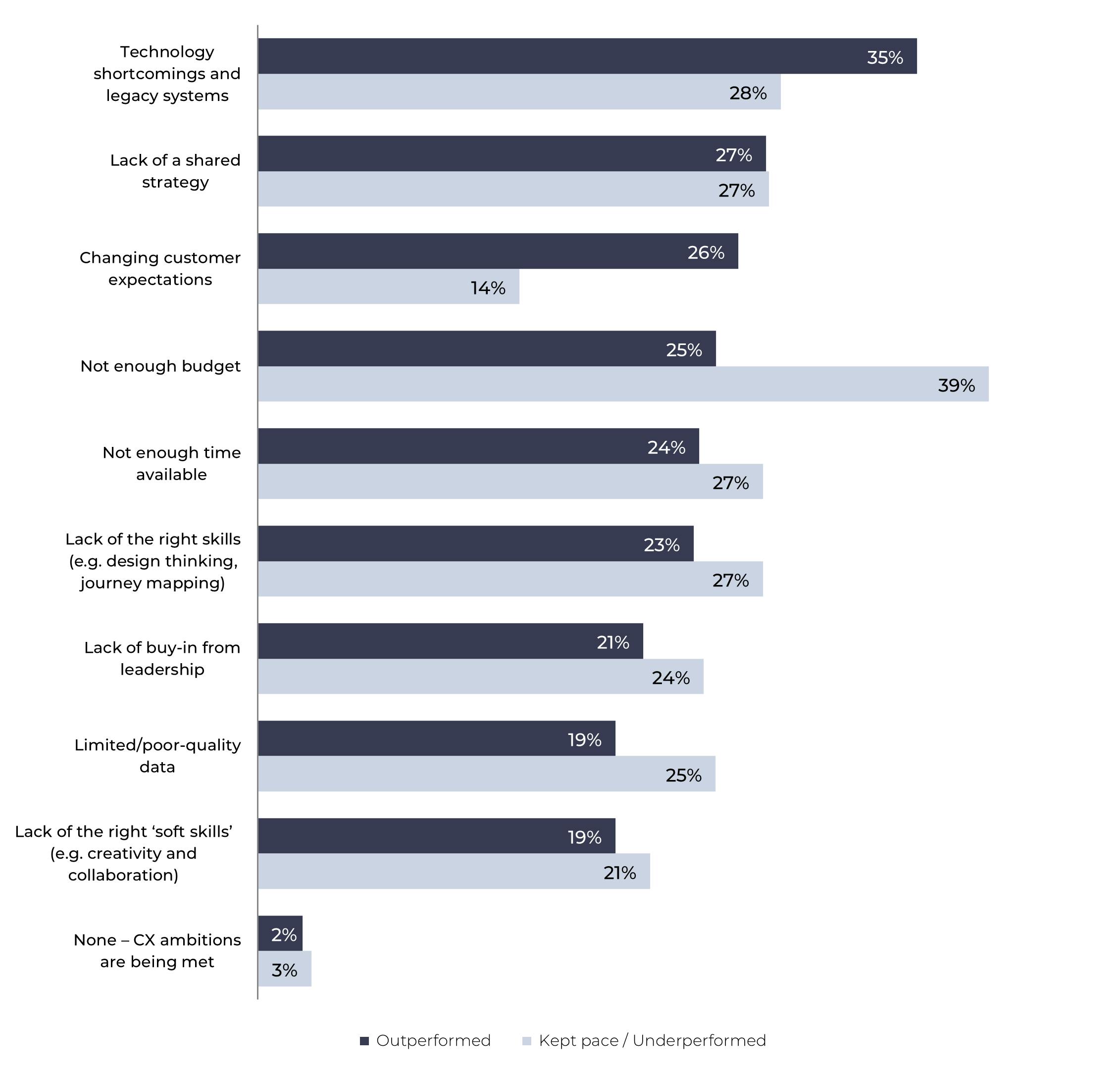
Despite the importance of CX having been recognised for some time now, many customer experiences still fall short of expectations. The reasons marketers attribute to this show a clear divide between those market leading organisations and those market followers.
For market leaders, the top challenge is technological shortcomings and the ongoing impact of legacy systems. For those that underperformed or simply kept pace with the market, the challenge is a lack of budget for CX improvements.
Figure 13: What are the chief barriers holding your organisation back from meeting its customer experience (CX) ambitions? Select up to three
Source: Econsultancy’s Future of Marketing survey | Sample: Outperformed 339, Underperformed/kept pace: 318
The importance of a shared vision
There’s a belief internally that success with CX is about budget. I don’t necessarily think that is the case. I think it’s more about planning your vision up front and then applying that across all your actions – whether that is the brief you give for a photoshoot, the capability you build in for your website or the content management system you invest in to allow you to build certain experiences.
Björn Barnard, Digital Marketing Director EMEA, ACCO Brands
Shared ground, however, can be found in the challenge of a lack of a shared strategy, with this being the second most cited shortcoming by both groups. Pierre Charchaflian, Senior Partner of the Global Leader Marketing Transformation Consulting Practice IBM IX, attributes this in part to the ambiguity of who is responsible for CX: “Who owns the customer experience? Sometimes it’s marketing, sometimes it’s digital. That lack of clarity over ownership is a missed opportunity.”
Though many organisations may describe themselves as customer-centric, few have fully embedded that focus on the customer into all elements of the business. Becoming truly customer-centric will often require organisations to rethink their capability building and structures. That has been the case for Reckitt. “Consumer centricity is our obsession,” explains Haley Eiser, Senior Marketing Director at the FMCG giant, describing how this obsession has led them to “build capability across our entire marketing organisation to focus on the consumer and ensure our structures and systems are set up for consumer centricity”.
Experience is increasingly a differentiator in B2B
Anyone who has been involved in business purchases over the last decade will be familiar with the fact that CX within B2B has often lagged behind the experience offered by consumer-facing companies. However, the importance of CX and CX investment for competitive fitness is increasingly being recognised by B2B players, driven in part by the rise of ecommerce in this space and the changing demographics and expectations of business buyers.
For Shonodeep Modak, Chief Marketing Officer for Energy Management at Schneider Electric, working within the B2B space can actually be a boon for delivering improved experiences: “Our B2B customers from their own personal online experience have come to expect a B2C experience. We just need to be as good. Going to something state-of-the-art is not necessarily better.”
Improving their customer experience has been a significant focus for energy management and automation technology provider Schneider Electric – work that appears to being paying off, with the company’s most recent earning report showing an 8% growth in organic revenue across the group.[11]
5.2 What’s next in experience?
Part of the reason why CX is never ‘done’ is that customer expectations change. Driving the next set of expectations will be what new technologies and data capabilities allow brands to do – particularly when it comes to AI and personalisation.
“Hyper-personalisation is going to be key,” shares Shonodeep Modak, Chief Marketing Officer for Energy Management at Schneider Electric. Hyper-personalisation, also known as one-to-one marketing at scale, has long been an ambition within marketing. However, data setups and automation solutions have fallen short of the delivery of truly relevant and individualised communications. For the experts interviewed for this report, GenAI may hold the key to making true personalisation at scale a reality.
Bea Montoya, COO at Simply Business, sees this as creating both an opportunity – “the world will continue to be increasingly competitive and customers’ expectations will change and grow, with personalisation being critical to win” – but also a challenge, adding that “customer expectations are likely to change with less tolerance for untargeted communications”.
The ‘why-driven experience’
If I were to lay out the key phases we have seen across digital experiences, it would start in the 2000s. These were the early days and here everything was about the ‘transaction experience’ and how we capture that first-party transaction data. Next we saw a move to what could be described as the ‘journey-driven experience’. Nothing was a greater driver of that than Covid. This is getting into what I call ‘first-party behaviour data’ – not only what you’re buying, but also how you are engaging with the brand.
Now, I believe we are embarking on to what I call the ‘why-driven experience’, which is about understanding why you engage with the brand. It’s not just understanding that you’re going to Chicago, but why you’re going to Chicago and whether your trip is for leisure or business. With that information I can then make recommendations, or serve you with different content. To make sure those are relevant though, I need to know more about you – what food you like, what activities you like to do. So we are moving from first-party data to zero-party data.
Pierre Charchaflian, Senior Partner, Global Leader Marketing Transformation Consulting Practice – IBM IX
For practical guidance on delivering outstanding experiences, see Econsultancy’s guide to Implementing a CX Strategy.
6. Data and Measurement
Access to business-ready data is a key determiner of market performance. Companies who outperformed the market were more likely to report that they have unified, actionable, real-time customer data available, and high visibility of customers and their behaviours.
Data has long been both one of marketing’s top priorities, and one of its thorniest problems to solve. That challenge remains with a full third of marketers (33%) describing their organisation’s data maturity as either low or poor. Resolving this issue is only going to become more important for organisations as quality, actionable data is foundational to both CX and the ability to leverage AI tools.
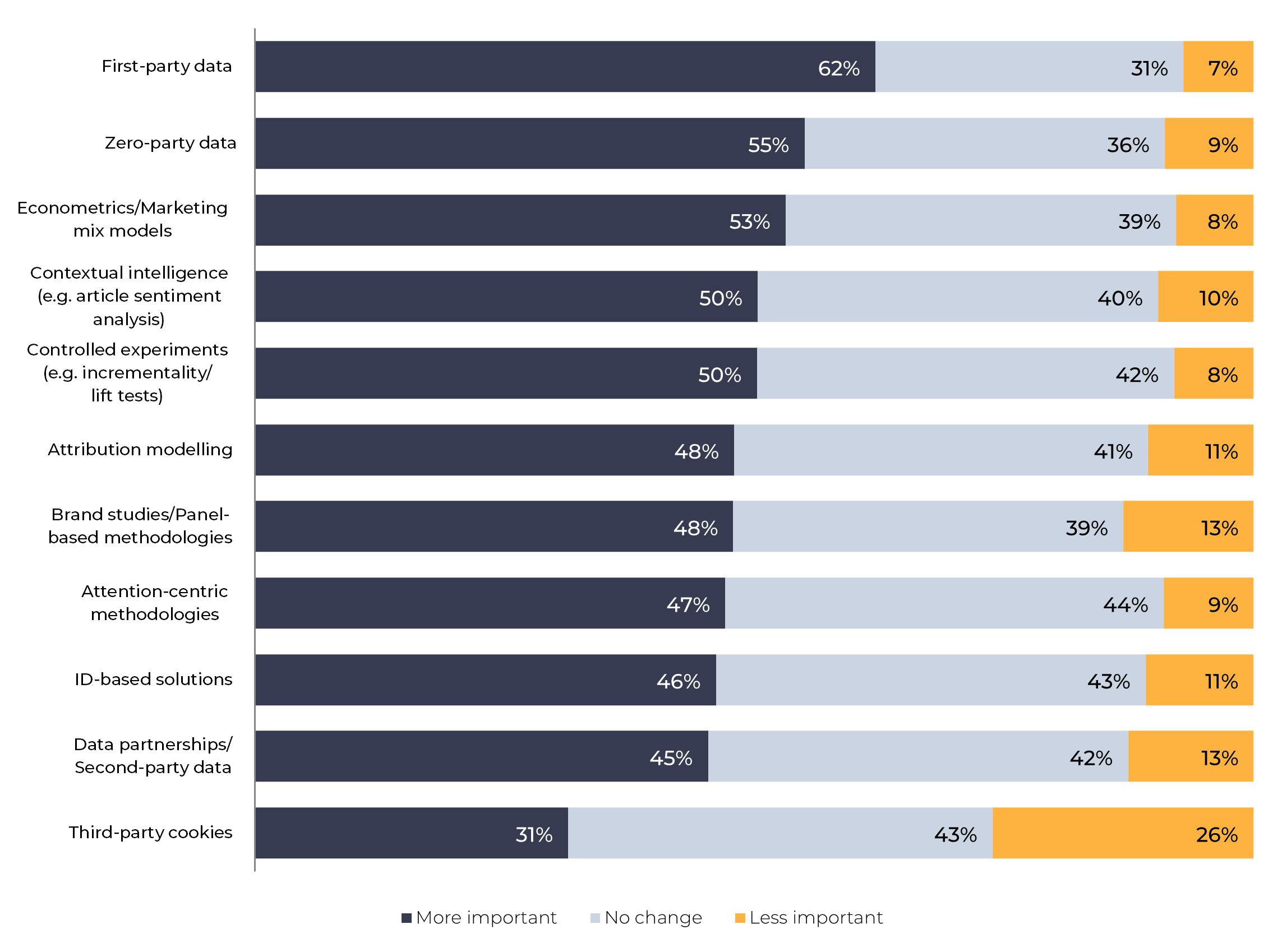
The measurement landscape has been a turbulent one in recent years, from new privacy rules to the announcement, and then row back, of Google’s third-party cookie crackdown. Faced with these challenges, and what is still set to be a low-cookie environment,[12] marketers are rightly shifting their focus to customer data shared directly with and owned by them in the form of first- and zero-party data.
Figure 14: How do you expect the importance of the following forms of measurement and targeting to change for your organisation over the next two years?
Source: Econsultancy’s Future of Marketing survey | Sample: 597
For more information on how brands are responding to the changing measurement landscape, see Econsultancy’s guide to Measuring and Driving Digital Marketing Effectiveness.
6.1 Privacy, regulation and value exchange
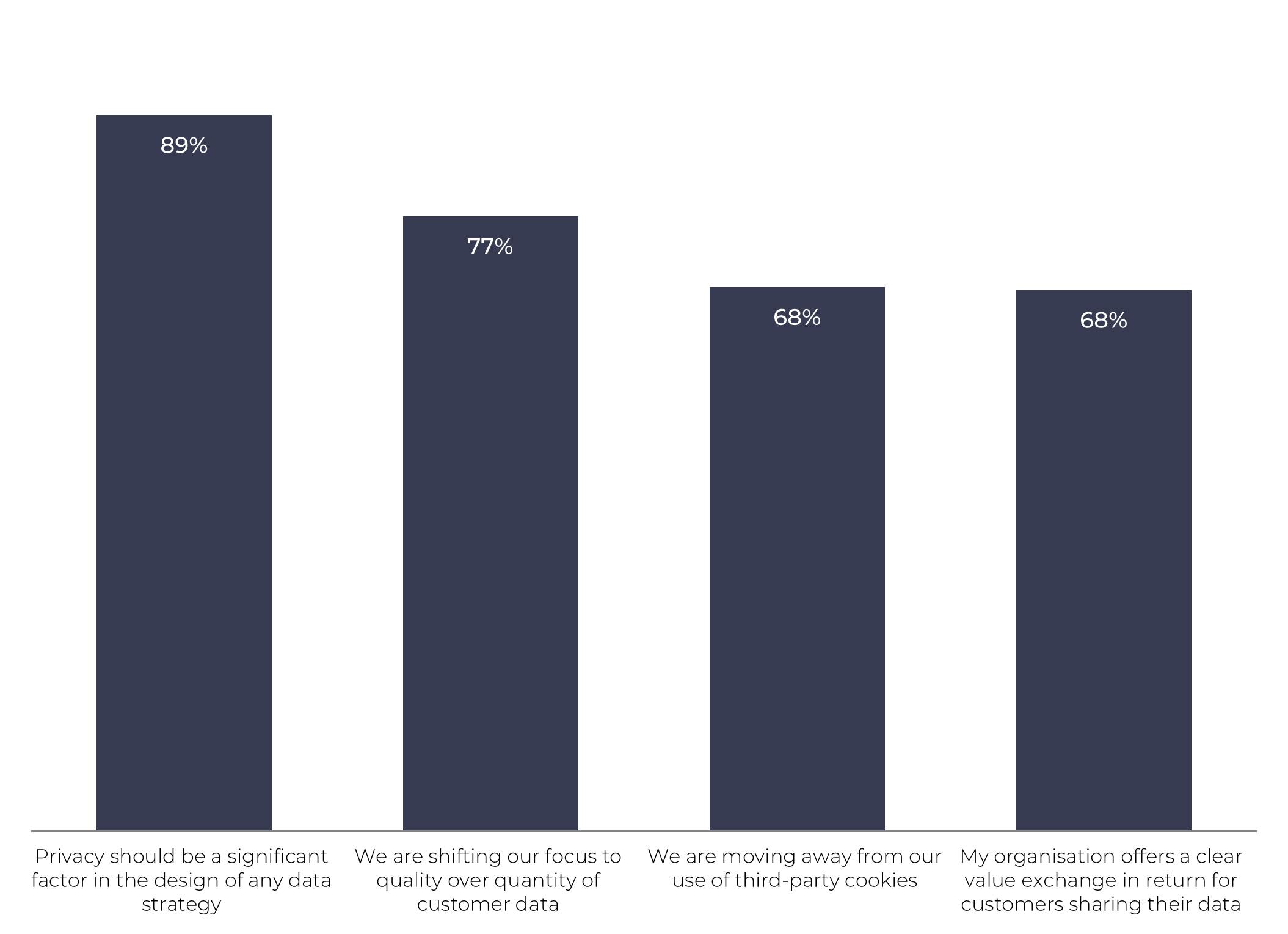
First-party data has long been considered the most valuable form of data for marketers, in part because it raises less privacy concerns. Marketers recognise the importance of privacy, with 89% saying it should be a key factor in the design of any data strategy.
Reflecting a maturation of the measurement and data landscape from treating customer data as an ‘all you can eat buffet’ to something more strategic, 77% of marketers report their organisation is shifting focus to the quality over quantity of customer data.
Figure 15: Do you agree or disagree with the following statements? (Agree only)
Source: Econsultancy’s Future of Marketing survey | Sample: 616
Alongside being more discerning with what is collected, marketers need to think about the value offered to customers in exchange for their data. Given the global proliferation of data privacy and protection laws,[13] giving customers a reason to want to proactively share their data will become increasingly important. As Pierre Charchaflian, Senior Partner of the Global Leader Marketing Transformation Consulting Practice IBM IX, puts it: “Value to the customers and customer privacy/data security go hand in hand.”
To improve your skills when it comes to collecting, managing and activating customer data, see Econsultancy’s Data Acquisition and Management Learning Plan.
7. Sustainability
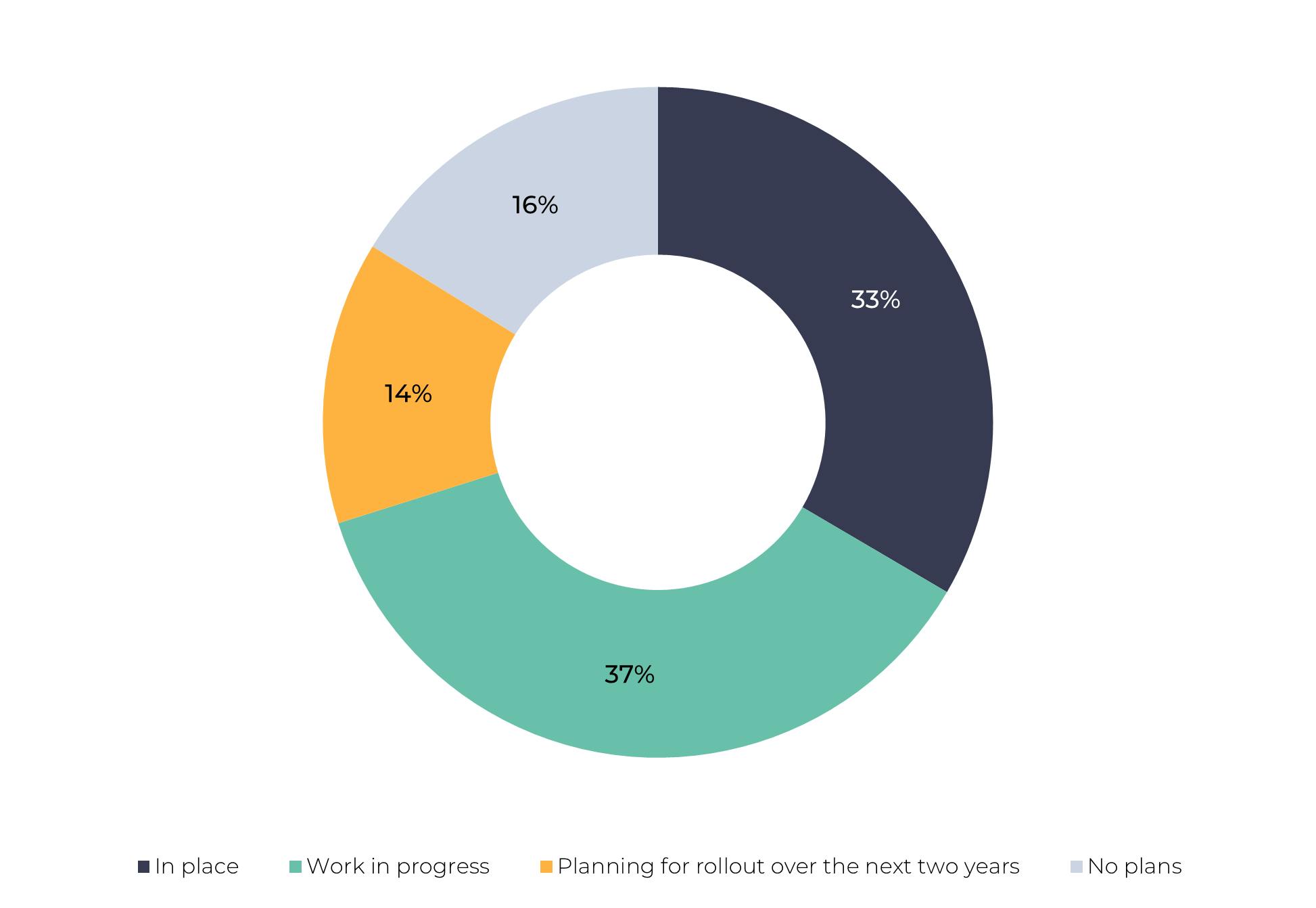
In what is set to be the hottest year on record,[14] just a third of marketers (33%) report that their organisation has a clear sustainability strategy in place. Though over half of marketers do report their organisation’s strategy is a work in progress (37%) or is due to be launched in the next two years (14%), for many it seems like action is not being taken quickly enough.
Figure 16: Does your organisation have a clear sustainability strategy in place?
Source: Econsultancy’s Future of Marketing survey | Sample: 624
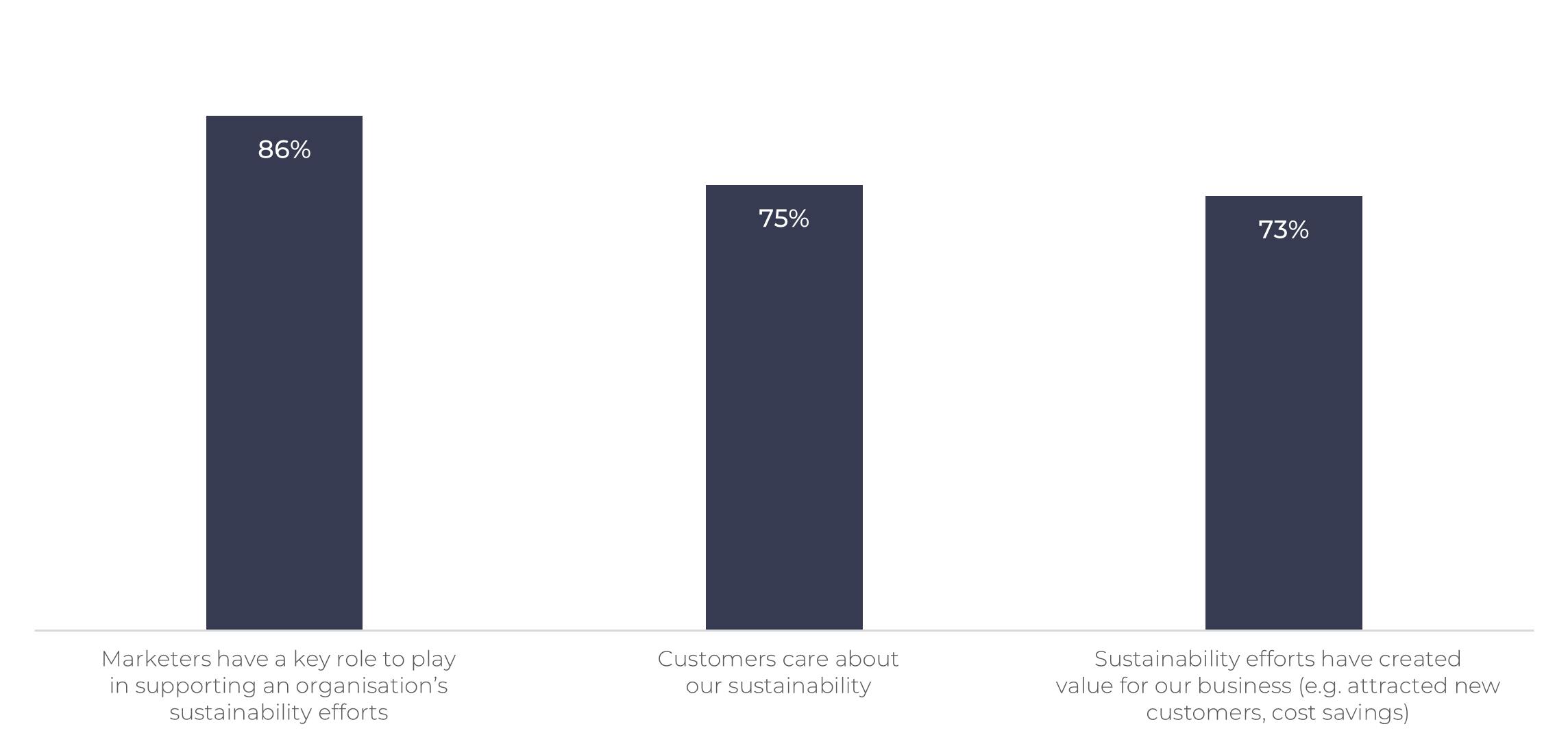
Beyond the moral imperative, there is a competitive cost to not addressing sustainability, with 73% of marketers reporting that sustainability efforts had created value for the business (Figure 18).
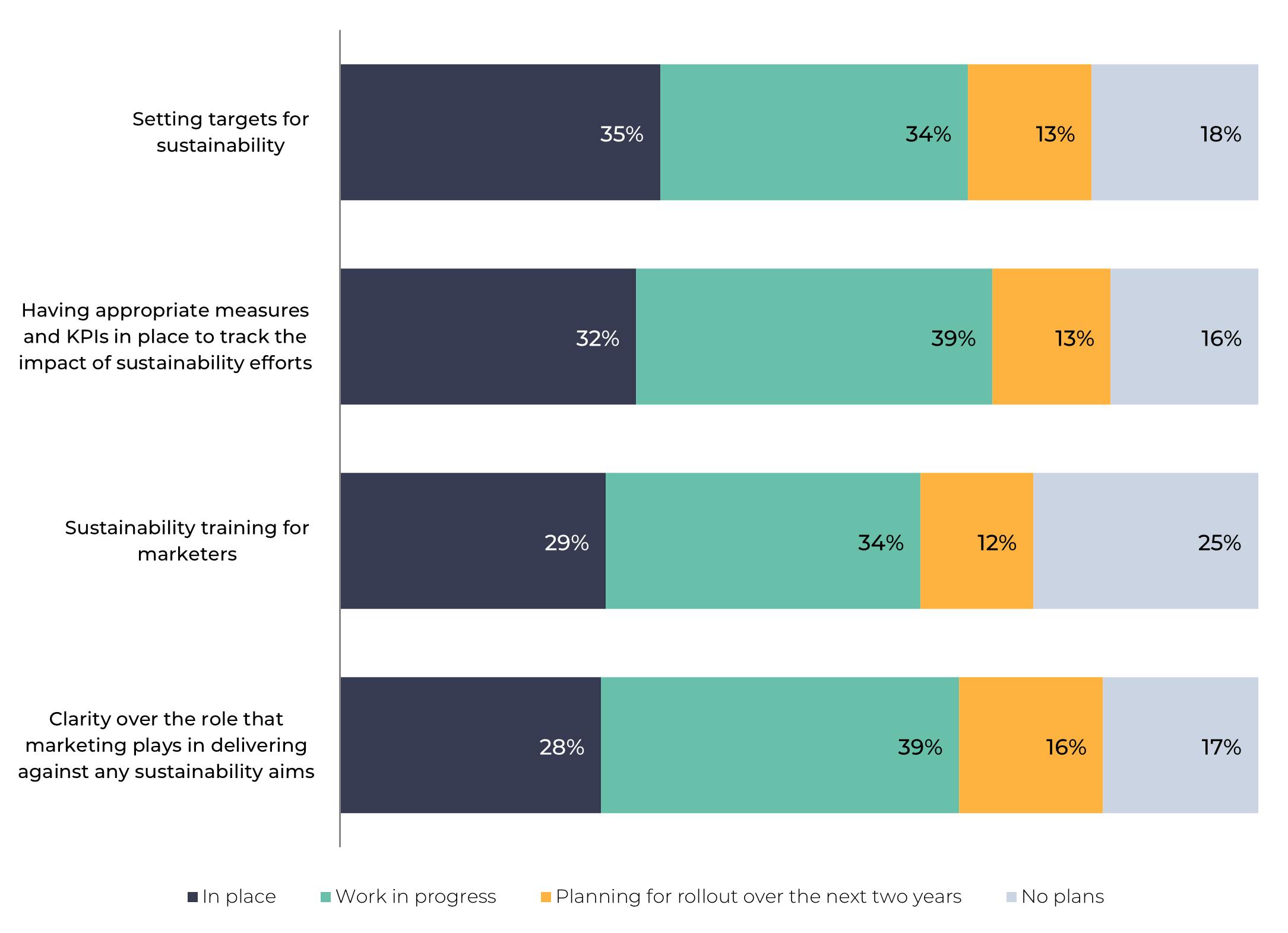
Yet only a small proportion of marketers report that their organisations have the foundations in place to support these strategies, with just 32% of marketers saying that their organisations have appropriate measurement in place to track the impact of sustainability efforts, and only 29% suggesting there is sustainability training available for their teams.
Figure 17: When it comes to sustainability and marketing, what stage is your organisation at with the following?
Source: Econsultancy’s Future of Marketing survey | Sample: 624
7.1 Marketing’s role
Though most marketers (72%) report that they do not have clarity on the role that marketing should play in delivering against the organisation’s sustainability goals, the vast majority (86%) believe it has a key role to play in supporting their organisation’s sustainability effort, while a further three quarters (75%) report that this is something customers care about.
Marketing is essential to the viability of green initiatives
In general, I believe most consumers want brands and products to be more sustainable.
However, sustainability efforts may result in greater manufacturing or packaging costs, which can result in compressed margins or a higher retail price. For brands looking to differentiate, it’s important to understand the relative importance of sustainability claims versus price and other product features/benefits. In a scenario that leads to a higher competitive price point, the viability of a sustainability initiative comes down to the ability to effectively communicate the claim and the consumer willingness to pay. Consumers may care, but how much and is that enough to justify the initiative?
Chris Hintermeister, Brand & Business Leader, Tropicana Brands Group
Figure 18: Do you agree or disagree with the following statements? (Agree only)
Source: Econsultancy’s Future of Marketing survey | Sample: 616
Sustainability is also a matter of brand safety, with protecting brand reputation one of the top drivers for organisations to address their environmental sustainability (38%), equalled only by an alignment with the organisation’s broader aims (38%) and closely followed by customer expectations and preferences (33%).
Brand reputation is likely one of the key reasons organisations have become more cautious about speaking about their sustainability efforts, as concerns over being accused of greenwashing have led to the phenomenon of so-called ‘green hushing’, where organisations go silent on their environmental initiatives.[15]
For ACCO, sustainability is “increasingly both a requirement and a source of competitive advantage”, shares Björn Barnard, Digital Marketing Director at the manufacturing company, as the businesses they sell to have become more demanding when it comes to product traceability and environmental impact. However, communicating that competitive advantage has its challenges. To avoid any accusations of greenwashing, Barnard adds: “Our legal team has evolved into an extension of our marketing team. Not being a regulated industry, we’ve had to ensure that our product activation processes allow additional time for those legal reviews.”
For those brands not taking action to address their environmental impact, they are leaving themselves open not only to competitive and brand risks, but the potential to be caught out by new regulations, as faced with the impact of the climate crisis, governments across the globe are bringing in new environmental rules.[16]
Among the experts calling attention to the importance of sustainability, each understood the challenges involved but highlighted that increasingly not taking action was no longer an option. “It’s not a trend. It’s a requirement,” emphasises Haley Eiser, Senior Marketing Director at Reckitt, adding “sustainability is something we need to do and must be a priority end to end”.
8. Conclusion
Marketers are right to be optimistic about the future – as long as businesses seek growth, there will always be a need for marketing. That is unchanging, it is just the tactics, methods and tools available to marketers that evolve. These will require new skills, investment and adaptability from an industry already well versed in transformation.
When looking to the future it can be easy to focus only on what is changing. Though the next two years will undoubtedly offer much in the way of shifts and transformation, much of it underpinned by technological advancement, some things will remain consistent. As Chris Hintermeister, Brand & Business Leader at Tropicana Brands Group, puts it: “Marketers are humans trying to communicate with other humans. While the tools and tactics are changing, those fundamentals are not.”
9. Appendix
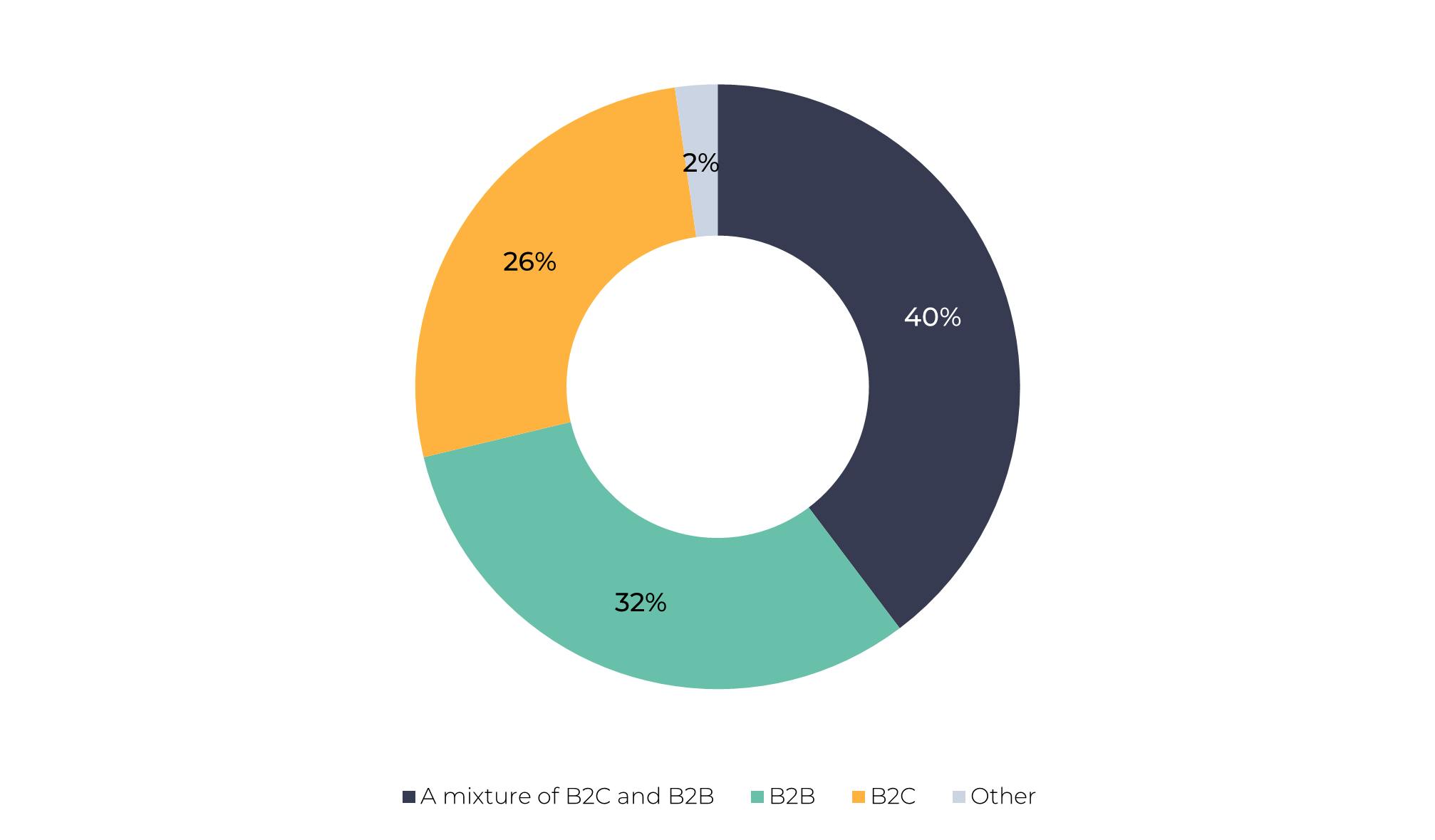
Figure 19: What best describes your job role?
Source: Econsultancy’s Future of Marketing survey | Sample: 608
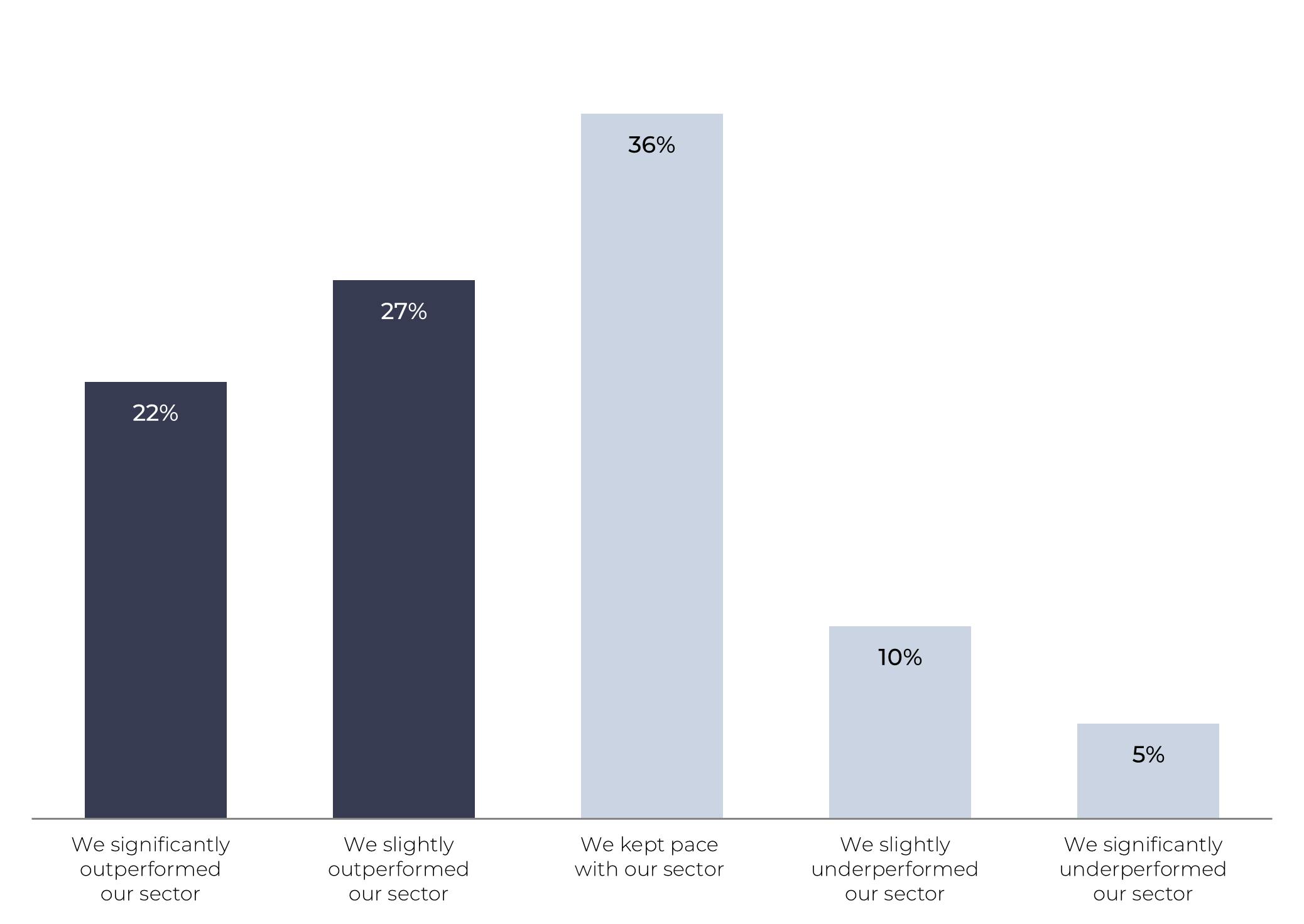
Figure 20: Thinking about the competition in your organisation’s primary sector over the last year, how did your company perform?
Source: Econsultancy’s Future of Marketing survey | Sample: 910
Figure 21: In which country or region are you (personally) based?
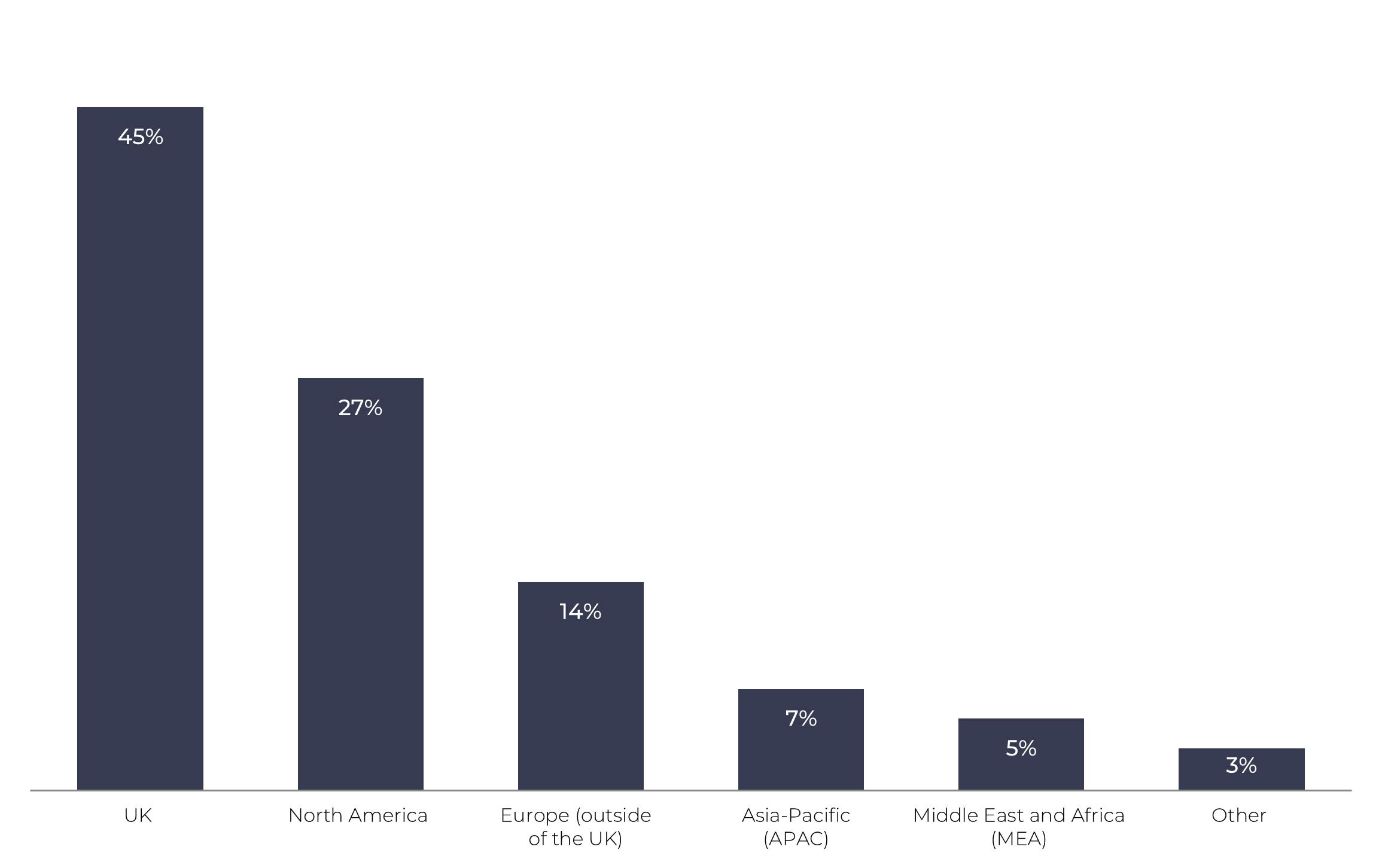
Source: Econsultancy’s Future of Marketing survey | Sample: 612
Figure 22: What is your annual company revenue?
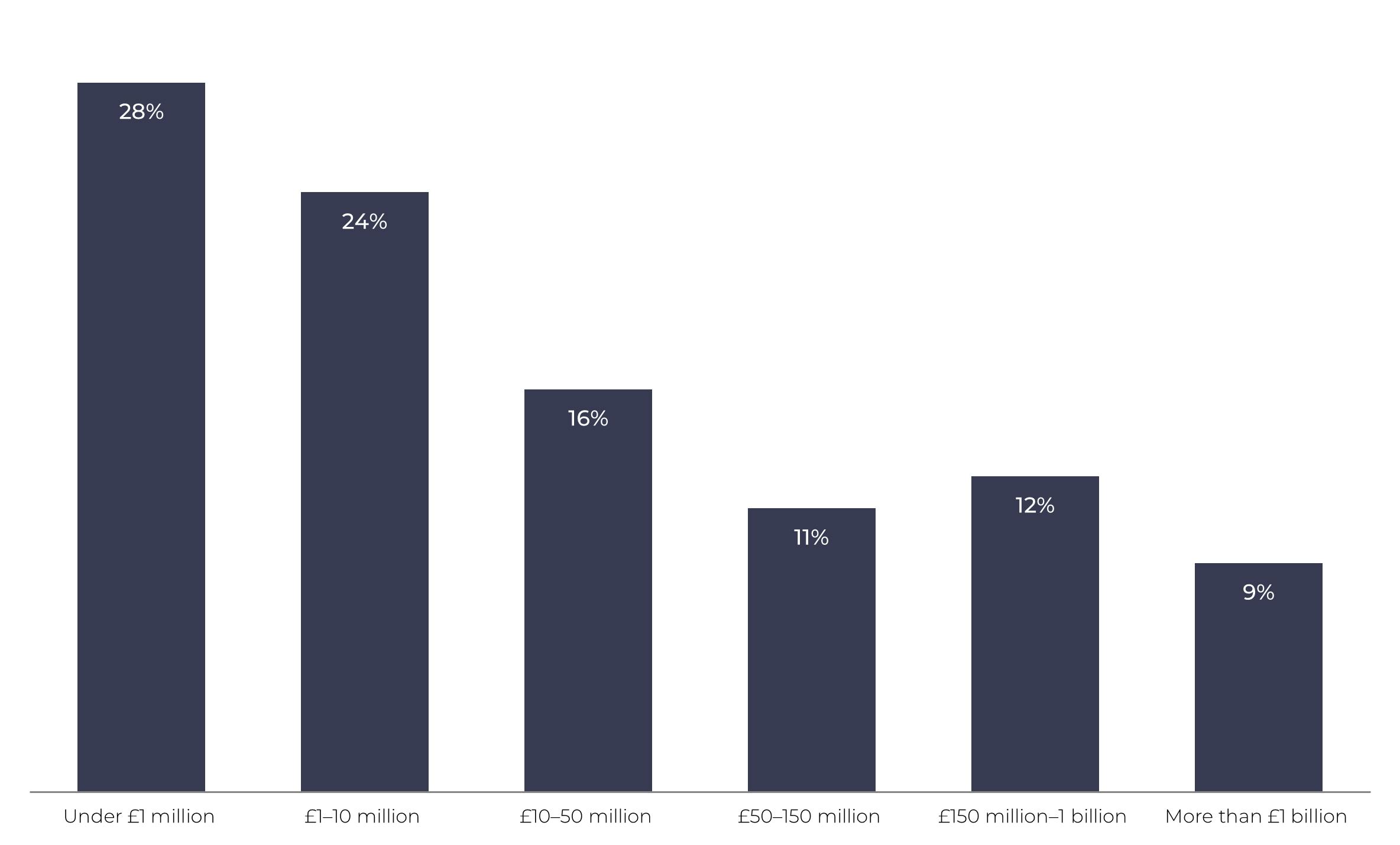
Source: Econsultancy’s Future of Marketing survey | Sample: 616