
Content marketing
Content
Innovation and Trends
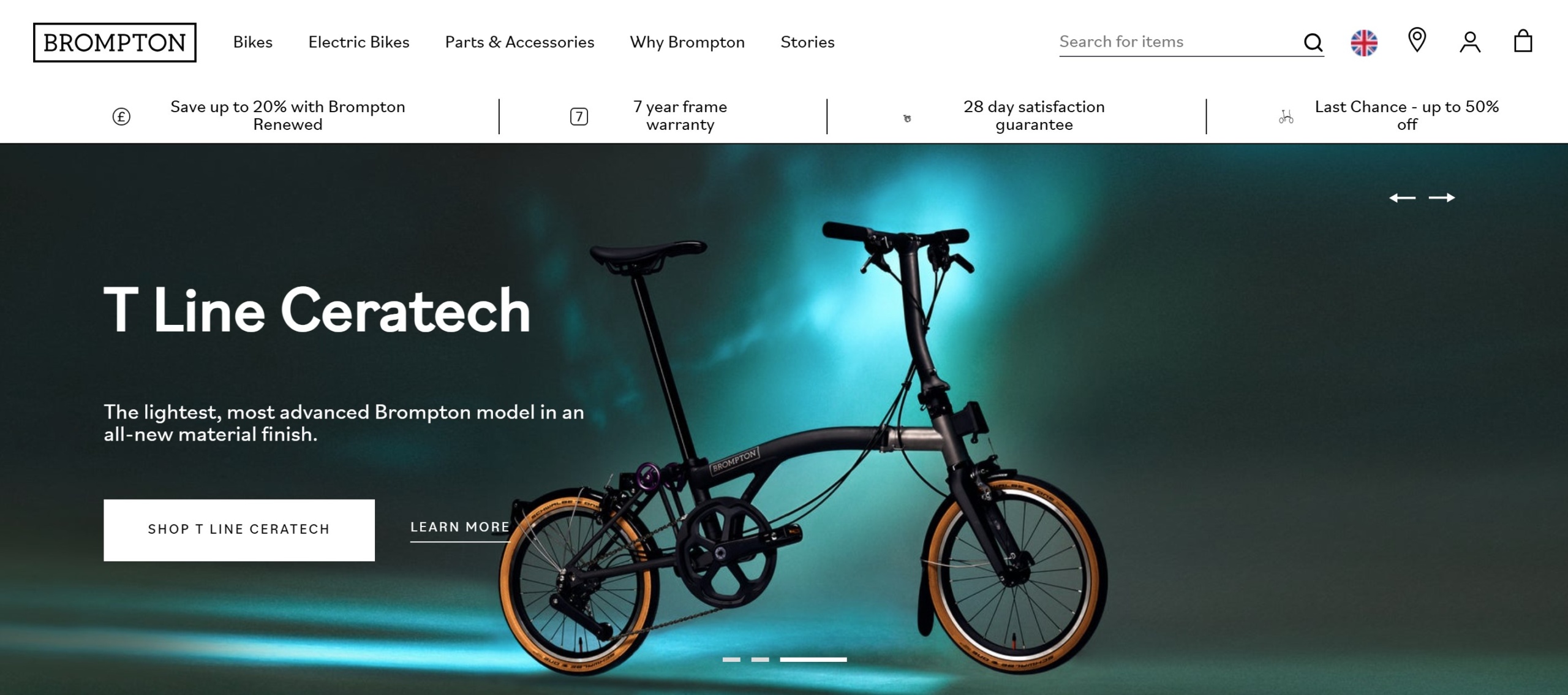

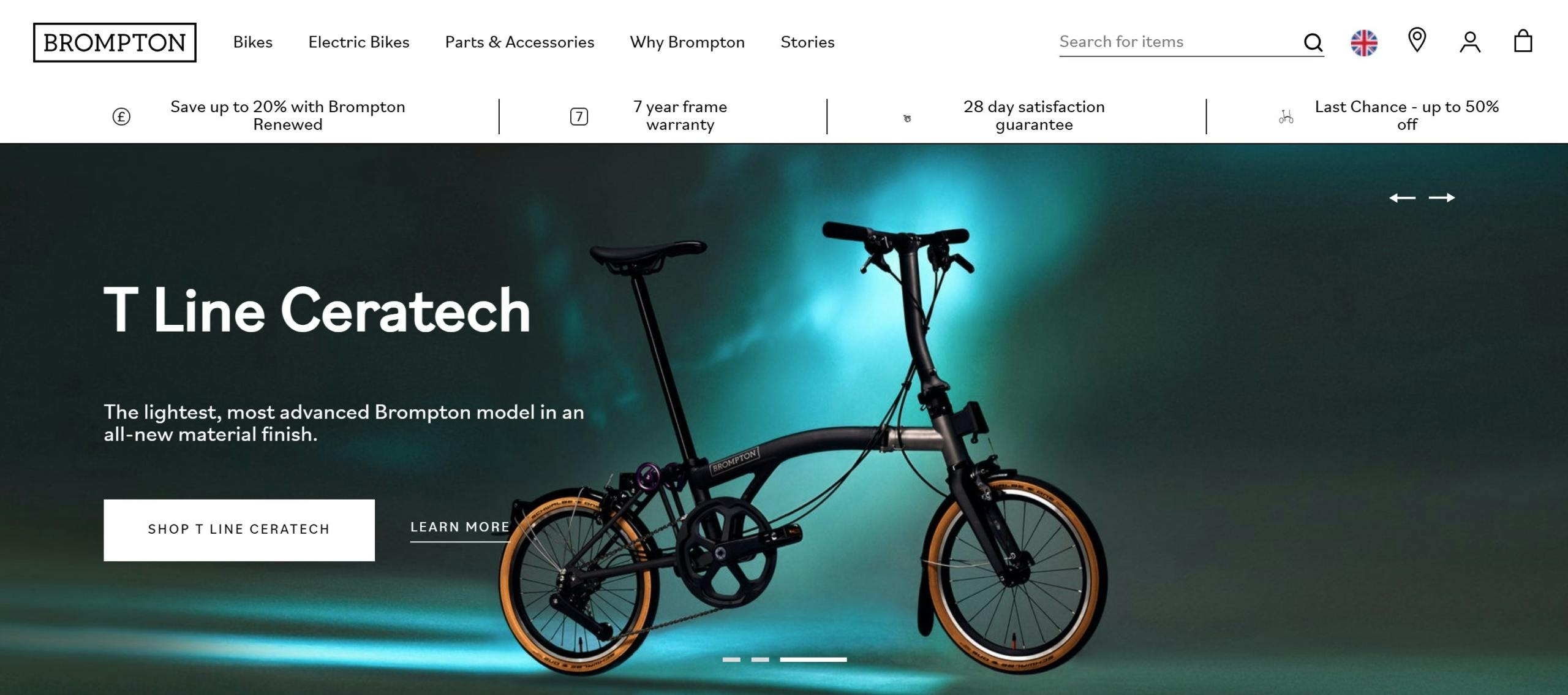
Folding bike brand Brompton Bicycle, now approaching its 50th anniversary, specialises in high-end bikes that last. Whether customers are shopping in a bricks and mortar outlet or online, they’re making a considered purchase of a high-quality product.
However, until a few years ago, Brompton’s online experience wasn’t of the same quality as its bikes. “Our bikes are premium … and hence, they come with the price point that they [do],” explained Chris Matthews, global DTC channel director at Brompton Bicycle. “It’s critical that we’re representing that really well [online] … [but] we knew we weren’t giving the experience we wanted to give.” A partnership with composable commerce platform BigCommerce helped to bring Brompton’s site experience quite literally up to speed – but this was just the first step.
I spoke to Matthews about the results from Brompton’s replatform and where they’re headed next; the challenge in building a full picture of a protracted customer journey; and how Brompton encourages customers to come back to the brand beyond their purchase.
The cycling industry as a whole was given something of a wake-up call with the onset of the pandemic: demand for bikes surged, and specifically surged through online channels as stores had been forced to close. “It’s a traditional industry, the bike industry – there’s a lot of businesses that needed to catch up in our space, especially when Covid happened,” said Matthews.
Brompton was no exception: Matthews described the brand’s ecommerce business as having been “very small” when he joined Brompton in 2019 (direct-to-consumer as a whole was a relatively recent move for the brand). The sheer sales volume brought about by Covid quickly forced a reassessment: as Matthews reflected, “It moved us along significantly, and no doubt has driven a quicker transition to a more digital-led business that we are today.”
If you’re shopping something that’s quite a considered purchase … Nothing gives you a lack of trust like a slow website.
A major concern for Brompton and a key metric that has been used to gauge the success of its replatform was site speed. “When you’re a premium brand, when you’re a high-ticket purchase brand – site speed is critical.
“If you’re shopping something that’s quite a considered purchase … Nothing gives you a lack of trust like a slow website. Especially on checkout … It just doesn’t give you confidence to spend that amount of money.” Prior to Brompton’s replatform, Matthews recalled that checkout would take a full 10 seconds to resolve. “These are lifetimes in our world.”
From this glacial state of affairs, Brompton transitioned to a fully mobile-responsive website with one- or two-second page load times and the ability to handle numerous additions to the tech stack, as well as sudden influxes of traffic, such as for the launch of special edition Brompton models.
Conversion rate is another key metric that has improved significantly since the replatform. “We can add more products; we can surface products better; we have more payment options – all these things are the small things that make sure conversion rate heads in the right direction.” Matthews estimated that conversion rates for Brompton are up 40-50% this year (allowing for slight variations in different international markets) compared to the previous year.
The improved website infrastructure has unlocked additional possibilities for Brompton in creating a richer and more immersive experience. “We need to give customers who are doing a more digital journey full confidence in understanding what they’re buying, especially at higher price points,” said Matthews, explaining that the replatformed site can seamlessly handle different product variants like colour and handlebar options.
“Video is critical for us – really being able to show off touchpoints on our products in detail. … We are now deciding to explore 3D imagery, 360 imagery, rendered imagery – which we can host confidently on the tech stack that we’ve got.”
Video is critical for us [in] being able to show off touchpoints on our products in detail.
As immersive as online journeys can be, customers will often want to see and test out a bike before they buy it, especially for higher-end models. Offline touchpoints, and in particular test rides, are an important part of the decision-making process for Brompton customers.
“We actually want people to come onto our website but then go to our stores – or one of our retail [partners] – to test ride the Brompton,” said Matthews. “…Our bike is a bit quirky, a bit different – it’s not your standard cycle, which is what we love; but once we get people to do a test ride, we know it really moves them through the funnel down to a much more intentful point to purchase.”
Brompton’s new tech stack offers more insight into customer data, but getting a full picture of a protracted customer journey across online and offline – and moreover, measuring the impact of specific touchpoints – is still a challenge. “It is a long journey, we know that; so, it’s critical for us to understand how we measure our funnel,” Matthews said.
“It’s about understanding – okay, they’ve come to our website; how do we get somebody to sign up to a general piece of information about [us] – and that gives us some type of communication with the customer. Then, how can we ensure our CRM journey is up to speed? Make sure they understand about Brompton the brand – what it is, what the benefits are.”
We know that bricks and mortar is in growth … so … how can we ensure that digital and offline play together?
Nudging the customer to take a test ride will most likely bring them to a Brompton retail partner – “the closest Brompton retailer is probably not our own store” – and so one priority is to ensure better integration of data from these vendors.
“Our next step is how we integrate our retailers much more so they’re part of this journey with us, because a critical channel for us is still our B2B model,” explained Matthews. “…But it’s a two-way street – now, with our tech stack, we’ve got much more confident in how we can interact with a retailer; but it requires them also to have the right solutions to talk back to us.
“…We know that bricks and mortar is in growth – we can see our footfall to stores growing – so, knowing that this is a considered purchase, how can we ensure that digital and offline play together?”
Brompton has also begun rolling out a subscription model as a more affordable way of introducing customers to a Brompton bike. “We just started that recently – it’s really, really gaining traction,” said Matthews. “…You can subscribe to a Brompton, and … we’ll look after it for you, we’ll maintain it, it’s insured, it’s all those things.
“From our side, we know that customers who do that are very likely the ones who’ll buy a full-price product. … After a month, they can return it back, that’s fine – but what we find is that people use it a lot more than a month … and they convert to a full-price bike.”
Thanks to the replatform, Brompton has been able to bring this subscription product fully within the overall digital journey: “We [used to] manage subscriptions completely separately – we’ve now brought that onto [the] digital journey online; that’s another big, big plus.”
After such a protracted customer journey, making a sale is a win, but all brands want to ensure that their customers keep coming back. This is more tricky when the brand’s main product is a significant purchase that’s designed to be long-lasting.
Brompton’s new platform can handle user accounts much more effectively, which gives Brompton a way of keeping in touch with the customer, although Matthews was keen to stress that this is “not [for] purely marketing-led reasons, but brand-led, product-led reasons.
“… I think people are clever now with marketing techniques, and can see when you’re being asked for information for a marketing-led purpose, or whether it’s actually for, ‘This is enhancing my experience with the product’ – and we can do that a lot more now.”
With that said, “There is a revenue element to it – there are accessories; there are products you can buy, and we can bring people back in to purchase … apparel, or features that can enhance your experience on the bike.”
Matthews added that Brompton is now thinking a lot more about servicing. “We can now sell servicing through digital platforms – you can book a service, or have somebody send your bike in to get it fixed; we’ll come out and collect your bike for you; you can take it to one of our partners – trying to make that as seamless as possible is another big post-purchase contact point with customers.”
Despite the ever-surging popularity of rewards- and points-based loyalty systems, Matthews emphasised that Brompton is keen to make sure loyalty doesn’t take the form of “a membership points system type thing – we’re not about that”.
“We’re very much a community brand,” Matthews added. “We have very strong brand advocates who use our products and love it – and then are part of our communities. A huge point of loyalty for us is … we do so many events, and we want communities to come [together] on the back of it.
“Word of mouth still works [well] for us as a customer acquisition tool.”
A major Brompton event coming up in June is the Brompton World Championship (BWC), part of the London Cycle Festival, in which cyclists race their (non-electric) Bromptons around a 900-metre track. This year, the BWC will also be a celebration of Brompton’s 50th year.
“It’s a big year for us … [The Brompton World Championship] brings people from all over the world who want to show off their bikes … That for us is a loyalty piece and brings people together. You can [also] sell things at those events – there are new products, there’s accessories.”
Speaking of Bromptons around the world, Brompton Bicycle has ambitious plans for upping its international expansion in 2025 and beyond. “Another reason we chose BigCommerce over other tech stack providers for the replatform is the fact that we can go to multiple international markets very easily,” Matthews noted.
Brompton has established presences in the US and in Europe, where the focus for ecommerce is continuously improving the quality of the customer experience and upping metrics like conversion rate and engagement scores.
However, expanding further into Asia – into countries like China, which is Brompton’s largest market “not just digitally, but on all channels”, Japan, South Korea, and parts of Southeast Asia – is the next big goal. Last month, Brompton opened its first direct-to-consumer retail store in Tokyo, which has been performing well, “and we’re hoping to follow up with ecommerce in the near future as well.
“We’ve done a lot of international growth over the last few years – but there’s, very excitingly, still a lot more markets to go into … from an ecommerce perspective.”
Read more about creating great CX and omnichannel experiences in our best practice guide.