Content marketing
Content
Innovation and Trends
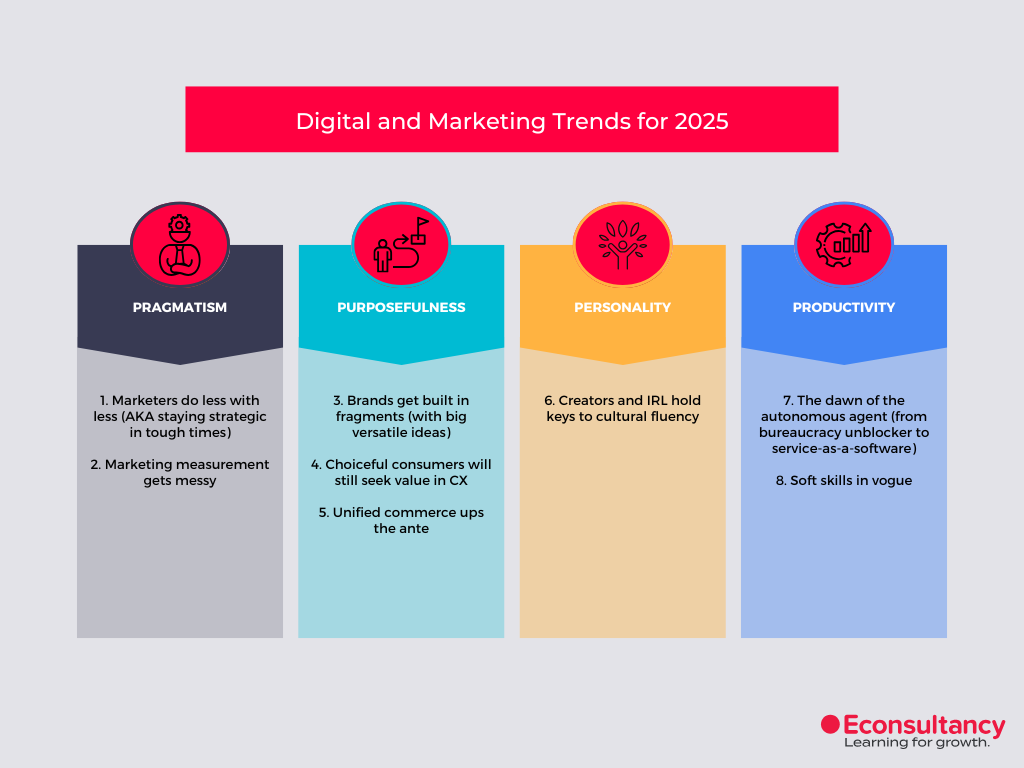

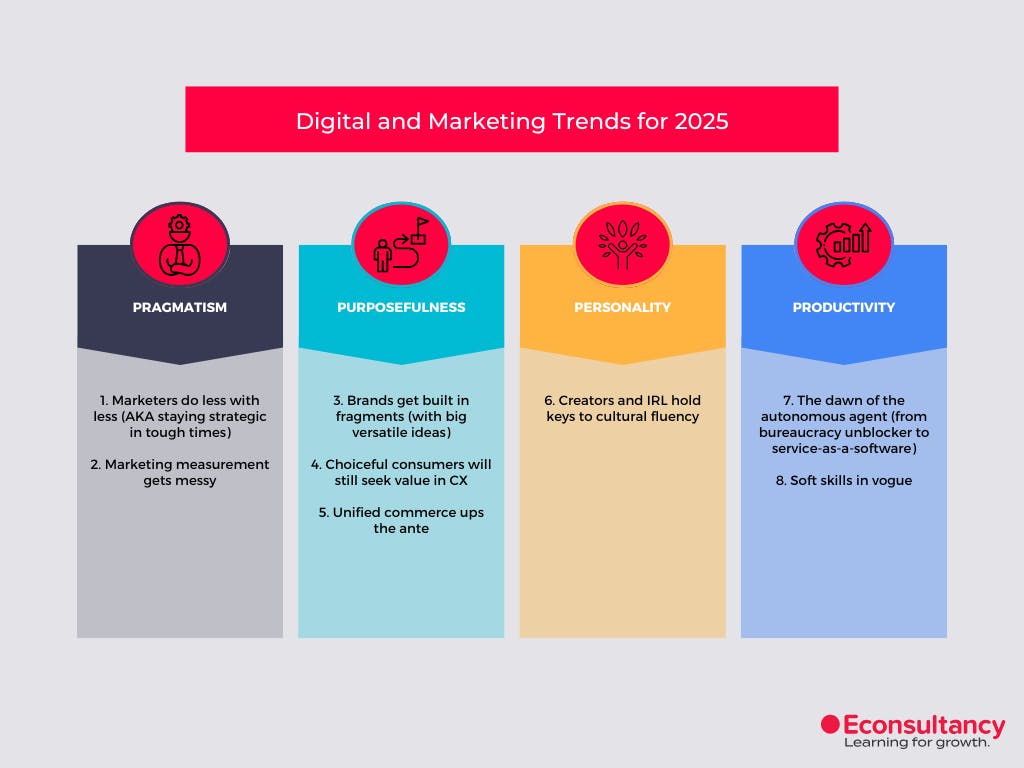
Every January at Econsultancy we write a trends post summing up some of the skills and strategies set for prominence over the next 12 months in the worlds of marketing, ecommerce and digital.
If you fancy poring over previous years’ offerings (most of them by co-founder Ashley Friedlein), you can do so here.
This year we’ve got eight trends, and for a bit of fun I’ve put them in four buckets – pragmatism, purposefulness, personality and productivity. I am in no way trying to redefine the 4Ps, it’s simply a naked ploy to make the list more memorable.
You can use the links below to jump between each trend.
N.B. If you’re a marketing leader or work in L&D and are interested in how you can upskill your team in 2025, get in touch, or attend our next Capability Forum.
Pragmatism
Purposefulness
Personality
Productivity
Here we go….
“Fewer, bigger, better,” and on a tighter budget. A tough economic outlook means there is no room for tactics to leapfrog strategy.
When we asked a few agency folk about the elephant in the room heading into 2025, Mindshare Sweden’s Nils Andersson Wimby pointed to a familiar beast.
“Our field is still pestered by the confusion of tactics and tools with strategies, with tech and channel FoMo, with a nervousness and lack of confidence that means we keep adding more things rather than focusing on fewer, bigger, better.”
Wimby highlighted the tension of a marketing industry known for its (potentially distracting) innovation and populated by many professionals that lack formal education in their field.
“Strategy is largely an exercise in prioritization, in choosing what not to do. That’s not an easy undertaking when there are so many fun new opportunities,” the client director said.
“TikTok, for example, is not a strategy, it is a tool that may or may not fit into a strategy. The same goes for influencers, performance marketing, omnichannel and even AI. Fighting to put these new things into perspective is a herculean task, and a lot of people are losing that battle,” he added.
Strategy is largely an exercise in prioritization, in choosing what not to do. That’s not an easy undertaking when there are so many fun new opportunities.
This is where Wimby refers to the “silver lining” of the current economic landscape – perhaps allowing marketers to find greater focus. We know there have been layoffs – such as in consumer goods, and in retail where ONS data shows 40,000 fewer UK jobs than last year (with many larger retailers also trialling more automation). And we know that budgets are tight in 2025. The Q4 IPA Bellwether report was positive at face value (21.7% of panellists reported an increase in their total marketing budgets, 19.9% reported cuts, for a net balance of 1.9%) but looks very sluggish when compared to its 2023 counterpart (net balance of 14.7% as companies ramped up for holiday spending that year).
Those marketers who haven’t maintained or grown their budgets in tough times (see Britvic for a recent success story) are therefore tasked with using their time and money even more wisely. As Wimby puts it, this “will force us to focus on the things that generate profit rather than the things that are trendy”.
The industry talks a lot about doing more with less, perhaps doing less with less might be a paradoxically productive mantra. Drop that shiny thing.
There are no magic metrics or one-size-fits-all methodologies. Marketers are blending attribution, marketing mix modelling and incrementality testing. Analytics consultancies are in high demand.
Data and analytics is consistently noted as the chief skills gap in marketing teams. It has topped many a Marketing Week Career and Salary survey in this regard, as well as Econsultancy’s Future of Marketing surveys. In this year’s version of the latter, it was joined by AI skills at the top of a list of priorities.
The rise in AI has prompted debate about whether self-serve data analysis could be on the horizon, ready to solve our problems with some sort of natural language interface. In Scott Brinker and Fran Riemersma’s Martech for 2025 report, a survey on genAI usage found that finding and consuming data is the second most popular use case for the tech, after content. This includes searching across data and knowledge bases (43% said they had used this functionality) and the ability to ‘chat with your data’ (39%).
In an essay in the same report, the authors talk to Chris O’Neill, CEO of GrowthLoop, who discusses agentic AI and the ability for autonomous or semi-autonomous agents to undertake “data ingestion or data scoring”, as well as building audiences that might best deliver a campaign outcome.
It’s hard to disagree with the assertion that AI is going to help marketers manage an increasing number or complexity of campaigns, and in our interview with Andrew Hood, founder of analytics consultancy Lynchpin, he advises marketers to, “Start thinking more about data management, and specifically capturing data in a way that makes it ready for AI.”
“Investment in data quality now is going to be a massive future value enabler,” adds Hood.
However, leaving aside the tantalising idea that AI might eventually solve some of our data skills deficits, what it can’t do (and arguably may never be able to) is the sharp end of marketing measurement. The mix of commercial and technical acumen.
What’s happening currently in the world of campaign measurement is actually hard-nosed realism about the effectiveness of different methodologies, and how they can work together to throw light on marketing effectiveness.
This requires some very human data science chops. “Marketing measurement is becoming more complex – legally, technically and analytically,” says Hood. “A new blend of skills is increasingly required to successfully triangulate attribution, marketing mix modelling and incrementality testing, and to address the nuances of data collection itself. But equally critical is the business experience to align these techniques with the commercial backdrop to make sure the results can drive effectiveness.”
This measurement paradigm, sometimes called the ‘golden trinity’ or ‘trifecta’ is explained neatly in an article from November by János Moldvay, VP of Measurement at Funnel (a platform and consultancy) and also explored in Econsultancy’s guide to digital marketing measurement.
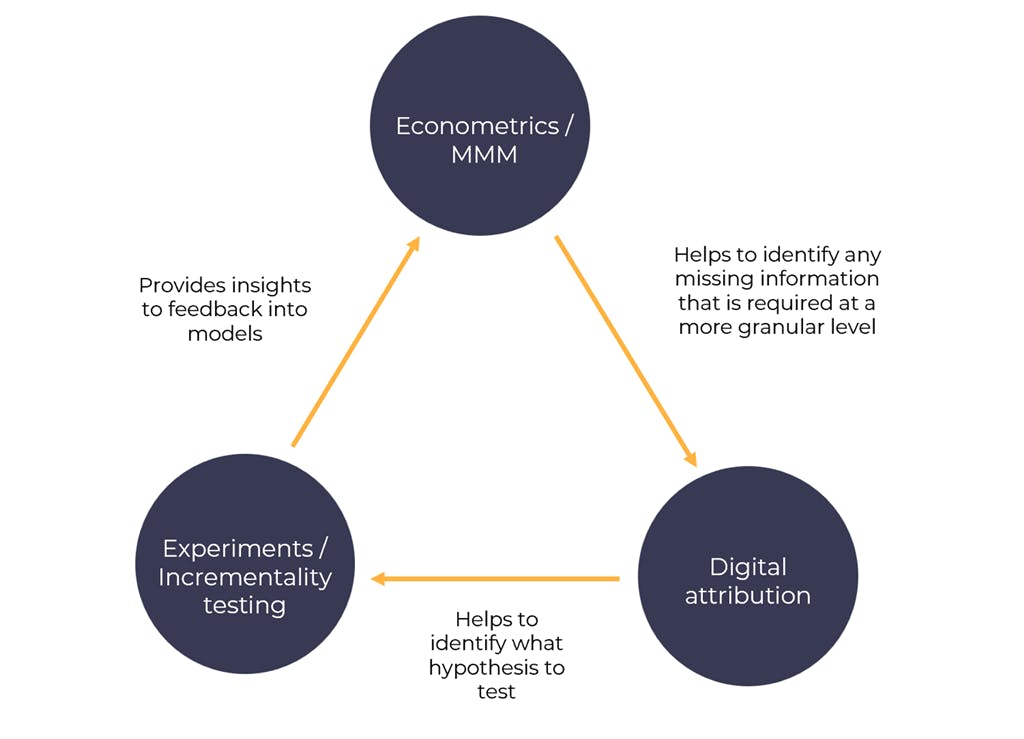
Marketers have long known the pros and cons of each of the three methodologies. So – rather than trying to alight on a magic metric, rely on walled garden numbers, or cling to the idea that all online spend is trackable – they are using a mix of attribution (at a click level), MMM and incrementality testing to uncover insights that, when overlaid, will offer a better perspective on effectiveness.
The partial death of third-party tracking cookies over the past few years has perhaps been the wakeup call that marketers needed, in order to see the inherent messiness of measurement. The recent growth of retail media and recognition of the limitations of the ROAS metric has also played a part, with incrementality startups on the rise.
For more on triangulation and measurement frameworks, see Econsultancy’s report chapter on Choosing and Evaluating a Digital Marketing Measurement Approach.
Marketers must strive for adaptable yet coherent campaigns in a fragmented media environment.
Most marketers will know that brand building across multiple channels has an accretive effect (if not, read Grace Kite in Marketing Week). There is a degree of synergy between each channel that makes the whole greater than the sum of its parts, as borne out in Kite’s econometrics work.
Roughly speaking, somebody who sees two TV ads, a different ad on Instagram and maybe some out-of-home creative will likely have a greater chance of forming positive associations with that particular brand, compared to somebody who has seen just the repetitive TV ads.
Adding to the effect of channel synergy is the power of contextual advertising – reaching your target audiences in the places they hang out with ads relevant to the surrounding content will leave them more likely to remember your campaign than if they are simply interrupted. As Kite points out, the devil lies in the detail of (algorithmically?) coordinating this variety of advertising so that it has the best chance of leading to a sale.
This increasing understanding of how channels layer together doesn’t mean that creating effective multichannel campaigns is easy. It’s hard to ignore the fact that a decade of anxiety about the (un)suitability of online ad formats to both great creative and great exposure has now melded with newer anxieties about the enshittification of online spaces, and the impact that genAI could have in commoditising creativity. To make the point plainly, marketers (especially the nostalgic ones) are wondering if their ideas are as good as they used to be, and if they work together well enough to cut through (despite the advances in creative pre-testing and effectiveness measurement). In fact, 82% of marketers responding to Econsultancy’s Future of Marketing survey reported that achieving cut-through is increasingly a challenge.
Kevin Wassong, founder of mktg.AI, a platform that combines creative assets and analytics, recently posted on LinkedIn about longing for “the intellect and intelligence that used to go into crafting a message” and how he bemoans the industry “filling spaces with little regard for what fills the space itself”. He went further, asking whether advertising on online platforms is “white noise” and if AI might exacerbate the problem. Of course, the purpose of his software and others is to help marketers tailor their creative to best suit each channel, and to recognise when they are successful.
As Grace Kite makes clear, the variety of the ‘many-touchpoint’ campaign can help entertaining, funny or emotional ideas stick in people’s heads more readily, making the associated brand more memorable. But ideas must be both “ruthlessly stuck to” and “versatile”, with creative tailored to match the platform (“a matching set of luggage that’ll take them to the moon, the arctic, and to Croydon”). Spotify Wrapped is one that comes to mind for me, with its famous billboards complementing its social activity.
This idea of building brands in fragments reasserts the idea that marketers must know their strategy – and have it ready to shape of their chosen media channels.
Further reading: Driving Effectiveness with Creativity
In times of low consumer confidence, shoppers still want trusted and engaging experiences (online and off), as shown by the success of some of the UK’s big multichannel retailers. Bargain hunters can be targeted through personalisation.
Last year in Econsultancy’s trends article, we highlighted the need for businesses to focus on the customer’s long-term satisfaction, amidst the disillusionment caused by rising prices (including shrink- and skimp-flation). That’s easier said than done in tough times, and indeed Forrester reported in June 2024 that US consumer perceptions of customer experience quality had dropped for the third year in a row (across each of the dimensions of ‘effectiveness’, ‘ease’ and ‘emotion’).
This is disappointing, given the importance of CX. Even in the world of grocery, where convenience is a major factor in determining where people shop, experience holds its own. A study by RRD found that 32% of shoppers surveyed in Q2 of last year said that they prioritise an ‘engaging shopping experience’ over ‘convenience and proximity’ (rising to 39% of Gen Z).
Marks and Spencer is one retailer that has been reaping the rewards of its customer experience strategy throughout its recent renaissance. Over the holidays it saw good results from investment in new and renewal stores, which “continued to outperform expectations” according to its Christmas trading update.
Although Forrester, rightly points out that differentiation through CX is not cheap, given it often requires this type of strategic investment, there are still some interesting dynamics playing out in sectors such as retail. M&S CEO Stuart Machin pointed to Clothing, Home and Beauty and the retailer’s “focus on turning stock faster, further reducing options and optimising store range and space” including “plans to modernise the supply chain and utilise digital and technology to maximise our online potential”.
This is a notable part of omnichannel strategy – using ecommerce to offer a full range of products, in some cases bolstered by third-party brands (lower margin but lower risk), and thereby allowing for a less cramped store experience where the reduced choice means less stock left over for sales and more “full price sell through”.

As well as retailers understanding the right size of range to present to customers, customers themselves have become more choiceful in an economic downturn. This often means trading up as well as trading down, a bit like the lipstick effect – deciding where to buy private label products, for example, and where to spend extra on products they desire (hence the premiumisation strategy some brands have pursued).
Next’s impressive holiday results perhaps provided some evidence of choiceful customers, too, as it showed shoppers “buying fewer entry-level products and more items at the middle and top end of our price architecture”. The retailer clarifies this as “buying fewer, marginally more expensive items,” which in turn can deliver operation efficiency, as it can be expected to reduce the cost of handling “each unit relative to its value”.
One interesting aspect of this choiceful behaviour may be the continuing growth in the influence of ecommerce – whether it be buying online or researching online to buy in store. Both Next and M&S’s holiday growth was driven by ecommerce, and the former saw a 9% increase in third-party brand sales. With money tight, consumers want to shop around online to ensure they are getting a good deal (hence the return of John Lewis’ ‘Never Knowingly Undersold’), but they also want to buy from trusted brands with good fulfilment options, such as a well-oiled click-and-collect service. Consumers want a trusted and easy experience when shopping online. They are not just seeking value in the form of the right price point (despite the growth of Shein and Temu in the UK).
Retailers can, however, be smart about how they target those customers that do want a bargain. Boots has launched a campaign targeting deal-savvy shoppers and will use its Advantage loyalty data to target those who make smaller purchases. Online dress retailer Oh Polly takes a similar tack with its merchandising, showing discounted SKUs to sale shoppers.
Stepping away from retail specifically, it’s worth reflecting on how marketers go about influencing the customer experience. Of course, CX is quite a broad church, but in the digital sphere, it often means platforms that drive customer engagement. Here, perspective is needed for those marketers that might be slightly lost in the martech.
Jonathan Moran, Head of Martech Solutions Marketing at SAS, makes this point nicely in an interview with Scott Brinker and Fran Riemersma for their Martech for 2025 report.
Moran says, “…my main advice to marketers would be: stay focused. Focus on what really matters in martech, which is increasing customer value through creation and activation of exceptional customer journeys.”
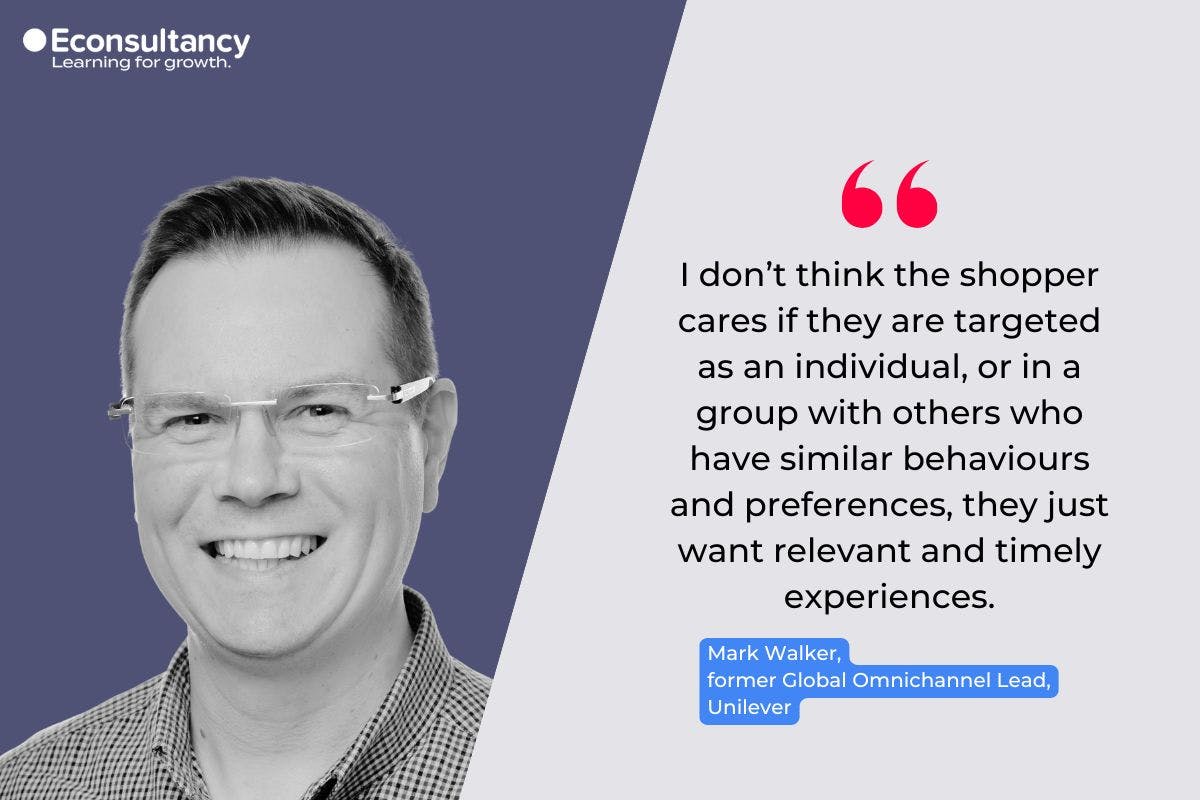
Mark Walker, former global omnichannel lead at Unilever, makes a similar point when it comes to personalisation. Talking to Econsultancy about the future of omnichannel FMCG and grocery he said, “I know there’s a lot of debate about a one-to-one vs one-to-many approach to personalisation; I get the nuances and efficiency benefits, but I do wonder if we are looking through the right end of things. I don’t think the shopper cares if they are targeted as an individual, or in a group with others who have similar behaviours and preferences, they just want relevant and timely experiences. This is at its best, for me, when it feels natural and subtle.”
Slick omnichannel retail experiences and upgraded POS systems are raising customer expectations.
Unified commerce is a term that’s been around for a while. It lives in the same universe as MACH and composable commerce, the idea that a centralised backend system including inventory, payments and customer data connects to a range of frontend platforms.
You could argue it’s a hazy concept that isn’t that far removed from the notion of omnichannel commerce, just a change in jargon to sell more software. But, whatever language you want to use, you know a slick commerce experience when you encounter one – accurate inventory levels, consistent promotions, quick and convenient pickup and return options, POS/in-store systems that don’t exist as an island and can help serve known customers, with an understanding of how they shop across channels.
POS may be a particular focus this year. Commercetools has launched InStore, part of its composable commerce solution. Shopify continued to develop its POS solution in 2024, adding features such as email capture at checkout, ship to customer (when they buy in-store), ship from store (when they buy online), and custom returns rules.
A survey published this month by RCP found that 54% of retailers said expanding and enhancing the customer experience was their top business priority for 2025. A whopping 3 in 5 (61%) said they will be investigating a POS upgrade or replacement this year.
Taste-making is a tall order for brands in a fragmented media landscape; piggy-backing trends on increasingly noisy social media won’t cut it. Marketers in search of cultural fluency need to have self-awareness, understand storytelling, find the right creators to cede (some degree of) control to, and explore more IRL activations (print!) and communities.
Nobody can pretend that the declining influence of (linear) television, the fragmentation of media and the rise of the creator are new trends.
However, there are always moments that act as milestones, telling everybody how far we’ve come on a particular path. The 2024 US and UK elections were arguably milestones, with lots of discussion, for example, about Donald Trump’s far-reaching appearance on Joe Rogan’s podcast, as well as the role of TikTok in appealing to certain parts of the electorate (typical headlines read, ‘Is this the first TikTok election?’).
On LinkedIn this month, Ben LaBolt, White House Communications Director and Senior Advisor to President Joe Biden, reflecting on his tenure, wrote, “It’s harder than ever before to break through. President Biden did 60 interviews this year across broadcast, podcasts, print and YouTube, but the average person doesn’t see even a big interview anymore. You have to be omnipresent across channels. Most Americans under 35 have moved away from traditional news sources. Your media mix should change appropriately. The evening news gets you 20 million largely seniors but not much beyond it. The rise of the creator has been a very influential development and provided a new platform for people who distrust institutions.”
For brands, this shift shows how the rules are changing when it comes to cultural fluency. Social media is a difficult place to achieve cut-through, amid the algorithmically boosted noise of AI slop, misinformation and copycat posting. GenZ research and strategy firm DCDX writes about the risk of falling into the ‘Great Brand Soup’, a Sisyphean pursuit of viral trends and fleeting attention. They argue that brands should aim for ‘consistency’ (stable attention around the brand) and that in the feast or famine pursuit of relevance, brands “risk losing out on being Magnetic” (their caps).
Sophie Kitchen of 160over90, lays out some interesting thoughts in Campaign about an ecosystem where, as Elon Musk puts it, “You are the media now”. The strategist discusses the need for radical self-awareness from brands, the need to find simpatico creators and give them a greater degree of control, and also the remit for “taste-curating” (rather than making), including more IRL events.
Aimee Mclaughlin’s recent article in Creative Review about a print renaissance picked up on some similar themes, describing the revitalisation as part of the reaction to the “sense of overwhelm, brain rot and exhaustion so many of us feel when it comes to our online lives now.”
Isobel Farmiloe, group brand strategy director of Dazed Media, told Mclaughlin, “It’s too much and it’s unsustainable. It’s causing us to crave physical media that demands a slower experience.”
My favourite campaign of 2025 thus far is the experiential activation (if that’s not too bland a word for it) in Grand Central by Apple TV, which promoted the new series of Severance by creating its dystopian office space within a plexiglass box, in which the cast appeared, as if acting out their typical in-role working day. This sort of stunt shows how experiential events are seen by marketers as an extension of social media, and a way to stand out amidst the aforementioned platform brain rot.
Think inside the box.#Severance Season 2 — Premieres Friday on Apple TV+ pic.twitter.com/5hdSFMy7hv
— Apple TV (@AppleTV) January 16, 2025
Putting all these ideas together, what is the real takeaway for marketers, beyond the fact that a cool brand is, for the most part, an oxymoron? Well, speaking to some experts for our social commerce predictions for 2025, there was a consensus that to sell on social requires a holistic approach, not just an ad budget and creator posting:
Going back briefly to the idea of brand ‘self-awareness’ on social (and in the round), it’s worthwhile revisiting Econsultancy co-founder Ashley Friedlein’s trends to 2030 (written in January 2020). In one section on ‘humane tech’ (the problem of ‘streaks’, gamification, and heuristics that encourage platform use), Friedlein referenced the backlash to addictive digital tech and the potential for GenZ to turn away from their screens:
“Very few of us are big enough just to try and shout louder than the rest. Instead we really do have to understand our brand essence, more than ever before, and find ways to make that connect with our prospects and customers in a more human way.”
Agentic AI may begin to let marketers focus on the customer by getting rid of back-office admin or even enabling fully automated services such as market research.
Though many are excited by consumer-facing AI (customer service chatbots, for example), it could be a red herring for some marketers in the short term. The technology’s impact on back-office efficiency may truly be what makes organisations more customer-centric.
This was highlighted by Glyn Britton, CMO at SME comparison service Bionic in our B2B predictions for 2025, as he declared, “…all the chat about chat misses the bigger story. Autonomous agents will finally kill off the white-collar busywork clogging most businesses”.
“The businesses that win [in the coming year] will be the ones that answer emails and make things genuinely easy,” he continued.
AI as productivity booster is a familiar narrative. But it’s also notable that the tech creates the possibility for fully-fledged, automated services. This is a concept that no doubt every reader has been aware of for a while – the idea that AI is making further inroads into areas such as market research, media planning and creative production.
…all the chat about chat misses the bigger story. Autonomous agents will finally kill off the white-collar busywork clogging most businesses.
– Glyn Britton, Bionic
Agencies and startups are offering AI products in these areas that show the potential to provide outcomes rather than tools e.g. synthetic data and personas for businesses whose customer base is hard (or expensive) to reach, leading to the notion of automated segmentation, positioning, budget recommendations and so on.
The phrase ‘service-as-a-software’ is one I first read in Scott Brinker and Fran Riemersma’s Martech for 2025 report. The authors discuss AI-powered services that could “replace both internal software products and the labor required to use them,” and they offer the scenario of simply paying for clickthroughs and leads, rather than a content distribution tool, for example.
Expect the debate about AI’s impact on labour to ramp up.
Humans need to show they can be human in an age of automation and flexible working.
When have soft skills not been in demand? After all, marketers are often defined by how they influence and interact with the rest of the business.
Nobody is pretending that hard skills, for example in data and digital, are not desirable at all levels of a marketing organisation. However, the twin pressures of automation and hybrid working seem to be driving a greater appreciation for soft skills.
Whether it is part of tech company PR or is just common sense, it’s hard to read anything on AI that doesn’t feature reassurances about the importance of humanity in the workforce. This is AI promising to get rid of the drudgery but leaving the knotty tasks, those requiring emotional intelligence, for us humans.
This sentiment is nothing new either. The same idea suffused workforce debate in the AI summer of 2017 (the initial wave of broad AI hype in the industry). A 2018 article from Forbes discusses this trend, and the fact that, despite the ROI shown on soft skills training, it may only represent around 10% of training spend.
AI brings extra scrutiny of soft skills at the executive level, too. A study in late 2023 by Peter Cardon at the USC Marshall School of Business found that as the technology takes root, integrity is a quality likely to grow in importance (according to 78% of respondents), with high moral values seen as important for oversight of the technology in the workplace.
And as for the ongoing debate around RTO (return to office) mandates, the question is whether executives have the leadership qualities (to motivate and empathise) to make work as productive as it could be, whatever the model they choose.
In Econsultancy’s Future of Marketing survey, published last month, soft skills placed 4th in the priorities for marketers, after AI skills, data and analytics skills, and brand marketing skills. LinkedIn stats, by contrast, have shown a majority of US executives (72%) agree that soft skills are more valuable to their organisation than AI skills.
However they rank, both AI and soft skills look set to be under the spotlight in what is a tough job market so far in 2025.
If you’re a marketing leader or work in L&D and are interested in how you can upskill your team in 2025, get in touch, or attend our next Capability Forum.