Content marketing
Content
Innovation and Trends
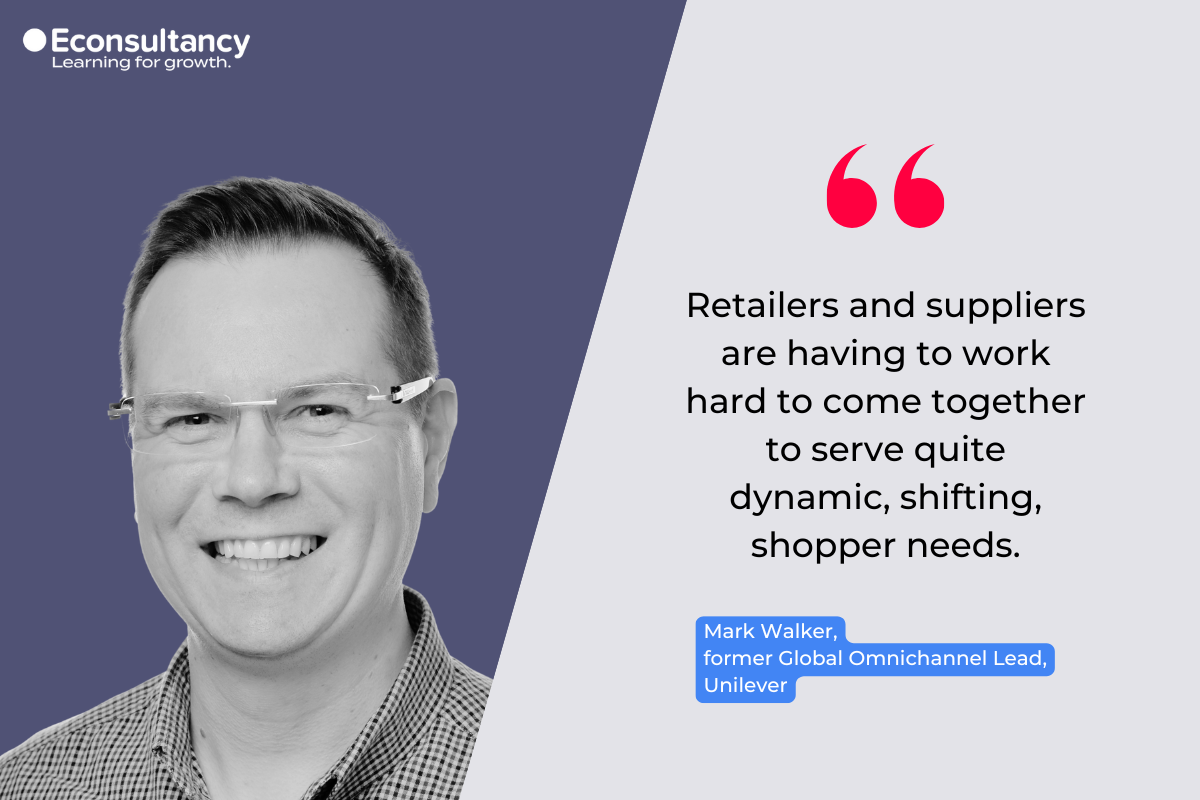

The FMCG industry is “on the cusp” of what ex-Unilever omnichannel leader Mark Walker suspects is “quite a big step change,” and one driven by “big consolidation” since Covid in the face of changing shopping behaviours.
“I think it’s a really, really interesting time for FMCG,” said Walker, who also acknowledged that the ongoing drive for growth amidst the “underlying pressure” of inflation and uncertainty has seen “a huge amount of capacity” in the system that’s been “squeezed out over time”.
Value conscious shoppers, changing preferences and market saturation have led many FMCGs to focus on their core brands, with analysts also noting a surge in acquisitions to achieve scale.
Speaking on a recent Econsultancy webinar, Walker described “a big reset” in relationships and collaboration in the industry. “I think retailers and suppliers are having to work hard to come together to serve quite dynamic, shifting, shopper needs,” he said.
“This idea about driving growth and ultimately profit: The only way organisations can deliver on that at the minute is coming together and working hard in very complex environments to execute.”
Part of the imperative for collaboration is the opportunity for “new revenue streams in the digital space”, which are “coming out of nowhere” and at speed, according to the former Tesco, dunnhumby and Unilever exec.
“A lot of these new routes to market in social or live selling, for example, jump to mind. Or new media networks… throwing up a whole load of complexity that… the supply-base and retailers are really struggling to get to grips with.
“And then throw on top of that, AI and all the dynamics and change in AI. Fundamentally, it means that from my perspective, organisations are having to be supremely agile to get to grips with these topics and then drive those skills back into their organsations to thrive and grow [over] the next three to five years,” added Walker.
You have to try and keep ahead of that pace of change, to be relevant in your role… to customers and shoppers.
Many other industries are facing common challenges, but the pace of change has been marked in FMCG, and presents an obstacle to the upskilling needed for businesses to adapt, according to Econsultancy Managing Partner Paul Davies.
“If you talk to any organisation and ask… ‘what’s the big problem you’re grappling with?’ It’s just how busy people are, and in this sector in particular… the clue’s in the [name] – ‘fast moving’. The planning cycle is shrinking, so carving out time for people to learn is really, really difficult.”
Both Walker and Davies said businesses should be prioritising learning that is hyper relevant to specific roles, is available easily at the point of learner need, and is engaging.
Coming out of the Covid pandemic, “there was an over reliance on online learning to build skills”, said Davies. He pointed out that though e-learning plays a key role in cost effective ways of building knowledge, it doesn’t engage “large distributed teams” in the same way as live programmes.
With FMCGs “heavily focused on outputs and results” and affecting shopper behaviour, L&D pathways should be approached in the same way, said Walker, who defined a culture of continuous improvement as a competitive advantage.
“You have to have a constant need to raise the bar individually and as a team and as an organisation.
“You have to try and keep ahead of that pace of change, to be relevant in your role and relevant in organisations, to be relevant to customers and shoppers.”
“There has to be an obligation… to protect that space to learn,” concluded Walker. “And I know from my own experience… [it’s] often the first thing that gets dropped from your objectives or from your personal development plans because ‘I haven’t got time’.”
“We saw that, especially in Unilever, where we put senior leaders at the front of the learning journeys… to make it visible and… show that [if they] are engaged and creating time in their own busy schedules to do it, so should [the rest of the business].”
Watch the webinar or download the accompanying whitepaper: Bridging the Gap Between Learning and Application in FMCG