
Content marketing
Content
Innovation and Trends
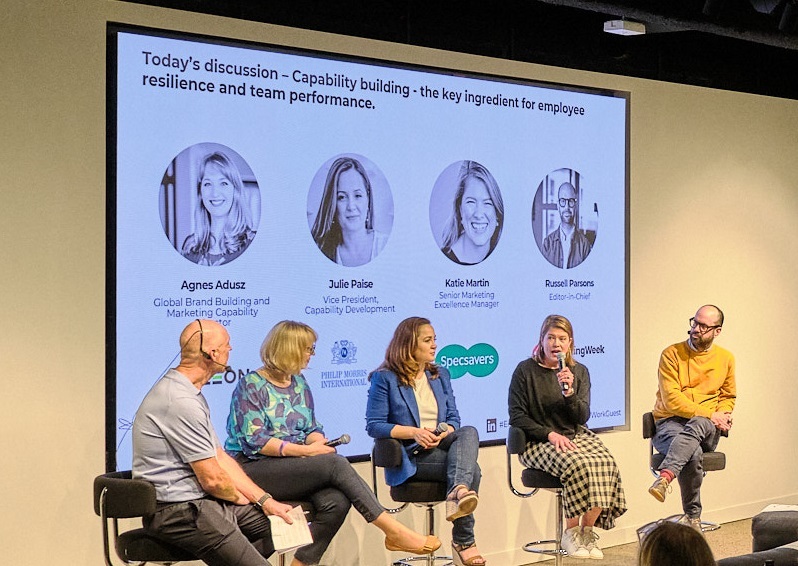

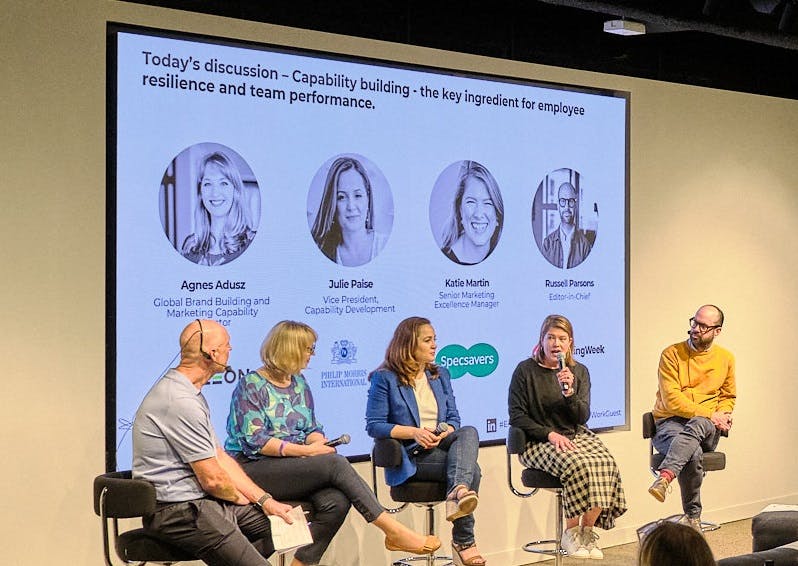
“As an industry, marketing is having a bit of an identity crisis,” said Katie Martin, Senior Marketing Excellence Manager at Specsavers. “It’s anchored in the need to ‘do more with less’ but I think we’ve lost the essence of ‘less is more’.”
Martin was speaking at Econsultancy’s Capability Leaders Forum, where attendees had heard statistics from Marketing Week’s 2025 Career and Salary Survey outlining the bleak environment that marketers find themselves in. Among the survey’s findings was the fact that 58% of marketers reported feeling overwhelmed, while 56% felt undervalued.
Half of marketers (50%) also said that they were experiencing emotional exhaustion, while 48% reported that they weren’t enjoying their work – painting a sobering picture of the industry.
“I think we’ve lost that North Star when it comes to decision-making: representing the customer voice and what we stand for,” Martin added. “It’s very easy to get pulled into the shiny new thing but I think the way forward is actually about single-mindedness… anchoring everything in the customer and how you influence from there.”
Agnes Adusz, Global Marketing Capability Director at consumer health company Haleon, noted that the demands on marketers and the complexity of the marketing function have increased exponentially in recent years. “Where I see the biggest stress for marketers is the internal expectation of ‘I should know every speciality of marketing’.
“Yes, restructuring and the complexity of the job are definitely key factors when it comes to feeling overwhelmed but it’s also about understanding that marketing in itself has changed over the years.”
The Capability Leaders Forum was focused on the question of how capability building can tackle the problem of burnout, such as by equipping marketers to deal with the evolving challenges of their role and increasing their sense of purpose and job satisfaction.
Agnes Adusz said that Haleon sets out to simplify everything – tools, processes, and training – as much as possible to avoid inundating staff. “Capability building is focused on: how do we make sure that marketers have everything they need to know in tiny little bite-sized boxes?” she said. “So that they can tap into [capability building] in their daily life and not necessarily have overwhelming [amounts of] workbooks and long training to get the skills they need.”
She added that equipping marketers with the right knowledge and skills helps the company achieve its aims strategically. “…We are not going after everything – we have focus areas where we need to make a shift,” she added. “We are also focused on mindset and behavioural change, which goes hand-in-hand with skill-building.”
Specsavers’ Katie Martin emphasised that marketers and capability leaders should “never forget the power of human connection” in a world of AI. “A lot of our programme is really about that person-to-person support network: how you build that one sense of community even though you have geographical and time zone barriers in place.”
The true value of community is in its members “holding each other to account… lifting each other up,” said Martin: “That is where the magic really happens but I think it’s so often overlooked because we’re so focused on technical skills.”
Reflecting on how organisations can avoid creating a further source of stress by adding learning to marketers’ already high workloads, she noted, “If it’s done well, capability and marketing excellence makes your job easier and yes, that takes time, but it can really enable the day job and get you working better, more effectively, together.”
If it’s done well, capability and marketing excellence makes your job easier … and [can] get you working better, more effectively, together.
However, she cautioned leaders to be aware of the potential for teams to take on too much and overextend themselves. “We talk about giving people stretch opportunities – great, let’s give them a bit of stretch.
“But see how you can give them the right level of opportunity in which to grow and learn, focusing on how it will enable the day job and ultimately make everyone’s lives easier, while being mindful that we’re not stretching them to the point of breaking.”
Martin pointed out that turning to external, rather than internal, measures of success can help convince senior leadership of the benefit of introducing capability programmes in the first place.
Specsavers, for example, doesn’t make learning mandatory but the company has recently accredited its Marketing Academy so that it counts towards Continuing Professional Development (CPD) hours. “We’re trying to be as famous for our Marketing Academy and Specsavers being a place to build your marketing career as we are for our marketing campaigns,” she said.
In organisations where leadership needs to be sold on the merits of capability-building, Martin noted that the idea of strengthening the employer brand in this way can be persuasive.
Within large businesses that have a complex, decentralised structure, creating a single capability function and implementing a common way of working can also be a difficult sell. Agnes Adusz observed that, “There is no company on this planet that doesn’t need capability – the question is: Who owns that?
“Is it a different department? Is it the department head? Every organisation is different.” Haleon itself has a dedicated capability department but also capability leads embedded within each area of the business. Agnes Adusz concluded, “It does depend on the complexity of your organisation – but capability is a need that every organisation has. If you have that mindset, then you can create the business case … that you need a function that carries that load.”
Panel moderator and Econsultancy MD Paul Davies added that many large organisations are now decentralising, putting increased pressure on capability-building. “Creating that single way of doing things is much harder in [a decentralising organisation],” he said.
He suggested that senior leaders should look for clusters within the organisation that complement one another – such as markets that have characteristics in common – which can create a “centre of gravity” for joint capability programmes.
Agnes Adusz also explained that when Haleon’s capability programme was first put in place, the organisation created a unified approach and elevated skill levels across the board – “raising the floor and raising the ceiling” – by embedding capability-building within company strategy.
“It started with really understanding where the company needs to go – what are the strategic priorities, and what holds us back? Both from a behavioural perspective, a mindset perspective … It’s a comprehensive understanding of where the company is and what we need to shift.
“Capability-building is at the core of the strategy: driving the company, not serving and just looking through capability gaps. That’s the big difference.”
Join us at Econsultancy’s next Capability Leaders Forum, taking place on 10th September in Waterloo. Learn more and save your seat.