
Content marketing
Social
Content

- Early Peak Season Predictions
- Holiday Shopping
- Online Grocery
- Cross-Border Retail
- Ecommerce Market Share
Listen to the highlights from author Rose Keen and Econsultancy Deputy Editor Rebecca Sentance:
1. Early Peak Season Predictions

Though we may only be part way through December, the holiday shopping season is well under way. Following a year of inflation-related consumer reticence, predictions for holiday spending online for the US and UK are looking both merry and bright.
For the US, Adobe expects online holiday sales to be up 8.4% YOY to total a forecast of $240.8bn across this holiday shopping season, with over half (53.2%) of that online spend set to take place via mobile.[1]
In the UK, Adobe forecasts consumers will spend a record £25.9bn online during the festive season, up 6.1% from 2023, with 56.3% of that total spend predicted to take place on mobile devices.[2]
Predictions within Europe are more muted, with Germany’s Retail Association (HDE) predicting only modest growth in the block’s biggest economy across the golden quarter.[3]
Across the board though, the key factor in driving spend will be discounts, as inflation-impacted consumers are still looking for ways to make their budgets go further. This can be seen in the spending patterns across November. Despite many discounts and sales launching earlier in the month, many consumers held off on their purchasing until Black Friday week itself.
2. Holiday Shopping

Black Friday goes digital
The big winner across the Black Friday weekend was ecommerce. In the US, across the five days from Thanksgiving to Cyber Monday, online sales grew by 8.2%, reaching $41.1bn according to Adobe Analytics data.[4]
Though Black Friday itself has previously been associated with physical retail, $10.8bn of those ecommerce sales across the five-day discounting period were made on the Friday, up 10.2% on last year. Physical stores saw an 8.2% fall in foot traffic this year, as reported by Sensormatic Solutions,[5] which at least reduces the likelihood of any store staff getting trampled by hordes of discount-hungry customers – scenes that once characterised Black Friday at least in terms of media coverage.
Reflecting that move online, 2024’s Cyber Monday was the largest ever ecommerce day in terms of sales in the US, totalling $13.3bn according to Adobe Analytics data. The Thursday of Thanksgiving itself also saw a record number of sales ($6.1bn, up 8.8% YOY). Naturally, online shoppers are not limited by public holidays or being sat around the Thanksgiving table.
Due to the lateness in November of this year’s Thanksgiving, which is the traditional kickoff of the holiday season in the US, plus the ongoing impact of inflation on household budgets, retailers launched many discounts and sales earlier in the year – for some these went live as early as October. However, spending patterns suggest that many shoppers still delay hitting the buy button for the Black Friday weekend itself.
This focus on the weekend is also true in the UK, where retail sales across most of November have been disappointing.[6],[7] Black Friday accounted for the biggest online shopping day of the year, with Adobe data showing that UK consumers spent an estimated £1.12bn online on the day, up 7.7% YOY.[8]
Of course, Black Friday is now a global phenomenon, even for those who do not celebrate turkey day. Salesforce data showed that globally ecommerce sales across Black Friday week were up 6%, totalling $314.9bn.[9]
Given the heavy emphasis on discounting events to drive sales this year, retailers may be looking at the calendar for a further date to base a promotion on. With Christmas falling on a Wednesday this year, we may see a flurry of last-minute offers across Super Saturday as retailers seek to win the final bit of 2024 holiday spend.
Bridging the digital inspiration gap
November saw Amazon debut an immersive 3D ‘holiday shop’. The experience is designed to take the shopper on a guided journey through gift product categories,[10] with the likely aim being to recreate some of the delight and discovery found within brick-and-mortar stores.[11]
Though more festive purchasing is taking place online, ecommerce experiences typically are not well set up for discovery and inspiration. Increasingly social media appears to be filling this gap, with a recent survey by MGH finding that over half of consumers use TikTok for gift inspiration.[12] Of the social platforms, TikTok’s algorithmic feed and combination of entertainment and commerce make it particularly well-suited to product discovery.
Looking to capitalise on this, TikTok launched an incentivisation programme aimed at small- and medium-sized sellers, who can apply to become a part of TikTok’s ‘gift guide’ experience. Those who are selected will receive greater exposure for their products via the 2024 TikTok Shop Holiday Emporium. To be eligible, however, businesses must commit to a minimum ad spend on Shop Ads during the holiday season.[13]
Taking a longer-form approach to shoppable content is Walmart, who building on their episodic holiday romcom series from last year have produced a full Christmas movie for 2024. The film, ‘Jingle Bell Love’, will air on Roku and will offer viewers the opportunity to buy the products on screen via their TV during specific parts of the story. From their past experimentation, Walmart learned that watch time was a key deciding factor in how likely viewers were to make a purchase, so expanding into feature length makes sense.[14]
Another route to gift inspiration being taken by a larger number of consumers this year has been the use of personal digital shoppers in the form of generative AI chatbots. According to data from Adobe, US traffic to retail sites from chatbots on Cyber Monday increased by nearly 2,000% YOY.[15] Though that figure is impressive, this still represents only a small, if fast-growing, share of total holiday retail traffic.
In an unexpected holiday season twist, there has been a resurgence in the use of physical gift catalogues by some retailers, most notably US retailer J.Crew, who produced a catalogue which resembled a glossy coffee-table book.[16] Unlike their predecessors, these catalogues are less focused on mail order and more seen as branding and product inspiration, designed to capture shoppers’ attention and inspire them to shop via the ecommerce store.
Each of these touchpoints may be filling an important gap in the holiday ecommerce experience, but they are also adding further complexity to the customer journey, highlighting the importance for retailers and brands to have an aligned omnichannel CX strategy – one that is shared across all customer-facing teams.
Singles’ Day festival sees shopper growth, but platforms are quiet on total performance
Evidence for the slowing growth of China’s primary discounting period can be found in what is not being shared by the country’s ecommerce giants.
Alibaba, who rebranded 11 November as a discounting event back in 2009,[17] once again did not report overall sales performance across the shopping festival. Instead it reported that Tmall and Taobao platforms had achieved an unspecified growth in gross merchandise volume, with the release also detailing high levels of merchant participation and consumer engagement.[18]
Alibaba’s rival JD.com was equally selective on its performance metrics, focusing in on a 20% increase in shopper numbers across its Singles’ Day promotion.[19]
Prior to 2022, JD.com and Alibaba did both publish the total value of the festival’s transactions, but for the last two years these overall numbers have been notably absent from company releases. This silence suggests the slowing growth of annual festival buying.
The performance of Singles’ Day is considered a barometer on Chinese consumer sentiment – and the nation’s economy as a whole. Here, the focus on a growth in shopper numbers and transaction volumes may be disguising the fact that many of the sales made across the discounting period were of household essentials as consumers feel the economic squeeze.
Related content:
3. Online Grocery

US grocery ecommerce reaches $10bn
October saw US online grocery reach the milestone of $10bn in sales, data from Brick Meets Click’s Grocery Shopper Survey suggests, representing a 28% increase and a substantial shift in US consumer behaviour.[20]
This pattern was repeated in Walmart’s most recent quarterly results, which showed ecommerce sales up 22% in the US (27% globally).[21] Online commerce still makes up a relatively small share of Walmart’s total business, but the company sees it as a key channel for growth. The retail giant has emphasised investment in delivery solutions and automation as key in improving ecommerce’s profitability.[22]
Rival big-box retailer Target also reported third quarter online sales growth, with ecommerce sales up 10.8% YOY, driven by nearly 20% growth in same-day delivery.[23]
In an attempt to both expand the market through increased adoption and compete better with Amazon, the big-box retailers’ strategies have focused on membership models and the convenience of getting products delivered. This approach has been successful for Walmart in terms of attracting higher net wealth households, who are also less subject to inflationary pressures.[24]
Tesco launches Ocado tech solutions rival
Though still delivering many UK households’ weekly shops, Ocado’s strategic focus has shifted from selling eggs and sourdough to selling automation-focused fulfilment solutions for other online retailers.
September saw Ocado acquire a new competitor in this space as Tesco introduced Transcend Retail Solutions, a similar product covering both soft- and hardware solutions and consultancy. It has been designed to support grocery chains in other countries with the acceleration of their ecommerce operations.[25]
There is still significant untapped potential for online grocery internationally. However, one of the key reasons for that is the ongoing challenge of ecommerce profitability. If Tesco is able to leverage its hard-won experience and proven solutions in a way that helps to solve that problem for retailers, this will make a compelling sales pitch, while also opening up a new, potentially high-margin revenue stream for Tesco.
How successful this venture will be is entirely dependent on sustained consumer appetite for getting groceries delivered. Ocado’s own turbulent business results have shown how subject to consumer sentiment this business is. Indeed, the company has only lifted its earnings warning this quarter, after inflation dampened shoppers’ enthusiasm for ordering groceries online.[26]
India’s quick commerce company Swiggy has largest tech IPO in 2024
Quick commerce is big business in India. In November, the nation’s second-biggest rapid delivery company Swiggy launched an IPO. Shares ended debut day up 10.67% at ₹455.95 ($5.4), culminating in a total value of $1.4bn, making this the largest tech sector IPO globally and India’s second-largest IPO this year after Hyundai Motor India.[27] Investors will be betting on the long-term potential of the quick commerce market, which has seen rapid expansion in recent times.
Following the IPO, Swiggy announced plans to expand Bolt, its 10-minute food delivery service, to more than 400 cities and towns across India – the aim being to recapture some of the food delivery market share conceded to its larger rival Zomato over the past few years.[28]
In response, Zomato embarked on its first major fundraising round since its 2021 IPO, raising $1bn from institutional investors in a bid to defend its market leader position.[29]
Both Zomato and Swiggy may face a new rival in the coming months, as Amazon is reportedly planning on launching its own quick commerce product, codename ‘Tez’, in early 2025.[30] The rapid growth of the quick commerce market in India makes it an appealing space for new launches. However, as has been seen in other regions, there is a limited number of providers markets, and delivery networks, can sustain.
This has certainly been the case in Europe and the UK, where following rapid expansion there has been significant consolidation in the quick commerce market. Though there have been challenges around the costs of acquiring customers and meeting the rapid delivery promise, consumers do want these services. In the UK, supermarket chain Co-op attributed its increased profits in the face of shoplifting losses to the group’s growing q-commerce business, which now accounts for a quarter of the total UK quick commerce market.[31]
For FMCG and food brands, the differing needs of the quick commerce consumer should feed into considerations around product development and positioning. Other sectors outside of grocery should also consider what products may be something a consumer would need urgently, such as electrical accessories, gifts or health products.
Related content:
4. Cross-Border Retail
Economic and political headwinds spell trouble for PDD
PDD Holdings, owner of Temu and Pinduoduo, is feeling the effects of China’s economic languor. PPD reported disappointing sales and profit last quarter, as Chinese consumers hold back on purchasing amid the broader national economic slowdown.[32] Similarly, rivals JD.com[33] and Alibaba[34] also posted lacklustre results.
Alongside dampening consumer demand at home, these platforms face high levels of uncertainty in terms of their cross-border operations as well. In the US, President-elect Donald Trump’s planned tariffs for Chinese goods will present significant challenges to their ability to offer ultra-cheap products to US consumers.[35]
In addition, October saw Indonesia request the removal of Temu from both the Google and Apple app stores.[36] Meanwhile over in Europe, the EU is planning a crackdown on potentially unsafe business practices, having launched an investigation into the possible sale of illegal goods on the platform,[37] opening up the potential for substantial fines for Temu.
The rise of the ultra-low-cost cross-border ecommerce apps has been one of the biggest stories in ecommerce for the last two years. Amazon and other retailers will be keeping a close eye on how these platforms respond to the current headwinds.
Temu competitor Amazon Haul reportedly an ‘AI-image wasteland’
An investigation by Modern Retail found that Haul, Amazon’s new ultra-low-price service is filled with AI-generated images, some of which, they report, run counter to Amazon’s own rules around imagery including the prohibition of nudity and the use of other brands’ logos. Alongside these issues and problems around consistent product scale in listings, some of these images stray into the bizarre. Modern Retail highlights a listing for neoprene gloves that shows a fisherperson battling with a human-sized glove.[38]
Launched in November in the US, Haul is Amazon’s response to the competitive threat of Temu, offering products at ultra-low prices, primarily from China-based sellers.[39] In what seems to be an almost wholesale replication of the ultra-low-cost cross-border marketplace business models, Amazon has also inherited the same set of problems, including potential issues around consumer trust and vulnerabilities to new potential tariffs. In addition, if all these platforms offer the same service, there is a question as to how many the market can support. Amazon has a history of short-lived trials of new products – Haul may prove to be another such experiment.
Related content:
5. Ecommerce Market Share

Latest US data has ecommerce responsible for 16.2% of total retail sales
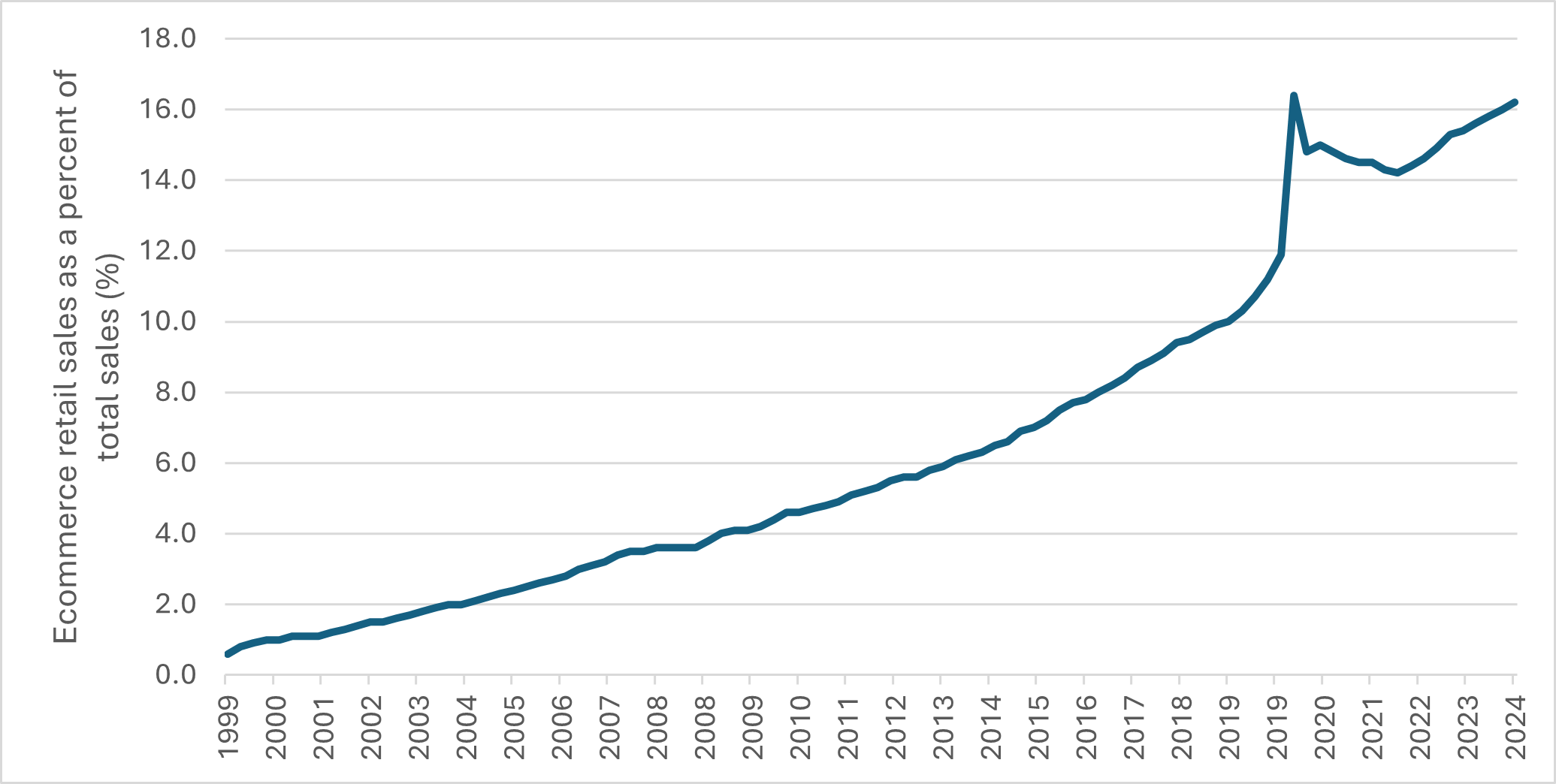
Note: US Census Bureau, Ecommerce Retail Sales as a Percent of Total Sales [ECOMPCTSA], retrieved from FRED, Federal Reserve Bank of St. Louis. Retrieved: December 12, 2024. Source: https://fred.stlouisfed.org/series/ECOMPCTSA
In the UK, ecommerce accounted for 27.7% of total retail sales in October
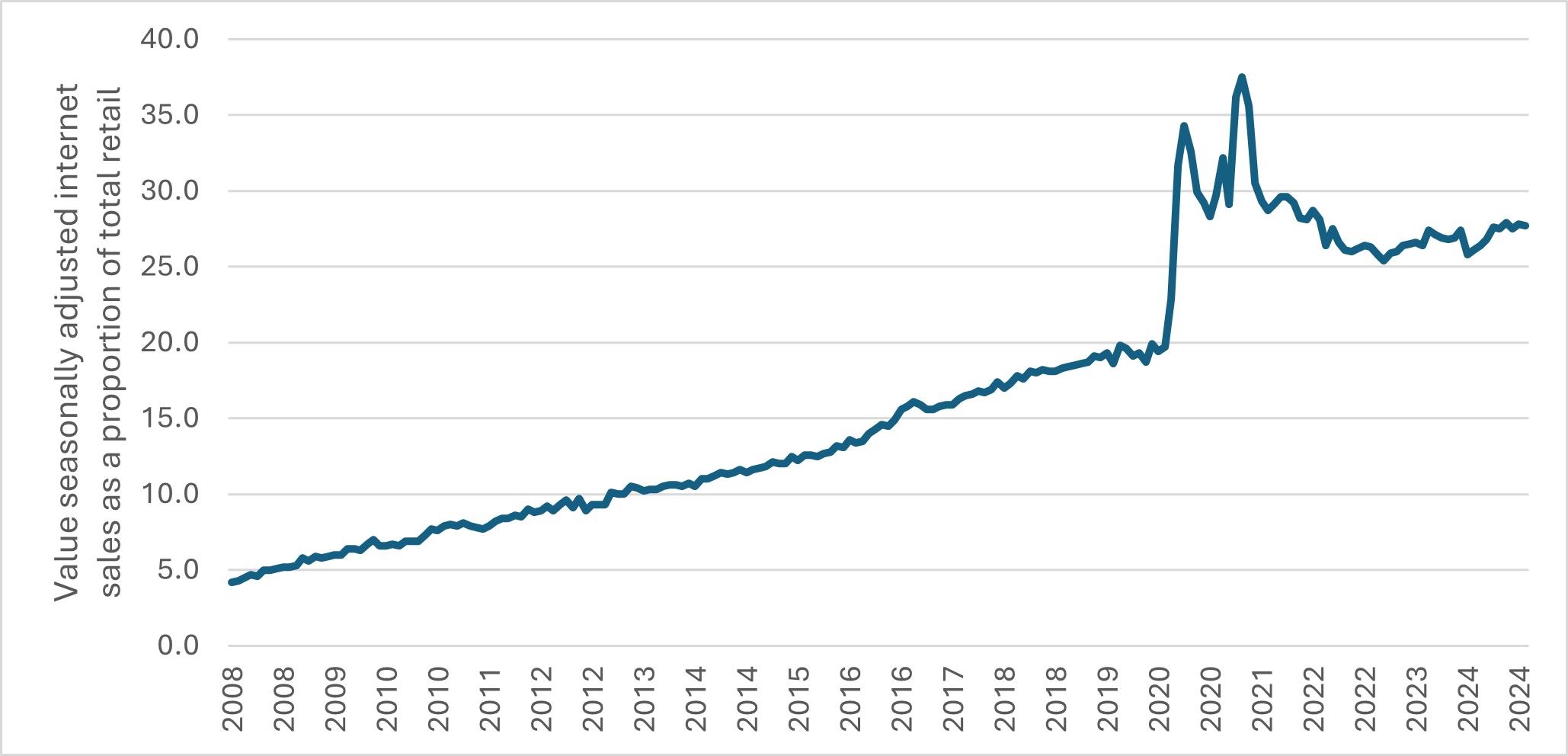
Note: All UK retail excluding automotive and fuel, seasonally adjusted, January 2008–October 2024. Source: https://www.ons.gov.uk
Ecommerce share of total UK retail across grocery, fashion and household goods
| Sector | October 2024 |
| Predominantly food | 9.4% |
| Textile, clothing and footwear | 28.5% |
| Household goods | 26.4% |
Source: https://www.ons.gov.uk
Sign up for Fast Track to Ecommerce: Partners and Platforms
This Fast Track course is designed specifically for organisations that sell through retail partners and third-party platforms, enabling them to upskill teams of one to one thousand, all included in the Econsultancy membership. Next cohort starts on 4 March, 2025.