Content marketing
Social
Content

1. Introduction
Copywriting is as essential to an email’s success as images, design and technology, but it is also often undervalued. When crafting an email, the priority often lies with choosing the images and template design, rather than the words in the message. However, the copy, from the subject line to the footer at the bottom of the email, is crucial to communicating the right message.
When campaigns regularly underperform, a lack of effective and persuasive email copy should be considered as one possible reason. This guide will analyse the role email copywriting plays in the success of a campaign and will provide best practices for writing copy for each element of an email message. It will also look at how new technology in the form of generative AI content tools can enhance the creative experience.
1.1 Executive summary
- Copywriting for email is not the same as for web, social media, direct mail or other channels because its goal is not to convert within the email but to persuade the customer to click through to the website, where the conversion happens.
- A conversion from email is made up of three ‘micro-conversions’, each of which requires a different approach to copywriting: persuading readers to open the email, encouraging them to click to the landing page on the website, and supporting both email and landing page with copy that aligns with each micro-conversion.
- Although an email is made up of disparate elements, each one must work in harmony with the others to create a cohesive message.
- Persuasive copywriting is most effective when it employs a basic knowledge of the psychological principles that motivate people to act. These include Cialdini’s seven persuasion principles, which are reciprocity, commitment and consistency, social proof, affinity, authority, scarcity/loss aversion/urgency and unity.
- Generative AI is changing the way email marketers perform their craft. It could be the tool copywriters have longed for, but at the same time it must be used strategically and with an understanding that its role is to assist copywriters, not to take over their work.
1.2 Methodology
The methodology involved two main phases:
Phase 1: Desk research to identify relevant issues, examples and models.
Phase 2: A series of in-depth interviews with a range of email marketing experts.
Econsultancy would like to thank the following interviewees who contributed to this report:
- Tony Allen, Global CRM Lead, Volvo Cars
- Jess Evans-Tudor, Head of CRM, Rated People
- Kelly Haggard, VP – Marketing Innovation, Synchrony
- Jakob Holm, Email Marketing Director, Pandora
- Mar Juárez, CRM Manager, IVI RMA Global
- Beata Linz, Global CRM Director, AdBirds
- Lisa Pettit, CRM Lead Developer, Specsavers
- George Williams, CRM Manager, FARFETCH Platform Solutions
1.3 About the author
 Kath lives and breathes email marketing and is recognised as one of the industry’s leading email marketers. CEO of boutique consultancy Holistic Email Marketing, she devotes her time to developing customer-centric ecommerce journeys using a holistic, multi-channel approach.
Winner of the 2021 ANA/EEC Email Marketers Thought Leader of the Year, Kath is an industry veteran of 23 years. She is the author of the best-selling and award-winning book Holistic Email Marketing, and is a sought-after international keynote speaker, blogger, expert contributor and trainer.
linkedin.com/in/kathpay
kath@holisticemail.com
@kathpay
2. Persuasive Writing for Email
2.1 Why email copywriting is different
Writing for email is not the same as writing for a website. A great content writer and web writer might not be the most effective email copywriter. This is because of the inherent differences between the email channel and the website channel and the roles each one plays in the path to conversion and the customer experience.
Email is a ‘push’ channel. Email marketers have full control over brand-owned email channels and decide when to push messages to the subscribers who have agreed to receive them. In contrast, a website is a ‘pull’ channel that draws visitors from search marketing, social media, and other sources.
Email and web marketing play different roles in a digital marketing programme, based on both the attributes of the channels themselves and the mindsets of the people using them.
The desired conversion does not happen in the email. The email’s primary purpose is to persuade readers to click through to the website landing page to drive further engagement towards achieving a particular goal or conversion. (See Section 3.1 for more on how the definition of a conversion is different in email marketing.)
An email message is not the place to display all of the information to the customer. Instead, it should intrigue readers, enticing them to click through to the website to find out more.
The website, in contrast, must persuade the customers who come to the landing page from the email to stay, engage further and hopefully convert. This requires a different persuasion formula. For more information on optimising landing pages, see Econsultancy’s guides on Ecommerce Best Practice: Converting Demand and SEO Best Practice: Landing Page Optimisation.
Email readers generally are not as motivated as website visitors to convert. They are further back in the sales funnel, and all of the copy in the email, including the call to action, must recognise this.
This position holds true even with the advent of email interactivity through AMP for Email,[1] which allows some web actions to be moved into the email message. Many consumers are still not ready to commit while viewing an email message.
2.2 Cialdini’s seven principles of persuasion
In Influence: The Psychology of Persuasion and Pre-suasion: A Revolutionary New Way to Influence and Persuade, US psychologist Robert Cialdini identifies seven ‘weapons of influence’ that can be used to influence people. The seven weapons were originally developed with reference to personal interactions, but they can be applied equally to email marketing. This section demonstrates how to use them in online communications.
- Reciprocity
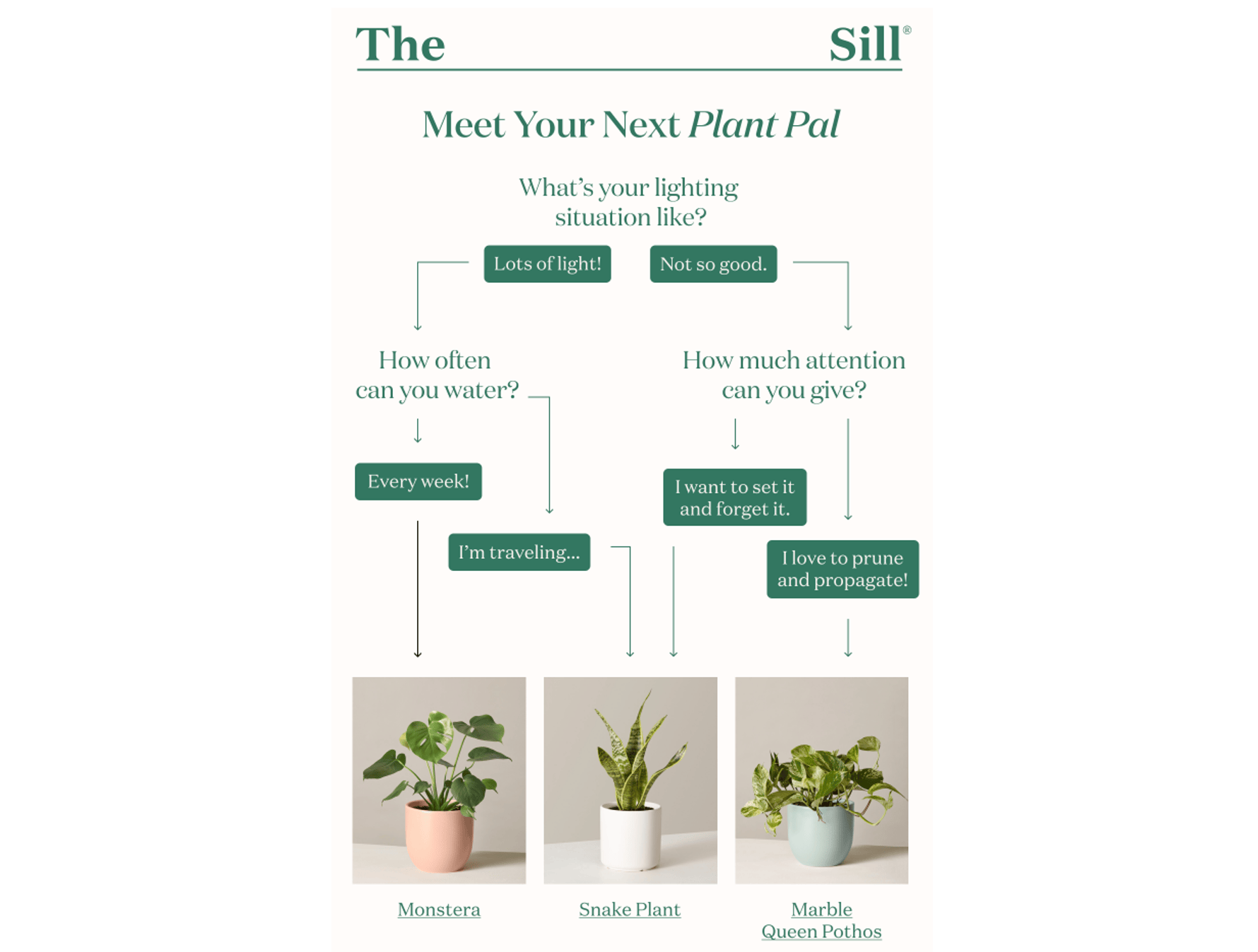
Reciprocity is the idea that people will respond to a positive action with a reciprocal positive action. Applied to email marketing, it dictates that customers will feel indebted through the psychology of exchange. The email should offer or link through to valuable, exclusive content (like guides or exclusive email offers).
The example email from Sill aims to help customers buy plants that suit their lifestyles and environments, understanding that one successful purchase can lead to more.
Figure 1: Providing valuable content
Source: The Sill via MailCharts
- Commitment and consistency
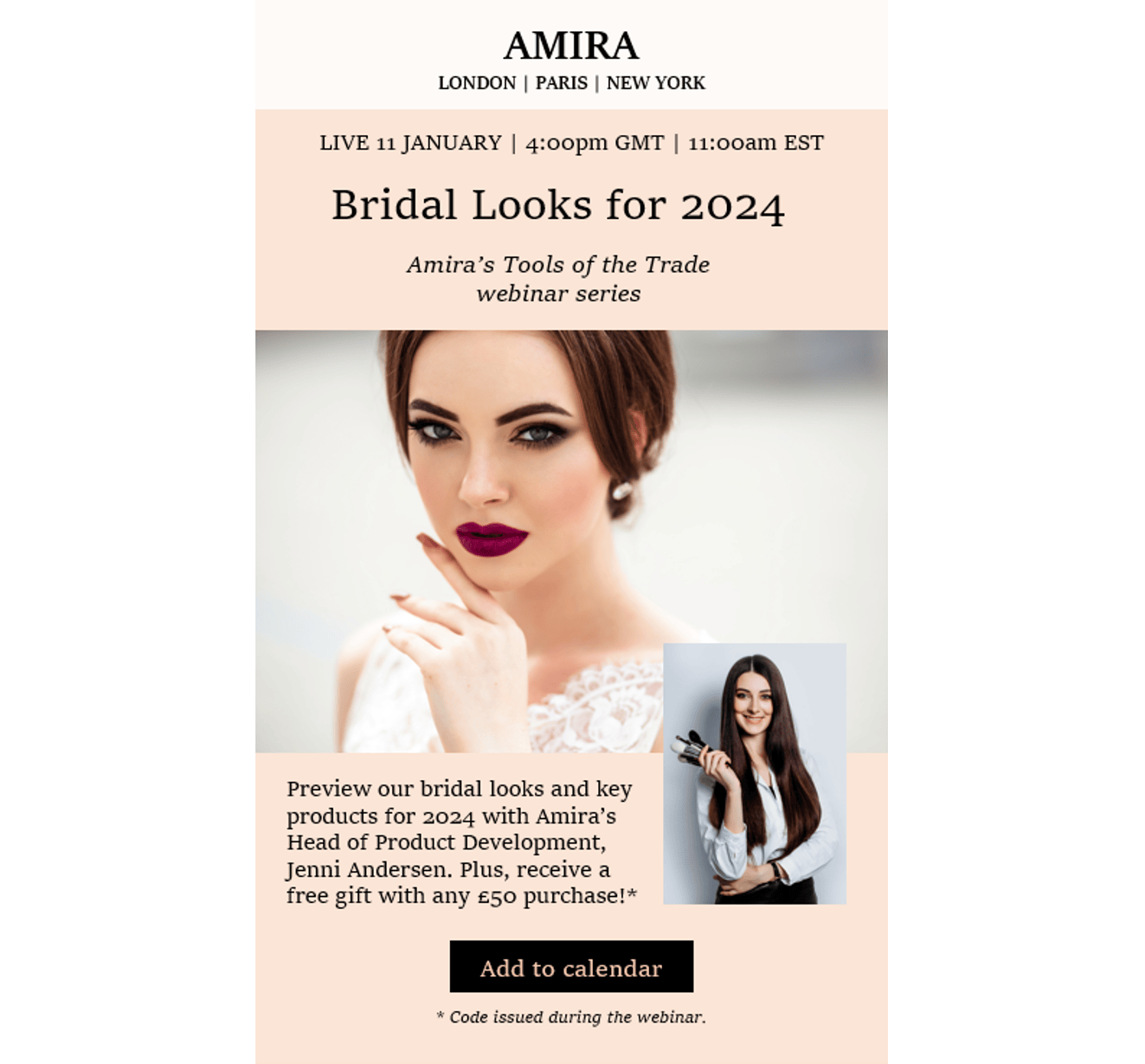
People tend to feel obliged to stick to something they have committed to, as they like to be consistent. Customers who are not ready to commit to a significant action such as a purchase might be willing to take a smaller step towards one or engage with the brand on a more casual level, which could lead to a greater commitment later on. An interactive module like an ‘Add to Calendar’, as seen in Figure 2 below, or ‘Set Alarm Clock’, can induce that first engagement action.
Figure 2: Inviting action besides purchasing
Source: Econsultancy
- Social proof
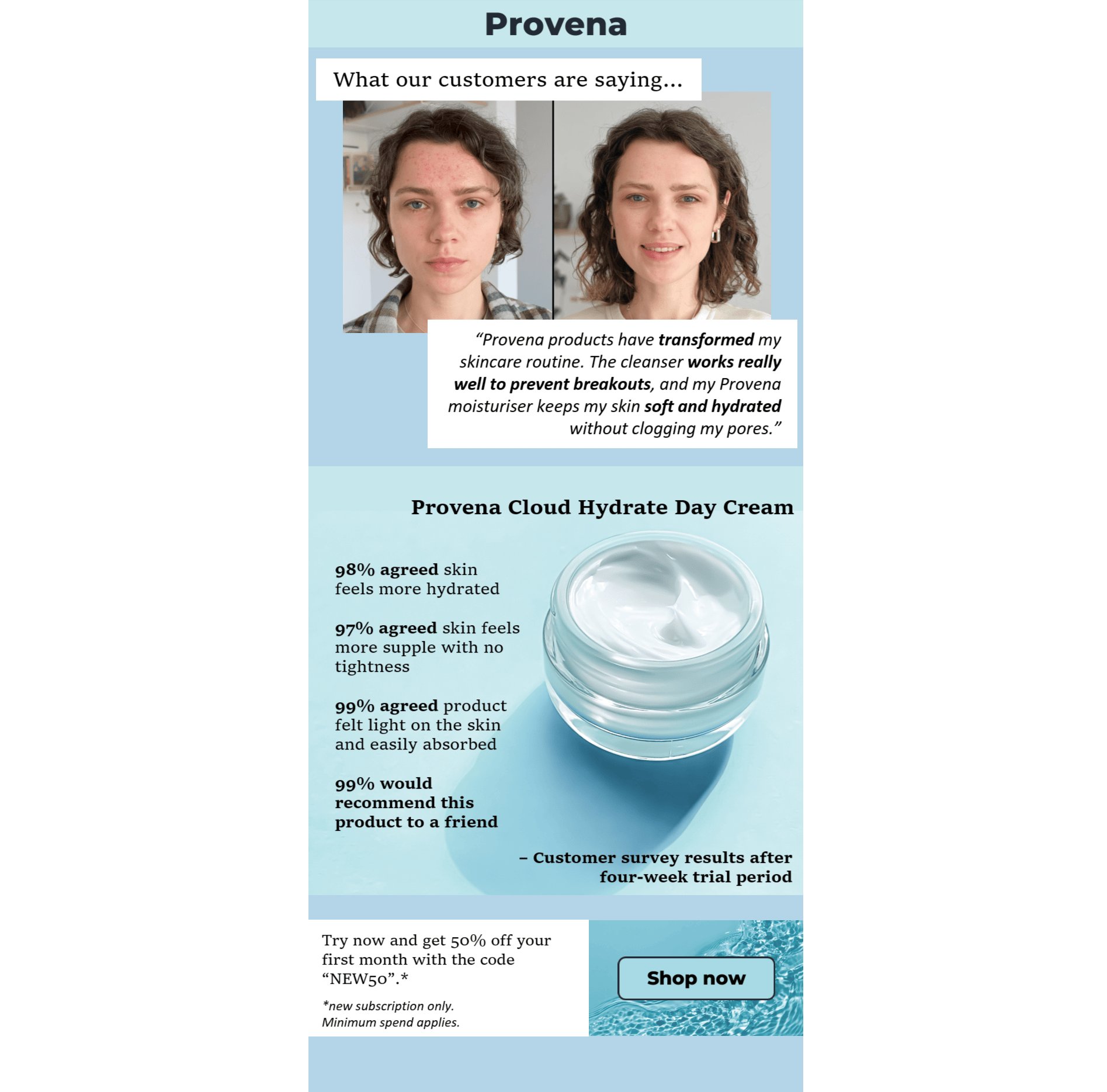
An audience will believe other customers more than they believe a brand’s claims. Reviews, case studies, and testimonials can bolster a company’s claims. Copy should show how others have already benefited. The example in Figure 3 below combines a before-and-after visual with a testimonial as well as positive survey results from customers to build trust and remove doubt.
Figure 3: Demonstrating social proof
Source: Econsultancy
- Affinity (liking and credibility)
People are highly influenced by people they like or who are like them. So, again, use recommendations or endorsements by people who are known to the audience or to whom they can relate to. This is different from social proof because there will be a greater affinity between an individual and someone they identify with as opposed to a general member of the public. The ability of an ‘influencer’ to persuade their audience will be stronger than generic social proof.
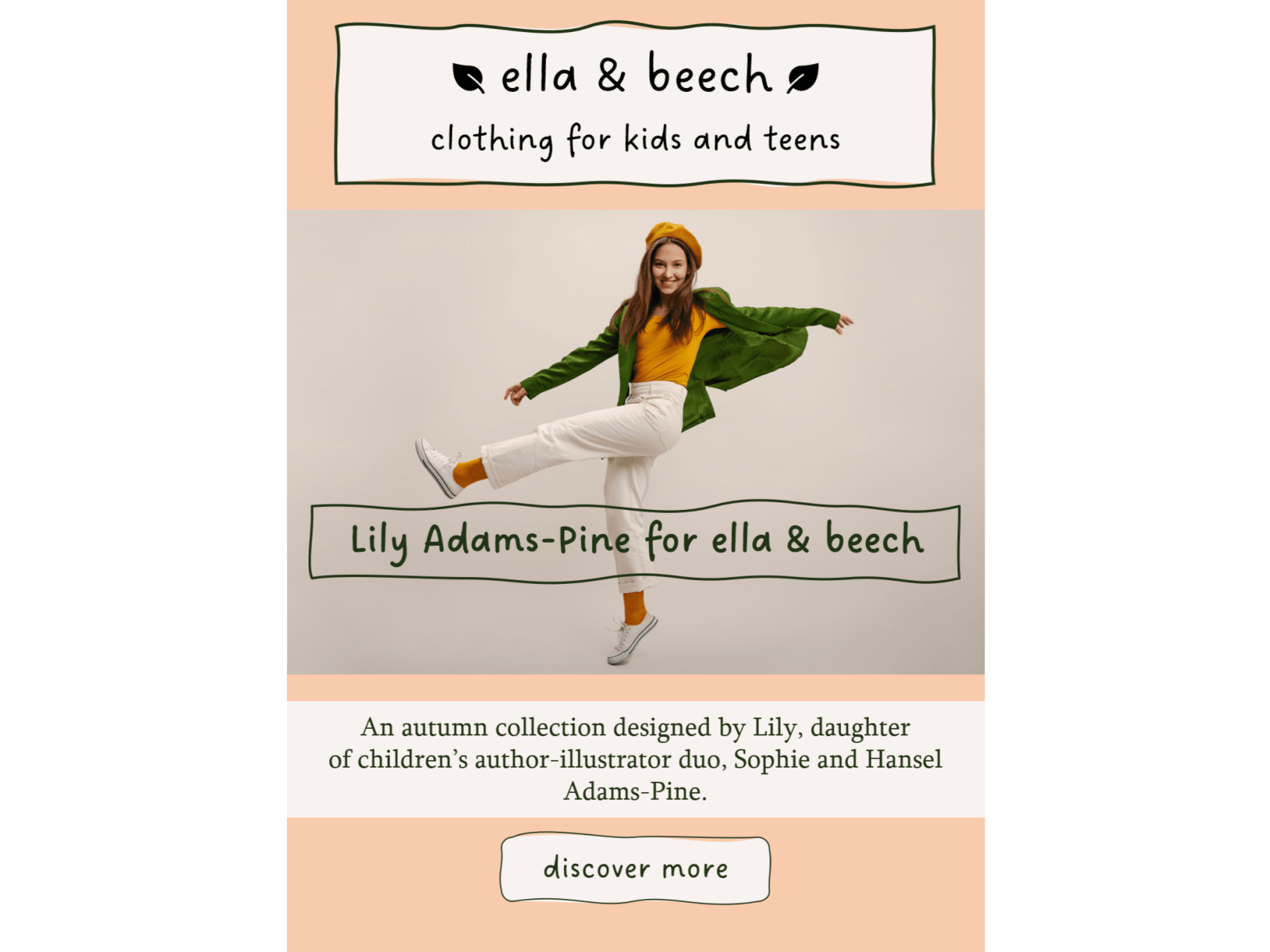
The email in Figure 4 from a children’s clothing retailer promotes a collection designed by an influencer who would be familiar with the brand’s target audience of parents.
Figure 4: Demonstrating affinity
Source: Econsultancy
- Authority
A well-known brand has authority, which is closely tied to brand trust. Brands can use that authority to enhance its claims of legitimacy over its own products or brand extensions that might be ancillary to its regular product line.
A good example of this in action comes from the energy drink brand Red Bull, which expanded into the world of extreme sports. As race team sponsors, Red Bull has established authority in the world of motorsports. The brand trades on this authority to promote branded race merchandise but this association between the brand and elite sport also helps foster positive attitudes towards its drink product.
- Scarcity/Loss aversion/Urgency
The fear of loss is more powerful than the desire for gain. Email copy can convey a sense of urgency, such as by using time-limited offers, along with a sense of scarcity to show customers that they could miss if they do not act quickly. Phrases such as “selling fast”, “order soon to avoid disappointment” and “nearly sold out” effectively play on this principle.
- Unity
This is the newest of Cialdini’s principles. This principle, he writes, “is about the categories that individuals use to define themselves and their groups, such as race, ethnicity, nationality, and family, as well as political and religious affiliations”.[2] This is a natural approach for non-profit organisations and brands promoting social and environmental initiatives. For businesses, an electronics retailer might draw attention to the energy efficiency of its products, for example, or offer trade-ins or recycling programmes.
3. Conversion-Focused Email Copywriting
When seeking to understand how to write good email copy, it is essential to comprehend the difference between copywriting for email and copywriting for other channels, as the concept of a conversion from email is different. Understanding that distinction is the first step towards writing more conversion-focused email copy, which this section addresses.
3.1 Three steps to email conversions
Most marketers think of the ‘conversion’ as a single act. In reality, an email conversion consists of three micro-conversions. Two of these micro-conversions must happen in the email before customers reach the landing page, where the third micro-conversion can happen:
- Open the email
- Click on the call to action
- Convert on the landing page
The following three rules can help an email achieve each of these micro-conversions.
- Create an inviting presence in the inbox to increase opens
Getting attention in the inbox and persuading customers to open the email is the first step. This can be achieved with the combination of a trusted and readily identifiable sender name, a strong, clear and persuasive subject line, and a supporting preheader.
All three of these elements work together to help the email stand out, let readers see right away who has sent the message, and understand quickly why they should open the message. They should form a whole that is greater than the sum of the individual parts.
Tactics to create more effective inbox copy are addressed in Section 4.
- Focus message copy on persuading customers to click on the call to action, not to commit to an action
This is where the power of email persuasion comes into play. From a conversion perspective, email readers are further away from a conversion decision than web visitors who land on the page through paid or organic search. The email copy must awaken customers’ interest in a particular product or service to drive a conversion. It must show them how they will benefit by converting and tell them clearly what steps they need to take next.
The email message is not necessarily the place to list every feature or attribute of a product or service, but to whet the customer’s appetite and encourage them to learn more. However, it must also recognise that email readers are not ready to commit to the conversion merely by viewing a paragraph or two of copy or an image.
Commanding language, such as “Buy now” or “Book your trip today” can be off-putting to shoppers who are curious but not poised to purchase just yet.
In contrast, “Find your perfect style” or “Explore your risk-free cruise options” are softer approaches that can also be compelling enough to push prospects to the website landing page, where the next phase of the conversion process takes over.
- Align email and landing page copy but focus on benefits
Marketers spend generous amounts of time on landing pages, as this is where the conversions happen. However, many brands will take the copy they use on the landing page and paste it into the email message. This is a mistake. As email readers are further back in the decision-making process, language that assumes they are ready to buy can discourage them from further consideration. The email headers, copy blocks and calls to action must reflect this.
The landing page has the luxury of time and space to close the deal. While keeping the benefits front and centre, it can also list the competitive features of the product that, in an email, might get in the way of a clickthrough decision.
Good copywriting helps create a better customer experience by positioning the email so it focuses on benefits rather than features. Features have their place on the website. The email must persuade customers to click through to the website. Once customers reach the landing page, the copywriting style can shift into answering questions, focusing on features and details, and inviting customers to commit.
3.2 Best practices for more effective copywriting
A McKinsey study from the height of the pandemic credited Covid-19 with moving digital transformation ahead by three to four years.[3] During the first few months of the pandemic lockdowns, Glance Inc research found that email engagement soared by more than 200%.[4] However, this increase in initial engagement on email did not extend to attention spans as one might have expected.
The average amount of time email subscribers spent on the messages they opened shrank by 33.3% from 2018 to 2022, according to Litmus.[5] In 2018, the average read time was 13.4 seconds, but by 2022, this was down to an average of 8.94 seconds.
This gives email copywriters even less time to make their case for conversion. The time-honoured advice to make email copy short, scannable and action-oriented still holds. However, bulleted lists, short paragraphs and concise, active sentences are not the only keys to persuasive email copy. The following best practices address other factors that can affect copy performance and how subscribers react to message content.
- Know the objective of the email and understand the audience
Copy must be tied inextricably to the email campaign’s objectives and strategy. Every word should have some connection to the intended results and align with the brand voice, tone, identity and audience expectations. This should be expressed plainly in the brief prepared for the email campaign to avoid misunderstandings and subsequent reworking.
- Write an attention-getting headline
As with the headline of a newspaper article or magazine feature, the email headline tells readers exactly what the email is all about. It can play off the subject line or take a totally different tack. Should it shock? Entertain? Amuse? Alarm? Whatever the email’s purpose, the headline should reflect it, whether in a single word or a complete sentence. Because space and attention are at a premium in email copy, the header should not merely repeat the subject line or call to action.
A good example comes from UK supermarket chain ASDA, which has a developed many memorable phrases to promote the value for money it strives to offer customers.[6] In an email promoting its loyalty programme in the run up to Christmas, the enticing subject line reads: “Psst! Your rewards are waiting…” The header plays of this with the line: “Earn pounds, not points this Christmas.” It focuses the customer on the benefit of downloading, installing and using the supermarket chain’s mobile app.
See Section 4.4 for more guidance on writing effective headline copy.
- Write informally
Email is an intimate medium, more given to conversations than lectures. A brand’s powers of persuasion can be deployed in a more creative way in this less formal environment. A common understanding in both B2B and B2C copywriting is that people buy from other people, not from companies. Hence, the copy should sound as if the brand is speaking face to face with the individual customer, using a conversational tone, rather than in a tone that recites facts or implies a one-sided discourse.
Moosejaw, a US outdoor fashion brand known for its irreverent approach to email copy, infuses its email messages with a conversational approach. In a transactional email confirming an order placement, the header reads: “You’re awesome, I got so excited about your order I texted my mum about it.”[7] The message copy continues the tone: “Way to go. This is the best order confirmation we’ve sent out all day.”
Crucially, the brand does not omit important details in favour of the colloquial approach. The email includes the billing and shipping address, the purchased items and prices, payment source, and links to customer support, return and order pages. The company details and address are listed in the footer (see Section 4.5).
- Use active language that includes powerful verbs
Lyrical writing can have a place in email copy if it aligns with the brand, products, customer expectations and email purpose. However, it should not overwhelm the email’s primary goal: moving customers to the website to convert.
Powerful verbs like those in Table 1 can move email readers to action. Many of them, like ‘improve’, ‘succeed’, ‘ensure’ and even ‘prevent’ also convey the benefit of acting.
Table 1: 27 powerful verbs for stronger email copywriting
| Choose | Improve | Increase |
| Avoid | Act | Boost |
| Build | Capture | Explore |
| Ensure | Learn | Prevent |
| Gather | Keep | Maximise |
| Overcome | Simplify | Solve |
| Stop | Succeed | Manage |
| Save | Conquer | Win |
| Unleash | Discover | Rethink |
Source: Holistic Email Marketing
- Use white space to define and highlight copy blocks
A long grey river of type is difficult to read in almost every medium, but especially so on a mobile screen. When confronted with this long stream of text, readers are more likely to swipe right to the next email in the inbox.
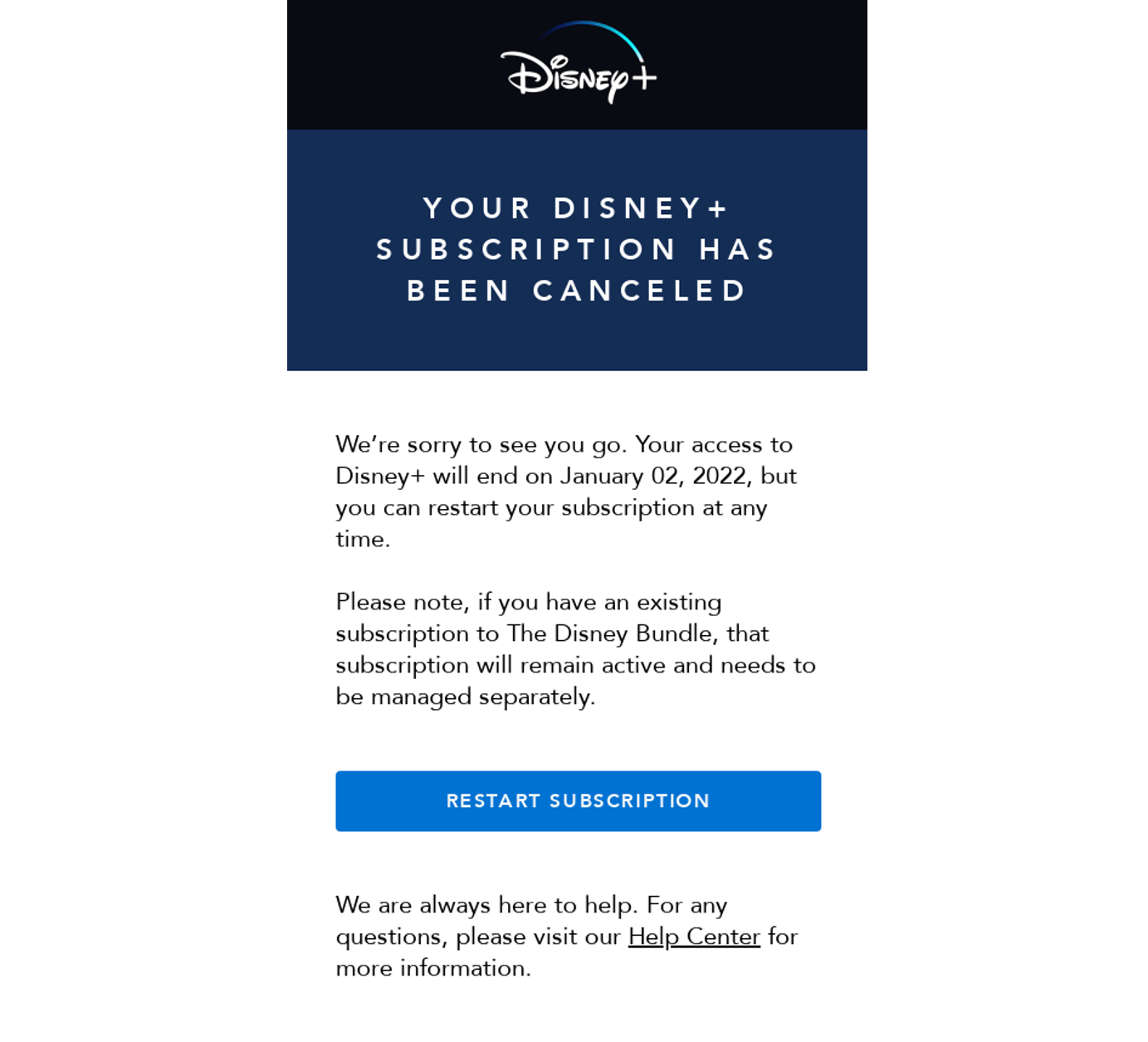
Using white space to break up copy helps to isolate and highlight key points and make it more scannable and consumable for the reader. In Figure 5, Disney+ uses white space to separate the three key points in the email. This helps each point stand out and avoids misunderstandings.
Figure 5: White space defines key points in a transactional email
Source: Disney+ via MailCharts
- Match the tone of the copy to the purpose and audience of the email
There is no such thing as ‘one size fits all’ in email copywriting. The copy’s tone should reflect the reason for sending the email.
Tone is different from brand voice. Brand voice is “the distinct personality a business curates to communicate with its target audience across mediums”, defines Sprout Social. “It includes a unified approach to tone, style and messaging to build brand recognition and nurture connection with the audience.”[8]
The tone reflects the emotion the email copy is intended to convey, which will differ depending on the purpose of the communication. An email promoting a flash sale might be written to convey excitement and urgency, whereas a legal notice notifying customers of a change in the privacy policy would be looking to inform readers, using more neutral language.
In Figure 5, the tone of the copy used in the Disney+ subscription cancellation email is significantly different from that which would be used for a promotional email, such as a plug for a new television series. The tone of the Disney+ email is neutral and reassuring, which matches the point of the email: letting the customer know the transaction has succeeded, what other conditions might apply, etc.
- Put ‘you’ before ‘we’
This is a delicate balancing act, and it speaks to the need to tailor messages to the email audience and purpose. Customer-centricity is a hallmark of ‘helpful marketing’, as explained in the report on Email Marketing Best Practice: Communications Strategy. Customer-centric emails focus on benefits, on helping customers buy easily and successfully. Put another way, the email copy must always answer the unspoken question in the customer’s mind: “What’s in it for me?”
But the emails in the programme must also serve the brand’s interests. When a brand helps customers achieve their goals, they will, by patronising the brand, help the brand achieve its own goals. To ensure this, brands must use copy that reinforces the brand’s value proposition. They should also use updated brand identifiers like logos and custom colours to position the brand effectively.
An easy way to tell whether sales copy is ‘we’-focused or ‘you’-focused is to run it through entrepreneur Jeffery Kirk’s Customer Focus Calculator. Upload the copy to a web page, enter the URL in the calculator, and click the ‘Calculate Customer Focus’ button.
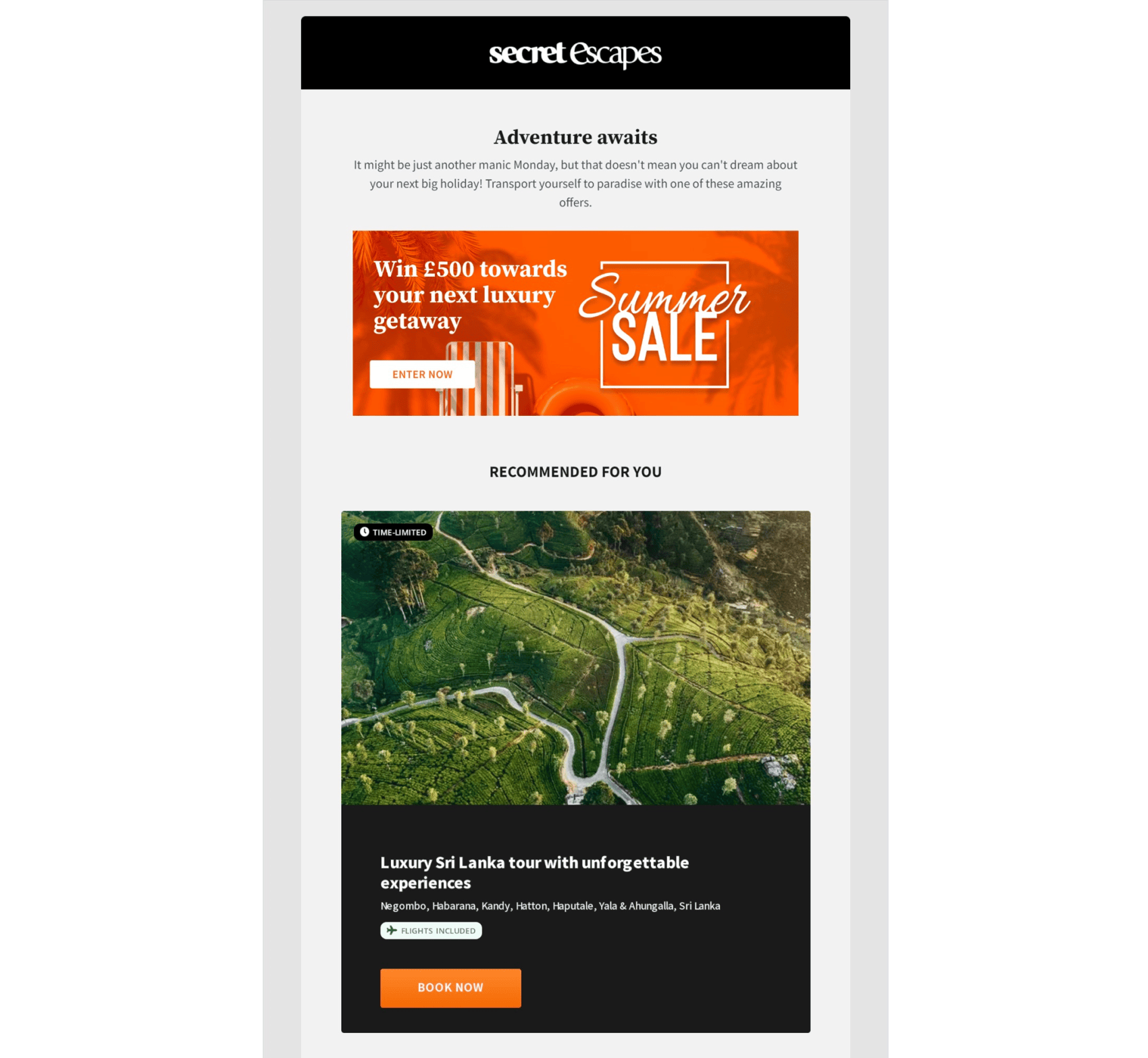
All of the copy in the following email from Secret Escapes is customer-focused (Figure 6).[9] Where another brand might be tempted to say, “We picked these for you” or “Our best deals for you”, Secret Escapes changed the focus to the customer benefit:
Adventure awaits
It might be just another manic Monday, but that doesn’t mean you can’t dream about your next big holiday! Transport yourself to paradise with one of these amazing offers.
Figure 6: Example of ‘you’-focused email copy
Source: Secret Escapes via MailCharts
- Write like a journalist: Be clear and concise and stick to the facts
Good journalism is rooted in the truth. It does not deliberately misstate, overstate or omit facts to persuade customers to click through and convert. Writing informally, keeping it brief, and using action-oriented words and phrases will also help achieve this.
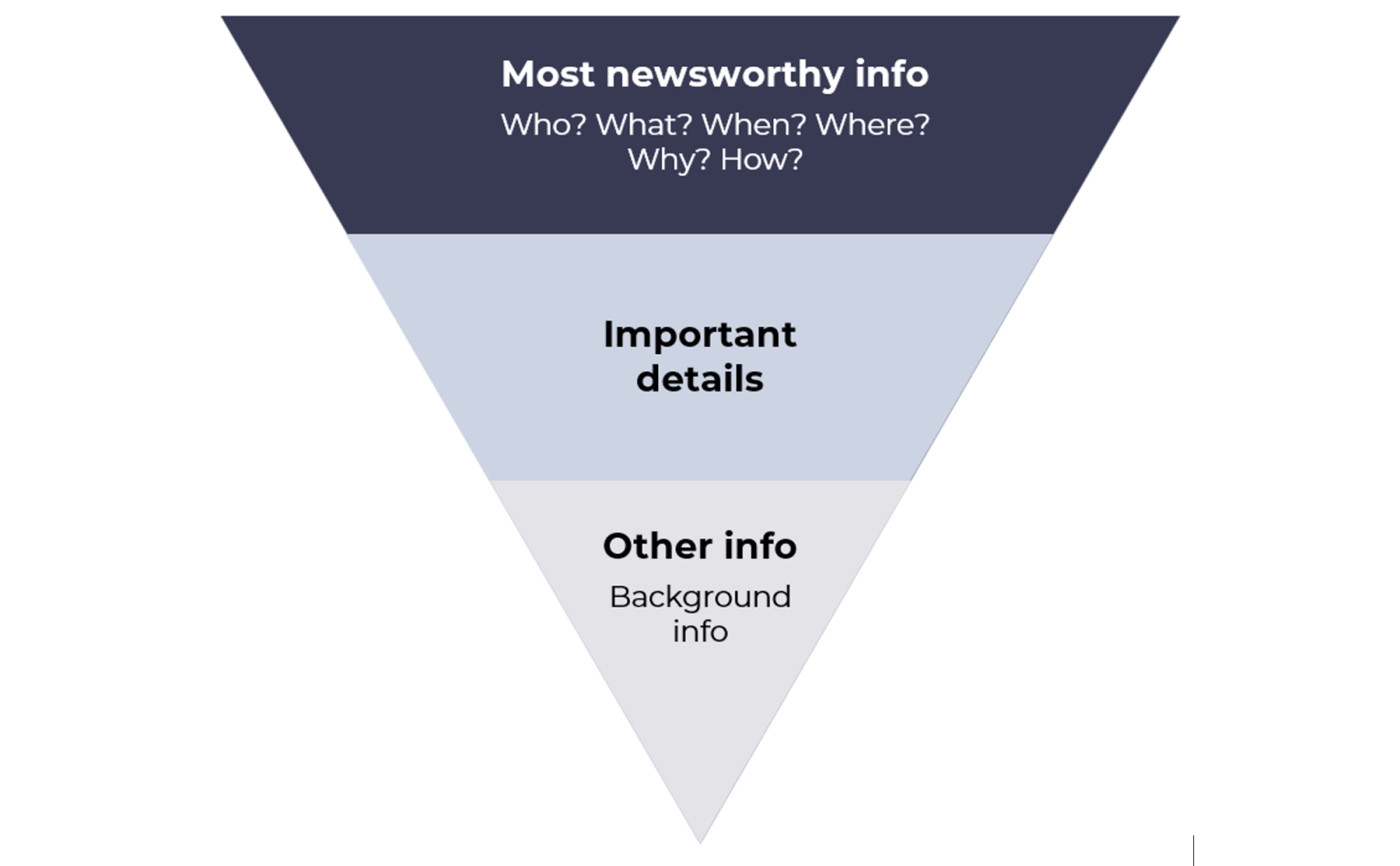
For an email that must rely more on words than images, such as a newsletter, breaking-news bulletin, policy change or company announcement, a traditional newspaper method referred to as the inverted pyramid (Figure 7) can be used. The frameworks dictates that the most important information be delivered first, tapering down to the least important information.
Figure 7: The inverted pyramid
Source: Holistic Email Marketing/Econsultancy
- Use the rule of three
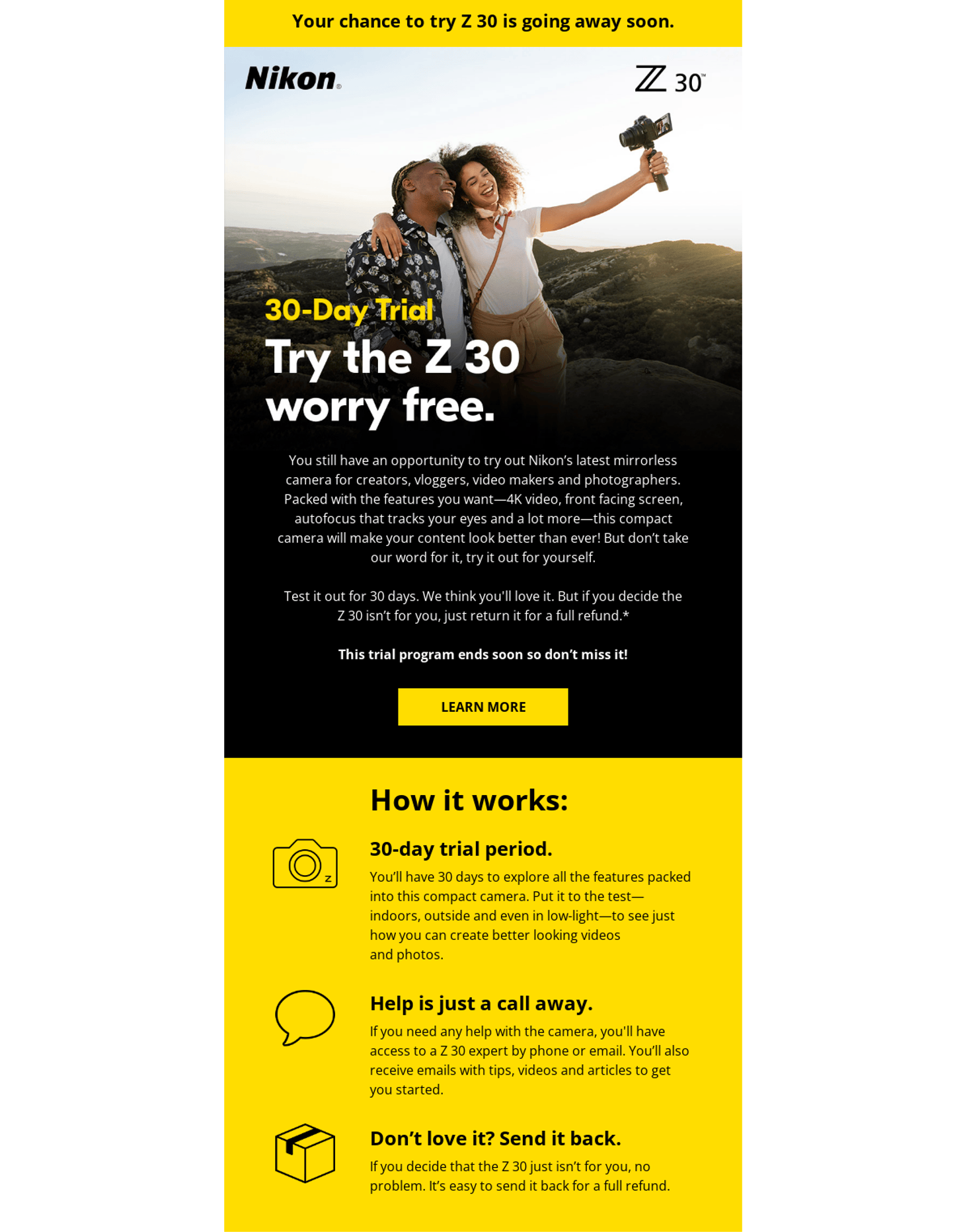
Things in threes have a natural cadence and rhythm. A three-part pattern is easy to absorb and sticks in readers’ minds.
In Figure 8, NikonUSA’s email campaign melds copywriting and design to create a memorable representation of benefits for its camera trial programme under the “How it works” heading.[10]
Figure 8: Copywriting using the rule of three
Source: Nikon via MailCharts
- Target copy to the reader’s position in the funnel
This builds on from matching the copy’s tone to the audience. The email copy should focus on where the customer is in their journey with the brand.
Emailing a broad audience, which could be made up of a wide range of customer types, from people who have never purchased to one- or two-time buyers, high-value repeat shoppers and lapsed customers, requires a different approach to sending a targeted email that acknowledges a customer’s relationship with the brand.
For example, loyal customers who already know the brand and products would ideally receive very different messaging from a new, infrequent or lapsed customer. This highlights the importance of segmenting the brand’s audience.
This also is an excellent argument for segmenting the brand’s audience. See Econsultancy’s Email Marketing Best Practice: Segmentation and Personalisation guide for further advice on this.
- Excite the reader’s emotions
Alongside what they want the reader to do in response to an email, marketers also should consider how they want the recipient to feel. Arousing an emotional response is key to capturing a subscriber’s attention. This concept is related closely to Robert Cialdini’s seven principles of persuasion, which are addressed in Section 2.2 of this guide.
Curiosity, aversion to loss and fear of missing out are three common emotional responses that underpin many email messages. Marketers will be most successful when they target emotions strategically in line with the campaign goal, the message purpose and the brand voice.
Variety is also important. A steady diet of “Time is running out” messages lessens the emotional impact and can turn customers away from emails that offer nothing else.
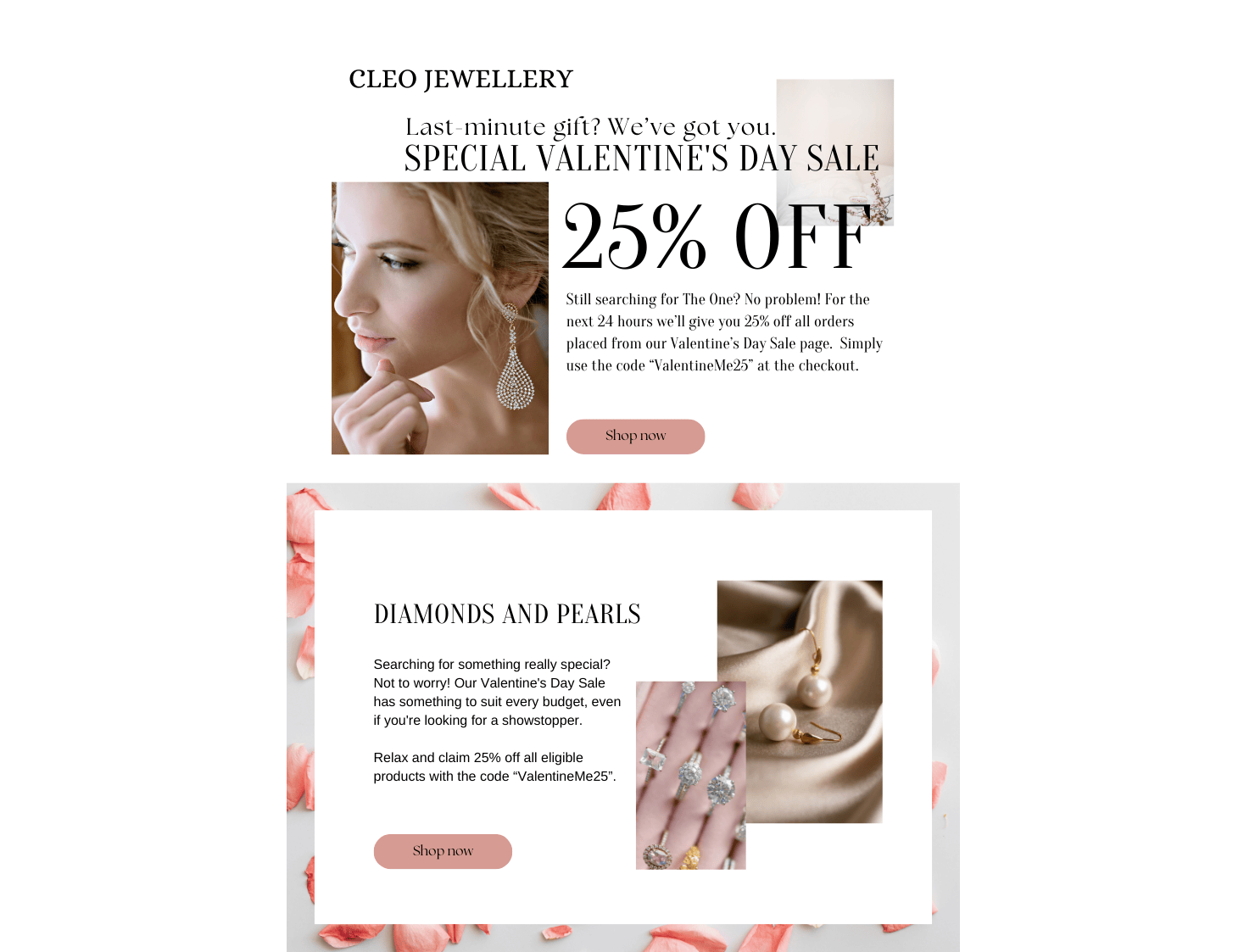
Anxiety can be a negative emotion, but the copy in Figure 9 from this jewellery brand turns it into a positive by helping customers feel confident about finding a special gift in time for Valentine’s Day.
Figure 9: Cleo Jewellery adds a positive spin on gift shopping anxiety to boost customer confidence
Source: Dedoci Studio via Canva
Empathy mapping can be a useful tool for gaining a rich understanding of what a customer wants and needs in a specific context. For more information on using empathy maps, see Econsultancy’s Customer Journey Mapping Best Practice Guide.
- Vary sentence length and style
An excellent guide to writing attention-grabbing sentences comes from the renowned writer Gary Provost, author of Make Every Word Count and 100 Ways to Improve Your Writing.[11] The following oft-quoted excerpt highlights perfectly the importance of varying sentence length. His works are valuable resources for all copywriters, but especially email writers where space is at a premium and the words have to engage the reader quickly.
“This sentence has five words. Here are five more words. Five-word sentences are fine.
But several together become monotonous. Listen to what is happening. The writing is getting boring. The sound of it drones. It’s like a stuck record. The ear demands some variety.
“Now listen. I vary the sentence length, and I create music. Music. The writing sings. It has a pleasant rhythm, a lilt, a harmony. I use short sentences. And I use sentences of medium length.
“And sometimes, when I am certain the reader is rested, I will engage him with a sentence of considerable length, a sentence that burns with energy and builds with all the impetus of a crescendo, the roll of the drums, the crash of the cymbals–sounds that say listen to this, it is important.”
- Persuade through proof
Trust forms a major part in the success of an email campaign. For customers to purchase a product or service they must trust the brand. Elements that help build trust are:
- Recognition – does the reader recognise the business?
- Prior experience – has the reader had previous positive interactions with the brand?
- Recommendation – do others trust the brand?
- Repetition and consistency – does the brand behave consistently at all times?
All of these points can be reinforced through copywriting. Including the brand name in the top section of the copy, reminding customers about previous interactions, and outlining the experience of others can help to achieve campaign goals. Above all else, email copy should be of a consistent style so the recipient can build a picture of the brand and learn to trust the communications.
3.3 Do a SCOPE review
Econsultancy’s SCOPE framework is an easy-to understand approach to writing online copy that can be applied to email copywriting. It balances the reality of short attention spans and tight message spaces with the emotional components of great copy.
SCOPE is an acronym for:
- Short: Email copywriting is all about telling a compelling story within the average reader’s short attention span. Keep messages simple, limiting paragraphs to one or two short, direct sentences. After writing the first draft, go back and cut it by 30%.
- Compelling: Whether the email is for a B2B or B2C audience, it will get more attention if it addresses at least one emotional or psychological need. (See Section 2.2 for a discussion of persuasion psychology.) The copy should connect to customers’ problems and opportunities.
- Orienting: Coordinate email and landing page copy so readers who click through from the email know they have landed in the right place.
- Propulsive: Use calls to action that are persuasive enough to prompt readers to click but do not ask them to commit to a big decision before they are ready.
- Enrolling: Email copy should convey the brand’s promise and personality to assure the reader that the business aligns with their values and sense of self.
Applying the learning: Building credibility for email campaigns
Email readers can be cynical, so it is important to convey credibility. Here are some guidelines for overcoming cynicism and building trust through email copywriting:
1. Try to connect with readers by using customer language and terms they would know and use regularly.
2. Spell out the benefits that a feature, product or service provides. For example, use a bulleted list in a different font or format to emphasise the benefits.
3. Back up claims with facts and numbers.
4. Use testimonials such as customer quotes, number of customers who have bought a product or used a service, client names and independent reviews and awards. Social media channels and customer service departments can be rich sources of customer commentary. For further guidance about using customer reviews, see Econsultancy’s Quick Guide to Ratings and Reviews.
Holistic Email Marketing
4. Fitting the Email Pieces Together
This section focuses in detail on the individual elements of the email. Although each element is considered separately, it is essential to remember that an email is like the human body: it is most effective when all of the individual parts work together instead of against each other.
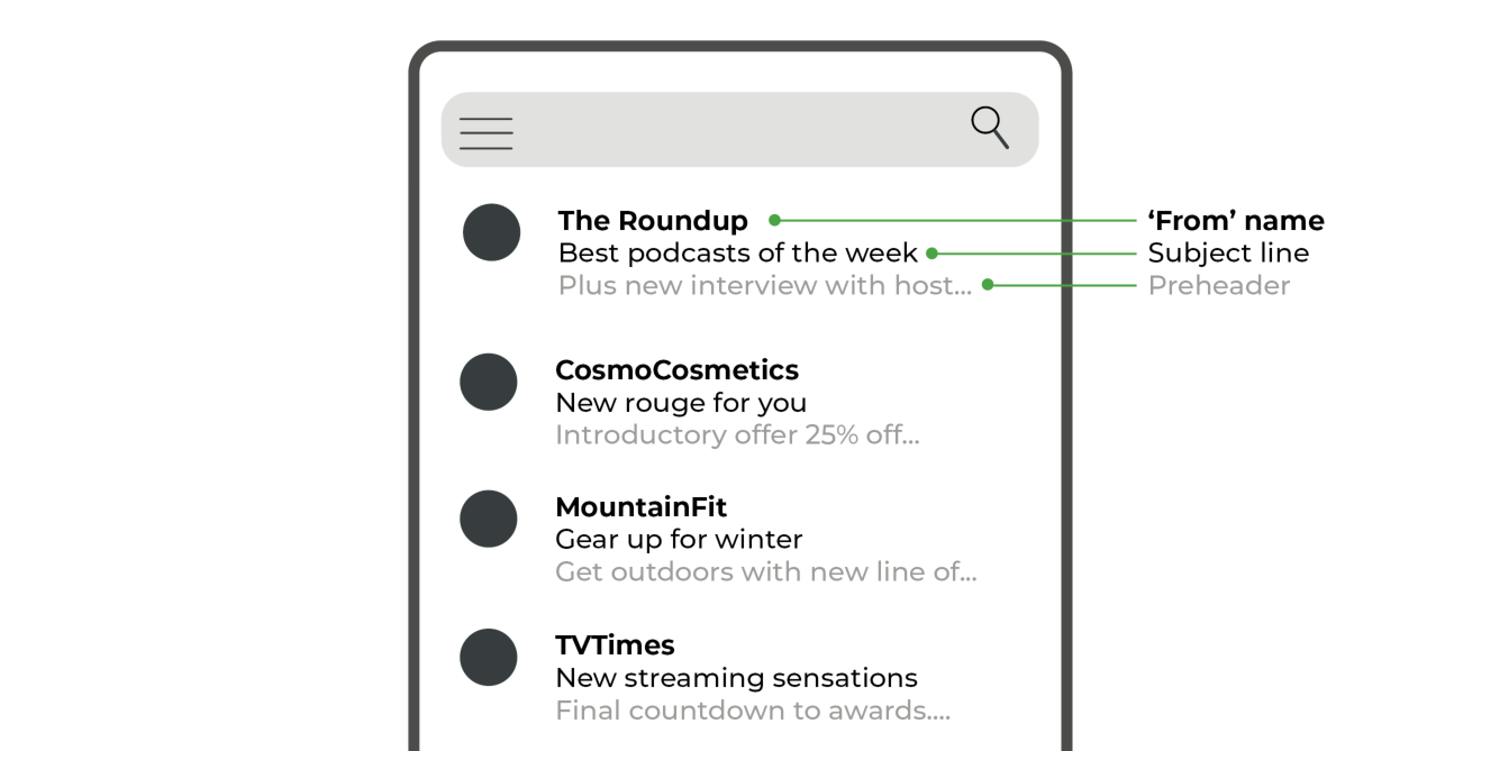
The inbox in an email client – whether desktop, web client or mobile – gives subscribers three kinds of information that they can use to decide whether to open or delete the email or mark it as spam:
- The subject line, which tells the subscriber what is in the email.
- The ‘from’ name, which tells the subscriber who sent the email.
- The preheader, usually the first line of copy in the email, which is used to support or extend the subject line.
Figure 10: Anatomy of an email in the inbox
Source: Econsultancy
The main headline and footer are found in the body of the email and can be read as the email’s opening and closing messages.
The following sections look at each of these elements in turn.
4.1 The subject line
Marketers and email copywriters spend hours thinking about, writing, testing, rewriting and thinking again about subject lines, and for good reason. The subject line can make or break the email experience for all but perhaps the most ardently loyal customers.
For many years, those who have developed ads and direct mail have used the AIDA framework to get ‘attention, interest, desire and action’. The email subject line can be treated in the same way. Marketers are trying to get attention as the email is competing with many other emails, but additionally marketers are looking to provoke interest and desire so that the recipient opens the email. The subject line copy often also conditions the recipient to take a second action, i.e. clicking on a call to action once the email has been opened.
4.1.1 New thinking on subject line length
For years, marketers have assumed that shorter subject lines were more effective than longer ones. One element of best practice is to ‘front load’ the key points in the subject line so that they do not get cut off in the inbox. However, whether long or short is better is the wrong question to ask.
While shorter subject lines can lead to more opens, this does not always result in more clicks and conversions, especially if subscribers find they did not get enough information from the subject line to decide whether the email content was interesting enough to prompt them to go further.
Instead, a more useful question to ask is: “Should my subject lines be generic or specific?”
In general, generic subject lines appeal to a broader audience, which can lead to higher open rates. The more generic they are, the more people can read into them what they want to. However, more specific subject lines qualify leads in the inbox. That is, they appeal more to the people who are more likely to convert from the open. Fewer people will open the email, but more of those that do will click through to the website.
Case Study: Generic vs specific subject lines
Mockingbird, a marketing agency specialising in marketing services for law firms, wanted to learn whether specific subject lines for its regular newsletters would increase campaign open rates and clickthroughs. In each of seven A/B split tests, the control was its standard subject line (“Mockingbird Marketing: From Around the Blog”). The variable was the title of an article featured in the newsletter, such as “When We’re Happy to See Clients Go…” and “Yes, You Need Call Tracking”. The KPIs were open rate and clickthrough rate (CTR).
Results: In six of the seven split tests, the unique subject line outperformed the generic one. According to the agency, specific subject lines achieved an average open rate of 15.74% compared with 13.56% for the control, and an average CTR of 2.34% compared with 1.93% for the control. The test was run on 1,033 email addresses.
Mockingbird[12]
One caveat to using open rate as a KPI: it is a good measure to use if the campaign objective is to reach as many people as possible, as was the case in the Mockingbird experiment. However, if the objective is to gain conversions, other metrics, such as conversion rate, would be more appropriate.
4.1.2 Techniques for writing effective subject lines
The subject line can use several techniques to gain attention. Common elements include:
- The teaser. This is intended to intrigue. It says, ‘read me’ and is often combined with a question.
- The question. This will usually allude to the benefits. It will work on a need or problem the customer may be facing, which could be financial or time-based.
- Loss aversion. People often have a preference for avoiding loss as opposed to making gains. A change in phrasing can have a dramatic effect on perception. For example, “Free shipping this week” can become “Save on shipping costs before Friday” to increase the sense of urgency.
- The event tie-in. This leverages an occasion, such as an annual holiday, festive season or company promotion to provide relevant, timely messaging.
- The direct approach. Clearly state the offer or benefits, without trying to be intriguing or humorous.
- Personalisation. The name of the recipient can be incorporated into the start of the subject line, but note this can be viewed as false intimacy.
- Emojis. The use of emojis in email has increased over recent years. While fashionable in some industries, it is important to test whether they resonant with the target audience and have a positive or negative impact on the organisation’s email metrics.
- The CURVE rule: The subject line should have two or three of these attributes:
- Curiosity
- Urgency
- Relevance
- Value
- Emotion
Given the importance of subject lines, they should not be left until just before the email is sent. Think about them at the planning stage, early in the campaign, and refine them from there.
Applying the learning: Testing the CURVE
One approach to refining email subject lines is to think through synonyms for each word and evolve them as follows by brainstorming different alternatives. For example:
1. Free break in Florida
2. Free weekend in New Orleans
3. Exclusive weekend in Miami
4. Your exclusive weekend in Miami
5. Exclusive all-expenses paid weekend in Miami
Here, the fourth option could work, since it is reasonably specific and intriguing as well as being customer-focused, while the fifth option is very specific and focuses on the WIIFM (“what’s in it for me?”).
A subject line test could include two variations that reflect different attributes, such as testing curiosity against urgency. In this testing scenario, the default could be “Exclusive all-expenses paid weekend in Miami” and the variant “One more day to claim your exclusive all-expenses paid weekend in Miami” (See Section 5.6 for a discussion of using generative AI, such as ChatGPT, to create subject line variables).
Holistic Email Marketing
4.2 The ‘from’ name
‘From’ names are equally, if not more, important than the subject line. Recipients look at the ‘from’ name as much as the subject line when deciding whether to open the email, delete it, or mark it as spam.[13]
The ‘from’ part of an email has two components:
- The displayed ‘from’ name, e.g. Clinique Online
- The sender’s email address, e.g. clinique@e.clinique.com
It is best to use the ‘from’ line that recipients would expect to see, such as the brand or newsletter name. In some situations, such as where there is a celebrity, CEO or an account manager in B2B who is known to the recipient, it may be more effective to use an individual name. Sometimes a combination might work, for example: Jane Smith, Brand Name <janesmith@brandname.com>
This tactic needs to be tested before use and it should be ensured that the brand name is not cut off.
Some brands will vary the ‘from’ name throughout the year to highlight important campaigns or add information to the subject line and preheader. While this can introduce variety into the inbox, it can backfire if readers interpret the email as spam or fraud and either delete it unread or mark it as spam.
It is generally not a good idea to allow the sending address to appear in the displayed ‘from’ name field in the inbox because that can be a hallmark of spam or fraudulent email. Another entry to avoid is the ‘do not reply’ or ‘no-reply’ email address. This might be the address associated with an account that the marketing team does not monitor, but it is off-putting to recipients. As discussed, many email recipients use the ‘from’ name in the inbox to decide whether to open the email. “No-reply”, even with a brand name attached, can look suspect.
Copywriters should remember that the individual elements that make up the inbox experience – the ‘from’ name, the subject line and the preheader (see Section 4.3) – do not exist in a vacuum. Copywriters should note that they relate to one another and consider the total impact of their copy choices.
Having a ready source of email examples can also inspire creativity for subject lines, preheaders, headers and all other email content design, such as these two sources:
- A ‘swipe file’ of notable email content, comprised either of a recipient’s personal collection of individual emails received, or an online collection maintained for group access on an internal server such as an intranet, Slack channel or a document-sharing service like Google Docs).
- A searchable database of full-size email examples, including MailCharts[14] (free and paid subscriptions), Milled[15] (free), and Really Good Emails (free).[16]
4.2.1 Spammers’ new tool: From names
To get more opens, spammers are co-opting the from name, which as noted above is one of the markers email users look for when deciding whether to open an email. Many spammers are now using household brand names to lure people into opening their emails.
This spam technique trades upon the deliverability premise that getting more emails opened in the inbox helps the sender’s reputation with the inbox provider, thus increasing the chance that future emails will be delivered to the inbox. This means that someone who opens a spam email in the inbox, but does not click the ‘report spam’ button, is helping to legitimise the spammer who sent it.
4.3 The preheader
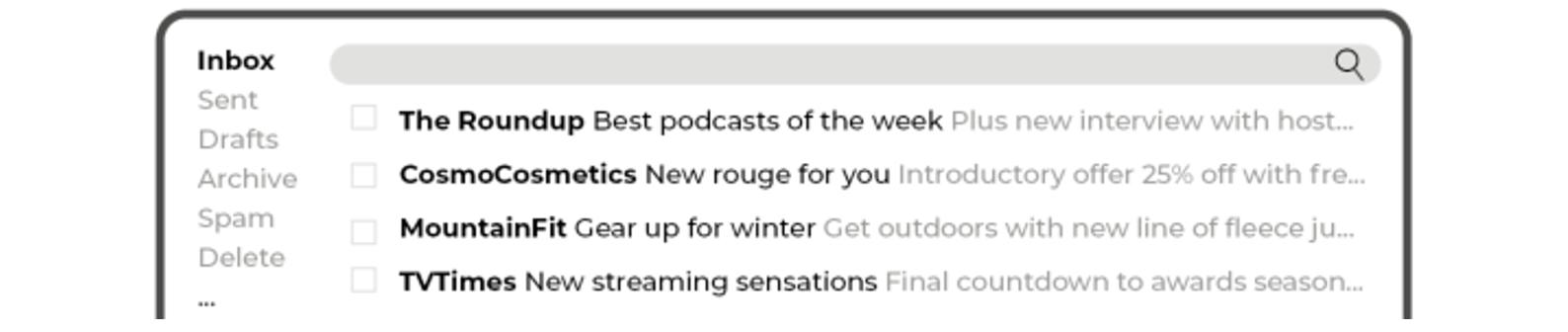
The preheader is the first line of copy in the message body of the email. Many email clients, especially mobile clients, automatically pull this line into the field next to the subject line. In many email templates, this first line is used for service messages like “View in browser” or “Add us to your address book”. This is a functional preheader.
A better use of the preheader would be to use copy that tells the subscriber more about the email. It can augment the subject line, in order to highlight a secondary offer or accomplish another goal. This is a marketing preheader.
Figure 11: The preheader displayed after the subject line
Source: Econsultancy
Three examples of marketing preheaders:
1. Brand: UNIQLO
Subject line: Utility styles incoming
Preheader: Plenty of pockets included
2. Brand: Mr Porter
Subject line: What’s new from CELINE HOMME
Preheader: Get 10% off your first purchase with the MR PORTER app when you use code AP
3. Brand: Who Gives a Crap
Subject line: Life in plastic isn’t fantastic
Preheader: No offence, Barbie
4.4 The headline
The headline inside the email also helps to set expectations, explain what is on offer, and create excitement. So, what is a headline for? It should:
- Add to the subject line and preheader, not simply repeat them.
- Connect to the lead paragraph or offer.
- Encourage an immediate impulsive click, for example by conveying urgency or curiosity.
Applying the following messages or techniques can help create powerful headlines:
- Include a direct or indirect benefit
- Ask a question
- Make a provocative statement
- Ask a provocative question
- Offer to teach
- Give news
- Appeal to personal self-interest
- Get the right sort of attention
- Use quotes
- Reflect the brand voice
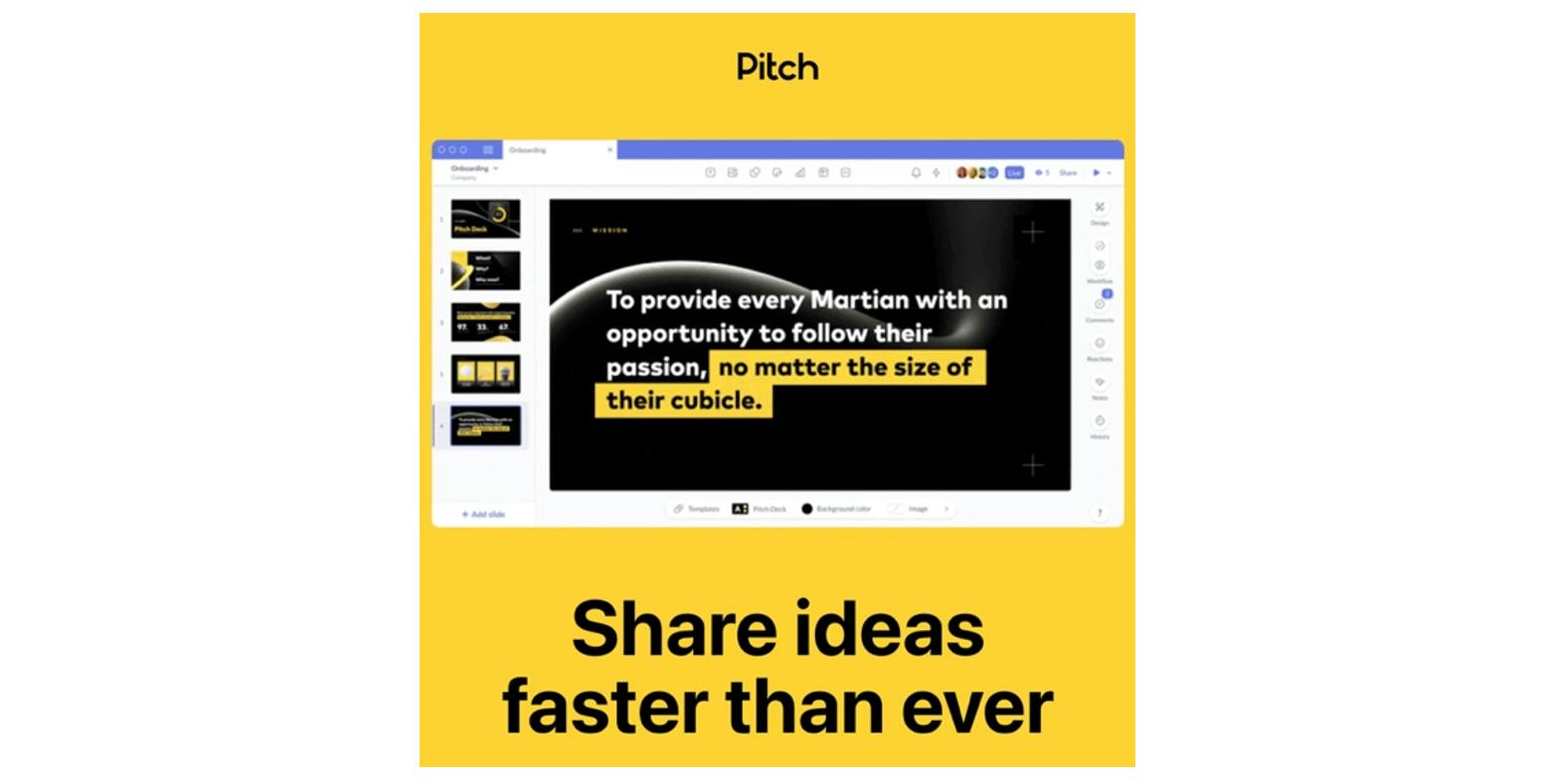
Figure 12: A B2B example of an effective email headline from Pitch
Source: Pitch
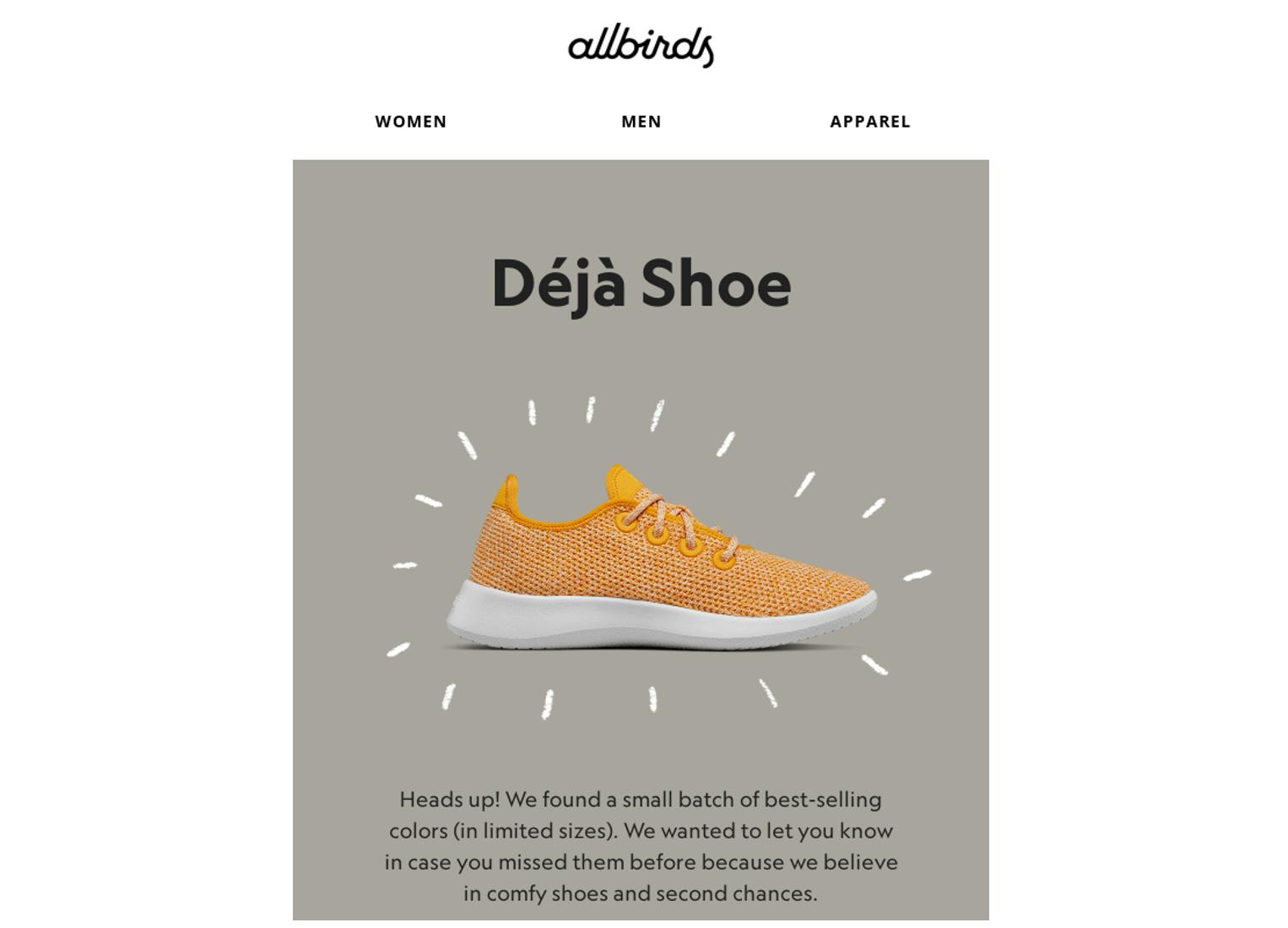
Figure 13: A B2C example of an effective email headline from Allbirds, following the subject line: ‘Some Old Favourites Are Back’
Source: Allbirds via MailCharts[17]
4.5 The footer
The footer is the section of copy at the bottom of an email message. Some also call it the ‘admin footer’, the ‘admin centre’, or just ‘the admin’ because it can include legally required information, links to help customers manage their subscriptions and accounts, and other administrative information.
Commonly found in the email footer:
- Unsubscribe link
- Preference centre
- Social media links
- Company postal address
- Store or customer support hours and contact information
- Other legally required information such as where the company is chartered or the legal business name
- A frequently asked questions (FAQ) page link
- Map or find-a-store link
- Customer loyalty programme or account links
- Third-party rating service results
The email footer is more than an information box. Providing detailed contact and customer support information builds trust and helps customers buy more confidently. It also helps to resolve issues quickly.
4.6 Automating inbox content for multiple audiences
Up to this point, the discussion of best practices for creating ‘from’ names, subject lines, preheaders, headline copy and footers has been focused on single email campaigns. With the advent of email automation that enables the creation of hyper-personalised content at scale, the need for extending that personalisation into the inbox copy has grown.
The following case study addresses the use of automation in creating dozens or hundreds (or more) of personalised inbox identifiers to match personalised content in the message. For an in-depth discussion of email automation itself, see Econsultancy’s Email Marketing Best Practice: Segmentation and Personalisation guide.
Case study: Automated personalised newsletter increases CTR and saves six hours a week
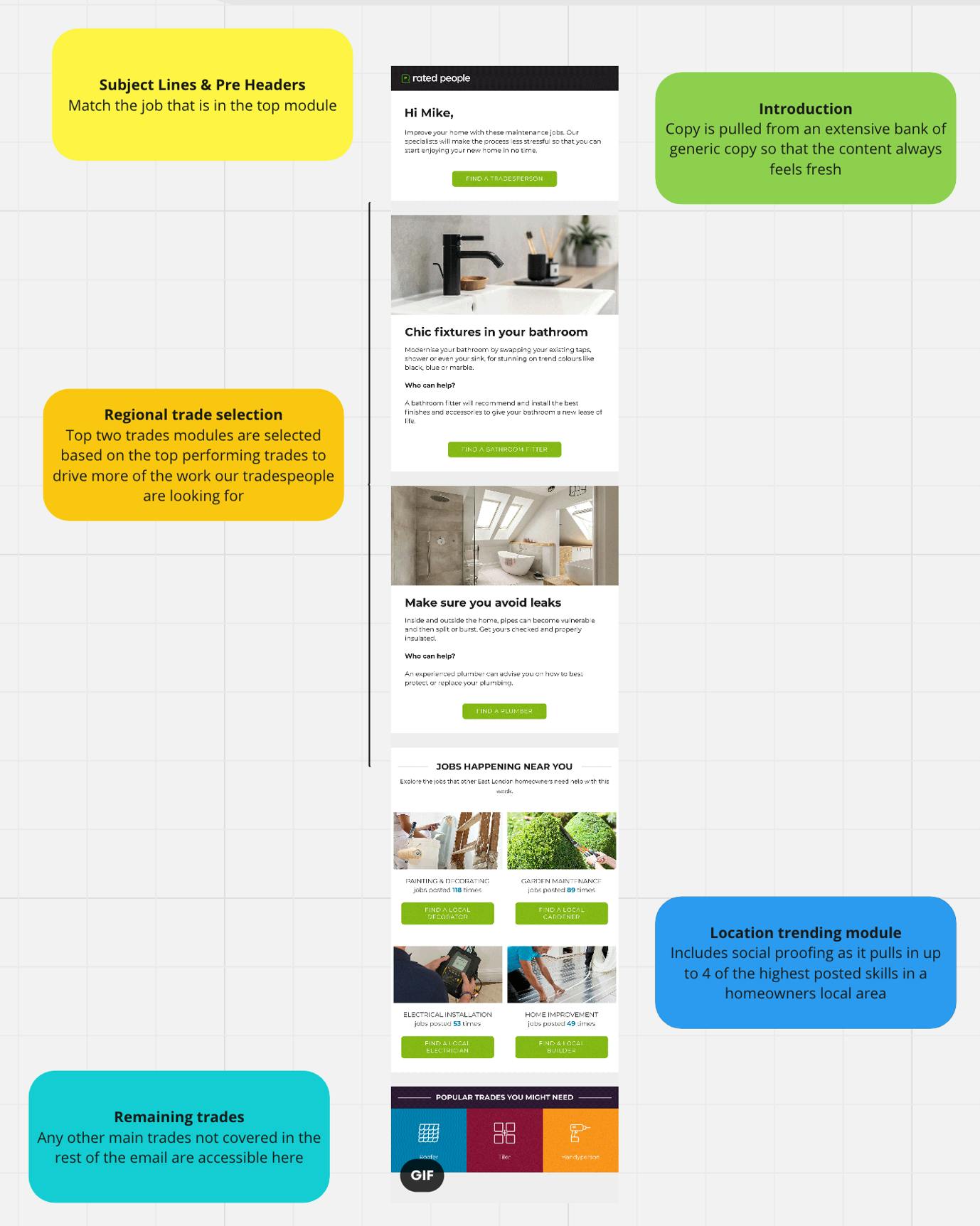
Rated People, a UK-based online recommendation service that connects homeowners with local, recommended tradespeople, wanted to find new ways to streamline the production of its weekly jobs newsletter, a manually produced broadcast email newsletter whose engagement had begun to plateau.
To make the newsletter more engaging, the team developed a series of automated, regionally personalised jobs newsletters, featuring jobs with the highest purchase rate and profitability among its tradespeople, and will continue to grow that newsletter inventory and ensure homeowners’ projects will be fulfilled.
The team created a bank of email copy elements such as subject lines, preheaders and message copy, and produced an extensive number of copy variations for each trade. The team also wrote journey logic that rotated the mentions of specific trades in the newsletter to prevent back-to-back mentions and keep newsletter copy varied from issue to issue, while allowing the option to overwrite the logic in order to feature a specific trade, if required.
Results: The clickthrough rate from customers with home-service job requests rose 11%, which led to an uplift of purchase rates for tradespeople. The switch to automation also saved the team six hours of production work each week.
Figure 14: Rated People’s automated, personalised newsletter
Source: Rated People
Jess Evans-Tudor, Head of CRM, Rated People
5. Generative AI and Email Marketing
Generative AI refers to “artificial intelligence-powered tools that produce text, imagery, or video”.[18] Like other forms of AI, it uses data-led algorithms to drive decision-making without relying exclusively on human-designed rules.
This section of the guide will review the evolution of generative algorithms and marketers’ attitudes to the technology. It will explore marketing use cases and generative AI’s role in copywriting and content creation along with recommended best practices.
For wider discussions and updated thinking about generative AI’s role in marketing, from channel and organisational impacts to its potential for different industry verticals, refer to Econsultancy’s collection of articles and briefings.
5.1 The evolution of AI in email marketing
Since email emerged as a viable marketing channel in the 1990s, it has evolved from a simple communication tool to a powerful business strategy, reaching vast audiences with personalised content. AI has been a key driver behind this transformation.
- Phase 1 – Personalisation emerges: In the early 2000s, email marketers began exploring basic personalisation techniques like inserting the recipient’s name into the subject line or message body, or segmenting the email database based on demographics. These tactics were revolutionary at the time but were also limited in their ability to create truly personalised experiences.
.
Also, while these tactics incorporated simple automation, marketers still had to write rules to guide the automations, manually select segments and create multiple versions of each email campaign for targeting.
- Phase 2 – Machine learning takes over: As machine learning (ML) algorithms became more sophisticated in the mid- to late 2000s, email marketers gained the power to analyse vast amounts of data to predict user behaviour and preferences. This ushered in hyper-personalisation, where emails could be tailored to individual preferences, leading to higher engagement rates and conversions. AI also was used to test and optimise subject lines and predict what will engage an audience to generate the best preheaders, headlines, calls to action and subject lines.
- Phase 3 – Advanced email filtering: AI-powered email filtering systems arrived in the early 2010s, combating spam and improving inbox deliverability. These intelligent filters ensured that relevant emails reached the recipients, enhancing the overall email marketing experience.
- Phase 4 – Automated content generation: Integrating natural language processing (NLP) with large language models in the 2020s allowed marketers to automate content creation for email campaigns. AI-generated content now enables marketers to streamline their processes and focus on strategy while maintaining high-quality and engaging content.
Generative AI made headlines and gained immediate attention from marketers in 2022 with the launch of ChatGPT, a large language application built on GPT-3 (Generative Pre-Trained Transformer 3), a neural network ML model built by the research laboratory OpenAI and trained on internet data to generate text in response to prompts.[19] Its successor, GPT-4, was launched in early 2023, and incorporates DALL-E for generating images. GPT-4 has more data and computing power than GPT-3 and is said to be more accurate, creative, and reliable in solving complex problems.
With more than 100 million users now registered,[20] ChatGPT is one of the fastest growing AI-driven natural language models. Users can choose from several dozen tools, some of which are proprietary while others, such as Bing from Microsoft and Bard from Google, are available to users of those companies’ internet browsers.
5.2 Email marketer acceptance and use of generative AI
From corporate leaders to hands-on email marketers, interest in using generative AI is high. Several research studies point to generally positive reactions.
In a Gartner-sponsored poll of 2,500 executives, 45% said publicity around ChatGPT prompted them to invest more in AI-driven programmes. While 19% of executives said their organisations were already using or piloting AI efforts, 70% said they were researching or exploring them.[21]
Even before ChatGPT launched in November 2022, marketers were favourably disposed towards the use of AI. In Capterra’s 2022 AI Marketing Survey, 82% of marketers agreed with a statement saying copy generated by AI or ML software was as good or better than copy written by humans.
The survey also found that email marketing was the number one use of AI or ML software (63%), ahead of advertising (58%) and data analysis (57%).[22]
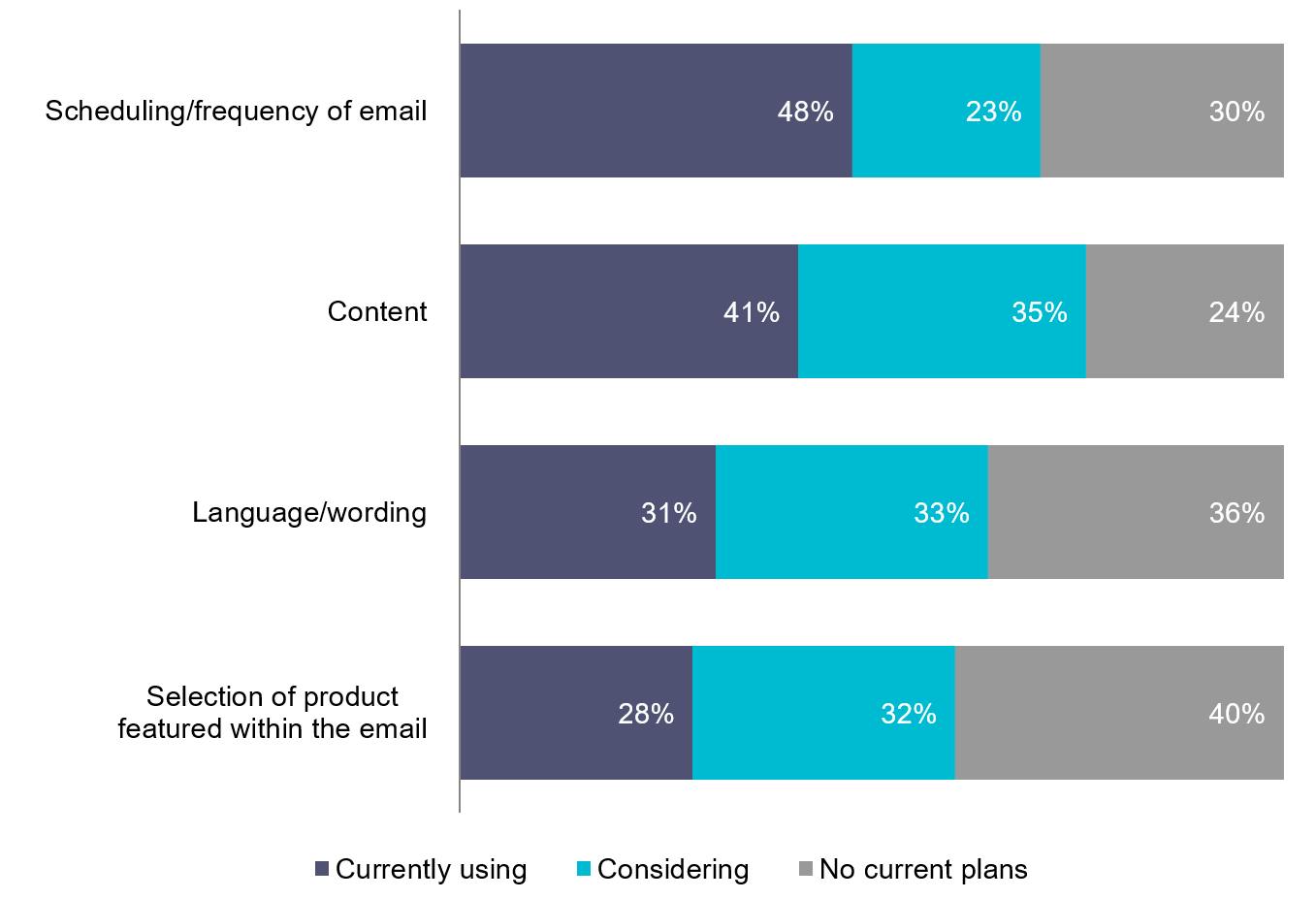
Results from Econsultancy’s 2023 Future of Marketing survey showed that the primary use of AI tools in marketing for close to half of all respondents (48%) is for scheduling and managing the frequency of email campaigns (Figure 15). However, marketers are also investing in AI solutions for content (41%).
Figure 15: In which of the following areas have you implemented predictive or intelligent solutions in place of manual marketing processes for email
Source: Econsultancy’s Future of Marketing survey[23]
In a survey of email marketers, RPE Origin and Ascend2 found that a majority of email marketers are already using some form of AI in their work.[24] Among the findings, the study revealed that:
- 57% of email marketers are already using AI “extensively” or “to some extent”.
- 25% are not using AI but plan to.
- 14% do not intend to use it.
- 4% are not sure.
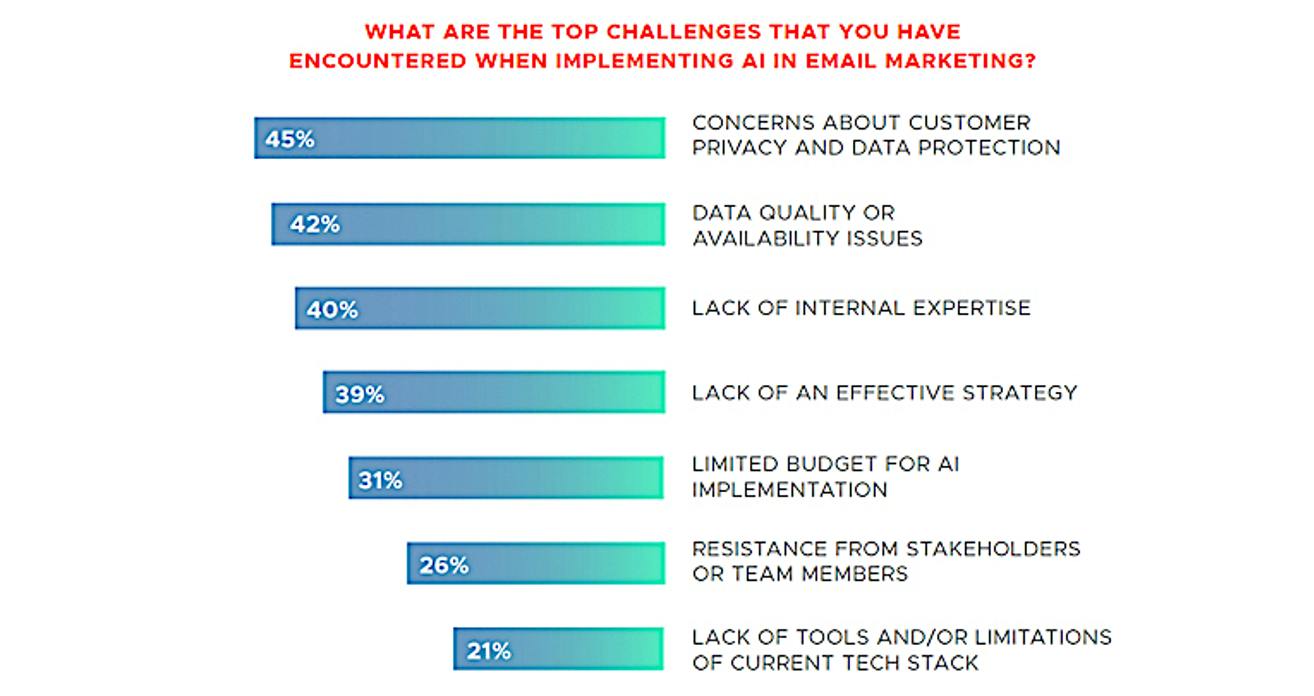
However, even with that largely positive view, marketers acknowledge that they experience several challenges when using AI in their email programmes. Concern about customer privacy and data protection was the top challenge (45%) (Figure 16).
Figure 16: Marketers’ challenges in implementing AI in email marketing
Source: RPE Origin/Ascend 2[25]
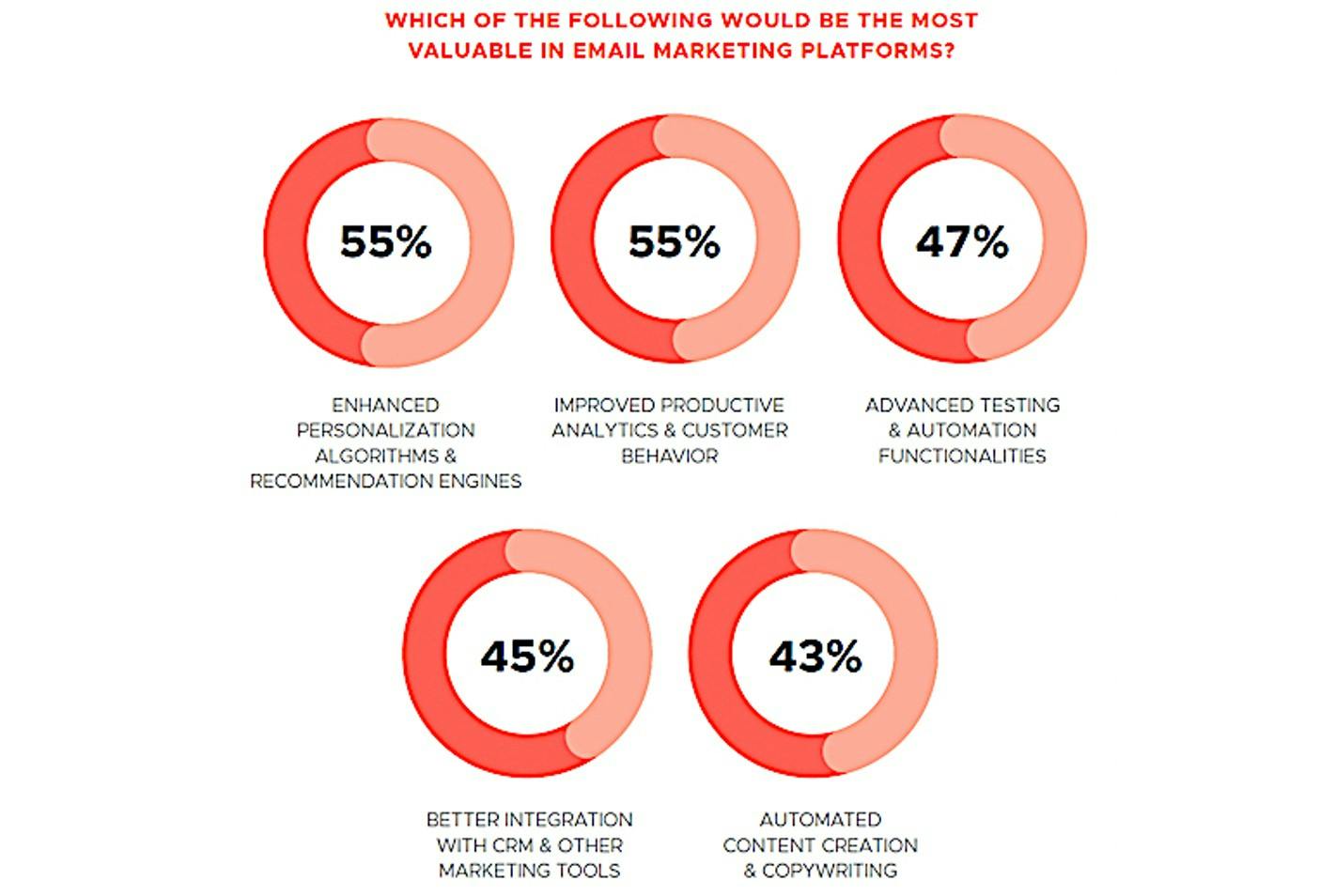
Recognising that email service providers have begun adding some generative AI features to their email platforms, the survey also asked marketers which capabilities would be most useful. Alongside improved analytics, advanced personalisation came out on top, indicating that marketers want to do more with generative AI than write subject lines.
Figure 17: Marketers’ wish lists of AI capabilities or features in ESPs
Source: RPE Origin/Ascend2[26]
5.3 The benefits and impact of generative AI on email marketing
As generative AI tools and the technology and data behind them improve and expand, and as marketers become more skilled at using them, more benefits of AI are being discovered for email content creation in general, and copywriting in particular. Some of these include:
- Enhancing and simplifying content creation and production.
- Generating larger volumes of content without a corresponding increase in worker headcount or time.
- Greater precision in producing copy and images that target specific audiences, align with brand voice and values, and provide context in line with content objectives.
- Freeing marketers from repetitive content tasks.
Sections 5.4 and 5.5 discuss the challenges and concerns email marketers face today when working with AI and generative AI.
Writing copy without a copywriter
“After we brought operations in-house, one gap we saw was in copywriting. It was a skill we didn’t have within the team, so we looked to substitute a copywriter with AI copywriting.
“We use a tool called Jasper, which is an artificial intelligence platform, to create copy for us. It learns your brand’s tone of voice and the phraseology that you do and don’t like. That allowed us to create copy and content as quickly as we needed it. It’s almost instantaneous. We can ask it to write five bullet points and five seconds later it’s done.”
Tony Allen, Global D2C CRM Lead, Volvo Cars
Saving time with ChatGPT
“We have used ChatGPT in figuring out how we can solve problems in a process or save time. Especially for email, we use it when we are launching a new programme. Now, instead of getting copy to both copywriters and translators and waiting for results, we can create new email copy in ChatGPT for a first draft, which we can then launch directly instead of having to brief in copywriters, wait for the copy and then wait for translations.
“Of course we always have human eyes on the copy, and we have marketers proofread it and copywriters going in and proofreading at a later stage. But it’s good enough for version one.
“With the translations, we just did a round of translations across our key markets, and no one pointed out a single grammatical error in them. That’s not what we’re seeing when we use human translators, so it has been extremely powerful.
“We have brought in an expert who is taking people from our team and our copywriters through a prompt-engineering course. So we are helping them get the basics in place in terms of how we get the most out of ChatGPT.”
Jakob Holm, Email Marketing Director, Pandora Global
While some marketers have criticised generative AI as a novelty that takes away marketer independence and decision-making, others see it as a development that will transform marketing in terms of creativity and cost-effectiveness.
Tools such as ChatGPT and its cousin DALL-E, which generates images,[27] can create content faster than human creators, potentially even more accurately. Marketers say this could allow them to spend less time on the more mundane work of day-to-day marketing and give them the time they lack now for more creative work, such as planning, strategising and optimising their email programmes.
Besides using these tools to create short-form text and still images, some marketers and developers are using tools to create videos, write songs or jingles, and generate or verify code. Some specialised tools even write books, scripts, and songs or create short-form and long-form videos, all with just a few prompts, uploaded images and references.
Others see generative AI as driving wide-ranging change throughout the organisation.
In an article on digital and marketing trends for 2023, Econsultancy writers reported that: “The current economic headwinds will cause organisations to look to reset costs. This will accelerate the adoption of automated technologies.”[28]
The article concluded: “There are still key issues to be debated this year around copyright, accuracy and privacy – if these can be worked out, generative AI has the potential to change the day-to-day work of the marketer.”
Offering another perspective, McKinsey’s Quantum Black report included the following analysis: “Generative AI and other foundation models are changing the AI game, taking assistive technology to a new level, reducing application development time, and bringing powerful capabilities to nontechnical users.”[29]
5.4 Challenges and concerns around the use of generative AI
Since the launch of ChatGPT and the widespread rollout and diffusion of generative AI technology that followed, several concerns have arisen over the use of text and image generators, such as ChatGPT, Google’s Bard,[30] Microsoft’s Bing Chat (incorporated into its Bing search engine),[31] and proprietary tools such as Jasper,[32] WriteSonic[33] and GrammarlyGO.[34] The following list highlights some of the foremost concerns:
- Copy that does not adhere to an email’s underlying goal: to persuade the subscriber to click from the email through to the website.
- Output that reflects incorrect or out-of-date resources in the information database the AI tool uses to write its texts or create images. Because generative AI relies on training data to produce outputs, this can lead to the unauthorised use of copyrighted images or copy.
- Generic copy that a prospect might view in a similar form on other websites. This is a concern that B2B email copywriters must watch out for in particular because it waters down their brand’s authority as a knowledgeable source of information and assistance.
- Material that does not reflect a brand’s guidelines, voice or values.
- ‘Hallucinations’ that fabricate information and data.[35]
- Using potentially offensive or stereotyped references and images that do not reflect brand imperatives for diversity, equity or inclusion.
- Inadvertently including proprietary information in the prompt that can be picked up by outside users either accidentally or deliberately if they know details about a company’s products or processes.
Section 5.7 covers best practices for using generative AI to help avoid these pitfalls.
5.5 What copywriters know that generative AI does not
Marketer enthusiasm for generative AI tools is understandable, given the expectation that they will save time, cut down on repetitive tasks, and free up marketers to focus on strategy and creativity.
In part, this is because marketers, particularly copywriters, finally have a tool they can call their own. Every other marketing function has tools to help them succeed. Copywriters previously had tools they borrowed from other channels, like keyword generators for search marketers, along with automated editors, such as Grammarly, that use AI to check the work they had already produced for grammar, clarity, language use, and even tone and temperament.
AI language models will generate text or images, but they do not carry out original thinking. Output depends on millions of connections based on how the model was constructed, the content it was trained on, what others have searched for and what content the model, like a giant search engine, can discover.
ChatGPT and other tools like it should not be used as copy-and-paste shortcuts, and AI tools should not be considered a replacement for skilled copywriting. Email copywriters would be better served to think of generative AI as an assistant that can help them create better first drafts. Email copy still requires human oversight and intervention. Furthermore, using AI content as a first draft or prompt for a more complete version of a white paper, product description, customer-service response, or other written assets will ensure they are providing unique material.
Instead of struggling to start from a blank screen, the copywriter can write a detailed prompt that includes enough information to help the tool to deliver a good-enough first draft that the copywriter can revise, refine, augment and test.
Email copywriters must call on their own resources to make the final product as specific and useful as possible, and to ensure it stands out in what might otherwise become a sea of undifferentiated copy. Incorporating the following information can add a layer of authenticity that rings true with email audiences:
- Numbers: Customer and subscriber data, web and journey behaviour and testing results that both succeeded and failed.
- Intuitive knowledge: The brand’s unique voice and equity, the unique foibles of its customers and market, and where the intended recipients are in the sales funnel or on the customer journey.
- Strategic impact: What the email is intended to accomplish or what the desired response is from subscribers.
Combining the first-draft speed of AI-generated copy with the unique knowledge the brand’s copywriting team possesses will help make the best use of these new tools.
Incorporating AI
“AI may cause FOMO in many marketers. Similar to the ‘shiny object syndrome’, the cure is to first understand what is available and see if this is the right thing for you and your business.
“What I’m most curious about is how marketers can keep up with these developments and be agile in their strategies and day-to-day operations. Successful teams should save at least a small fraction of their time to educate themselves about their options and test and learn.”
Beata Linz, Global CRM Director, AdBirds Global
5.6 Best practice: Key uses for generative AI in email
The applications for generative AI likely will expand as marketers become more skilled in using it, as it becomes more sophisticated and as the neural networks that these tools call on are refined and improved. Even at present, generative AI can have dozens of uses through the entire marketing organisation.
Email copywriters in particular should investigate how these six elements of email content could benefit from experimentation with generative AI.
- Subject lines: Subject lines were one of the first elements to be targeted by AI tools. Subject line creation and optimisation remains a major area of interest among email marketers and copywriters.
.
Write a prompt that asks the tool to create 10 subject lines (or vary the number according to requirements) with specific keywords targeting a specific or general audience and conveying a specific tone or emotion.
- Preheaders: As discussed in Section 3, the preheader can refine or amplify the information in the subject line.
.
Follow the same guidelines as those for subject lines, but be sure to specify that it is for a preheader.
- Calls to action: AI can generate useful variations for CTAs as well. A carefully written prompt can specify the number of variations, number of words, words to include or exclude, and any other relevant characteristics.
- Copy block variations: These can include headlines, product copy, standalone copy blocks, footer copy and more.
- Images: Using a tool that allows image uploads, add a product image and ask the tool to create variations. Or, ask the tool to create a standalone image (photograph, illustration or cartoon) with desired characteristics.
- Testing: Ask the tool to generate variations on the copy that reflect different emotions or psychological motivations (urgency versus scarcity, for example) or a hard-sell direct approach versus an emotional appeal.
Generative AI in action: Copy variations from ChatGPT
Prompt: You’re an email marketer for an ecommerce clothing retailer tasked with writing compelling copy to increase conversions for an email. You’re selling a new range of summer dresses that are affordable, pretty, comfortable and stylish. Deliver one subject line and call to action for each of the seven persuasion principles, without actually mentioning the principle in the copy. Label each example with the principle: Reciprocity, consistency and commitment, social proof, authority, affinity/liking, scarcity and unity.
Results:
- Reciprocity: “Your Exclusive Gift: Enjoy A Surprise Treat with Every Dress Purchase!”
- Commitment and Consistency: “Update Your Wardrobe with Confidence: Embrace Our Latest Dress Collection!”
- Social Proof: “Join Thousands of Fashionistas Loving Our New Dress Collection!”
- Authority: “Styled by Experts: Discover the Hottest Dress Trends of the Season.”
- Affinity/Liking: “Dresses You’ll Adore: Find Your Perfect Match Today!”
- Scarcity: “Hurry, Limited Stock! Grab the Latest Dresses Before They’re Gone!”
- Unity: “Join the Fashion Movement: Embrace Your Style with Our New Dress Arrivals!”
Applying the Learning: Five steps to writing an effective prompt
Generative AI has something in common with creative writing: both need a good prompt to get the juices flowing. In some tools such as ChatGPT, the copywriter will supply the prompt. In proprietary tools, the copywriter will fill in data fields with information such as the campaign goal, keywords, audience, tone, links to related resources and other details.
The prompt’s quality and detail directly affect the text or image output. The more specific and detailed the prompt, the more useful the copy suggestions. These tips can help you create a prompt that can lead to a useful first draft almost every time.
1. Tell the AI tool exactly what you want it to produce. This could be a 60-character subject line or preheader for an email introducing a new product collection, a four-word call to action for an abandoned cart email reminder or a three-email series promoting an event, including subject line, preheader, call to action and body copy.
2. Tell the AI tool whom it should ‘act as’. The phrase ‘act as’ directs the tool to write in a specific voice and gives it context for the copy you want it to produce.
3. State the objective. The objective could be simply to persuade a customer to click through to the website, or a more specific action, such as purchasing a product, renewing a subscription, completing an account registration or downloading a guide. This information should be included in the prompt.
4. Keep the prompt short. It should be no longer than three to four clearly worded, short sentences, without jargon or technical language.
5. Refine the prompt in a follow-up request. If the copy the AI tool produces does not meet expectations, refine the prompt. Most tools provide a data field that allows the user to add language to refine or redirect the copy. Do not start a new prompt session, as tools like ChatGPT use what they learn from the prompt and output and apply it to the writer’s future requests.
Prompt writing is so important to output quality that ‘prompt engineer’ is fast becoming a highly touted skill. An article in the Harvard Business Review posits a contrary view, saying prompt engineering is not as useful as “problem formulation – the ability to identify, analyse, and delineate problems”. The article adds: “without a well-formulated problem, even the most sophisticated prompts will fall short”.[36]
Holistic Email Marketing
5.7 Best practice: Applying a strategy to the use of generative AI in email marketing
- Define objectives for using generative AI
.
As with any tool, the use of generative AI is a tactic, to be deployed to carry out a specific strategy that will help the email programme achieve a goal. It will be most effective when the marketing team can identify when, why, and how it is to be used.
.
For example, it could be used in conjunction with testing to create variables against a control, such as a subject line or call to action. Or the goal could be to free the copywriter up to focus on other projects. Having a clearly defined objective will ensure the entire team is using the tool in ways that complement their work.
- Take time to learn the technology
.
Success, even with user-friendly tools like ChatGPT or text generators like Jasper or WriteSonic, comes only when the user has mastered the requirements and learned the idiosyncrasies of each tool. Invest time in training and give everyone on the team time to experiment with the technology before adding it as a process in the email creation workflow.
- Always review all content generated through AI
.
Best practice set out in this guide has recommended using AI as a first-draft tool. It is essential that every piece of content produced via AI be vetted for accuracy and appropriateness, adherence to the prompt or copy brief, outdated information, alignment with a brand’s guidelines and other factors.
.
Because AI draws on previously created content, it can perpetuate stereotypes or introduce bias. As an example, Microsoft’s Bing Image Creator[37] was asked to create multiple variations of an image showing email marketers looking at computer screens showing metric dashboards. In the resulting images, the marketers were male and mostly Caucasian, despite the fact gender and ethnicity had not been specified.
- Test generative AI content against human-produced content
.
Never assume that AI-generated copy will be automatically superior to copywriter-produced copy. Before investing time and effort in AI tools, test AI and copywriter examples to determine which is more likely to achieve the goals. Try to determine where or if the improvements are greater for some kinds of material than for others.
From the humble beginnings of personalisation to today’s cutting-edge AI applications, the history of AI use in email marketing is one of continuous innovation and evolution. When used strategically and in concert with an organisation’s human resources, generative AI technology can empower marketers to stand out in a competitive landscape, build lasting customer relationships, and achieve unparalleled success in their email marketing endeavours.
6. Conclusion
Copywriting is both an art and a science. The art comes in choosing words that satisfy the creative brief while also moving an email reader to act, while the science provides the data-based information that the copywriter brings to life with words.
Email copywriting demands close attention to the goals of the message, whether it is a one-to-everyone broadcast email or a highly personalised message triggered from a customer’s action. It also requires the ability to maintain a brand voice, tell a compelling story, and do it for an attention span of only a few seconds.
These demands have evolved over the years as the channel itself has evolved, from the devices used to read emails to the needs and desires that drive a customer’s inclination to click on a call to action, from copy-heavy rivers of grey type to bursts of quickly consumed concepts, even for B2B audiences.
Now AI has finally come to copywriting, bringing with it the possibilities and even the problems that have already revolutionised work for the copywriter’s teammates in testing, acquisition and segmentation. For copywriters, generative AI could be the ultimate gamechanger – when handled wisely and strategically.
The copywriter’s main challenge with AI might well be to persuade management that it is not an automated replacement for a human being with deep knowledge of the brands, its products or processes, and its market and audience.
6.1 Key takeaways
- The best copywriting for both business and consumer-focused audiences is brief but persuasive. Especially with the transition from desktop screen viewing to mobile phones and even wearable devices, it is essential to deliver key information in brief, scannable chunks.
- People buy from people, not brands or companies. Emails should sound conversational, with ‘you’ appearing far more often than ‘we’.
- Understand that email is the vehicle driving the subscriber to the landing page or to the phone, where the conversion happens. The objective of the email is not to sell the subscriber on the solution or product, but simply to sell them on clicking through to the landing page or picking up the phone.
- A subject line should include two or three of the attributes in the CURVE model (curiosity, urgency, relevance, value, emotion). A SCOPE check (short, compelling, orienting, propulsive, enrolling) can measure the interior message for engagement and value.
- First impressions count – make the most of the subject line, preheader and preview pane.
- Consider the seven psychological principles behind shoppers’ motivations to buy, drawn from Robert Cialdini’s seven persuasion principles of reciprocity, commitment and consistency, social proof, affinity, authority, scarcity/loss aversion/urgency, and unity.
- Generative AI can help email marketers produce more content, tailor it to specific audiences, and free them up for more strategic and creative work. Content produced by generative AI tools is most useful as a good first draft, not a final product to be copied and pasted into an email campaign. Email content will always need a copywriter’s human touch.
7. Further Reading
7.1 Econsultancy email marketing reports
Econsultancy | Quick Guide to Why Email Still Matters
https://econsultancy.com/reports/quick-guide-why-email-matters/
Econsultancy | Email Marketing Best Practice: Setting Goals and Measuring Performance
https://econsultancy.com/reports/email-marketing-setting-goals-measuring-performance/
Econsultancy | Email Marketing Best Practice: Segmentation and Personalisation
https://econsultancy.com/reports/email-marketing-segmentation-personalisation/
Econsultancy | Email Marketing Best Practice: Communication Strategy
https://econsultancy.com/reports/email-marketing-communication-strategy/
Econsultancy | Email Marketing Best Practice: Layout and Creative
https://econsultancy.com/reports/email-marketing-layout-creative/
Econsultancy | Email Marketing Best Practice: Optimisation
https://econsultancy.com/reports/email-marketing-optimisation/
Econsultancy | Email Marketing Best Practice: List Quality and Deliverability
https://econsultancy.com/reports/email-marketing-list-quality-deliverability/
7.2 Other Econsultancy reports and articles
Econsultancy | Customer Journey Mapping Best Practice Guide
https://econsultancy.com/reports/customer-journey-mapping-best-practice-guide/
Econsultancy | The Future of Marketing
https://econsultancy.com/reports/the-future-of-marketing/
Econsultancy | Quick Guide to Ratings and Reviews
https://econsultancy.com/reports/quick-guide-to-ratings-and-reviews/
Econsultancy | A year in generative AI: sorting the potential from the hype
https://econsultancy.com/a-year-in-generative-ai/
Econsultancy | The ethics of AI writing and the need for a ‘human in the loop’
https://econsultancy.com/contentbot-nick-duncan-ethical-ai-copywriting/
Econsultancy | Econsultancy’s digital and marketing trends for 2023
https://econsultancy.com/marketing-digital-trends-2023/
7.3 Other reports and articles
RPE Origin | AI in Email Marketing Research Report
https://www.rpeorigin.com/2023-ai-in-email-marketing-research-report/
MarTech | 5 AI writing assistants in action
https://martech.org/5-ai-writing-assistants-in-action/
Influence At Work | The Science of Persuasion: Seven Principles of Persuasion
https://www.influenceatwork.com/7-principles-of-persuasion/
Zapier | The top AI text generators in 2023
https://zapier.com/blog/ai-text-generator/