Content marketing
Social
Content

1. Introduction
Nearly all research into email personalisation over the last 20 years supports the contention that customers will act on email messages that are relevant to their interests, preferences and behaviour.
Relying on one-size-fits-all communications fails to maximise the potential of email as a direct-response, business-building channel. A targeted approach that uses a strategic combination of segmentation and personalisation will help marketers achieve higher response rates and drive success.
1.1 Executive summary
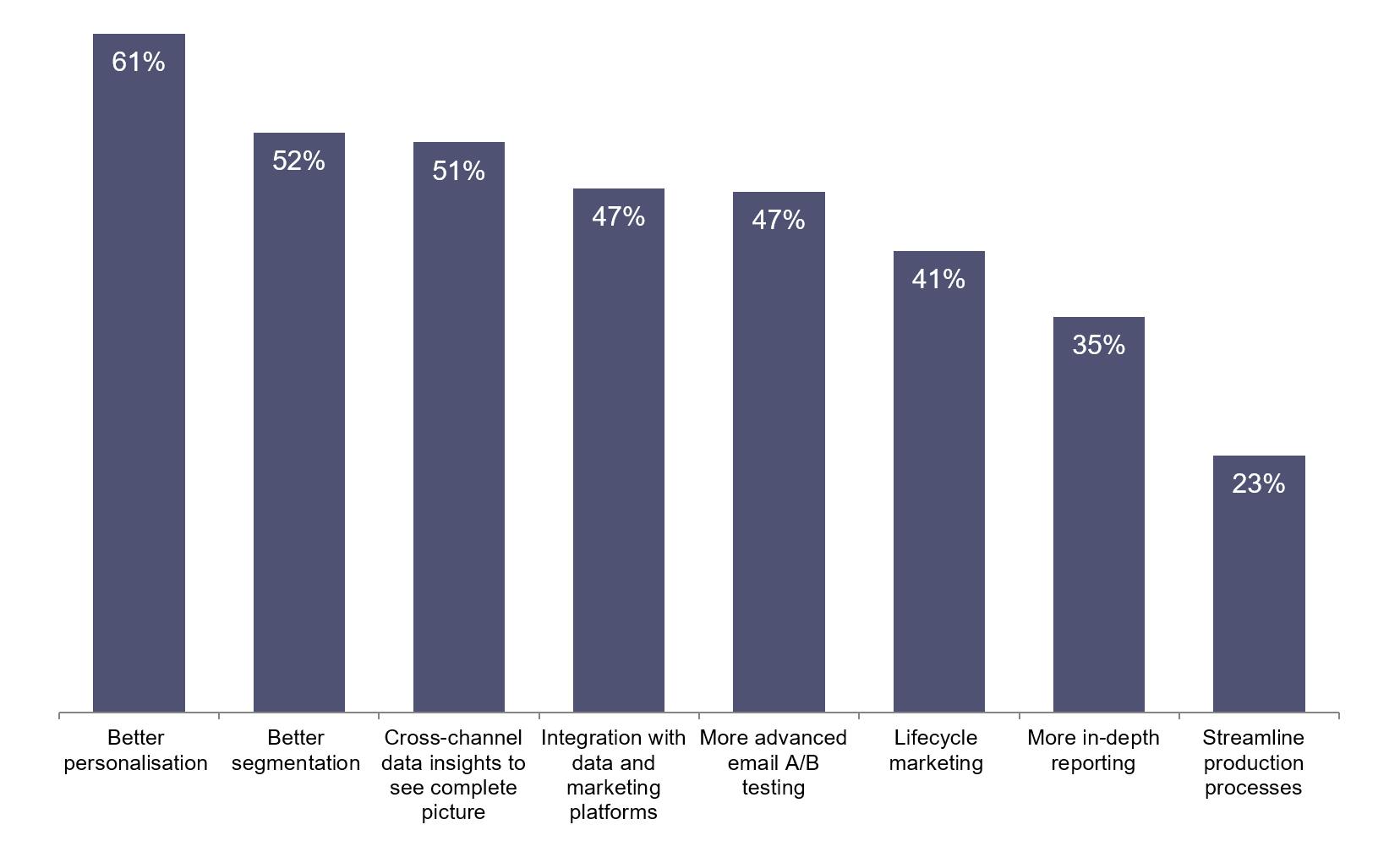
- Segmentation and personalisation remain high on marketers’ wish lists of techniques they aspire to execute more effectively. Econsultancy’s 2023 Future of Marketing survey found 61% of marketers want to apply better personalisation, 52% want to implement better segmentation, with 51% highlighting how they want more data and insights for cross-channel insights.
- A targeted approach delivers messages that have a higher value for recipients because they reflect the recipients’ needs, preferences and behaviour, in general terms and even, in some uses, highly specific ways. This can be achieved by segmenting people into groups and by varying the messages to reflect the shared qualities of each group.
- Increasing concerns about data privacy and the resulting regulation of commercial data-handling practices have added further challenges to the personalisation landscape.
- With the loss of third-party cookie data, all digital marketers must work harder to obtain personal data as directly as possible. Zero-party data (data customers willingly supply through preferences, surveys, polls, interviews, etc.) and first-party data (data the company observes through email activity, website behaviour, and other direct sources) should be essential resources for marketing decisions, including message content and frequency.
- Interest in loyalty programmes is increasing. Marigold’s 2023 Consumer Trends Index found 67% said the loyalty programmes offered by their preferred brands were ‘critically important’ for winning their loyalty. And 46% of consumers said they were relying more on their loyalty benefits to offset rising product costs.
- Lifecycle marketing has become an effective means of combining data and automation to achieve many marketing objectives because it uses data obtained all along the customer’s journey with the brand and triggers highly personalised messages based on a customer’s activity, or in some cases the lack of activity.
- Machine learning and artificial intelligence can help marketers make sense of all the data that floods in through every customer touchpoint and take segmentation and personalisation to an even higher level using algorithms that can act on and learn from new data to take the next steps without relying on humans to create rules.
- Data-privacy laws around the world and privacy features in familiar email platforms are requiring marketers to alter their practices for acquiring, managing, storing and using data. Developments such as Apple’s Hide My Email and Mail Privacy Protection remove easy sources of data such as primary email addresses and email-open data. While these moves have been concerning, they also can benefit marketers by improving their efforts to collect more relevant data and to stop relying on questionable data such as the open rate.
1.2 Methodology
The methodology involved two main phases:
- Phase 1: Desk research to identify relevant issues, examples and models.
- Phase 2: A series of in-depth interviews with a range of email marketing experts.
Econsultancy would like to thank the following interviewees who contributed to this report:
- Jakob Holm, Email Marketing Director, Pandora
- Jess Evans-Tudor, Head of CRM, Rated People
- Beata Linz, Global CRM Director, AdBirds
- Tony Allen, Global CRM Lead, Volvo Cars
- Kelly Haggard, VP, Marketing Innovation, Synchrony
- Mar Juárez, CRM Manager, IVI RMA Global
- George Williams, CRM Manager, FARFETCH Platform Solutions
- Lisa Pettit, CRM Lead Developer, Specsavers
1.3 About the author
 Kath lives and breathes email marketing. She is recognised as one of the industry’s leading email marketers. As CEO of boutique consultancy Holistic Email Marketing, she devotes her time to developing customer-centric ecommerce journeys using a holistic, multi-channel approach.
Winner of the 2021 ANA/EEC Email Marketers Thought Leader of the Year, Kath is an industry veteran of 23 years. She is the author of the bestselling and award-winning book Holistic Email Marketing, and is a sought-after international keynote speaker, blogger, expert contributor and trainer.
linkedin.com/in/kathpay
kath@holisticemail.com
@kathpay
2. The Role of Segmentation and Personalisation
Segmentation and personalisation remain high on marketers’ wish lists of techniques they aspire to execute more effectively. Econsultancy’s 2023 Future of Marketing survey found 61% of marketers want to be able to apply better personalisation, and 52% want to implement better segmentation. Related to this, 51% would like to have more data and insights to see the complete cross-channel picture for their brands.
Figure 1: What would you like to do with your email marketing that you currently cannot do to your satisfaction?
Sample: 339
Source: Econsultancy’s Future of Marketing survey 2023
Econsultancy’s Personalisation Best Practice Guide defines segmentation as “a way of categorising or grouping an existing set of customers based on the data and insights gathered on customer behaviour”.
The guide summarises the benefits: “It helps companies prioritise who they want to focus on, and in which channels. Segmentation also provides marketers with clearly defined groups against which hypotheses can be mapped, enabling personalisation tactics to be defined, prioritised and tested.”
This is an important distinction. Segmentation and personalisation are often thought of as interchangeable, but they have different purposes and effects.
Segmentation involves creating groups of people who share specific characteristics such as gender, location or product preferences. The messages sent to these groups, called ‘segments’, are customised to reflect these general group characteristics.
Personalisation is a different strategy. It is a marketing approach that customises email content based on data such as recipient name, location, purchase or user history, interests, email or product interests and the like. Personalisation allows a sender to target each recipient with unique information. This is often called ‘1:1 personalisation’.
Segmentation, in contrast, will deliver content that is targeted to each segment. However, each member of a segment will receive the same information as all the others in the segment, with the potential exception of minor personalisation such as the use of a customer’s first name.
A wide range of variables can be used to segment audiences for the purpose of customising messages for different groups of people. The objective is to select variables that will optimise email effectiveness. Each variable should be relevant to the campaign for which messages will be customised. As an example, a campaign introducing a new product collection could employ a block of ‘dynamic’ (automatically changeable) copy that would automatically select items representing a category the customer has shopped previously according to their purchase data or browsing history. This would give the campaign greater relevance, while not distracting from the email’s intent to create interest in the new products.
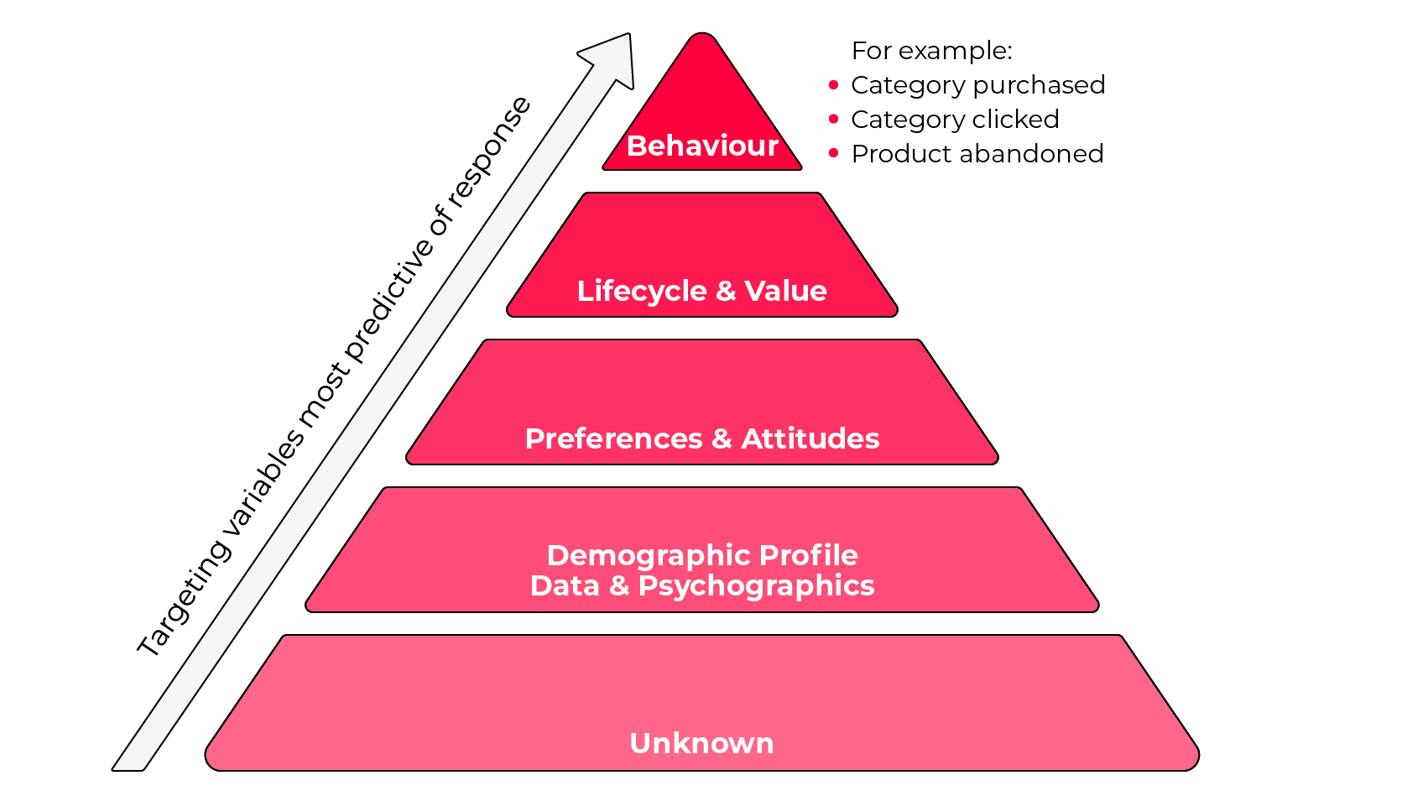
Figure 2 shows a list of segmentation variables based on their level of sophistication, from low to high. The order of the ‘layers’ in Figure 2 indicates how likely each variable is to trigger a reaction by the recipient. Behavioural variables that sit at the top of the pyramid, such as the time and type of a customer’s last purchase, provide the biggest response uplift.
Figure 2: Strategic segmentation options for digital marketing
Source: Econsultancy
Segmentation based on every known variable is not always possible or practical because of the resources needed to integrate data. However, if contact data such as name and location is available and structured correctly, then certain fields could be used to dynamically personalise content (see Section 2.1). In practice, this is what happens when names are dynamically inserted in email ‘{first name}’ salutations.
2.1 Dynamic content personalisation
Dynamic content personalisation allows a marketer to set up rules that automatically insert or configure the content of an email to match an individual’s preferences, behaviour or other characteristics. This often is accomplished in real time, such as including weather or other location-based content that would vary significantly from one region to another.
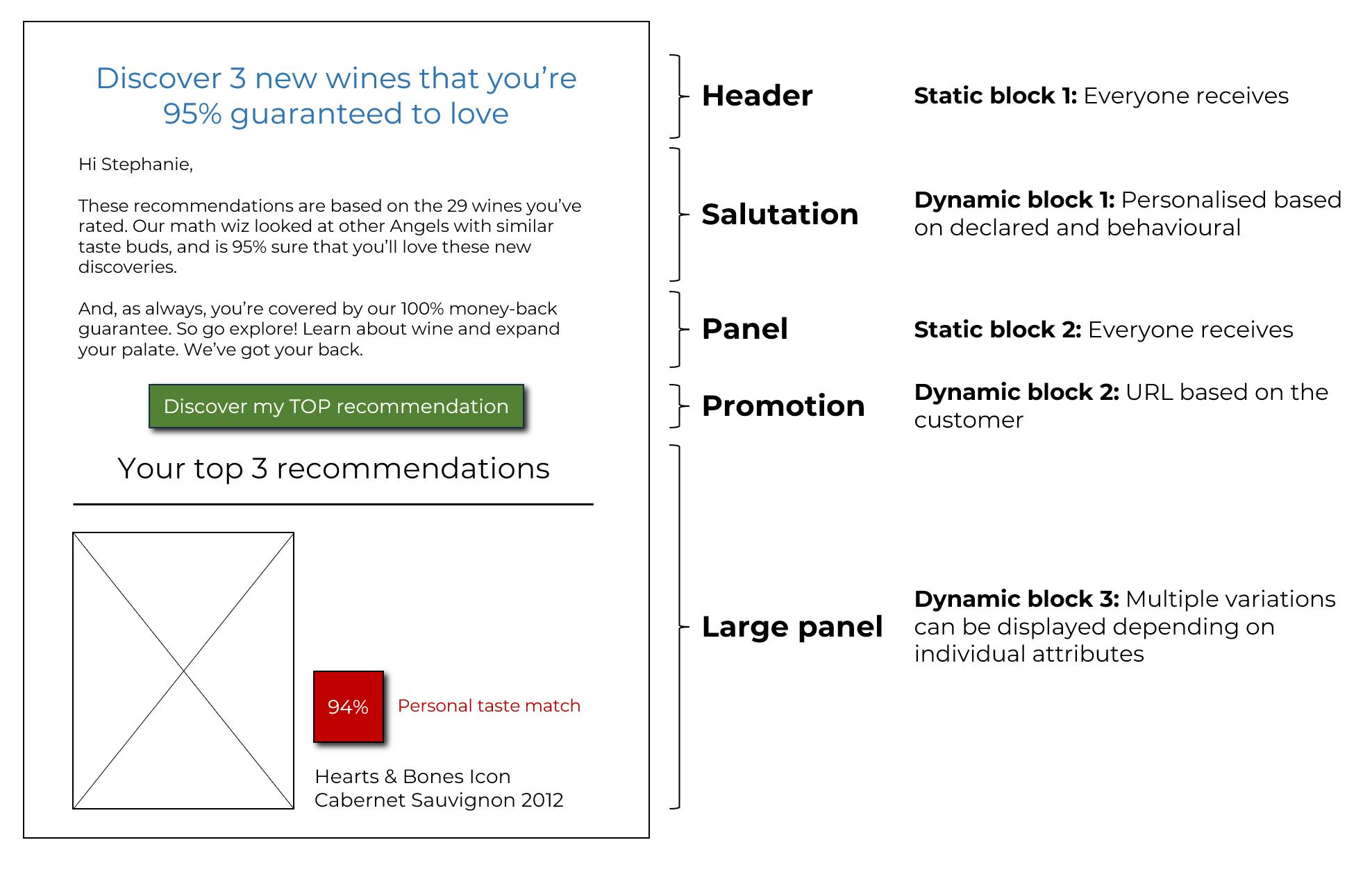
Figure 3 below shows the wireframe, or diagram, of a modular email. It breaks the message into its relevant parts and shows the strategic thinking and personalisation data sources behind the different components of the email.
Figure 3: Wireframe for a dynamically personalised email
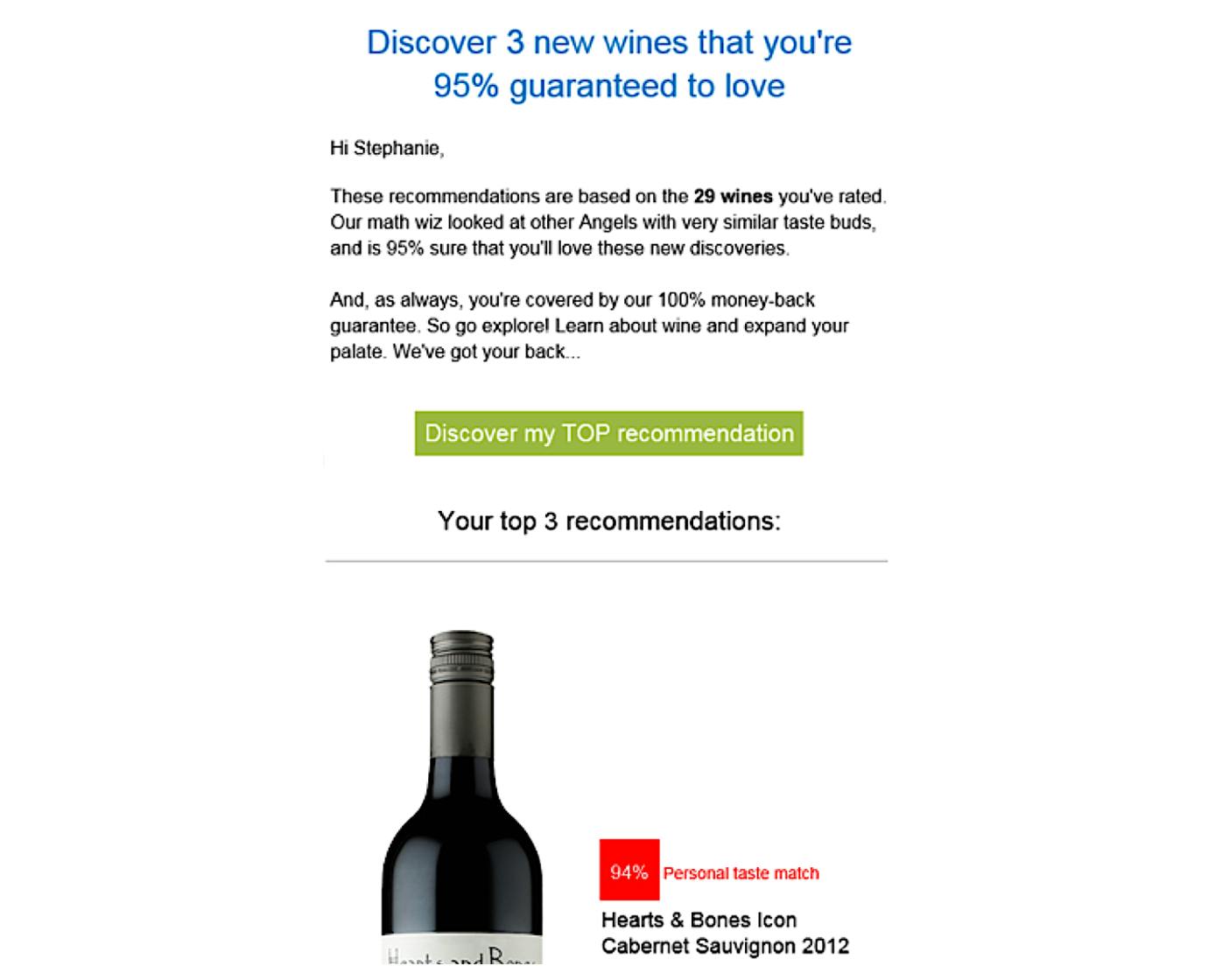
Source: Holistic Email Marketing
Different design styles can be used for different audiences, depending on the budget and resources available.
Brands should consider creating a standard modular layout, in which individual elements such as images or blocks of text can be interchanged easily, as shown in Figure 3. This interchange, which usually swaps out one module of content for another, can be handled manually, but it is also an excellent use case for automation (see Section 4.2).
Most email service providers (ESPs) can run dynamic content segments through their interfaces with relative ease. Dynamic content insertion can be simple if custom field data is stored within each email record (see Section 4.1). Machine learning tools can support this tactic (see Section 4.3).
3. Approaches to Segmentation and Personalisation
Marketers can choose from many different ways to approach segmentation. Customers can be grouped according to individual traits, such as where they live, who they are, what they like and how they behave. Additionally, they can be segmented based on factors that pertain to the company’s business models or business goals, such as where they are in the customer lifecycle, or by how much potential value they could bring to the business. This section looks at the different data types and approaches marketers can employ for segmentation and personalisation.
3.1 Data types for segmentation and personalisation
As outlined in Econsultancy’s Segmentations and Personas Best Practice Guide, customer data can be categorised into four groups for segmenting customers: geographic, demographic, psychographic and behavioural. Each of these can be layered to create meaningful sub-groups for more targeted email content.
Figure 4: Data types for segmentation
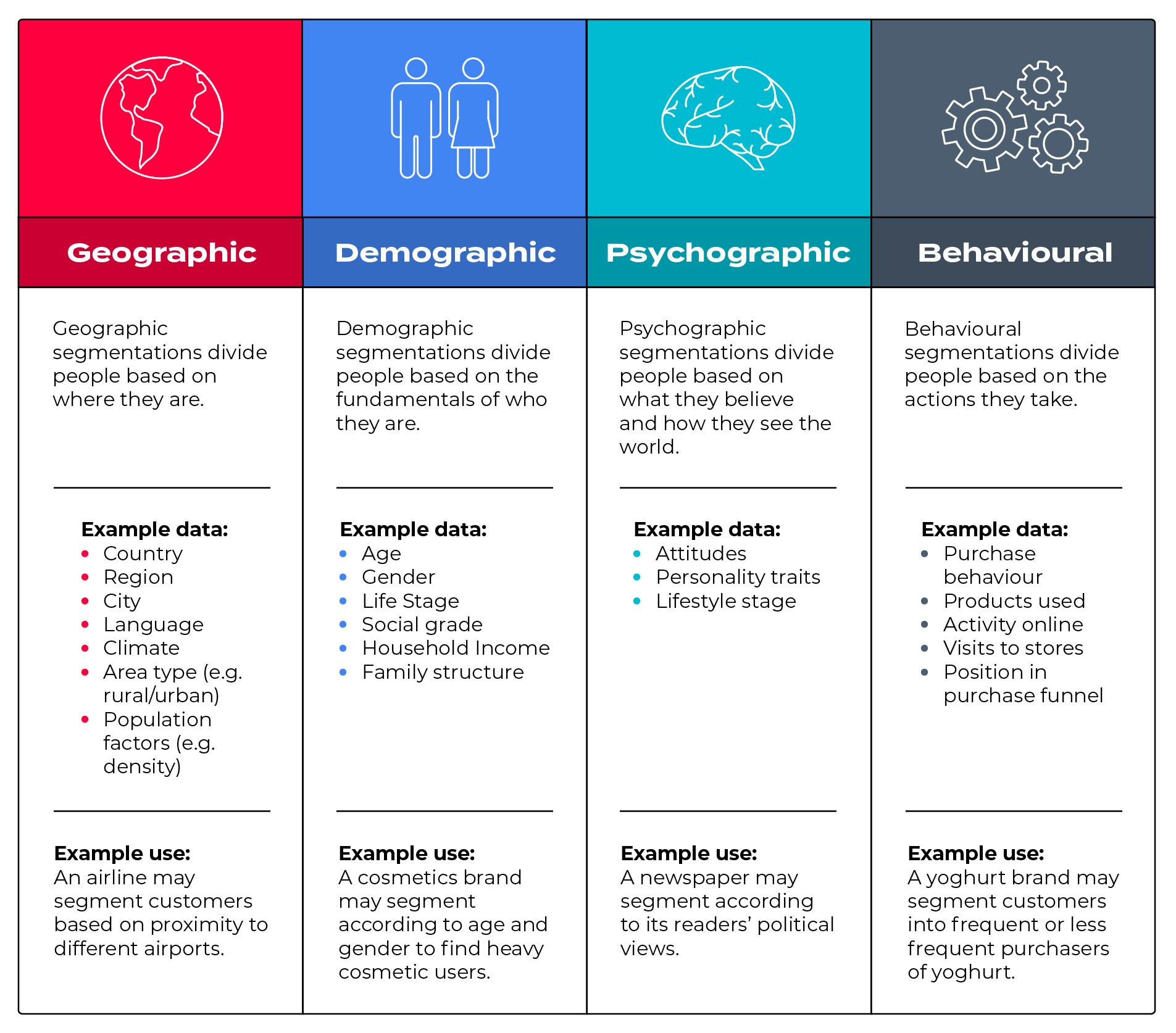
Source: Econsultancy
3.1.1 Segmentation with geographic data
Geographic segmentation is based on where customers live and assumes that customers in a given region will share common attitudes or have similar needs based on their location.
Customers can be grouped by factors such as temperature, population, food habits, clothing needs, local sports teams, topographic considerations (mountains, valleys, lakes), local industries, etc. Grouping customers by location can help marketers target customers in a particular area where their product or service is more likely to be relevant to the audience.
3.1.2 Segmentation with demographic data
Segmenting by demographics is the practice of dividing a market by characteristics such as age, household size, income, education level, nationality, and gender.
Figure 5 illustrates two emails from the same brand that have been segmented based on gender.
Figure 5: Customised emails from clothing retailer based on gender
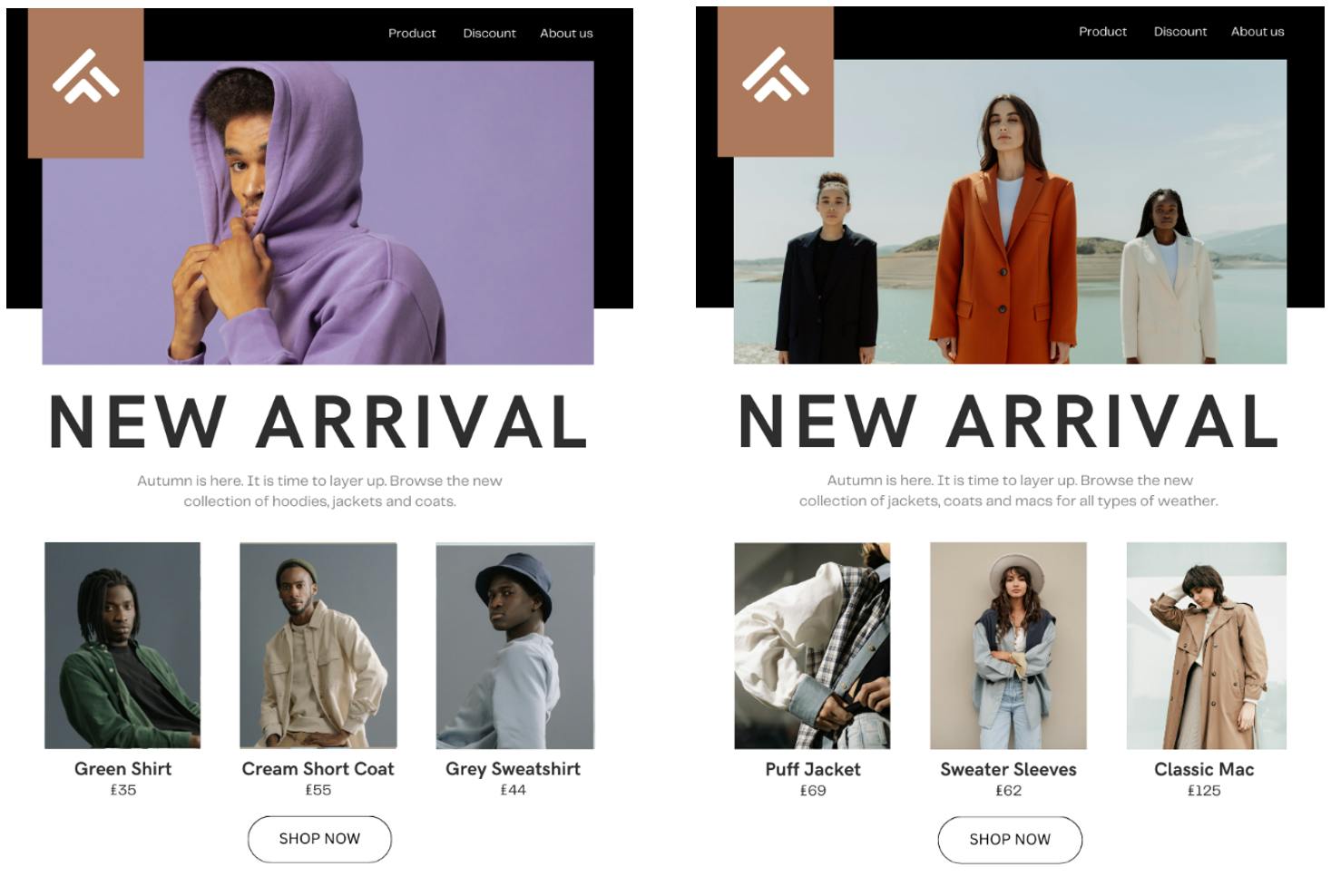
Source: Milie Studio via Canva
Demographic data can be captured via a website in a preference centre or during a purchase. Brands can email customers inviting them to click through to the preference centre and provide key demographic details about themselves in order to receive more relevant offers and communications (see Section 3.2.1).
Marketers can also invest in third-party services that provide data which can be appended to existing contact data. For example, it is possible to use Experian or Acxiom data to overlay economic data based on postal codes.
With the use of third-party cookies being phased out, marketers who rely on tracking data to collect demographic data from third-party cookies will likely find this method less reliable. Google is set to start to discontinue the use of third-party cookies in its Chrome browser in the second half of 2024.[1] At the time of writing, this is the most recent Google timetable for migrating all Chrome users to its Privacy Sandbox and disabling third-party cookies.
Segmentation with firmographic data
The B2B equivalent of demographic data is firmographic data. Firmographic data relates to company size, industry sector, revenue or characteristics of individuals within the decision-making unit. For example, messages to C-level contacts might require a different tone or approach compared with manager- or specialist-level contacts.
3.1.3 Segmentation with psychographic data
Psychographic segmentation is based on understanding consumers’ lifestyles and includes studying opinions, interests and values.
Marketers can use preference centres to capture this kind of data, or they can use social media if they have access to a messaging platform or similar automations that can extract indicators such as aggregate likes and interests. For example, as well as fitting certain demographic categories, individuals might also be golfers or gamers, or any combination of interests.
Creating these kinds of segments can be complex, but layering information in this way creates a more rounded view of potential customers than geographic or demographic segmentation alone ever could.
Segmentation based on customer values
Some brands are making use of values-based information for enhancing and enriching customer segments for the purposes of targeting. Values-based information gives an indication of the type of moral and political values an individual has. This kind of information could affect their product choice, and it could affect the type of communications they will respond to.
Some increasingly popular values that companies are using to segment revolve around political beliefs, support for diversity or inclusion, sustainable living or manufacturing processes, personal wellness or mental health.
As an example, a company could select audiences for an Earth Day campaign using segmentation based on customers who expressed concerns for environmentally friendly manufacturing processes or purchased products that reflect those values.
Values-based data can be captured by conducting social listening research to understand customer sentiment or adding surveys or polls to email messages. This analysis could then be attributed to individual customer records or used to guide content and testing decisions for all customers.
3.1.4 Segmentation with behavioural data
The impending demise of third-party cookies among Chrome users, who make up just over 60% of the marketplace for web browsers,[2] means marketers must search for other sources of data they could use to target customers. One example is behavioural data.
Behavioural data reflects consumers’ actions across the marketing channels a brand tracks. For email marketers, the key actions include email clicks to campaign landing pages and what website visitors do after that – converting, moving to other website pages, bouncing off the page, etc.
Behavioural data is one of the most popular methods to group consumers because it is seen as a concrete manifestation of a customer’s intentions. What a customer does is often considered more reliable than what that customer appears to think or reports as a preference.
If a customer claims to want to hear about golf products but spends more money on tennis equipment, the company faces a dilemma: send content based on what customers say they want or override their preferences with content based on what they do. That customer, for example, might purchase tennis equipment for children more often than golf items for themself.
3.2 Obtaining data from customers
As mentioned in the preceding section, the move to eliminate third-party cookie use in all major web browsers has caused digital marketers to refocus their attention on the data they have already gathered on their customers.
Subscriber preferences have traditionally been broken down into explicit or expressed preferences and attitudes and implied or inferred preferences. These preferences are obtained directly or indirectly from one’s own customers instead of outside sources.
Explicit preferences are classified as zero-party data, while implicit preferences are classified as first-party data. This distinguishes them from second-party data (usually data shared between two organisations assuming they have the data owners’ consent) and third-party data purchased from external sources such as data providers or collected from web cookies, with or without user permission.
Figure 6 compares each data category in terms of its value to the organisation and the quantity of data available. Zero-party data has the highest value of these four categories, but it can be difficult to obtain, is available in much smaller quantities, and can be hardest to extract. Third-party data, gathered from web cookies, purchased from data sources or extracted by other means, has the most reach but can often include meaningless, outdated or incorrectly matched data. Companies should also take into account how any data collected meets the necessary regulatory and technical requirements around consent and use of data.
Figure 6: Reach and scale in zero-, first-, second- and third-party data
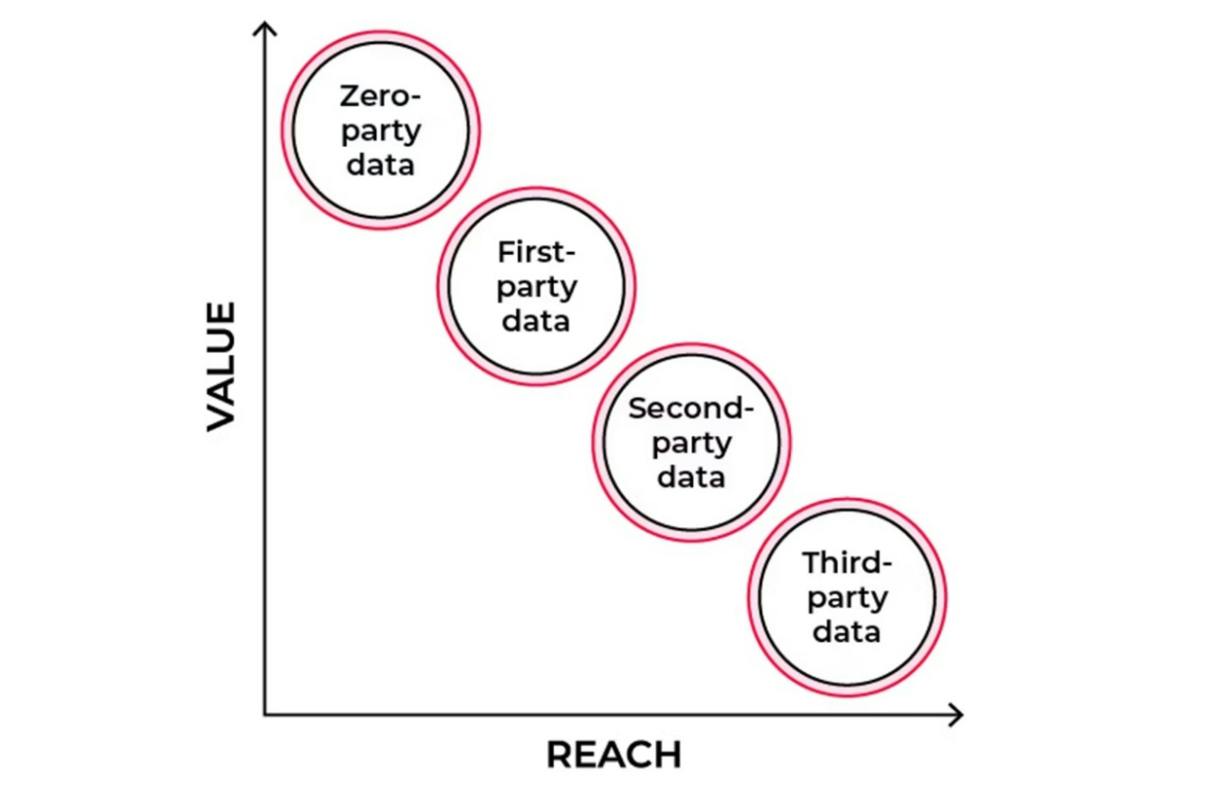
Source: Econsultancy
3.2.1 Explicit preferences (zero-party data)
Expressed or explicit preferences are those given by customers either when they subscribe or when they are prompted at a later point, for example, through a preference form or some other data-gathering device such as a survey, pop-up quiz or competition.
Capturing customers’ explicit preferences is a powerful way of understanding customers’ interests and their position in the buying cycle.
Zero-party data is important in the email marketing equation because it focuses marketers’ attention on the essential value proposition of email: Customers are motivated to share personal data (up to a point) if they see a benefit, such as more personalised customer experiences. In return, the organisation can use this data to learn more about their customers and create more relevant messages.
To discourage customers from withdrawing their consent for their data to be used and from unsubscribing, marketers should ensure they use the data for the purposes they have given their customers.
Although marketers can give some weight to the expressed preferences of their customers, this type of data has some drawbacks:
- The accuracy of the data can degrade over time as customer needs and interests change. A customer who lists an interest in baby goods as a preference and whose data is added to a CRM will likely have different preferences two years later. Hence, it is essential that organisations do all they can to ensure they have up-to-date preference data. A brand that relies solely on zero-party data could misjudge the consumer’s interest and increase the chance for inactivity or attrition.
- Collecting this data requires a brand to have a consistent system for eliciting preferences in order to maintain an up-to-date understanding of the customer. As noted previously, these can include solicitations such as surveys, quizzes, emails which invite recipients to vote for their favourite products, etc.
Consistent data is needed to achieve advanced personalisation
“We invest a lot of resources to make sure our data is reliable because to achieve mature levels of personalisation we need to have consistent data. In other words, we take personalisation very seriously. Showing the recipients messages that are relevant to them and based on the info they provided shows how much we care about them, and this translates into higher engagement and loyalty.”
Mar Juárez, CRM Manager, IVI RMA Global
Case Study: Progressive polling drives personalised recommendations
Research shows a strong correlation between personalised experiences, loyalty and purchase intent. Synchrony, a financial-services company, wanted to find a way to leverage its treasure troves of Synchrony HOME cardholder data to drive cardholder spend and personalisation at scale
To keep up with consumers’ ever-changing interests, needs and budgets, Synchrony’s challenge was to make sure the HOME brand continued to speak their cardmembers’ language, highlighting relevant perks, and personalising the experience for their more than 5 million cardholders.
Synchrony leveraged an email personalisation tool’s in-email polling to capture zero-party data to better understand which DIY projects were a priority for its customers. As well as setting up social proof to highlight how many cardholders chose which category (art and decor, electronics and appliances, or flooring), Synchrony HOME sent personalised retargeting emails based on individualised responses. If cardholders said they were working on flooring, the follow-up email would spotlight relevant online retail partners that sell flooring products.
The poll’s presence led to a 225% lift in open rate in the follow-up email, even if customers did not engage with the poll. Those who did take the poll had a 100% lift in clickthrough rate with their personalised content compared with those who did not.
Following the succesful poll campaign, the Synchrony team sought other ways to use Synchrony HOME cardholder-shared data and their email personalisation tool to drive even more value for their cardholders and partners.
To understand how in-store shoppers planned to shop for the holidays, Synchrony tapped into live polling again. Synchrony HOME sent follow-up marketing messages catered to each cardholder based on their preferences, including local stores and online retailers in specific categories and across their vast partner network.
As financial brands continue to prioritise share of wallet, Synchrony’s data-focused approach and use of progressive polling helped to ensure they maintained customer trust, and offered products and services that kept the brand top of mind.
Kelly Haggard, VP, Marketing Innovation, Synchrony
3.2.2 Implicit preferences (first-party data)
Implicit or inferred preferences can be obtained by observing customer behaviour. Clickthroughs, purchase history, conversions and browsing patterns can be used to assess product interests and status of customer activity. Thus, implicit preference is a behavioural targeting variable.
3.2.3 Using loyalty programmes to enhance zero- and first-party data
Marketers are turning to a number of methods for collecting more zero- and first-party data to combat the rising cost of acquiring and retaining customers, alongside the challenges around data privacy initiatives. Two findings from a recent study by SimplicityDX highlight how these costs have risen over the last decade:[3]
- In 2013, merchants lost on average $9 for every new customer acquired. By 2022, merchants lost $29. This equates to a 222% rise. Customer acquisition costs and higher rates of product returns account for virtually all of the difference.
- In 2013, a repeat sale generated an average of $28 for merchants. By 2022, that had risen to $39. This equates to a 36% increase.
Both of these findings highlight the need to continually focus on retention and loyalty. Segmentation, customisation and personalisation can create the kind of elevated customer experience that makes customers feel more loyal to a brand. Providing a loyalty programme has benefits for both the customer and the organisation:
- Customers are rewarded for their continued connection with the company based on metrics such as transactions, basket or purchase values, longevity, email activity, social participation, customer referrals and other factors.
- Companies can make up for the cost of operating a loyalty programme with more transactions, higher-value transactions, lower turnover, less money spent acquiring new customers, and more.
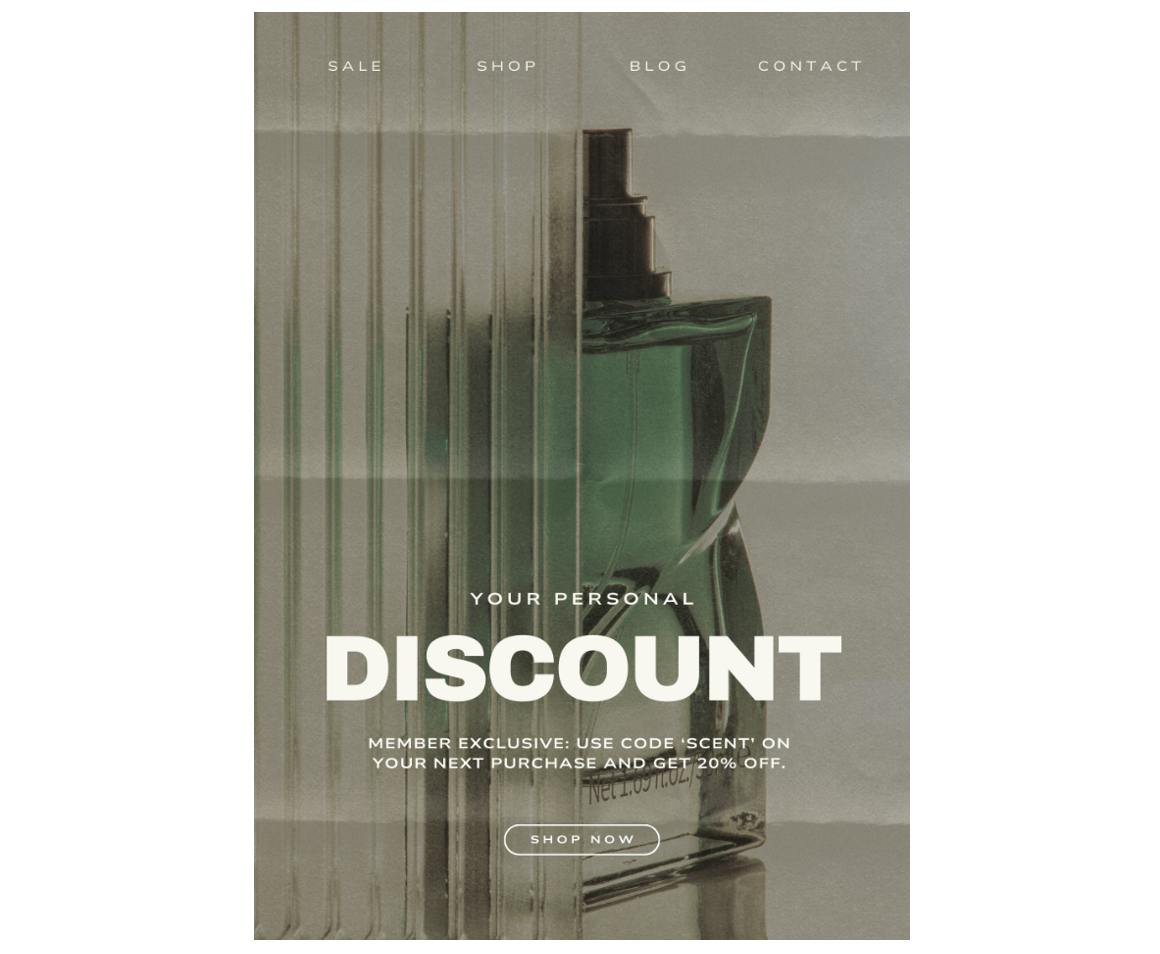
Email and loyalty programmes are natural allies in the battle to retain customers and increase their long-term value to the organisation. Email campaigns can promote and deliver loyalty benefits. In the first instance, customers can be invited to join via email with an enticing sign-up offer.
Figure 7: Exclusive member offer delivered as part of a loyalty programme
Source: Katexlab via Canva
Loyalty programme data consists of both the zero-party data customers provide, including contact and location information and preferences, and the first-party data that companies can observe and collect directly from their customers’ actions. This includes transactions, referrals, order values and responses to various email loyalty promotions.
The data can be used to segment and personalise email content, and to thank customers for continuing to do business with a brand. These techniques are all intended to build stronger connections with customers, many of whom likely belong to competing loyalty programmes. Communications of this nature help to ensure a brand stays top of mind and is a customer’s first choice for future purchases.
This benefit – staying top of mind – is one that some marketers might overlook. Statistics in the DMA’s 2021 Marketer Tracking Report (the most recent published at the time of writing) show 38% of consumers said joining a loyalty programme was the main reason they agreed to receive marketing emails.[4] Thus, loyalty programmes can drive marketing email opt-ins and acceptance by customers.
Worldwide, interest in loyalty programmes is on the increase, according to Marigold’s 2023 Consumer Trends Index,[5] which reflects responses from nearly 7,000 customers in eight countries: Australia, France, Japan, New Zealand, Republic of Ireland, Spain, the UK and the United States. The study uncovered these attitudes toward brand loyalty and loyalty programmes:
- 67% said the loyalty programmes offered by their preferred brands were ‘critically important’ for winning their loyalty.
- 46% of consumers said they were relying more on their loyalty benefits to offset rising product costs.
The DMA’s 2023 Consumer Email Tracker found that the number one reason for people to give their email address to a brand was to receive discounts and offers. Joining a loyalty programme ranked sixth out of 15 options. The study revealed that the appeal of signing up for a loyalty programme fell three percentage points, from 38% in 2021 to 35% in 2023.[6] This apparent change in consumer sentiment represents an opportunity for marketers to refine or retool their loyalty programmes to emphasise benefits and rewards.
Applying the learning: Creating a birthday email programme
One popular loyalty programme reward is the birthday offer. During the welcome or onboarding process, a brand can ask for a customer’s birthdate (day and month, unless the year is needed to establish age for legal reasons). With this information, the brand can choose several methods to recognise the birthday:
- A simple greeting, using personalisation or other data if available.
- Offer a discount or incentive, such as a price cut, percentage off, free shipping or some other purchase-related benefit.
- Offer a gift with purchase.
- Offer a no-strings-attached gift.
The decision should be based on the budget available and the underlying objective for offering the birthday reward: Does the brand simply want to send a goodwill recognition of the customer? Is it intended to drive incremental purchases or revenue? Is it a reward for high-value customers who buy or otherwise engage often and represent significant revenue?
A successful birthday email programme can deliver a range of objectives for different segments based on customer value, longevity, or other factors. Testing can reveal which approach builds engagement, drives additional revenue, or supports retention.
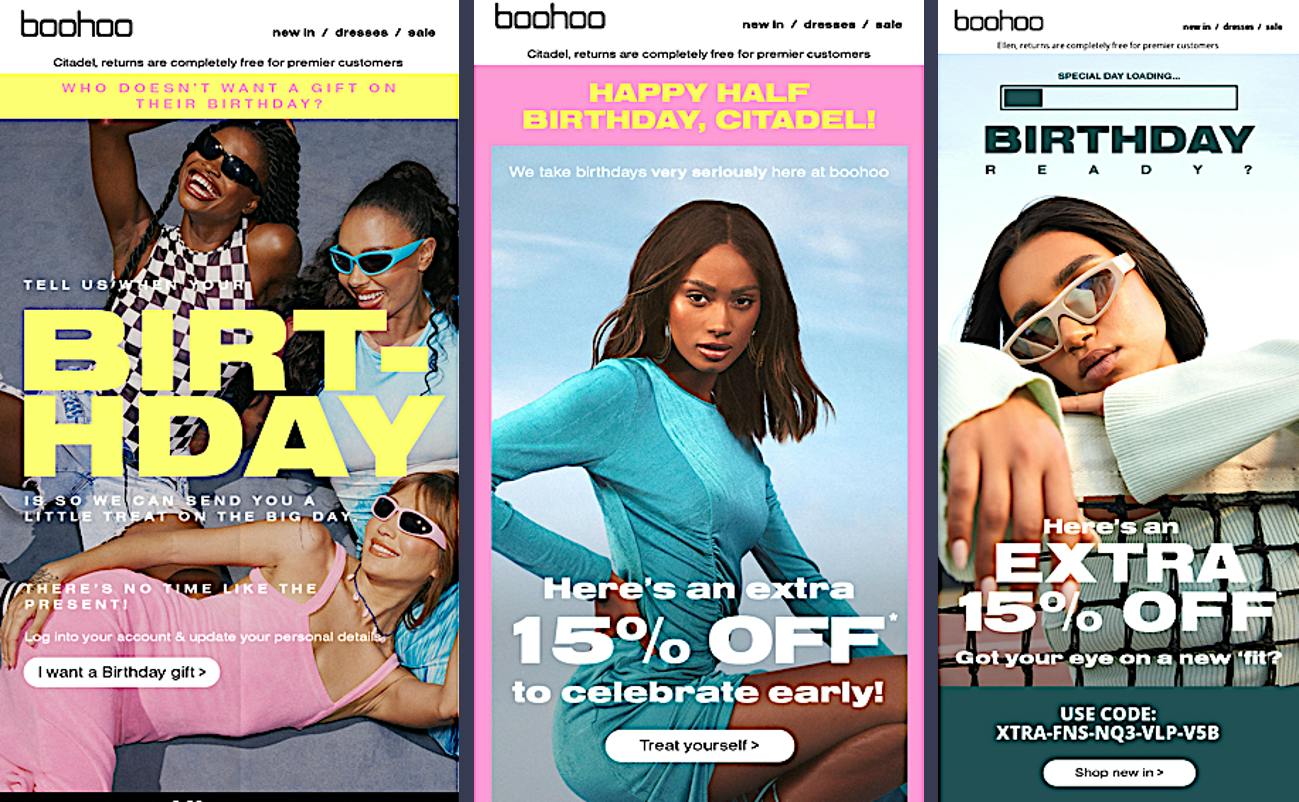
The UK clothing brand Boohoo has an extensive birthday programme. It begins with a standalone email message the brand sends to new customers or to those for whom it does not have birthdate information (see image on left in Figure 8). The brand then sends an email message at the six-month ‘half birthday’ point (centre image), and another greeting near the actual birthdate. The also brand sends several reminders to nudge customers into using their birthday offers.
Figure 8: Birthday programme email series from Boohoo
Source: MailCharts
Marketers should note that is essential to explain why the birthdate is being solicited and what it will be used for to allay customer concerns about sharing personal information.
Holistic Email Marketing
3.3 Segmentation based on customer lifecycle
Lifecycle marketing identifies key stages of a company’s customer lifecycle with a view to creating a targeted set of messages for each stage, triggered by customer behaviour. As well as timing, these messages are further customised with relevant content and copy. Customising messages for potential customers based on where they are in the customer journey is a useful tactic for making emails more personalised and, ultimately, valuable.
According to Econsultancy’s Personalisation Best Practice Guide, personalisation is a key driver in improving customer experience. The ability to deliver personalised experiences adds value to the customer and ultimately delivers benefits to the business. The more personalised an email, the greater its potential to inform customer decision-making, reduce time to purchase and increase conversion by delivering relevant and persuasive content. Personalisation has also been shown to reduce customer acquisition costs.
3.3.1 B2C lifecycle email marketing
Table 1 identifies the key stages in the customer journey with suggestions for timely and tactical emails.
Table 1: B2C lifecycle stages, communication and tactical goals
| Lifecycle stage | Communications goal | Tactical goals |
| Acquisition | Welcome subscriber |
|
| Conversion | Welcome customer |
|
| Retention | Encourage customer loyalty |
|
| Reactivation | Reactivate purchaser |
|
Brands must conduct customer journey mapping projects in order to clearly understand the phases in the customer journey and the opportunity that email marketing presents to facilitate the delivery of relevant and targeted messages throughout the journey.
Brands also need to determine whether the progress of one stage to the next follows the order presented in Table 1. It is natural to assume that customers will become email subscribers before completing a purchase, but this might not be the case. Customers who check out as guests instead of creating an account might be less likely to sign up for email.
Also, brands need to make use of unified customer profiles to analyse the relationship between transactions and emails. For example, consumers could open emails and click through to the website without ever converting. Equally, some customers might not open emails but continue to engage with a brand by purchasing or reading content. In this context, an email appearing in the inbox might effectively nudge a customer to act without requiring an open. (For more information on this ‘nudge effect’, see the Email Marketing Best Practice: Setting Goals and Measuring Performance report.)
For context, before launching a reactivation campaign, marketers will need to check email engagement alongside customer transactions. Otherwise, they risk sending emails to active customers who simply have not opened emails. Email marketing needs to form part of an integrated approach to marketing communications.
Personalisation helps patients cope with information overload
“One of our best personalisation examples is our After First Visit email. It is a transactional email campaign that is sent to our patients after they attend their first consultation at IVI Clinics.
“At that point in the patient journey they will have received so much information from our medical team that they are probably overwhelmed. Thus, we send most patients a hyper-personalised email three days after their visit with their name, the clinic name and the treatment(s) our medical team offered to them and different video cards for our fertility webinars.
“Based on every combination of treatments, each patient will see a different version of this email that includes the thematic webinars. For example, if they need to undergo an egg donation treatment in combination with a genetic assessment, we will show them our egg donation webinar and the one dedicated to genetics.”
Mar Juárez, CRM Manager, IVI RMA Global
3.3.2 B2B lifecycle email marketing
Table 2 identifies the key stages in the B2B customer journey with suggestions for timely, tactical emails.
Table 2: B2B lifecycle stages, communication and tactical goals
| Lifecycle stage | Communications goal | Tactical goals |
| Acquisition | Welcome subscriber and offer utility and value |
|
| Evaluation | Support decision-making and alleviate perceived risks |
|
| Conversion | Welcome customer and instil value |
|
| Retention | Encourage customer loyalty |
|
| Reactivation | Reactivate purchaser |
|
3.4 Segmenting by customer value
When customers are segmented into clusters, email marketing tactics can then be prioritised based on the most valuable segments.
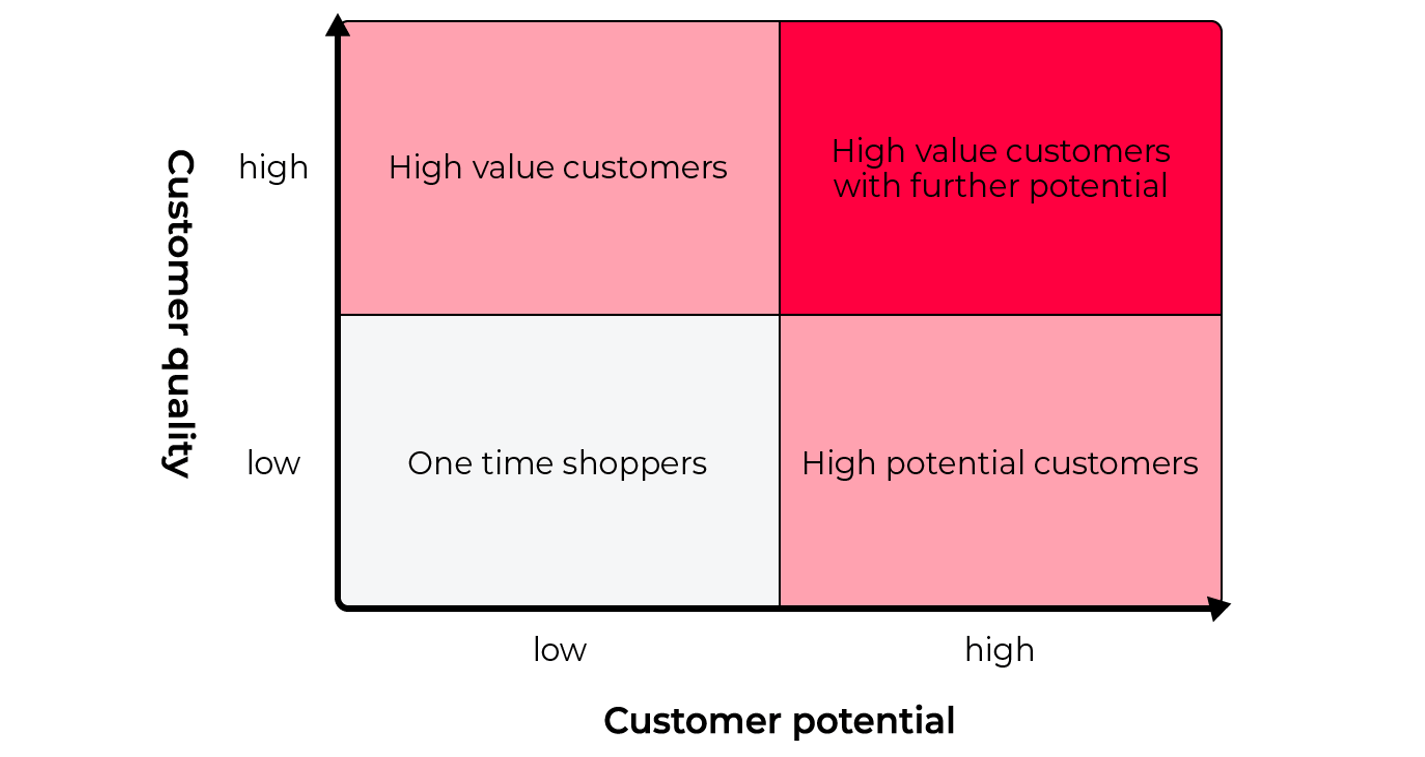
A simple approach is to value segments based on a 2×2 matrix that charts current value based on previous purchases against future value based on propensity models (Figure 9). Propensity models are based, in turn, on purchasing patterns and appended data such as lifestyle information.
Figure 9: Customer value matrix
Source: Econsultancy
Current customer value
The current value of a customer can be calculated using metrics such as:
- Average order value
- Order value per session
- Gross margin in % of net sales
- Returns in % of order value
Future customer value
Customer potential, or future, value can be calculated with the help of a propensity scoring model that may include metrics such as:
- Last date of purchase
- Number of active sessions as a customer
- Channel usage score
- Number of product categories
- Customer behaviour
- Proportion of full price versus sale price purchases
- Propensity to browse new products
- Propensity to purchase new products
3.5 Recency, frequency and monetary (RFM) analysis and segmentation
RFM analysis is a statistical method for categorising customers based on engagement. It enables customers to be categorised into actionable and easy-to-understand segments. Note: good email service providers have the functionality to create complex segments.
RFM analysis can be used to identify those most likely to purchase again while de-prioritising or removing those least likely to purchase. At the most basic level, marketers can choose to segment and target people based on purchase history and category of interest. Simple examples of this kind of rules-based, behavioural personalisation include segmenting by:
- Spend (over last months):
- Customers who have spent £300+ get message A
- Customers who have spent up to £300 get message B
- Product purchased:
- Customers who bought product X get message A
- Customers who bought product Y get message B
RFM segmentation typically works by assigning a score out 10 for each of the three variables (recency, frequency, monetary value).
Table 3: Scoring customers according to RFM
| Purchase history | Examples | Score (1–10) |
| Recency |
|
|
| Frequency |
|
|
| Monetary |
|
Different segments can be created from the intersection of values. A simple conflation would be to add together the three scores and target customers in thirds (highest RFM total, low RFM total, and those in between). For each segment, different email marketing tactics could be deployed by changing the content, design, timing and offers within emails.
Table 4: High, medium, low RFM scores
| RFM score | Description | Email tactics |
| High |
|
|
| Medium |
|
|
| Low |
|
|
A slightly more sophisticated approach would be to rank each attribute as either ‘high’ or ‘low’ to create seven segments. For each segment, appropriate actions could be considered.
Table 5: A more sophisticated approach to RFM segmentation
| Purchase recency | Purchase frequency | Monetary value | Email tactics |
| High (Bought recently) |
High (Buys often) |
High (Spends a lot) |
|
| High (Bought recently) |
High (Buys often) |
Low (Does not spend much) |
|
| High (Bought recently) |
Low (Does not buy often) |
Low (Does not spend much) |
|
| Low (Has not bought for a while) |
High (Used to buy often) |
High (Spends a lot) |
|
| Low (Has not bought for a while) |
High (Used to buy often) |
Low (Does not spend much) |
|
| Low (Has not bought for a while) |
Low (Does not buy often) |
High (Spends a lot when does purchase) |
|
| Low (Has not bought for a while) |
Low (Does not buy often) |
Low (Does not spend much) |
|
Further RFM segmentation: five scores per attribute
An even more sophisticated approach would be to use five scores per attribute. This would create 125 segments. Marketers can then collapse segments where there are too small a number of customers to be worthwhile.
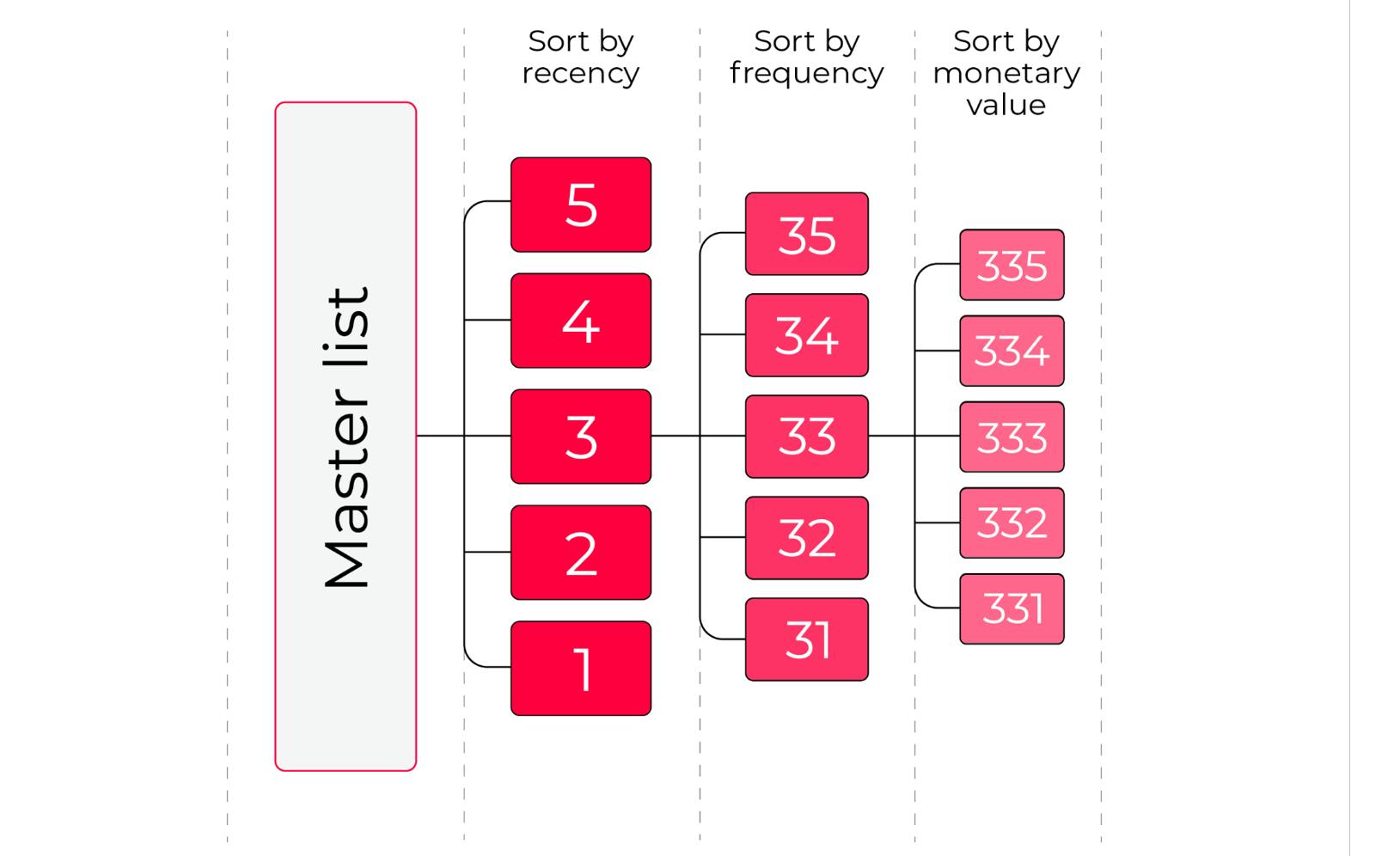
- Sort by recency: With this approach, marketers can sort their list by recency, in order of highest to lowest. This can then be divided into five equal segments representing 20% each. Each quintile can be given a score of 1 to 5, where 5 represents the top 20%. Thus:
- The top 20% – a score of 5
- The next 20% – a score of 4
- The next 20% – a score of 3
- The next 20% – a score of 2
- The next 20% – a score of 1
- Sort by frequency: Each recency segment can then be sorted for frequency and divided into five equal segments representing 20% each, as per step 1. With five frequency segments for each of the five recency segments, this will result in 25 recency plus frequency segments with RF scores ranging from 5-5 to 1-1.
- Sort by monetary value: Each of these segments is then further sorted by monetary value and divided into five equal segments, as per step 2. This creates 125 segments that have RFM scores ranging from 5-5-5 to 1-1-1.
This is your RFM index. Figure 10 shows the score breakdown for customers in the mid quintile.
Figure 10: RFM segmentation in quintiles
Source: Econsultancy
RFM segmentation is quite flexible, so in practice, marketers can choose how granular to make these segments based on the size of their database. The most important thing for marketers to understand is that whatever model of calculating RFM is used, the calculations should lead to the creation of behavioural segments that can be used to modify the content of email campaigns for success. One example is to target customers who buy infrequently but who place high-value orders when they do.
Applying the learning: Using a blend of approaches and data sources
Marketers do not need to choose one segmentation approach over another. In practice, it is wise to use a blend of demographic, psychographic, behavioural, geographic, lifecycle, and RFM segmentation. This is called ‘layered segmentation’.
These approaches can be used to create customer personas, which are archetypes to help marketers understand a typical member of a segment and bring the segments to life. Personas can be augmented with first-party data for delivering highly personalised and relevant emails.
For more on creating personas, see Econsultancy’s Segmentations and Personas Best Practice Guide.
4. Enhancing Approaches to Segmentation and Personalisation
A brand can take multiple approaches to segmentation and personalisation. It also has many options for using technology to enhance these approaches. This section will review the ways in which automation, machine learning and artificial intelligence can augment the processes involved in segmentation and personalisation. These include identifying valuable segments to streamlining workflows and generating dynamic content. A first key step is to ensure that the data the technology is fed is consistent and of good quality.
4.1 Unifying customer data
Organisations may have sign-ups coming from various places. These include website sign-ups as well as data from social media websites. B2B companies, in comparison, might be collecting data from trade shows or conferences. In these instances, attention should be paid to ensure that the data captured from different sources is consistent to ensure data integrity across prospects or customers.
It is not uncommon for companies to wish to do more segmentation only to find they have gaps in their data records, or that data has been stored in inconsistent fields. While having some channel-specific fields against a record is desirable, it is important to ensure that the basics are consistent.
4.2 Marketing automation
Email tactics that involve complex segmentation can strain email marketers’ resources. Instead of relying on maturity models to segment the customer database, marketers can use automation tools to achieve more with the same, or even less, budget.
Automated segmentation allows brands to send appropriate and targeted email content to recipients based on pre-set rules. Using real-time data and behavioural triggers to live-segment people represents a growing opportunity for marketers to add interest and relevance to messaging beyond relying on personas, traditional segmentation and clickstream data.
There are a number of benefits to using marketing automation:
- Email marketing automation can improve the customer experience. Marketing automation can deliver value throughout the customer journey. Section 2.1 describes how emails can be automated depending on where a person is in the customer journey. The key point is that marketing automation is not just a tool for demand generation and lead management. Interviewees for Econsultancy’s Marketing Automation Best Practice Guide agree that the marketing industry is moving towards using marketing automation to help with end-to-end marketing programmes.
- Email marketing automation can help with GDPR compliance. Econsultancy’s Marketing Automation Best Practice Guide describes how marketing automation can help marketers comply with data protection regulations by bringing customer data into an integrated platform. This creates one system of record for each individual, including their privacy options and preferences, allowing organisations to comply while providing a better level of transparency to customers who request their information.
- Email marketing automation supports measurability. An important tactic for marketers is to reduce manual work and replace it with predictable and measurable processes that can be optimised and repeated. This provides the opportunity to measure the impact of the marketing investment in real-time and inform future decisions.
- Email marketing automation is a useful way to explore further opportunities for automation. Automated segmentation is not a tactic reserved only for brands with the most sophisticated email systems. Understanding and getting familiar with ESP functions such as real-time queries, groups, segments and audiences, augmented with some creative thinking, can present a useful way to get started with automated marketing.
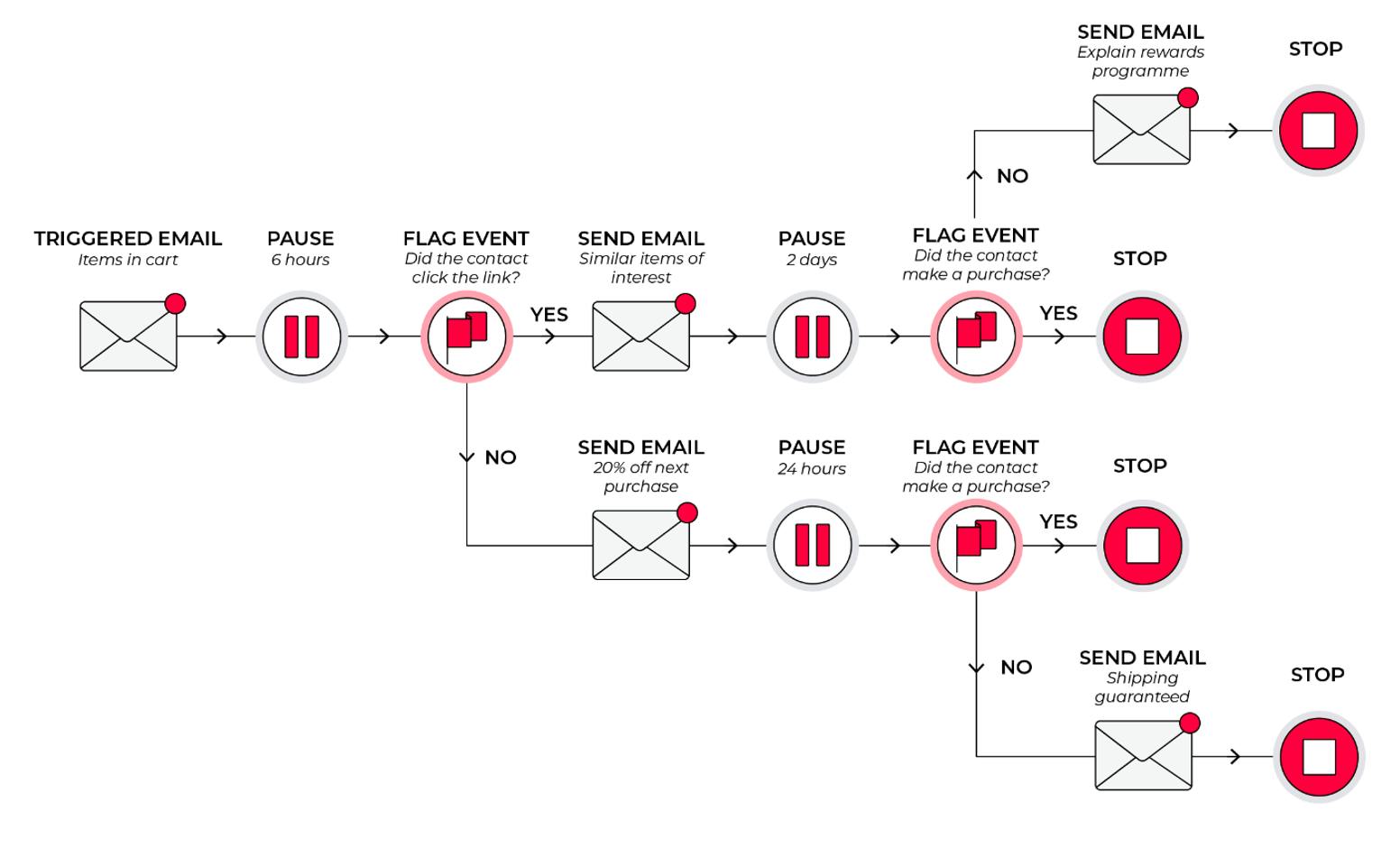
Marketers should research the functions of their ESPs, including programmes, automations and journey flows. Most ESPs will have systems to allow marketers to build out a step-by-step flow. Setting up a series of ‘journeys’ allows email marketers to automatically treat recipients differently or alter the content they receive.
In practice, a marketing automation process might resemble Figure 11.
Figure 11: A marketing automation process
Source: Econsultancy
4.2.1 Automating email marketing based on lifecycle triggers
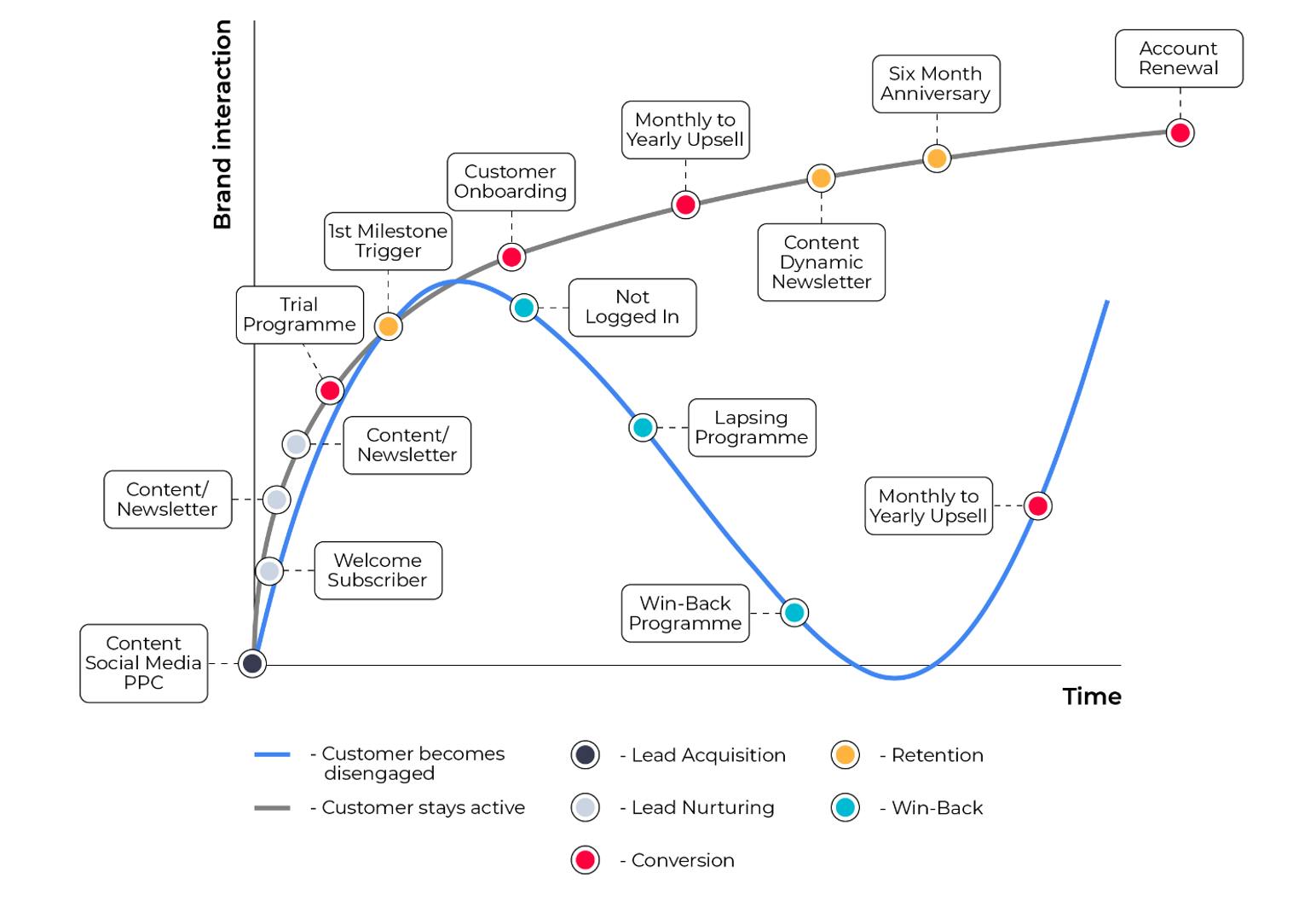
Once customer journeys have been clearly mapped (as outlined in Section 3.3), it becomes possible to automate the types of emails described in Table 1 and Table 2. Simple decisions, such as what helpful information can be included, will depend hugely on whether a customer already knows the brand or not.
Figure 12 presents a multifaceted approach to customer lifecycle messaging. It presents the points in a typical B2B customer journey from awareness through to renewal. The image illustrates the timing and type of emails that can be sent throughout the lifecycle to either nudge the customer farther along, retain the customer or reactivate the customer after a period of inactivity.
Figure 12: Lifecycle model and message opportunities linked to specific points in the customer lifecycle
Source: Econsultancy, based on Holistic Email Marketing
Automating welcome emails
Welcome emails represent a clear opportunity for automated content. It is important to acknowledge potential customers, thank them for subscribing, and move them to engage as efficiently as possible.
Welcome emails are the first opportunity to provide something of value to the customer, and the first opportunity to encourage and facilitate them to progress to the next step in the cycle.
As an example, a clothing retailer could send a first welcome email that delivers the membership opt-in incentive – a purchase discount – immediately after email confirmation. The brand could then follow up that first email with a second message two days later. This email could showcase the retailer’s key shopping categories (e.g. dresses, coats and jewellery) by organising products into easy-to-click categories with appealing visuals. It could also include the option for customers to create a personalised wish list.
Each type of automated email needs to have a clear objective. In this welcome email series example, there are three objectives, which are as follows:
- To welcome new subscribers and remind them of the value exchange in the email programme.
- To encourage subscribers to begin shopping and to create wish lists. This nudges subscribers along the path to purchase while supporting data collection, allowing for the personalisation of future emails.
- To convert new subscribers into customers. This represents the key tactical and commercial objectives.
4.3 Machine learning and artificial intelligence
Artificial intelligence (AI) is powering many features in the tools being used by marketers. In practice, AI tools can mine huge volumes of structured and unstructured data, generated by campaigns and customer interactions, to deliver analysis and insights and to drive automated processes such as triggered email programmes.
Algorithms that deploy machine learning, a branch of AI, have the ability to analyse large datasets that would be beyond the scope of a human and can reveal patterns from the data that potentially a person might not spot. Marketers can use machine learning tools to reveal overlooked and potentially lucrative customer segments, and to create a unique set of messages that appeal to these consumers.
As an example, Sky won the 2021 Marketing Week Masters award for Data-Driven Marketing for its use of ML to drive hyper-personalisation. It drilled down through 1.6 billion rows of customer viewing data in order to tailor emails with intriguing subject lines based on the customer’s viewing habits and messages with summaries of the content they had viewed, achieving true one-to-one communication.[7]
Email marketers have been studying machine learning and AI as the next frontier in delivering personalised messages at scale.
Machine learning refers to statistical approaches to train models to evolve and ‘learn’ when augmented with new data. Econsultancy’s AI, Machine Learning and Predictive Analytics Best Practice Guide defines machine learning (ML) as relating to “the capability of computer systems to learn quickly and independently using data so that they can benefit from previous experience and improve outputs without the need for explicit instructions”.
Marketers have used data this way for years, e.g. with the use of triggered emails. However, in the past, marketers had to codify the rules for triggering messages and filling them with content. Machine learning does not wait for someone to write a rule. Instead, a pre-programmed algorithm can act on and learn from new data to take the next steps on its own.
Machine learning makes sense of all the data that floods in through every customer touchpoint.
There are opportunities to apply machine learning to scale up approaches to email marketing automation. In such instances, the marketer or database manager can write rules for the integration, but the machine learning technology can base its content decisions on what it has learned about each subscriber and use that to optimise things such as:
- Email send times
- Calls to action
- Subject line copy
- Personalised content modules
This technology also allows marketers to optimise based on purchase history, and to analyse other segments that display similar behaviour (also called lookalike audiences) to identify opportunities for cross-selling and upselling.
Case study: Personalised newsletters are key to higher sales and customer engagement
In 2022, Volvo embarked on a CRM transformation project. Automobiles have a long purchase cycle, so Volvo must engage customers more frequently to ensure the brand remains top of mind when prospective and repeat customers are in the market. The goal was to communicate more often with engaged segments, hyper-target campaigns for relevance, and personalise campaigns that had a single focus.
Volvo selected machine learning platform iota-ML, AI-copywriting tool Jasper.ai, and video-in-email system Playable to deliver this upgraded customer experience. First, the team replaced its bi-monthly newsletter with a weekly version and sent it to a 10% test audience for 12 weeks. Volvo also measured the sales impact of all communications with universal control and holdout groups. Test customers responded well to the new format, so the company rolled it out to the rest of its audience.
The revamped newsletter contained two content types that could be categorised into ‘help and inform’ or ‘inspire and entertain’. Volvo built reports showing how the different content types performed. A cross-functional planning process pulled content from the business so that the CRM team could gather timely content from the operations, web and social teams.
Lastly, the email clickstream was classified at a lower level – into 28 categories denoting different customer content preferences. The iota-ML platform used these 28 categories to build predictive audiences to personalise and engage small segments. Volvo sent 75 predictive campaigns in the first year, targeted with “We thought you’d like this” positioning. This campaign was effective among groups with lower general engagement.
Results: Using machine learning via iota-ML streamlined data usage for content choices and reduced the campaign process to two hours from idea to campaign deployment. It also resulted in the following:
- 3x increase in YoY engagement
- 47% of new product sales came from ML audiences
- The ‘most engaged subscribers’ segment grew 4.5x
- The highly engaged segment interested in electrification content is 6x bigger
- The universal control group means they reported a proven impact in the millions of revenue
Tony Allen, Global CRM Lead, Volvo Cars
Applying the Learning: How to discover potentially overlooked segments
This approach requires some statistical analysis, but the overlooked or untapped segments it can reveal could open the door to more revenue, greater customer insights or (in the best possible scenario) both. Marketers can begin by mining their database to examine these kinds of customers:
- People who browse but rarely purchase
- Top spenders by recency, frequency and value
- First time purchasers who used discounts or incentives to reduce prices
- First time purchasers who were not attracted by discounts
- Special occasion buyers who do not return any other time in the retail calendar
These segments can be further analysed to uncover potentially underserved segments by asking:
- Who are the best customers? Are they being fully served?
- Are there opportunities to increase average order value?
- How can customers who respond to emails but do not transact be persuaded to convert?
- What email triggers can be used to shorten the period between first email engagement to conversion?
- What email triggers can be used to shorten the period between first transaction and further transactions?
- How can one-time or special occasion buyers be encouraged to transact again?
4.4 Generative AI
Generative AI, as defined by McKinsey, “describes algorithms (such as ChatGPT) that can be used to create new content, including audio, code, images, text, simulations, and videos”.
Marketers have been talking in general terms about generative AI and its ability to produce written content and illustrations for many years, but in late 2022 it moved from concept to reality as ChatGPT and Bard launched. These workable content-generation tools used natural language, responding to prompts.
There was considerable interest among marketers to learn how these tools worked and then find ways to incorporate them into their workflows. Today, many ESPs have added generative AI capabilities, primarily for content creation, as competitive features. These tools often are called ‘chatbots’, but they behave differently from the bots often found on webpages for customer service or managing enquiries. Instead of responding to human interactions with scripted answers, ChatGPT and similar tools respond to ‘prompts’ that could be questions or directions to create content that meets specific criteria.
As with a search engine, the chatbot’s answers will vary according to key phrases used in the prompt. However, the output is different. Instead of a list of URL suggestions, these tools produce content in full sentences. Here, for example, is how ChatGPT answered the prompt ‘How would you explain ChatGPT to an email marketer?’:
By utilising ChatGPT in your email programmes, you can benefit from its ability to understand natural language and context, enabling you to deliver more targeted and personalised content to your subscribers. It can help you craft email campaigns that resonate with your audience, increase open and clickthrough rates, and ultimately drive better engagement and conversions.
The list of use cases for generative AI in email marketing has grown quickly:
- Subject line generation
- Email content that reflects goals or tone of voice
- Content modules customised to reflect customer data
- Outbound (cold) email copy
- Call-to-action generation
- Suggestions for customer segments or personas that could be used in an email campaign
Applying the learning: Using generative AI in email marketing
Although marketers have been both excited about and wary of the implications these natural-language models pose for their creative work, it is more instructive to think of them as the tools that marketing copywriters have been longing for.
However, as with any tool, the way they are used will determine whether they are truly useful or distractive devices. Giving ChatGPT or Bard enough guidance in a carefully written prompt will help each AI model deliver a good-enough first draft that can then be revised, augmented and tested.
It is not advisable to rely on natural-language models to create finished content. Nor from a safety standpoint is it wise to include proprietary information because that data goes into the broader field of data that others can call on when writing similar prompts.
Where models like these can bring the greatest value to marketers is in reducing the time they now spend on repetitive tasks, such as creating content in customer-service emails, and in helping to kick-start the creative process with first drafts and alternate versions of email campaign copy, which the marketer can revise, optimise and test. This topic will be addressed in greater detail in the Email Marketing Best Practice: Copywriting report.
5. Data Privacy Challenges to Email Personalisation
Few events generated as much concern in email marketer circles as the advent of Apple’s Mail Privacy Protection feature in 2021. MPP, as it is commonly called, was one of several privacy-focused changes Apple has introduced in recent years to restrict outside organisations from accessing or tracking data from people using Apple devices.
MPP followed an earlier change in Apple’s iOS version 14.5 that required app developers and owners to get explicit permission from device owners in order to track their user data. The introduction of iOS 15 included two privacy features that more directly affected email marketers:
- Hide My Email, which allows email users to create alternative email addresses that concealed their primary email addresses from tracking.
- MPP, which anonymises email-open activity. This artificially inflated an email campaign’s open rate and rendered details such as the time, device and location of the open nearly useless.
The next two sections will provide background information on MPP and explain how it can affect segmentation and personalisation, in particular how it can affect the accuracy of some kinds of personalisation.
5.1 MPP effect on measurement
While many email marketers worried that they would no longer be able to measure their email activity effectively, many best-practice proponents have argued that making the open rate even more unreliable might finally persuade email marketers to stop using it as the success metric for revenue-based campaigns and to seek out more tangible and relevant metrics.
Early results in the months after MPP went into effect in September 2021 showed how the open rate appeared to increase because of the way Apple reported it. According to SparkPost data provided by company Co-Founder George Schlossnagle, unique opens rose about 12% for most senders.[8] About 75% of senders saw an 8% increase, and the remainder had an increase of 15% or more.
The inaccuracy stems from the way opens are measured in HTML email messages. (Text-only email does not generate open rates.) An HTML email includes a one-pixel image. When the email is opened, the tracking pixel sends a message back to the server, a signal interpreted as indicating the email has been opened. However, this signal does not activate when a customer views an email without images enabled or in a preview pane, or when the reader does not scroll down far enough in the email to activate the pixel.
Even though the open rate has been widely discredited as a best practice for measuring the success of revenue-based email campaigns, it is still the metric that 95% of email marketers track, according to a 2021 Litmus report, The State of Email Analytics, while 88% track the clickthrough rate.[9] In contrast, 55% of email marketers track conversions, and 17% measure ROI.
However, the MPP workaround many email experts suggested – to use the clickthrough rate instead – is only slightly better advice. Clicks are more tangible proof of customer interest than opens. But these also can be gamed, too, especially by click bots. Additionally, clicks also do not necessarily predict purchases, registrations, form completions or other actions relating to what the campaign’s goal might be.
After several years of implementation, MPP’s effects are still being analysed. However, a 2022 poll conducted by the email community Only Influencers, the ESP Campaign Genius and the email agency RPE Origin found that 70% of marketers said MPP had no effect on their business.[10]
5.2 MPP effect on personalisation
Although MPP’s effects on email have been discussed in terms of requiring changes in measurement, it also has had an impact on personalisation. One area that has been directly affected is real-time content personalisation.
As noted, MPP blocks the tracking pixel in HTML email that activates a signal on the sender’s server when that email is opened. Marketers have relied on these pixel activations as a proxy for reader activity. On devices where the user has enabled MPP, Apple now loads the tracking pixel and all other remote content on Apple’s servers instead of directly from the sender’s server.
This action masks other open-related data, such as the date and time a message was opened, along with the location and device where it was opened. This data had been helpful in creating dynamic email content that could be triggered according to location, such as weather information and store locations.
The introduction of MPP means that subscribers in one location might end up seeing content based on data from an Apple data centre’s location instead, which renders that content’s usability moot. Content affected by this includes maps of nearby store locations, geographically targeted event invitations, and localised weather reports.
Another personalisation tactic – real-time inventory updates – has also been affected. This feature meant a brand could include only items listed in its inventory as being in stock when an email was opened. By masking the email open time, the items pictured in the email might be out of date.
As a workaround, brands can revert to previous practices of linking to store locators to help customers find their nearest stores and using default merchandising collections of items based on past purchases.
6. Conclusion
Segmentation and personalisation help marketers send more relevant and meaningful messages. This has many benefits: it can result in higher email activity (as measured in opens and clicks), in more conversions (whatever the desired action might be), and in longer retention of valued customers.
Today’s automation and data integration software and data warehouses let marketers create email messages that look as if they are personal messages from the brand to the subscriber. This works well when the data is accurate and the personalisation is relevant and responsible. However, when it is wrong, or if the content reflects information customers did not know the company held on them, the effect can be unsettling for customers rather than beneficial.
As valuable as these two tactics are, marketers who rely on incomplete or outdated data, or who operate on instinct or gut reactions instead of data, can end up segmenting customers into groups that are irrelevant at best and damaging at worst. Similarly, using incomplete or outdated data for personalisation can mean inaccurate content is inserted into a message. Bad personalisation can break customers’ trust in the brand and even cause them to become suspicious about what the company is doing with their personal information.
More than ever, marketers must invest in methods to collect, manage and use data responsibly. A growing number of laws in many countries require this. But beyond the legal imperative, email marketers should consider it a duty to their customers as it is a sign of their trustworthiness and concern for them. In today’s environment in which people are becoming more wary of how their data is being used, this can be a significant driver of success throughout the company.
Effective segmentation and personalisation that is based on accurate and up-to-date information will not only lead to better email marketing performance but will also promote authenticity and trust in the brand.
6.1 Key takeaways
- The ability to deliver personalised experiences adds value for the customer in the form of relevant and timely communications, which in turn support satisfaction, retention and trust.
- Data forms the bedrock of any segmentation strategy. Marketers have many options for segmenting their audiences. They should develop responsible practices for collecting more zero- and first-party data from customers and use this information to build detailed customers profiles for decision-making on all aspects of their email programme.
- Automation and data integration have helped to move lifecycle marketing from an enterprise-level tactic to a best practice for companies of all sizes. This enables businesses of all types to create relevant messages for all the stages of a customer’s journey, from opt-in through to retention.
- AI and machine learning tools can be used to further refine, update and scale segmentation efforts.
- AI also has the potential to move beyond automation and testing to help marketers find ideas for segmentation and advanced optimisation, create or guide content, and free marketers from the drudgery of repetitive tasks. How marketers manage new tools for generative AI will determine how successful they will be.
- Data privacy regulations and consumer expectations have reshaped the landscape for data acquisition and its utilisation. However, this also represents an opportunity for brands. Marketers can find creative ways to increase customer trust in a brand through the email experience, such as with loyalty programmes and customer recognition efforts – everything from birthday greetings to highly personalised offers and incentives for high-value customers.
7. Further Reading
7.1 Econsultancy email marketing reports
Econsultancy | Quick Guide to Why Email Still Matters
https://econsultancy.com/reports/quick-guide-why-email-matters/
Econsultancy | Email Marketing Best Practice: Setting Goals and Measuring Performance
https://econsultancy.com/reports/email-marketing-setting-goals-measuring-performance/
Econsultancy | Email Marketing Best Practice: Communication Strategy
https://econsultancy.com/reports/email-marketing-communication-strategy/
Econsultancy | Email Marketing Best Practice: Copywriting
https://econsultancy.com/reports/email-marketing-copywriting/
Econsultancy | Email Marketing Best Practice: Layout and Creative
https://econsultancy.com/reports/email-marketing-layout-creative/
Econsultancy | Email Marketing Best Practice: Optimisation
https://econsultancy.com/reports/email-marketing-optimisation/
Econsultancy | Email Marketing Best Practice: List Quality and Deliverability
https://econsultancy.com/reports/email-marketing-list-quality-deliverability/
7.2 Other Econsultancy reports
Econsultancy | Personalisation Best Practice Guide
https://econsultancy.com/reports/personalisation-best-practice-guide/
Econsultancy | Marketing Automation Best Practice Guide
https://econsultancy.com/reports/marketing-automation-best-practice-guide/
Econsultancy | A Marketer’s Guide to AI and Machine Learning
https://econsultancy.com/reports/a-marketer-s-guide-to-ai-and-machine-learning/
Econsultancy | Generative AI deep dive: Digital Shift Q2 2023
https://econsultancy.com/reports/generative-ai-deep-dive-digital-shift-q2-2023/
Econsultancy | Econsultancy Guide to Generative AI
https://econsultancy.com/tag/generative-ai/
7.3 Other articles and reports
Marigold | 2023 Consumer Trends Index
https://go.meetmarigold.com/consumer-trends-index
TechCrunch | Google will disable third-party cookies for 1% of Chrome users in Q1 2024
https://techcrunch.com/2023/05/18/google-will-disable-third-party-cookies-for-1-of-chrome-users-in-q1-2024/
Only Influencers | Are Opens Really Dead?
https://www.onlyinfluencers.com/email-marketing-blog-posts/best-practice-email-strategy/entry/are-opens-really-dead
Econsultancy | Case Study Library
Econsultancy’s database of case studies showcases best practice and innovation from companies around the globe.

Browse the case study library: https://econsultancy.com/case-studies/
Submit a success story: https://econsultancy.com/case-studies/submit/